
Philippines Low-speed Vehicle Market (2026-2031)

The Philippines Low-speed Vehicle Market was valued at $5490 Million in 2026 and projected to reach to $6280 Million by 2031, representing a compound annual growth rate of CAGR 7.4%. The Philippines low-speed vehicle market is positioned for sustained expansion through 2031, driven by urbanization, traffic congestion in major cities, and the need for affordable last-mile mobility solutions.


| Market Size in | USD 26.32 MN |
| Market Forecast in | |
| CAGR | |
| Forecast Period | |
| Units Considered | Value (USD MN) |
Philippines Low-speed Vehicle Market Trends and Insights
- This growth trajectory reflects the Philippines' increasing adoption of cost-effective and fuel-efficient transportation solutions across urban and rural regions.
- The market in the Philippines is driven by rising demand for affordable mobility options, expanding middle-class populations, and government initiatives promoting sustainable transport alternatives. In the Philippines, low-speed vehicles serve as a critical solution for last-mile connectivity and short-distance commuting, particularly in congested metropolitan areas and developing provinces.
- The market expansion from 2026 to 2031 underscores the Philippines' potential as a key growth hub within the Asia Pacific region.
- Factors such as improving road infrastructure, increasing vehicle ownership rates, and the shift toward electric low-speed vehicles are expected to accelerate market penetration throughout the Philippines during the forecast period..
Key Market Statistics
- CAGR (2026-2031) CAGR 7.4%
- Market Size, 2026 ~USD 5490 Million
- Forecast, 2031 ~USD 6280 Million
- Country Philippines
Philippines Low-speed Vehicle Market Overview
Strong Market Growth :
The Philippines low-speed vehicle market is projected to grow from USD 5,490 million in 2026 to USD 6,280 million by 2031, with a robust CAGR of 7.4%, outpacing the global average of 5.5%.
Urban & Rural Adoption :
Increasing penetration of cost-effective and fuel-efficient low-speed vehicles across both urban congested areas and rural regions, addressing the Philippines' diverse transportation needs and infrastructure challenges.
Economic Accessibility :
Rising demand driven by affordability and lower operational costs compared to conventional vehicles, making low-speed solutions attractive to middle and lower-income segments in the Philippine market.
Sustainability Focus :
Growing environmental consciousness and government initiatives promoting eco-friendly transportation alternatives are accelerating the adoption of low-speed vehicles in the Philippines.
Philippines Low-speed Vehicle Market Dynamics
- The market's 7.4% CAGR reflects strong demand from both commercial operators and individual consumers seeking cost-effective transportation alternatives. Government policies supporting green transportation, coupled with improving infrastructure and rising disposable incomes in emerging urban centers, will further accelerate market penetration.
- The Philippines' unique geographic and demographic characteristics create significant opportunities for low-speed vehicle manufacturers and distributors to capture market share in this high-growth segment..
Market Ecosystem
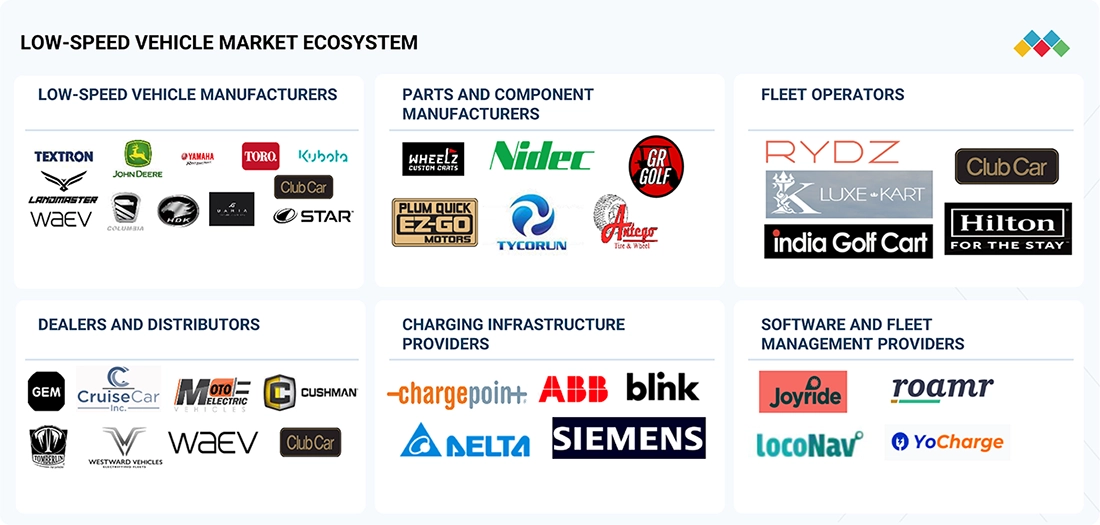
LOW SPEED VEHICLE MARKET SIZE, SHARE & ANALYSIS: COMMERCIAL USE CASES ACROSS INDUSTRIES
| COMPANY | USE CASE DESCRIPTION | BENEFITS |
|---|---|---|
 |
Deploys electric low-speed vehicles such as E-Z-GO and Cushman across golf courses, resorts, and industrial facilities, with focus on lithium-ion platforms and connected fleet management systems. | Lowers operating and maintenance costs, improves fleet uptime through remote diagnostics, and enables quiet zero-emission operations in regulated environments. |
 |
Supplies electric golf cars and utility low-speed vehicles in golf, hospitality, and large private facilities, with emphasis on energy-efficient drivetrains and durable battery systems. | Delivers reliable daily operations, reduces energy consumption, extends vehicle lifecycle, and improves user experience in leisure and commercial settings. |
 |
Integrates Gator utility low-speed vehicles into golf course maintenance, turf care, and municipal operations, aligned with its broader precision turf and equipment ecosystem. | Enhances workforce productivity, reduces fuel and servicing needs, and enables efficient transport of equipment and personnel across large operational areas. |
 |
Offers Workman electric utility vehicles across golf courses, sports venues, and commercial landscapes, often used alongside Toro turf equipment systems. | Supports low noise operations, improves task efficiency, and helps customers meet sustainability goals in commercial environments. |
Logos and trademarks shown above are the property of their respective owners. Their use here is for informational and illustrative purposes only.
Related Ecosystem
Automotive Advance Technologies
- Battery Electric Vehicle (BEV)
- Light Commercial Vehicles (LCVs)
- Fuel Cell Electric Vehicle (FCEV)
- Hybrid Electric Vehicle (HEV)
- Internal Combustion Engine (ICE)
- BOSCH LIMITED
- Continental ag
- Visteon Corporation
- DENSO Corporation
- ZF FRIEDRICHSHAFEN AG
Electric Hybrid Vehicles
- Battery Electric Vehicle (BEV)
- Fuel Cell Electric Vehicle (FCEV)
- Light Commercial Vehicles (LCVs)
- Hybrid Electric Vehicle (HEV)
- Agricultural Tractors
- Visteon Corporation
- BOSCH LIMITED
- Byd company ltd.
- Tesla, Inc.
- FORD MOTOR COMPANY
Logistics And Transportation
- Internal Combustion Engine (ICE)
- Crawler Excavator
- Fuel Cell
- Light Commercial Vehicles (LCVs)
- Sensors
- Siemens ag
- Alstom s.a.
- Hitachi, Ltd.
- Godrej Industries Limited
- ABB India Limited
Key Takeaways
- The Philippines low-speed vehicle market is valued at USD 5,490 million in 2026 and will reach USD 6,280 million by 2031, growing at a 7.4% CAGR.
- The Philippines market is driven by demand for affordable, fuel-efficient transportation and last-mile connectivity solutions in urban and rural areas.
- Electric low-speed vehicles are gaining traction in the Philippines as consumers and policymakers prioritize sustainability and reduced operating costs.
- The Philippines represents a high-growth opportunity within Asia Pacific, supported by infrastructure development and rising vehicle ownership rates.
Low-speed Vehicle Market Report Scope
| Report Metric | Details |
|---|---|
| Base Year | 2026 |
| Fastest Growing Segment | AIRPORTS (Application) |
| Forecast Period | 2026–2031 |
| Growth Rate | CAGR of 5.5% from 2026 to 2031 |
| Largest Segment | LITHIUM-ION BATTERIES (Battery Type) |
| Market Size Base Year (Billions) | ~USD 11.84 (2026) |
| Revenue Forecast (Billions) | ~USD 15.47 (2031) |
| Segments Covered | Vehicle Type, Power Output, Battery Type, Application |
Philippines Low-speed Vehicle Market Report Segmentation
4 segment dimensions are covered across the global market.
By Vehicle Type
- Commercial Turf Utility Vehicles
- Golf Carts
- Industrial Utility Vehicles
- Personal Mobility Vehicles
By Power Output
- 5–8 Kw
- 9–15 Kw
- <5 Kw
- >15 Kw
By Battery Type
- Lead-Acid Batteries
- Lithium-Ion Batteries
By Application
- Airports
- Golf Courses
- Hotels & Resorts
- Industrial Facilities
- Other Applications
Target Audience
- Vehicle Manufacturers & OEMs : Manufacturers need Philippines-specific market data to assess production capacity requirements, localization strategies, and market entry timing for low-speed vehicle segments.
- Distributors & Dealers : Distribution networks require detailed market insights to optimize inventory management, identify high-potential regions, and align sales strategies with regional demand patterns.
- Investment & Private Equity Firms : Investors need comprehensive market analysis to evaluate investment opportunities, assess growth potential, and make informed decisions on funding low-speed vehicle ventures in the Philippines.
- Government & Policy Makers : Policymakers require market data to develop supportive regulations, infrastructure plans, and incentive programs that align with the Philippines' transportation and sustainability goals.
- Technology & Component Suppliers : Suppliers need market forecasts to plan R&D investments, production capacity, and supply chain strategies tailored to the Philippines' growing low-speed vehicle demand.
Key Companies in the Philippines Low-speed Vehicle Market
| Company | HQ | Ownership | Strongest segments |
|---|---|---|---|
| TEREX CORPORATION | United States | Public Company | Aerials (Genie and Terex-branded MEWPs and telehandlers),Materials Processing (crushers, screens, washing, handling, concrete),Environmental Solutions (refuse, recycling, utility, software), |
| BMW | Germany | Public Company | BMW-branded automobiles,MINI and Rolls-Royce automobiles,Motorcycles (BMW Motorrad), |
| TATA MOTORS | India | Public Company | Passenger ICE vehicles,Electric vehicles,Spare parts and accessories, |
| TEXTRON INC. | United States | Public Company | |
| DEERE & COMPANY | United States | Public Company | Production and Precision Agriculture,Small Agriculture and Turf,Construction and Forestry, |
| YAMAHA MOTOR CO., LTD. | Japan | Public Company | Motorcycles and scooters (incl. knockdown parts),Marine (outboard motors, boats, WaveRunners, utility boats),Outdoor land vehicles (ATVs, ROVs, golf cars, snowmobiles), |
| THE TORO COMPANY | Canada | Public Company | Professional turf and grounds equipment,Residential lawn and garden equipment,Irrigation and water management, |
| KUBOTA CORPORATION | Japan | Public Company | Agricultural machinery and implements,Construction machinery (mini excavators, loaders, CTLs, SSLs),Engines and industrial machinery, |
TEREX CORPORATION
Terex Corporation is a United States-based public company founded in 1933 that employs 10,700 people. The company operates in the machinery and equipment manufacturing sector.
BMW
BMW is a German public company founded in 1916 with 154,540 employees. The company is a leading manufacturer of automobiles and motorcycles.
TATA MOTORS
Tata Motors is an Indian public company founded in 1945 with 60,332 employees. The company is a major manufacturer of automobiles, commercial vehicles, and related products.
TEXTRON INC.
Textron Inc. is a United States-based public company founded in 1923 with 34,000 employees. The company operates in multi-industry manufacturing including aerospace, defense, and industrial products.
DEERE & COMPANY
Deere & Company is a United States-based public company founded in 1837 with 73,100 employees. The company is a leading manufacturer of agricultural, construction, and forestry equipment.
YAMAHA MOTOR CO., LTD.
Yamaha Motor Co., Ltd. is a Japanese public company founded in 1918 with 55,176 employees. The company manufactures motorcycles, marine products, and other motorized equipment.
THE TORO COMPANY
The Toro Company is a Canadian-based public company founded in 1961 with 7,900 employees. The company manufactures turf maintenance equipment and irrigation systems.
KUBOTA CORPORATION
Kubota Corporation is a Japanese public company founded in 1890 with 52,503 employees. The company manufactures agricultural machinery, engines, and industrial equipment.
Reasons to Buy this Report
- Market Size & Growth Data : Access precise market valuation for the Philippines (USD 5,490M in 2026) with detailed 5-year forecasts and CAGR analysis to support investment and expansion decisions.
- Competitive Landscape Intelligence : Understand market dynamics specific to the Philippines, including key players, market share distribution, and competitive positioning to identify partnership and acquisition opportunities.
- Regional Demand Insights : Gain detailed understanding of urban vs. rural demand patterns across Philippine regions, enabling targeted go-to-market strategies and localized product development.
- Growth Driver Analysis : Identify and quantify the specific factors driving the Philippines market's 7.4% CAGR, including economic trends, regulatory changes, and consumer behavior patterns.
- Strategic Planning Support : Leverage comprehensive market forecasts through 2031 to develop long-term business strategies, resource allocation plans, and risk mitigation approaches for the Philippine market.
Frequently asked questions
What is the current size of the low-speed vehicle market in the Philippines?
The Philippines low-speed vehicle market is estimated at USD 5,490 million in 2026.
What is the projected market size for low-speed vehicles in the Philippines by 2031?
The Philippines low-speed vehicle market is projected to reach USD 6,280 million by 2031.
What is the CAGR for the low-speed vehicle market in the Philippines?
The Philippines low-speed vehicle market is expected to grow at a compound annual growth rate (CAGR) of 7.4% from 2026 to 2031.
What are the main drivers of growth in the Philippines low-speed vehicle market?
Key growth drivers in the Philippines include rising demand for affordable mobility, expanding middle-class populations, improving road infrastructure, and the shift toward electric low-speed vehicles.
Why are low-speed vehicles important in the Philippines?
Low-speed vehicles in the Philippines address critical transportation needs for last-mile connectivity and short-distance commuting in congested urban areas and developing provinces.
RESEARCH METHODOLOGY
The research study involves extensive use of secondary sources such as company annual reports/presentations, industry association publications, low-speed vehicle magazine articles, directories, technical handbooks, World Economic Outlook, trade websites, technical articles, and databases to identify and collect information on the low-speed vehicle market. Primary sources, including experts from related industries, low-speed vehicle OEMs, and suppliers, have been interviewed to obtain and verify critical information, as well as to assess growth prospects and market estimates.
Secondary Research
In the secondary research process, various secondary sources were used to identify and collect information on the low-speed vehicle market for this study. Secondary sources included annual reports, press releases, and investor presentations of companies; whitepapers, certified publications, and articles from recognized authors; directories; databases; and articles from recognized associations and government publishing sources. Low-speed vehicle sales and end-use industry demand are derived through secondary sources such as the International Light Transportation Vehicle Association, Inc., the National Mobility Equipment Dealers Association (NMEDA), the National Motorists Association, Neighborhood Electric Vehicle Association (NEVA), European Association of Motorcycle Manufacturers (ACEM), Light Electric Vehicle Association Europe, etc.
Primary Research
Extensive primary research was conducted after understanding the low-speed vehicle market scenario through secondary research. Several primary interviews were conducted with market experts from both supply and demand sides to obtain qualitative and quantitative information on the market. Primary sources from the supply side included industry experts, such as CXOs, vice presidents, and directors from business development, marketing, and product development/innovation teams, as well as related executives from various companies. Various system integrators, industry associations, independent consultants/industry veterans, and key opinion leaders were also interviewed.
Primary interviews have been conducted with market experts from the demand side (end-use industries) and the supply side (low-speed vehicle providers) across four regions: North America, Europe, Asia Pacific, and the Rest of the World. Approximately 80% of the primary interviews were conducted with low-speed vehicle manufacturers, and 20% with low-speed vehicle component providers. Primary data has been collected through questionnaires, emails, and telephonic interviews.
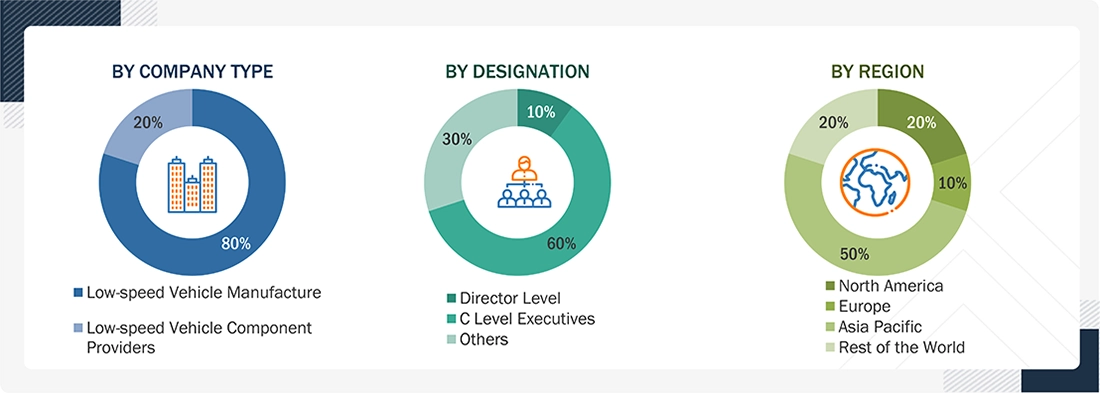
Note: Other designations include sales, marketing, and product managers.
Company tiers are based on the value chain; the revenue of the company is not considered.
To know about the assumptions considered for the study, download the pdf brochure
Market Size Estimation
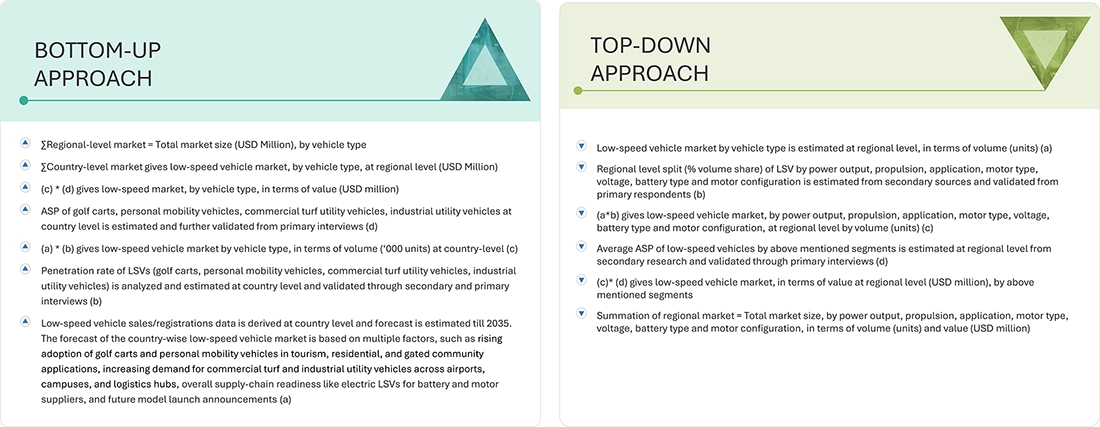
A bottom-up and top-down approach was used to estimate and validate the total size of the low-speed vehicle market. This method was also widely used to estimate the sizes of various subsegments in the market. The research methodology used to estimate the market size includes the following:
Data Triangulation
After arriving at the overall market size using the market size estimation processes as explained above, the market was split into several segments and subsegments. All parameters that affect the markets covered in this research study have been accounted for, viewed in extensive detail, and analyzed to obtain the final quantitative and qualitative data. All percentage shares, splits, and breakdowns have been determined using secondary sources and verified by primary sources. The data was triangulated by studying various factors and trends from both the demand and supply sides.
Market Definition
Low-speed vehicles, according to the US Department of Energy, are 4-wheeled motor vehicles capable of reaching speeds of more than 20 miles per hour (mph) but not more than 25 mph. These vehicles may not operate on a highway with a posted speed limit exceeding 35 mph. A city or county may adopt ordinances that allow the operation of low-speed vehicles on city streets or county roads with posted speed limits greater than 35 mph. Low-speed vehicles must comply with specific standards in Title 49 of the US Code of Federal Regulations, section 571.500.
Key Stakeholders
- Low-speed Vehicle Manufacturers
- Low-speed Vehicle Component Manufacturers
- Low-speed Vehicle Battery Providers
- Low-speed Vehicle Service Providers
- Low-speed Vehicle Dealers and Distributors
- Industrial and End Use Organizations/Associations
- Regulatory Authorities
Report Objectives
- To define, describe, and forecast the size of the low-speed vehicle market in terms of value (USD million) and volume (units) between 2026 and 2035 based on the following segments:
- By Application (Golf Courses, Hotels & Resorts, Airports, Industrial Facilities, and Other Applications)
- By Vehicle Type (Golf Carts, Commercial Turf Utility Vehicles, Industrial Utility Vehicles, and Personal Mobility Vehicles)
- By Propulsion (Electric, Gasoline, and Diesel)
- By Power Output (<5 kW, 5–8 kW, 9–15 kW, and >15 kW)
- By Battery Type (Lithium-ion and Lead-acid)
- By Category (L6 and L7)
- By Voltage (<60V, 61–100V, and >100 V)
- By Motor Configuration (Hub-mounted and Mid-mounted)
- By Motor Type (AC Motors and DC Motors)
- By Region (Asia Pacific, Europe, North America, and Rest of the World)
- To identify and analyze key drivers, restraints, opportunities, and challenges influencing the market.
- To strategically profile key players and comprehensively analyze their respective market share and core competencies.
- To analyze recent developments, including product launches, partnerships, collaborations, acquisitions, and expansions, among others, undertaken by key players in the market.
- To study the following concerning the market
- Supply Chain Analysis
- Ecosystem Analysis
- Technology Analysis
- Trade Analysis
- Case Study Analysis
- Patent Analysis
- Regulatory Landscape
- Average Selling Price Analysis
- Impact of AI/Gen AI
- Trend and Disruption Impact
- Key Stakeholders and Buying Criteria
- Key Conferences and Events
- Sustainability initiatives
- To understand competitive dynamics and assess companies using an evaluation matrix.
- To analyze the opportunities offered by various segments of the market to its stakeholders.
Available customizations:
With the given market data, MarketsandMarkets offers customizations in accordance with the company’s specific needs.
- low-speed vehicle market, By max speed
- low-speed vehicle market, BY seating capacity
Company Information:
- Profiling of additional market players (up to five)
Get the Full Low-speed Vehicle Market Report
Full forecast, segment splits, and company analysis for all Low-speed Vehicle Market.
- India Low-speed Vehicle Market
- Japan Low-speed Vehicle Market
- South Korea Low-speed Vehicle Market
- Thailand Low-speed Vehicle Market
- Indonesia Low-speed Vehicle Market
- Vietnam Low-speed Vehicle Market
- US Low-speed Vehicle Market
- Mexico Low-speed Vehicle Market
- Canada Low-speed Vehicle Market
- UK Low-speed Vehicle Market
- France Low-speed Vehicle Market
- Germany Low-speed Vehicle Market
- Italy Low-speed Vehicle Market
- Spain Low-speed Vehicle Market
- South Africa Low-speed Vehicle Market
- Brazil Low-speed Vehicle Market
- Iran Low-speed Vehicle Market
- China Low-speed Vehicle Market
Need a Tailored Report?
Customize this report to your needs
Get 10% FREE Customization
Customize This Report
