
Brazil Electric Construction Equipment Market (2026-2031)

The Brazil Electric Construction Equipment Market was valued at $185 Million in 2026 and projected to reach to $1118 Million by 2031, representing a compound annual growth rate of 29.3%. Brazil's electric construction equipment market is poised for transformative growth, driven by increasingly stringent environmental policies and substantial infrastructure investment across the nation.


| Market Size in | USD 26.32 MN |
| Market Forecast in | |
| CAGR | |
| Forecast Period | |
| Units Considered | Value (USD MN) |
Brazil Electric Construction Equipment Market Trends and Insights
- This exceptional growth trajectory reflects Brazil's commitment to sustainable infrastructure development and stricter environmental regulations driving fleet electrification across the construction sector.
- Brazil's market growth significantly outpaces the global average of 20.2% CAGR, positioning the country as a key growth engine in Latin America's transition to cleaner construction technologies. The surge in Brazil's electric construction equipment adoption is fueled by increasing government incentives, rising diesel costs, and growing demand from major infrastructure projects.
- Brazil's construction industry is increasingly investing in electric excavators, loaders, and compactors to meet sustainability targets and reduce operational expenses.
- Between 2026 and 2031, Brazil's market is expected to expand nearly sixfold, driven by technological improvements, declining battery costs, and heightened environmental awareness among construction operators and project developers..
Key Market Statistics
- CAGR (2026-2031) 29.3% CAGR
- Market Size, 2026 ~USD 185 Million
- Forecast, 2031 ~USD 1118 Million
- Country Brazil
Brazil Electric Construction Equipment Market Overview
Explosive Growth Trajectory :
Brazil's electric construction equipment market is projected to grow from $185.0 million in 2026 to $1,118.0 million by 2031, representing a remarkable 29.3% CAGR—significantly outpacing the global average of 20.2%.
Environmental Regulation Drivers :
Stricter environmental regulations and Brazil's commitment to sustainable infrastructure development are accelerating fleet electrification across the construction sector, creating substantial demand for electric equipment solutions.
Infrastructure Investment Momentum :
Brazil's ongoing infrastructure modernization initiatives and government sustainability mandates are positioning the country as a key growth hub for electric construction equipment adoption in Latin America.
Market Maturation Opportunity :
The 6-fold market expansion over five years indicates Brazil is transitioning from early adoption to mainstream electrification, presenting critical entry and expansion opportunities for equipment manufacturers and suppliers.
Brazil Electric Construction Equipment Market Dynamics
- The 29.3% CAGR significantly exceeds global benchmarks, reflecting Brazil's accelerated transition toward sustainable construction practices and fleet electrification.
- Government incentives, coupled with rising operational cost pressures from traditional diesel equipment, are compelling construction companies to adopt electric alternatives. By 2031, the market's expansion to $1,118.0 million will establish Brazil as a regional leader in electric construction equipment adoption.
- This growth trajectory is supported by improving battery technology, expanding charging infrastructure, and growing awareness of total cost of ownership advantages.
- Market participants investing in localized solutions, service networks, and financing models tailored to Brazilian market conditions will capture significant competitive advantages in this high-growth segment..
Market Ecosystem

ELECTRIC CONSTRUCTION EQUIPMENT MARKET: COMMERCIAL USE CASES ACROSS INDUSTRIES
| COMPANY | USE CASE DESCRIPTION | BENEFITS |
|---|---|---|
 |
Deployment of electric compact excavators and wheel loaders in urban infrastructure projects. | Zero local emissions, reduced noise for city sites, lower operating costs, and enhanced compliance with European zero-emission mandates. |
 |
Electric and hybrid machines for mining and heavy construction sites with high-duty cycles. | Significant fuel savings, reduced downtime, improved safety with advanced telematics, and support for sustainability targets in large-scale industrial projects. |
 |
Battery-electric excavators and digitally connected equipment for utility, infrastructure, quarrying, and smart construction projects. | Integration with digital platforms for predictive maintenance, quieter operations in residential zones, and alignment with Japan’s green infrastructure initiatives. |
 |
Electric excavators for tunneling and indoor construction where air quality and noise reduction are critical. | Zero emissions in enclosed spaces, reduced ventilation costs, improved worker safety, and compliance with strict urban and indoor emission standards. |
Logos and trademarks shown above are the property of their respective owners. Their use here is for informational and illustrative purposes only.
Related Ecosystem
Electric Hybrid Vehicles
- Battery Electric Vehicle (BEV)
- Fuel Cell Electric Vehicle (FCEV)
- Light Commercial Vehicles (LCVs)
- Hybrid Electric Vehicle (HEV)
- Agricultural Tractors
- Visteon Corporation
- Byd company ltd.
- BOSCH LIMITED
- Tesla, Inc.
- FORD MOTOR COMPANY
On Highway Off Highway Vehicles
- Internal Combustion Engine (ICE)
- Agricultural Tractors
- Crawler Excavator
- Battery Electric Vehicle (BEV)
- Excavators
- Visteon Corporation
- Deere & Company
- Honda Motor Co., Ltd.
- AB VOLVO PENTA
- Komatsu Ltd.
Key Takeaways
- Brazil's electric construction equipment market will grow from $185.0M (2026) to $1,118.0M (2031), representing a 29.3% CAGR that outpaces global growth.
- Brazil's market expansion is driven by government sustainability mandates, rising fuel costs, and major infrastructure investments requiring cleaner equipment.
- Brazil's construction sector is rapidly adopting electric excavators, loaders, and compactors as battery technology improves and operational costs decline.
- Brazil's market leadership in Latin America positions the country as a critical hub for electric construction equipment innovation and deployment through 2031.
Electric Construction Equipment Market Report Scope
| Report Metric | Details |
|---|---|
| Base Year | 2026 |
| Fastest Growing Segment | ELECTRIC MOTOR GRADERS (Type) |
| Forecast Period | 2026–2031 |
| Growth Rate | CAGR of 20.2% from 2026 to 2031 |
| Largest Segment | BATTERY ELECTRIC (Propulsion) |
| Market Size Base Year (Billions) | ~USD 3.81 (2026) |
| Revenue Forecast (Billions) | ~USD 9.56 (2031) |
| Segments Covered | Type, Battery Capacity, Battery Chemistry, Power Output, Propulsion, Application |
Brazil Electric Construction Equipment Market Report Segmentation
6 segment dimensions are covered across the global market.
By Type
- Electric Dozers
- Electric Dump Trucks
- Electric Dump Trucks/Wide-Bodied Trucks
- Electric Excavators
- Electric Lawnmowers
- Electric Load Haul Dump Loaders
- Electric Loaders
- Electric Motor Graders
- Electric Motors Graders
- Electric Self-Propelled Sprayer
- Electric Self-Propelled Sprayer
- Electric Self-Propelled Sprayers
- Electric Tractor
- Electric Tractors
By Battery Capacity
- 200–500 Kwh
- 50–100 Kwh
- 50–200 Kwh
- <50 Kwh
- >100 Kwh
- >500 Kwh
By Battery Chemistry
- Lithium Iron Phosphate
- Lithium Nickel Manganese Cobalt Oxide
By Power Output
- 150–300 Hp
- 50–150 Hp
- <50 Hp
- >300 Hp
By Propulsion
- Battery Electric
- Hybrid Electric
- Hydrogen
- Hydrogen Electric
By Application
- Agriculture
- Construction
- Gardening
- Mining
Target Audience
- Equipment Manufacturers : Electric construction equipment OEMs need Brazil-specific market data to develop localized product strategies, assess manufacturing investment requirements, and prioritize market entry timing in Latin America's fastest-growing segment.
- Construction & Infrastructure Companies : Brazilian construction firms require market intelligence to evaluate fleet electrification ROI, benchmark adoption rates, understand regulatory compliance timelines, and plan equipment procurement strategies aligned with market growth.
- Investment & Private Equity Firms : Investors targeting Brazil's construction technology sector need quantified growth projections and market dynamics to evaluate portfolio opportunities, assess company valuations, and identify high-potential acquisition targets.
- Distributors & Dealers : Equipment distributors and dealers in Brazil need market forecasts to plan inventory, assess channel expansion opportunities, evaluate supplier partnerships, and align sales strategies with projected demand growth.
- Government & Policy Makers : Brazilian government agencies and infrastructure planners require market data to evaluate policy effectiveness, assess sustainability goal achievement, and inform future environmental regulations and incentive programs.
Key Companies in the Brazil Electric Construction Equipment Market
| Company | HQ | Ownership | Strongest segments |
|---|---|---|---|
| EDF ENERGY | United Kingdom | Private Company | Electricity supply to homes and businesses,Nuclear and renewable generation,Gas supply, storage, and boiler solutions, |
| CLAAS KGAA MBH | Germany | Private Company | Combine harvesters,Forage harvesters and forage harvesting machinery,Balers and hay tools, |
| VISTEON CORPORATION | United States | Public Company | Instrument clusters (analog and display-based),Information displays and display systems,Infotainment and connected car (incl. Android platforms, voice assistants), |
| HITACHI CONSTRUCTION MACHINERY CO., LTD. | Japan | Public Company | Hydraulic excavators (construction and mining),Wheel loaders and compaction equipment,Rigid dump trucks and mining systems, |
| CATERPILLAR INC. | United States | Public Company | Construction Industries equipment and parts,Resource Industries equipment, technology, and parts,Energy & Transportation engines, turbines, and rail, |
| KOMATSU LTD. | Japan | Public Company | Construction Machinery and Vehicles – Construction Equipment,Construction Machinery and Vehicles – Mining Equipment,Utility, Waste, and Forestry Equipment, |
| SANY HEAVY INDUSTRIES CO., LTD. | China | Public Company | Excavating Machinery,Concrete Machinery,Hoisting Machinery, |
| DEERE & COMPANY | United States | Public Company | Production and Precision Agriculture equipment,Small Agriculture and Turf equipment,Construction and Forestry equipment, |
| SANDVIK AB | Sweden | Public Company | Mining and rock excavation equipment & rock tools,Metal cutting tools, tooling systems, and digital machining solutions,Materials technology, metal powders, tungsten products and recycling, |
| EPIROC AB | Sweden | Public Company | Equipment & Service – Underground and Surface Mining,Equipment & Service – Digital, Automation, and Electrification,Tools & Attachments – Rock Drilling Tools and Exploration, |
| LIEBHERR | Switzerland | Private Company | Earthmoving and Mining Equipment,Mobile, Crawler, and Tower Cranes,Maritime and Material Handling Cranes, |
| DOOSAN BOBCAT | South Korea | Public Company | Compact loaders and excavators,Telehandlers and compact tractors,Zero-turn mowers, turf and grounds equipment, |
| HUSQVARNA AB | Sweden | Public Company | Husqvarna Forest & Garden,Gardena,Husqvarna Construction, |
| XUZHOU CONSTRUCTION MACHINERY GROUP CO., LTD. | China | Public Company | Hoisting machinery (cranes and related),Excavators,Loaders, |
EDF ENERGY
EDF Energy is a private energy company based in the United Kingdom, established in 1989. With 819 employees, the company operates as a focused energy provider in the UK market.
CLAAS KGAA MBH
CLAAS KGAA MBH is a German agricultural machinery manufacturer founded in 1913, employing 11,654 people. As a private company, CLAAS specializes in the production of harvesting and farming equipment.
VISTEON CORPORATION
Visteon Corporation is a publicly traded automotive supplier headquartered in the United States, founded in 2000. The company employs 10,500 people and provides components and systems for the global automotive industry.
HITACHI CONSTRUCTION MACHINERY CO., LTD.
Hitachi Construction Machinery Co., Ltd. is a Japanese public company established in 1951, with 25,304 employees. The company manufactures construction and mining equipment for global markets.
CATERPILLAR INC.
Caterpillar Inc. is a leading American manufacturer of construction and mining equipment, founded in 1925. As a publicly traded company with 118,000 employees, Caterpillar is one of the world's largest equipment manufacturers.
KOMATSU LTD.
Komatsu Ltd. is a Japanese public company founded in 1884, employing 67,279 people. The company is a major manufacturer of construction, mining, and industrial equipment globally.
SANY HEAVY INDUSTRIES CO., LTD.
SANY Heavy Industries Co., Ltd. is a Chinese public company founded in 1994, with 28,469 employees. The company is a major manufacturer of construction machinery and heavy equipment.
DEERE & COMPANY
Deere & Company is an American public company founded in 1837, with 73,100 employees. The company is a global leader in agricultural, construction, and forestry equipment manufacturing.
SANDVIK AB
Sandvik AB is a Swedish public company established in 1862, employing 42,373 people. The company operates in mining, construction, and industrial equipment sectors.
EPIROC AB
Epiroc AB is a Swedish public company founded in 1873, with 19,398 employees. The company specializes in drilling and construction equipment for mining and infrastructure applications.
LIEBHERR
Liebherr is a Swiss private company established in 1949, employing 54,609 people. The company manufactures construction machinery, mining equipment, and other industrial products.
DOOSAN BOBCAT
Doosan Bobcat is a South Korean public company founded in 1947, with 142 employees. The company operates in the construction equipment sector.
HUSQVARNA AB
Husqvarna AB is a Swedish public company with origins dating to 1689, employing 11,655 people. The company manufactures outdoor power products and equipment.
XUZHOU CONSTRUCTION MACHINERY GROUP CO., LTD.
Xuzhou Construction Machinery Group Co., Ltd. is a Chinese public company founded in 1943, with 30,485 employees. The company manufactures construction and heavy machinery equipment.
Reasons to Buy this Report
- Market Size & Growth Validation : Quantified market projections for Brazil ($185M to $1.1B) provide concrete evidence of exceptional growth potential, enabling confident investment decisions and resource allocation for market entry or expansion strategies.
- Competitive Positioning Intelligence : Understand Brazil's market dynamics relative to global trends (29.3% vs. 20.2% CAGR) to identify competitive advantages, differentiation opportunities, and optimal timing for product launches in this high-growth market.
- Regulatory & Policy Insights : Detailed analysis of Brazil's environmental regulations and sustainability mandates driving electrification enables companies to align product development, compliance strategies, and go-to-market approaches with local requirements.
- Customer Demand Forecasting : Precise market segmentation and growth projections for Brazil help construction companies, fleet operators, and equipment manufacturers forecast demand, plan procurement, and optimize capital expenditure timing.
- Strategic Partnership Opportunities : Identify high-potential segments, emerging players, and distribution channels specific to Brazil's market to inform partnership strategies, joint ventures, and acquisition targets in this rapidly expanding sector.
Frequently asked questions
What is the projected size of Brazil's electric construction equipment market by 2031?
Brazil's electric construction equipment market is forecast to reach $1,118.0 million by 2031, up from $185.0 million in 2026.
What is the CAGR for Brazil's electric construction equipment market?
Brazil's electric construction equipment market is expected to grow at a compound annual growth rate (CAGR) of 29.3% from 2026 to 2031.
What equipment types are driving growth in Brazil's electric construction market?
Brazil's market growth is primarily driven by electric excavators, loaders, compactors, and other heavy-duty construction machinery transitioning from diesel to electric powertrains.
Why is Brazil's electric construction equipment market growing faster than the global average?
Brazil's 29.3% CAGR exceeds the global 20.2% average due to aggressive environmental policies, government incentives, rising diesel costs, and major infrastructure projects demanding sustainable equipment.
What factors are supporting Brazil's electric construction equipment adoption?
Brazil's adoption is supported by declining battery costs, improved electric equipment performance, government sustainability mandates, and construction operators seeking to reduce long-term operational expenses.
RESEARCH METHODOLOGY
To estimate and forecast the global electric construction equipment market, a robust four-step methodology was employed: secondary research, primary validation, foundational assumptions, and market analysis. Secondary research focused on mapping equipment types across core propulsion technologies (battery electric, hybrid, and hydrogen) while identifying upcoming industry trends. These findings and analytical assumptions were then rigorously validated through primary interviews with industry experts across the complete value chain. Finally, a top-down approach was used to determine the overall market size and break down figures across the individual target segments.
Secondary Research
In the secondary research process, various secondary sources were used to identify and collect information for this study. Secondary sources included annual reports, press releases, and investor presentations of companies; association [Construction & Mining Equipment Industry Group (CMEIG), Association of Equipment Manufacturers (AEM), Construction & Mining Equipment Industry Group (CMEIG), Association of Equipment Manufacturers (AEM), China Construction Machinery Association (CCMA), Japan Construction Equipment Manufacturers Association (CEMA), Korea Construction Equipment Manufacturers Association (KOCEMA), Construction Equipment Association (CEA), Indian Construction Equipment Manufacturers Association (iCEMA), Indonesia Construction Machinery Association (HAKI), Mining Industry Association of Canada (MIAC), and Earthmoving Equipment Manufacturers Association (EEMA)]; white papers and certified publications; articles from recognized authors, directories, and databases; and articles from recognized associations and government publishing sources.
Secondary research was used to obtain key information about the industry’s value chain, the overall pool of key players, market classification and segmentation according to industry trends down to the bottom-most level, regional markets, and key developments from market- and technology-oriented perspectives.
Primary Research
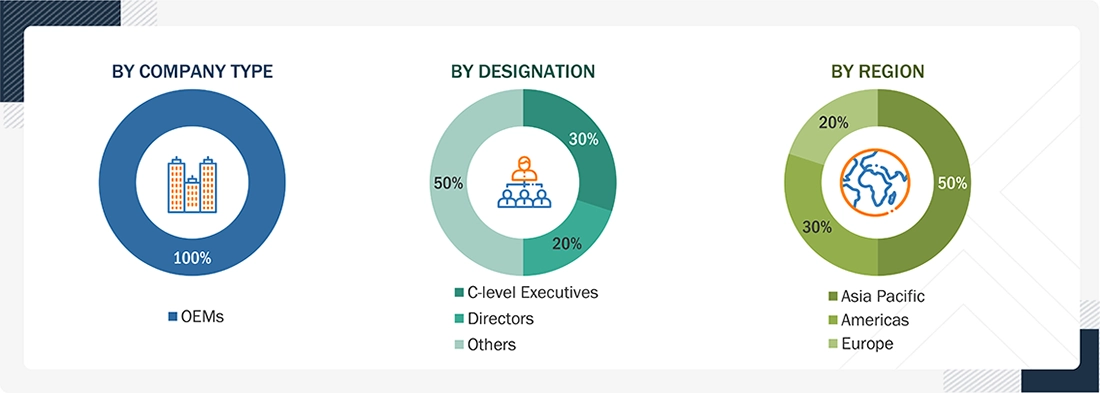
Extensive primary research was conducted after acquiring an understanding of the electric construction equipment market through secondary research. Primary interviews were conducted with market experts from the electric construction equipment manufacturers across Asia Pacific, Europe, and the Americas. Primary data was collected through questionnaires, emails, and telephonic interviews. Various departments within organizations, including sales, operations, and administration, were requested to provide a holistic viewpoint in the report while canvassing primaries.
After interacting with industry participants, brief sessions were held with experienced independent consultants to reinforce the findings from the primary research. This, along with the opinions of in-house subject-matter experts, led to the findings outlined in the remainder of this report.
To know about the assumptions considered for the study, download the pdf brochure
Market Size Estimation
A detailed market estimation approach was followed to estimate and validate the size of the electric construction equipment market, as mentioned below:
- Key players in the electric construction equipment market were identified through extensive secondary research using company annual reports, investor presentations, OEM product portfolios, industry associations, government databases, and regulatory publications. Market positioning and regional presence were further validated through interviews with OEM executives, distributors, battery suppliers, and industry experts.
- Penetration rates of electric construction, mining, and agricultural equipment were estimated through analysis of equipment parc, electrification roadmaps, pilot deployments, government decarbonization programs, and OEM product commercialization activities. These findings were subsequently validated through primary interviews with industry participants across the off-highway equipment ecosystem.
- Market segmentation and further breakdowns were developed using a combination of secondary research, equipment production analysis, model-level mapping, battery adoption trends, and regional infrastructure assessments. The outputs were cross-verified through discussions with industry stakeholders and subject-matter experts.
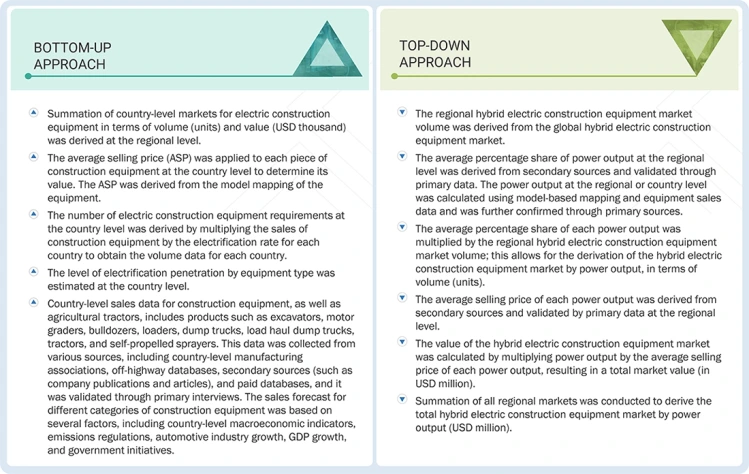
- Market forecasting was conducted using a hybrid modeling approach combining bottom-up and top-down methodologies. Forecast assumptions considered factors such as equipment electrification trends, battery cost trajectories, charging infrastructure expansion, emission regulations, mining and construction investments, OEM electrification strategies, and macroeconomic indicators across major regions. Scenario-based analysis and historical adoption patterns were also incorporated to evaluate future market penetration and technology transition rates.
- Average selling price of each electric construction equipment type at the country level derived from OEM websites and industry publications.
- The average selling price and volume of the electric construction equipment type at the country level are multiplied to obtain the market size of the electric construction equipment type in terms of value.
Electric Construction Equipment Market : Top-Down and Bottom-Up Approach
Data Triangulation
After determining the overall global market size using the above-mentioned methodology, the market was split into several segments and subsegments. The data triangulation and market breakdown procedures were employed, wherever applicable, to complete the overall market engineering process and derive validated market estimates for the key segments and subsegments. The extrapolated market data was triangulated by studying various macroindicators and regional trends from both the demand and supply-side participants.
Market Definition
Electric construction equipment comprises both battery-electric and hybrid-electric equipment. Battery electric equipment is fully electric, with the combustion engine replaced by batteries and an electric motor that powers the machine and its attachments. Meanwhile, hybrid electric equipment is powered by an internal combustion engine, combined with one or more electric motors that use energy stored in batteries to meet the additional auxiliary power needs of the equipment, electronic devices, and power tools.
- Construction Equipment: Construction equipment is built with durable structures, hydraulic systems, and powertrain technologies, and is used in the most demanding applications, ranging from road construction and infrastructure projects to aggregate loading, irrigation, brickwork, and other tasks.
- Mining Equipment: Mining equipment is a compact, robust machine engineered with advanced operational features to ensure productivity. It is built for demanding surface and underground mining applications.
- Agriculture Equipment: Agriculture equipment is designed to match and efficiently handle all kinds of farming, agricultural, and operational needs, including land preparation, planting, and harvesting activities.
Key Stakeholders
- Electric Construction Equipment Manufacturers
- Electric Mining Equipment Manufacturers
- Electric Tractor Manufacturers
- Electric Off-Highway Equipment Component Suppliers
- Battery and Drivetrain Suppliers
- Electric Construction Equipment/Component Traders, Distributors, and Suppliers
- Automotive Industry Associations, Government Authorities, and Research Organizations
Report Objectives
- To define, describe, and forecast the size of the electric construction equipment market in terms of volume (units) and value (USD thousand/million)
- By type (electric excavators, electric motor graders, electric dozers, electric loaders, electric dump trucks, and electric load haul dump loaders)
- By battery capacity (<50 kWh, 50–200 kWh, 200–500 kWh, and >500 kWh)
- By battery chemistry (lithium-iron phosphate, lithium-nickel manganese cobalt oxide, and others)
- By power output (<50 HP, 50–150 HP, 150–300 HP, and >300 HP)
- By propulsion (battery electric, hybrid electric, and hydrogen)
- By application (construction, mining, agriculture)
- By type (electric self-propelled sprayers and electric tractors)
- By propulsion (battery electric, hybrid electric, and hydrogen)
- By battery capacity (<50 kWh, 50–200 kWh, 200–500 kWh, and >500 kWh)
- By battery chemistry (lithium-iron phosphate, lithium-nickel manganese cobalt oxide, and others)
- By region (Asia Pacific, Europe, Americas)
- To understand the dynamics (drivers, restraints, opportunities, and challenges) of the electric construction equipment market
- To analyze the competitive landscape and company profiles of global players operating in the market, which includes business overview, products offered, and recent developments
- To strategically analyze key player strategies, competitive benchmarking, market share analysis, and revenue analysis
- To understand the dynamics of competitors and distinguish them into stars, emerging leaders, pervasive players, and participants according to the strength of their product portfolio and business strategies
- To study the market with supply chain analysis, ecosystem analysis, trade analysis, case studies, pricing analysis, patent analysis, trends and disruptions impacting customer business, technology analysis, total cost of ownership, bill of materials, key stakeholders and buying criteria, OEM analysis, regulatory landscape, and investment scenario
- To analyze and understand the customer buying behavior in the market
- To analyze recent developments, alliances, joint ventures, mergers & acquisitions, product launches, and other activities carried out by key industry participants in the electric construction equipment market
Additional Company Profiles
-
Detailed analysis and profiling of up to five market players
Get the Full Electric Construction Equipment Market Report
Full forecast, segment splits, and company analysis for all Electric Construction Equipment Market.
- China Electric Construction Equipment Market
- India Electric Construction Equipment Market
- Japan Electric Construction Equipment Market
- South Korea Electric Construction Equipment Market
- Germany Electric Construction Equipment Market
- UK Electric Construction Equipment Market
- France Electric Construction Equipment Market
- Spain Electric Construction Equipment Market
- Russia Electric Construction Equipment Market
- Italy Electric Construction Equipment Market
- Canada Electric Construction Equipment Market
- Mexico Electric Construction Equipment Market
- Argentina Electric Construction Equipment Market
- US Electric Construction Equipment Market
Need a Tailored Report?
Customize this report to your needs
Get 10% FREE Customization
Customize This Report
