
Nigeria Offshore Support Vessel Market (2024-2029)

The Nigeria Offshore Support Vessel Market was valued at $315.6 Million in 2024 and projected to reach to $383 Million by 2029, representing a compound annual growth rate of 3.9%. Nigeria's offshore support vessel market is positioned for steady growth through 2029, driven by continued investment in Gulf of Guinea oil and gas projects and the need for modern, specialized vessel fleets.


| Market Size in | USD 26.32 MN |
| Market Forecast in | |
| CAGR | |
| Forecast Period | |
| Units Considered | Value (USD MN) |
Nigeria Offshore Support Vessel Market Trends and Insights
- Nigeria's market growth is driven by sustained oil and gas exploration activities in the Gulf of Guinea and increasing demand for specialized vessel services to support deepwater operations.
- The offshore sector in Nigeria remains critical to the nation's energy infrastructure, with support vessels playing an essential role in maintaining production platforms and facilitating logistics across Nigeria's extensive offshore fields. The forecast period through 2029 reflects Nigeria's strategic importance as a major oil-producing nation in Africa.
- Nigeria's market expansion is supported by ongoing capital investments in offshore infrastructure and the need for modern, efficient support vessel fleets to meet operational demands.
- While Nigeria's growth rate of 3.9% is more moderate than global trends, the market demonstrates resilience and steady demand fundamentals rooted in Nigeria's established offshore petroleum industry..
Key Market Statistics
- CAGR (2024-2029) 3.9% CAGR
- Market Size, 2024 ~USD 315.6 Million
- Forecast, 2029 ~USD 383 Million
- Country Nigeria
Nigeria Offshore Support Vessel Market Overview
Market Valuation :
Nigeria's offshore support vessel market is valued at $315.6 million in 2024, with projected growth to $383.0 million by 2029, representing a CAGR of 3.9%.
Gulf of Guinea Operations :
Sustained oil and gas exploration activities in the Gulf of Guinea drive demand for specialized offshore support vessels, supporting deepwater operations and infrastructure maintenance.
Growth Differential :
Nigeria's market CAGR of 3.9% trails the global offshore support vessel market CAGR of 7.2%, reflecting regional economic and regulatory dynamics specific to West African operations.
Deepwater Specialization :
Increasing demand for specialized vessel services tailored to Nigeria's deepwater exploration requirements, including anchor handling, supply, and emergency response capabilities.
Nigeria Offshore Support Vessel Market Dynamics
- The market benefits from Nigeria's status as Africa's largest oil producer and ongoing deepwater exploration initiatives by major international operators.
- However, growth remains moderate compared to global trends due to regional economic volatility, regulatory challenges, and fluctuating commodity prices.
- Strategic investments in vessel modernization and compliance with international maritime standards will be critical for market participants seeking to capture opportunities in this evolving sector..
Market Ecosystem

OFFSHORE SUPPORT VESSEL MARKET: COMMERCIAL USE CASES ACROSS INDUSTRIES
| COMPANY | USE CASE DESCRIPTION | BENEFITS |
|---|---|---|
 |
Alimak faced significant challenges in adapting its elevator system for offshore vessels. Firstly, the company needed a solution for the variable elevator’s top landing, as it had to match the fluctuating heights of windmills or offshore platforms. Secondly, the limited space within the shaft posed a constraint. Thirdly, there was a tight deadline for installation, testing, and commissioning on the vessel itself, exacerbating the project’s complexity | To address these challenges, Alimak devised innovative technical solutions. The company implemented a variable top landing mechanism to align the elevator car precisely with the motion-compensated gangway, adapting to different heights of windmills or offshore platforms. Additionally, it optimized the design to accommodate the restricted space within the shaft. Despite the tight timeline, it completed the installation, testing, and commissioning on schedule, ensuring the elevator’s functionality for offshore logistics support, accommodation, and walk-to-work services during the construction of an offshore wind farm in the Irish Sea. Moreover, its rack and pinion elevator design proved resilient to the high roll, pitch, and heave motions typical of offshore environments, guaranteeing uninterrupted operation. With its robust construction and suitability for marine conditions, the Alimak marine elevator boasts an expected lifespan of at least 30 years with regular maintenance, making it an ideal solution for tough environments. |
 |
Vroon offshore support vessel is a twin-shafted vessel originally operated with a gland packing arrangement as primary shaft sealing. However, due to concerns about tail shaft wear associated with this system, ATZ Marine Technologies was hired to supply a retrofit class-type-approved seal design as a solution | The ATZ team has identified the starboard and port shaft that need to be overhauled. As part of planned maintenance, it was decided to pull out the Starboard shaft. The team took the following steps: Seal alignment measurements were taken to ensure that the seal was running true and that shaft alignment had been maintained. All working components were inspected and found to be in excellent condition. As part of the planned maintenance, an ATZ inflatable seal was fitted, and an ATZ sealing ring was also fitted |
Logos and trademarks shown above are the property of their respective owners. Their use here is for informational and illustrative purposes only.
Related Ecosystem
Oil And Gas Solutions
- Alumina Ceramics
- Ceramic Coatings
- Epoxy Resin
- Hot Melt Process
- Monolithic Ceramics
- TotalEnergies SE
- ENEOS Holdings, Inc.
- Hess Corporation
- Mol group
- Baker Hughes Company
Key Takeaways
- Nigeria's offshore support vessel market is valued at $315.6 million in 2024 and will reach $383.0 million by 2029.
- Nigeria's market is growing at a 3.9% CAGR, driven by sustained deepwater oil and gas operations in the Gulf of Guinea.
- Nigeria's offshore infrastructure investments and production maintenance requirements support steady demand for specialized support vessels.
- Nigeria's market growth reflects the nation's position as a major African oil producer with established offshore petroleum operations.
Offshore Support Vessel Market Report Scope
| Report Metric | Details |
|---|---|
| Base Year | 2024 |
| Fastest Growing Segment | WIND ENERGY (End-User Industry) |
| Forecast Period | 2024–2029 |
| Growth Rate | CAGR of 7.2% from 2024 to 2029 |
| Largest Segment | OIL & GAS (End-User Industry) |
| Market Size Base Year (Billions) | ~USD 25.64 (2024) |
| Revenue Forecast (Billions) | ~USD 36.3 (2029) |
| Segments Covered | Application, End-User Industry, Type |
Nigeria Offshore Support Vessel Market Report Segmentation
3 segment dimensions are covered across the global market.
By Application
- Deepwater
- Shallow Water
By End-User Industry
- Oil & Gas
- Wind Energy
By Type
- Anchor-Handling Tug Supply Vessels
- Chase Vessels
- Crew Vessels
- Multi-Purpose Support Vessels
- Other Vessels
- Platform Support Vessels
- Seismic Vessels
- Standby & Rescue Vessels
Target Audience
- Vessel Operators & Owners : Require Nigeria market data to optimize fleet deployment, assess demand for specialized deepwater support vessels, and identify growth opportunities in Gulf of Guinea operations.
- Oil & Gas Operators : Need market intelligence on vessel availability, service capabilities, and cost trends to plan offshore exploration and production activities in Nigerian deepwater fields.
- Maritime Service Providers : Seek Nigeria-specific market insights to develop service offerings, pricing models, and competitive strategies aligned with regional deepwater exploration and production requirements.
- Investment & Private Equity Firms : Require detailed market forecasts and growth analysis for Nigeria to evaluate investment opportunities in offshore vessel assets, maritime companies, and energy infrastructure.
- Government & Regulatory Bodies : Use market data to inform maritime policy, offshore safety standards, and economic development strategies for Nigeria's energy sector and Gulf of Guinea operations.
Key Companies in the Nigeria Offshore Support Vessel Market
| Company | HQ | Ownership | Strongest segments |
|---|---|---|---|
| TEREX CORPORATION | United States | Public Company | Aerial Work Platforms and Telehandlers (Genie/Terex),Materials Processing (Crushers, Screens, Washing, Conveyors),Environmental Solutions (Refuse, Recycling, Utility Equipment, Software), |
| SAIPEM | Italy | Public Company | Subsea development and pipelaying,Offshore structures, installation, and lifting,Onshore engineering and construction, |
| FLUOR CORPORATION | United States | Public Company | Energy Solutions (oil, gas, chemicals, LNG, power, energy transition),Urban Solutions (advanced technologies, life sciences, mining, infrastructure, staffing, maintenance),Mission Solutions (government, nuclear remediation, defense, logistics, O&M), |
| SAUDI ARAMCO | Saudi Arabia | Public Company | Crude oil and condensate,Natural gas and NGLs,Refined products (fuels, base oils, lubricants), |
| HESS CORPORATION | United States | Private Company | Crude oil,Natural gas liquids (NGLs),Natural gas, |
| TOTAL SA | France | Public Company | Upstream oil and gas,LNG and pipeline gas,Refining, fuels marketing, and biofuels, |
| ENI SPA | Italy | Public Company | Exploration & Production (oil, condensates, gas),Global Gas & LNG Portfolio and Power,Refining and Chemicals, |
| JXTG HOLDINGS | Japan | Public Company | Petroleum product refining and sales,Petrochemicals and functional materials,Lubricants, |
| MOL GROUP | Hungary | Public Company | Fuels (gasoline, diesel, heating oil, bunker, JET A-1, LPG/autogas),Petrochemicals and black products (bitumen, HFO, petrolcoke, residues),Lubricants, base oils, waxes, autochemicals, |
| PETROBRAS | Brazil | Public Company | Exploration and Production,Refining, Transportation & Marketing,Gas & Low Carbon Energies, |
| SHELL PLC | United Kingdom | Public Company | Integrated Gas (including LNG and GTL),Upstream (oil, gas, NGLs),Marketing (mobility, lubricants, commercial fuels), |
| TIDEWATER INC. | United States | Public Company | Anchor Handling Towing Supply (AHTS),Platform Supply Vessels (PSV),Specialty / subsea / construction support, |
| A.P. MOLLER - MAERSK | Denmark | Public Company | Ocean freight (full container and specialized),Logistics & Services (air, LCL, inland, e-commerce, lead logistics),Terminals and depots, |
| SEA1 OFFSHORE | Norway | Public Company | Subsea Vessels (construction and well intervention),Anchor-Handling Tug Supply (AHTS) Vessels,Platform Supply Vessels (PSVs), |
| SOLSTAD OFFSHORE ASA | Norway | Public Company | Construction service vessels (CSV) and subsea construction activities,Anchor handling tug supply (AHTS) and mooring/installation support,Renewable energy services and subsea support operations, |
| DOF | Norway | Public Company | Subsea construction & installation (CSV + engineering + ROV),Inspection, maintenance & repair (IMR) and survey,Anchor handling, towing, mooring and marine logistics, |
| SEACOR MARINE | United States | Public Company | Offshore oil and gas support (cargo, personnel, production support),Offshore wind farm installation, maintenance, and technician accommodation,Subsea equipment handling, well work-over, and decommissioning support, |
| HAVILA SHIPPING ASA | Norway | Public Company | Platform supply vessels (PSV),Rescue recovery and ocean patrol vessels,Subsea vessels and underwater construction support, |
| KAWASAKI KISEN KAISHA LTD. | Japan | Public Company | Dry bulk carriers,Car carriers (PCC/PCTC),LNG and liquefied gas carriers, |
| NAM CHEONG LIMITED | Singapore | Public Company | OSV Shipbuilding (AHTS, PSVs, MWVs, AWBs, SSVs),Vessel Chartering,Trading & Ship Delivery Services, |
| MMA OFFSHORE LIMITED | Australia | Private Company | Vessel Services,Subsea Services,Project Logistics, |
TEREX CORPORATION
Terex Corporation is a United States-based public company founded in 1933 that employs 10,700 people. The company operates in the industrial equipment and machinery sector.
SAIPEM
Saipem is an Italian public company established in 1957 with 30,000 employees. The company specializes in engineering, procurement, and construction services.
FLUOR CORPORATION
Fluor Corporation is a United States public company founded in 1912 with 22,995 employees. The company provides engineering, procurement, construction, and maintenance services across multiple industries.
SAUDI ARAMCO
Saudi Aramco is a Saudi Arabian public company founded in 1933 with 79,000 employees. The company is a major integrated oil and gas producer and refiner.
HESS CORPORATION
Hess Corporation is a United States private company founded in 1919 with 1,797 employees. The company operates in the oil and gas exploration and production sector.
TOTAL SA
Total SA is a French public company established in 1924 with 94,847 employees. The company is a major integrated oil and gas producer with global operations.
ENI SPA
Eni SpA is an Italian public company founded in 1953 with 32,349 employees. The company operates as an integrated oil and gas producer and energy company.
JXTG HOLDINGS
JXTG Holdings is a Japanese public company founded in 1888 with 34,099 employees. The company operates in the petroleum refining and energy sectors.
MOL GROUP
MOL Group is a Hungarian public company founded in 1991 with 24,744 employees. The company operates as an integrated oil and gas producer and refiner.
PETROBRAS
Petrobras is a Brazilian public company founded in 1953 with 43,199 employees. The company is a major integrated oil and gas producer with significant offshore operations.
SHELL PLC
Shell PLC is a United Kingdom public company founded in 1897 with 84,000 employees. The company is a major integrated oil and gas producer with global operations.
TIDEWATER INC.
Tidewater Inc. is a United States public company founded in 1956 with 7,300 employees. The company provides offshore support vessels and marine services.
A.P. MOLLER - MAERSK
A.P. Moller - Maersk is a Danish public company founded in 1904 with 100,000 employees. The company operates in shipping, logistics, and energy sectors.
SEA1 OFFSHORE
Sea1 Offshore is a Norwegian public company founded in 2005 with 756 employees. The company provides offshore support and marine services.
SOLSTAD OFFSHORE ASA
Solstad Offshore ASA is a Norwegian public company founded in 1964 with 906 employees. The company operates offshore supply vessels and support services.
DOF
DOF is a Norwegian public company founded in 1981 with 5,753 employees. The company provides offshore support vessels and marine services.
SEACOR MARINE
Seacor Marine is a United States public company founded in 1989 with 889 employees. The company provides offshore support vessels and marine services.
HAVILA SHIPPING ASA
Havila Shipping ASA is a Norwegian public company founded in 2000 with 414 employees. The company operates in the offshore and marine services sector.
KAWASAKI KISEN KAISHA LTD.
Kawasaki Kisen Kaisha Ltd. is a Japanese public company founded in 1919 with 5,262 employees. The company operates in shipping and maritime logistics.
NAM CHEONG LIMITED
Nam Cheong Limited is a Singapore-based public company founded in 1968. The company operates in the shipbuilding and offshore services sectors.
MMA OFFSHORE LIMITED
MMA Offshore Limited is an Australian private company founded in 1989 with 1,100 employees. The company provides offshore support vessels and marine services.
Reasons to Buy this Report
- Market-Specific Sizing : Access precise valuation data for Nigeria's offshore support vessel market with verified 2024 baseline ($315.6M) and 2029 forecasts, enabling accurate investment planning and resource allocation.
- Regional Growth Insights : Understand Nigeria-specific growth drivers including Gulf of Guinea exploration trends, deepwater project pipelines, and vessel service demand patterns distinct from global market dynamics.
- Competitive Positioning : Benchmark your operations against Nigeria's market CAGR of 3.9% to identify competitive advantages, pricing strategies, and service differentiation opportunities in West African offshore operations.
- Investment Decision Support : Make informed capital allocation decisions for fleet expansion, vessel acquisition, or service offerings in Nigeria with data-driven forecasts and market growth trajectories through 2029.
- Regulatory & Operational Context : Gain insights into Nigeria-specific operational requirements, regulatory compliance needs, and specialized vessel capabilities demanded by deepwater operators in the Gulf of Guinea region.
Frequently asked questions
What is the current size of Nigeria's offshore support vessel market?
Nigeria's offshore support vessel market is valued at $315.6 million in 2024.
What is the projected market size for Nigeria by 2029?
Nigeria's offshore support vessel market is projected to reach $383.0 million by 2029.
What is the growth rate of Nigeria's offshore support vessel market?
Nigeria's offshore support vessel market is growing at a compound annual growth rate of 3.9% from 2024 to 2029.
What drives demand for offshore support vessels in Nigeria?
Demand in Nigeria is driven by sustained oil and gas exploration and production activities in the Gulf of Guinea, deepwater operations, and the need for specialized logistics and maintenance services.
Why is Nigeria's market important for offshore support vessels?
Nigeria is a major African oil producer with extensive offshore petroleum infrastructure, making it a critical market for support vessel services that maintain production platforms and facilitate offshore operations.
RESEARCH METHODOLOGY
The study involved major activities in estimating the current size of the offshore support vessel market. Exhaustive secondary research was done to collect information on the peer and parent markets. The next step was to validate these findings, assumptions, and sizing with industry experts across the value chain through primary research. Both top-down and bottom-up approaches were employed to estimate the total market size. Thereafter, market breakdown and data triangulation were used to estimate the market size of the segments and subsegments.
Secondary Research
This research study on the osv market involved the use of extensive secondary sources, directories, and databases, such as Hoover’s, Bloomberg, Factiva, IRENA, International Energy Agency, and Statista Industry Journal, to collect and identify information useful for a technical, market-oriented, and commercial study of the osv market. The other secondary sources included annual reports, press releases & investor presentations of companies, white papers, certified publications, articles by recognized authors, manufacturer associations, trade directories, and databases.
Primary Research
The osv market comprises several stakeholders, such as offshore support vessel manufacturers, technology providers, and technical support providers in the supply chain. The demand side of this market is characterized by the rising demand for storage solutions in various applications such as energy, mobility, industrial, and transportation. The supply side is characterized by rising demand for contracts from the industrial sector and mergers & acquisitions among big players. Various primary sources from both the supply and demand sides of the market were interviewed to obtain qualitative and quantitative information. Following is the breakdown of primary respondents:
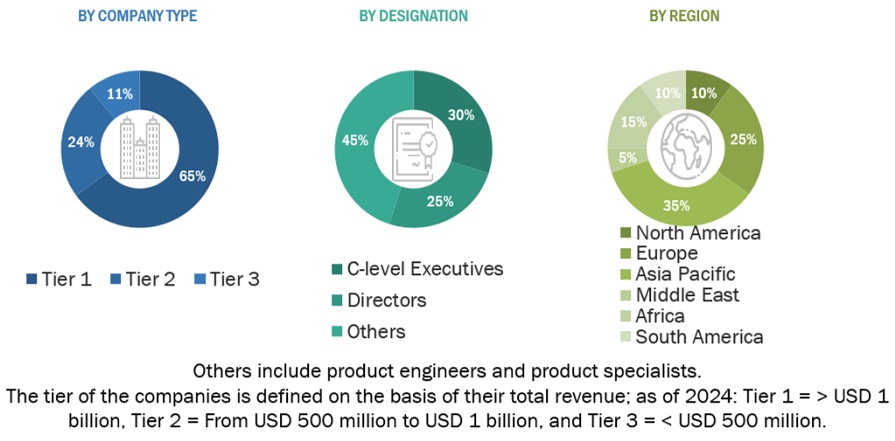
To know about the assumptions considered for the study, download the pdf brochure
Offshore Support Vessel Market Size Estimation
Both top-down and bottom-up approaches were used to estimate and validate the total size of the osv market. These methods were also used extensively to estimate the size of various subsegments in the market. The research methodology used to estimate the market size includes the following:
- The key players in the industry and market have been identified through extensive secondary research, and their market share has been determined through primary and secondary research.
- The industry’s value chain and market size, in terms of value, have been determined through both primary and secondary research processes.
- All percentage shares, splits, and breakdowns have been determined using secondary sources and verified through primary sources.
Offshore Support Vessel Market Size: Top-Down Approach
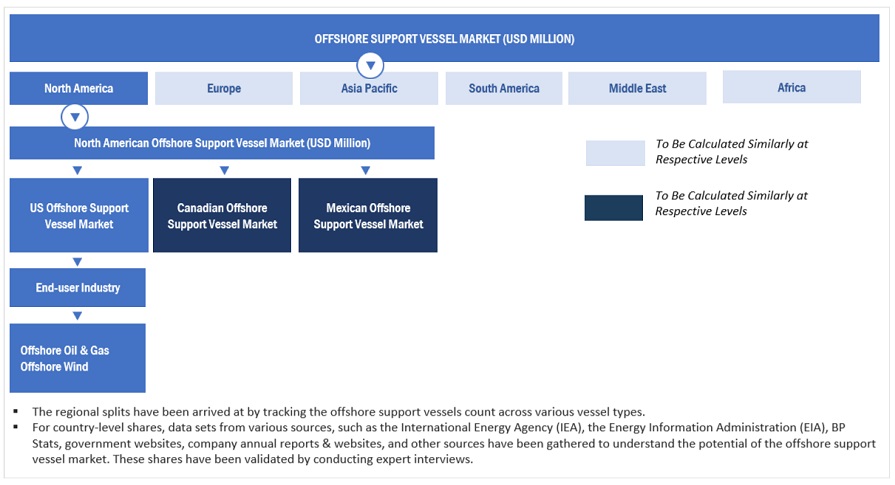
To know about the assumptions considered for the study, Request for Free Sample Report
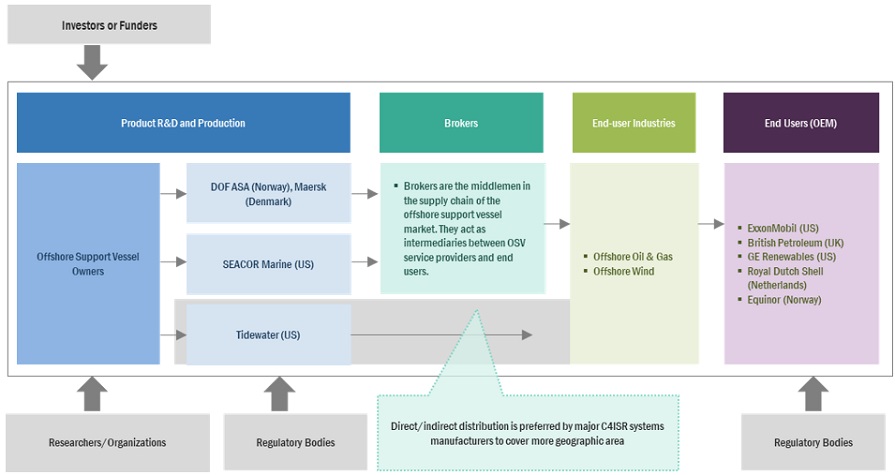
Offshore Support Vessel Market Size: Bottom-Up Approach
Data Triangulation
After arriving at the overall market size from the above estimation process, the total market has been split into several segments and subsegments. Data triangulation and market breakdown processes have been employed to complete the overall market engineering process and arrive at the exact statistics for all the segments and sub-segments, wherever applicable. The data has been triangulated by studying various factors and trends from both the demand- and supply sides. Along with this, the market has been validated using both the top-down and bottom-up approaches.
Market Definition
An offshore support vessel (OSV) is specially designed to support offshore exploration, drilling, production, and construction activities in the oil & gas industry. These vessels provide a range of services, such as transportation of personnel, equipment and supplies, maintenance and repair, and oil spill response. OSVs are also used for specialized tasks such as platform installation, decommissioning, seismic surveying, providing firefighting, towing, and positioning of drilling rigs and other offshore structures, and subsea construction. These vessels are equipped with dynamic positioning systems to maintain their position in rough seas and are built to withstand harsh offshore conditions. Different types of offshore support vessels are used in offshore oil & gas and offshore wind applications. OSVs play a crucial role in offshore oil & gas and offshore wind farms by enabling safe and efficient operations.
Key Stakeholders
- Offshore support vessel manufacturers and suppliers
- Offshore support vessel operators
- Offshore wind turbine manufacturers
- Oil and gas companies
- Wind farm owners, operators, and developers
- Offshore support vessel consulting companies
- Offshore logistics and ship authorities
- Offshore platform operators
- Associations and industry associations
- Government and research organizations
- Investment banks
State and National Regulatory Authorities Objectives of the Study
- To forecast the osv market based on materials used, fuels used, type, application, end-user, and region in terms of value
- To describe the market for four key regions: Asia Pacific, North America, Europe, and Rest of the World, along with their country-level market sizes in terms of value
- To provide detailed information regarding key drivers, restraints, opportunities, and challenges influencing the growth of the market
- To strategically analyze the micromarkets with respect to individual growth trends, prospects, and contributions to the overall market size
- To provide the supply chain analysis, trends/disruptions impacting customers’ businesses, market map, ecosystem analysis, tariffs and regulations, pricing analysis, patent analysis, case study analysis, technology analysis, key conferences and events, trade analysis, Porter’s five forces analysis, key stakeholders and buying criteria, and regulatory analysis of osv market
- To analyze opportunities for stakeholders in the offshore support vessel and draw a competitive landscape of the market
- To benchmark market players using the company evaluation matrix, which analyzes market players on broad categories of business and product strategies adopted by them
- To compare key market players with respect to product specifications and utility
- To strategically profile key players and comprehensively analyze their market rankings and core competencies
- To analyze competitive developments, such as contracts & agreements, investments & expansions, mergers & acquisitions, new product launches, partnerships, joint ventures & collaborations, in the osv market.
Available Customizations:
With the given market data, MarketsandMarkets offers customizations according to the specific requirements of companies. The following customization options are available for the report:
Product Analysis
- Product Matrix, which provides a detailed comparison of the product portfolio of each company
Company Information
- Detailed analyses and profiling of additional market players
Get the Full Offshore Support Vessel Market Report
Full forecast, segment splits, and company analysis for all Offshore Support Vessel Market.
- Netherlands Offshore Support Vessel Market
- Canada Offshore Support Vessel Market
- Mexico Offshore Support Vessel Market
- US Offshore Support Vessel Market
- Brazil Offshore Support Vessel Market
- Saudi Arabia Offshore Support Vessel Market
- UAE Offshore Support Vessel Market
- Qatar Offshore Support Vessel Market
- Oman Offshore Support Vessel Market
- South America Offshore Support Vessel Market
- Rest Of Europe Offshore Support Vessel Market
- Rest Of Asia Pacific Offshore Support Vessel Market
- Angola Offshore Support Vessel Market
- GCC Offshore Support Vessel Market
- Rest Of South America Offshore Support Vessel Market
- China Offshore Support Vessel Market
- India Offshore Support Vessel Market
- Malaysia Offshore Support Vessel Market
- Thailand Offshore Support Vessel Market
- Vietnam Offshore Support Vessel Market
- UK Offshore Support Vessel Market
- Norway Offshore Support Vessel Market
Need a Tailored Report?
Customize this report to your needs
Get 10% FREE Customization
Customize This Report
