
North America Optical Satellite Communication Market (2025-2030)

The North America Optical Satellite Communication Market was valued at $487.2 Million in 2025 and projected to reach to $830 Million by 2030, representing a compound annual growth rate of 11.2%. North America's optical satellite communication market is positioned for sustained growth, supported by robust defence spending, technological advancement, and the region's established aerospace ecosystem.


| Market Size in | USD 26.32 MN |
| Market Forecast in | |
| CAGR | |
| Forecast Period | |
| Units Considered | Value (USD MN) |
North America Optical Satellite Communication Market Trends and Insights
- This 11.2% compound annual growth rate reflects North America's leadership in aerospace and defence innovation, driven by increased demand for high-bandwidth, secure satellite communications across military and commercial sectors.
- North America's advanced infrastructure and significant government investment position the region as a critical hub for optical satellite technology development and deployment. The North America market benefits from strong defence spending, particularly from the U.S.
- Department of Defense and allied agencies seeking next-generation communication capabilities.
- North America's established satellite ecosystem, combined with private sector innovation from companies focused on low-earth orbit constellations, accelerates adoption of optical inter-satellite links and ground-to-space optical terminals.
- Between 2025 and 2030, North America is expected to maintain its competitive advantage through continued R&D investment and strategic partnerships in the optical satellite communication space..
Key Market Statistics
- CAGR (2025-2030) 11.2% CAGR
- Market Size, 2025 ~USD 487.2 Million
- Forecast, 2030 ~USD 830 Million
- Geography North America
North America Optical Satellite Communication Market Overview
US Market Dominance :
The United States accounts for $804.5 million of North America's optical satellite communication market, representing the largest regional concentration and driving innovation in military and commercial satellite systems.
Defense Sector Leadership :
North America's aerospace and defence sector is leveraging optical satellite communications for secure, high-bandwidth military operations, with significant government investment in next-generation satellite networks and space infrastructure.
Canadian Growth Contribution :
Canada's market segment valued at $25.6 million is expanding through increased participation in joint US-Canada defence initiatives and commercial satellite constellation development.
11.2% Regional CAGR :
North America's optical satellite communication market is growing at 11.2% annually through 2030, driven by demand for secure communications, space situational awareness, and commercial broadband satellite services.
North America Optical Satellite Communication Market Dynamics
- The US leads market expansion with major investments in military satellite networks and commercial space ventures, while Canada contributes through collaborative defence programs and emerging satellite operators.
- Government initiatives, including space force modernization and secure communication mandates, are accelerating adoption across defence and intelligence agencies.
- Commercial demand is rising from broadband providers and enterprise customers seeking high-capacity, low-latency satellite links.
- By 2030, the market is expected to reach $830 million, reflecting North America's strategic focus on space-based communications superiority and technological independence in critical infrastructure..
Market Ecosystem
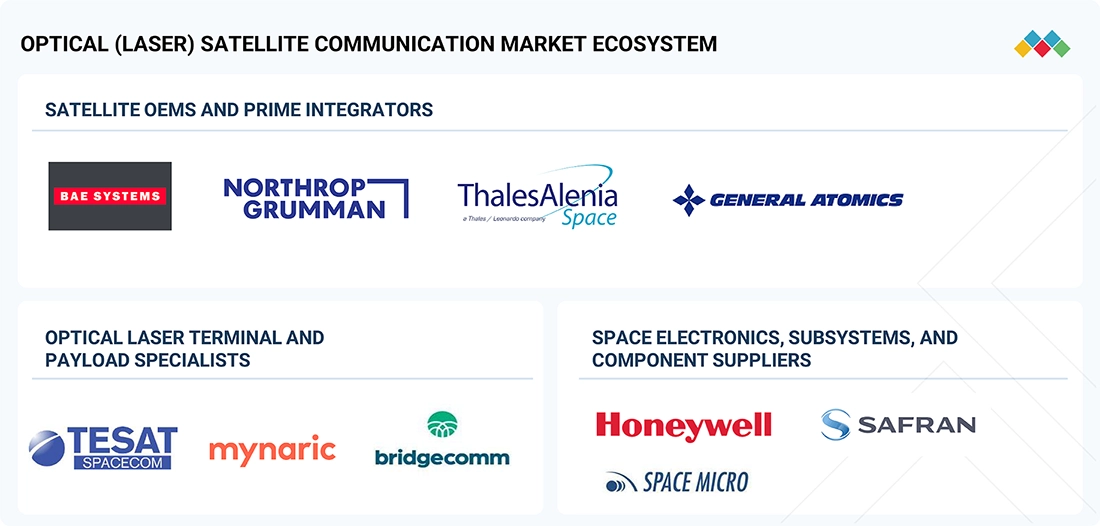
OPTICAL (LASER) SATELLITE COMMUNICATION MARKET SIZE & GROWTH: COMMERCIAL USE CASES ACROSS INDUSTRIES
| COMPANY | USE CASE DESCRIPTION | BENEFITS |
|---|---|---|
-satellite-communication-market-sda.svg) |
Required a secure, low-latency space network for missile tracking and tactical defense communications beyond RF limitations. | Enables jam-resistant mesh networking, improves global coverage, and supports real-time defense data transfer. |
-satellite-communication-market-spacex.svg) |
Needed high-capacity space-based routing to deliver low-latency broadband over remote and underserved regions. | Reduces ground gateway dependence and enables continuous global broadband coverage. |
-satellite-communication-market-nasa.svg) |
Required terabit-class downlinks to transmit large science and EO datasets beyond RF capacity limits. | Delivers ultra-high data rates and accelerates access to mission data. |
Logos and trademarks shown above are the property of their respective owners. Their use here is for informational and illustrative purposes only.
Related Ecosystem
Key Takeaways
- North America's optical satellite communication market will grow from $487.2M (2025) to $830M (2030) at an 11.2% CAGR.
- North America leads in defence-driven optical satellite adoption, supported by U.S. military modernization initiatives.
- North America's private sector innovation in LEO constellations accelerates optical inter-satellite link deployment.
- North America maintains competitive advantage through sustained government investment and advanced aerospace infrastructure.
Optical Satellite Communication Market Report Scope
| Report Metric | Details |
|---|---|
| Base Year | 2025 |
| Fastest Growing Segment | AIRBORNE TERMINAL (Platform) |
| Forecast Period | 2025–2030 |
| Growth Rate | CAGR of 20.4% from 2025 to 2030 |
| Largest Segment | SATELLITE COMMUNICATION TERMINAL (Platform) |
| Market Size Base Year (Billions) | ~USD 0.62 (2025) |
| Revenue Forecast (Billions) | ~USD 1.56 (2030) |
| Segments Covered | Platform, Application, Component, Laser Type |
North America Optical Satellite Communication Market Report Segmentation
4 segment dimensions are covered across the global market.
By Platform
- Airborne Terminal
- Ground Station Terminal
- Satellite Communication Terminal
By Application
- Earth Observation & Remote Sensing
- Network Backbone & Relay Communications
- Research & Scientific Exploration
- Scientific Research & Exploration
By Component
- Baseband Modem & Processing Electronics
- Optical Front-End
- Pointing, Acquisition, And Tracking Module
- Receive Module
- Transmit Module
By Laser Type
- Fiber Laser
- Other Lasers
- Semiconductor Diode Laser
- Solid-State Laser
Target Audience
- Defence Contractors : Understand government procurement trends, military satellite communication requirements, and competitive positioning to secure defence contracts across North America.
- Satellite Operators : Access market demand data, customer segments, and technology adoption rates to optimize constellation deployment and service offerings in North American markets.
- Technology Providers : Identify growth opportunities in optical communication components, ground stations, and integrated systems for North American aerospace and defence applications.
- Investment Firms : Evaluate market growth potential, emerging companies, and strategic acquisition targets within North America's optical satellite communication sector.
- Government Agencies : Assess market capabilities, technology readiness, and supplier landscape to inform space policy, procurement strategy, and national security communications infrastructure.
Key Companies in the North America Optical Satellite Communication Market
| Company | HQ | Ownership | Strongest segments |
|---|---|---|---|
| SPACEX | United States | Public Company | Connectivity (Starlink),Space (Launch and Spacecraft: Falcon 9, Falcon Heavy, Starship, Dragon),AI Platform (Grok, X, Enterprise AI, Compute Infrastructure), |
| MYNARIC AG | Germany | Private Company | CONDOR optical inter-satellite link terminals (Space segment),HAWK airborne laser communication terminals (Air segment),Engineering services, customization, and ground/terrestrial applications, |
| BAE SYSTEMS | United Kingdom | Public Company | Air,Maritime,Electronic Systems, |
| HONEYWELL INTERNATIONAL INC. | United States | Public Company | Industrial Automation,Building Automation,Energy and Sustainability Solutions (UOP and related), |
| MITSUBISHI ELECTRIC CORPORATION | Japan | Public Company | Factory Automation and Industrial Systems,Building Systems (Elevators, Escalators, BMS),Air Conditioning, Refrigeration, and Home Equipment, |
| AAC CLYDE SPACE | Sweden | Public Company | Satellite subsystems (power, ADCS, communications, structures, propulsion),Satellite platforms and mission services (EPIC, design, manufacturing, integration, launch, ground),Space data as a service and data delivery, |
| NORTHROP GRUMMAN | United States | Public Company | Aeronautics Systems,Defense Systems,Mission Systems, |
SPACEX
SpaceX is a United States-based aerospace manufacturer founded in 2002 that designs, manufactures, and launches advanced rockets and spacecraft. With 22,000 employees, the company operates as a public entity and focuses on commercial spaceflight, satellite deployment, and space exploration services.
MYNARIC AG
Mynaric AG is a German private company founded in 2009 with 314 employees specializing in optical communication technologies for space and terrestrial applications. The company develops laser communication systems designed to enable high-speed data transmission between satellites and ground stations.
BAE SYSTEMS
BAE Systems is a United Kingdom-based public company founded in 1979 with 111,400 employees operating across defense, aerospace, and security sectors. The company provides advanced technology solutions including space systems, military equipment, and related services globally.
HONEYWELL INTERNATIONAL INC.
Honeywell International Inc. is a United States-based public company founded in 1885 with 101,000 employees operating across aerospace, building technologies, performance materials, and safety solutions. The company serves commercial and defense markets with advanced technology products and services.
MITSUBISHI ELECTRIC CORPORATION
Mitsubishi Electric Corporation is a Japanese public company founded in 1921 with 150,386 employees operating across multiple sectors including aerospace, energy, industrial systems, and information technology. The company provides space-related technologies and satellite systems among its diverse product portfolio.
AAC CLYDE SPACE
AAC Clyde Space is a Swedish public company founded in 2005 with 198 employees specializing in small satellite technology and space systems. The company designs and manufactures nanosatellites and related components for commercial and institutional space applications.
NORTHROP GRUMMAN
Northrop Grumman is a United States-based public company founded in 1939 with 95,000 employees operating across aerospace, defense, and space technology sectors. The company provides advanced systems and solutions for space exploration, satellite communications, and national security applications.
Countries within North America - compare and drill down
| Country | 2025 size (native) |
|---|---|
| US | USD 804.5 Million |
| Canada | USD 25.6 Million |
Country market size visualization
Reasons to Buy this Report
- US Market Intelligence : Gain detailed insights into the $804.5 million US optical satellite communication market, including defence procurement trends, commercial operator strategies, and technology adoption patterns.
- Regional Growth Forecasts : Access country-level projections for the US and Canada through 2030, enabling precise market sizing and investment planning for North American expansion strategies.
- Defence Sector Analysis : Understand military and government demand drivers across North America, including space force modernization, secure communications requirements, and classified program insights.
- Competitive Landscape : Identify leading North American satellite operators, technology providers, and emerging players competing in optical communications, with market share and strategic positioning data.
- Investment Opportunity Assessment : Evaluate market entry points, partnership opportunities, and acquisition targets within North America's high-growth optical satellite communication ecosystem.
Frequently asked questions
What is the market size of optical satellite communication in North America?
North America's optical satellite communication market is valued at $487.2 million in 2025 and is forecast to reach $830 million by 2030.
What is the growth rate for optical satellite communication in North America?
North America's optical satellite communication market is expected to grow at a compound annual growth rate (CAGR) of 11.2% from 2025 to 2030.
What drives growth in North America's optical satellite communication market?
North America's market growth is driven by increased defence spending, demand for secure high-bandwidth communications, and private sector innovation in low-earth orbit satellite constellations.
Which sectors are leading adoption in North America?
North America's defence and aerospace sectors lead adoption, with significant contributions from U.S. military agencies and commercial satellite operators deploying optical inter-satellite links.
How does North America compare to the global optical satellite communication market?
North America's 11.2% CAGR is lower than the global 20.4% CAGR, reflecting North America's mature market position and established infrastructure compared to emerging regions.
RESEARCH METHODOLOGY
The study involved four major activities in estimating the current size of the Optical satellite communication Market. Exhaustive secondary research was done to collect information on the Optical satellite communication market, its adjacent markets, and its parent market. The next step was to validate these findings, assumptions, and sizing with industry experts across the value chain through primary research. Demand-side analyses were carried out to estimate the overall size of the market. After that, market breakdown and data triangulation procedures were used to estimate the sizes of different segments and subsegments of the Optical satellite communication Market.
Secondary Research
The market ranking of companies was determined using secondary data made available through paid and unpaid sources and by analyzing the product portfolios of major companies. These companies the performance on the basis of the performance and quality of their products. These data points were further validated by primary sources.
Secondary sources referred to for this research study included financial statements of companies offering Optical Satellite Communication hardware and information from various trade, business, and professional associations. The secondary data was collected and analyzed to arrive at the overall size of the Optical Satellite Communication market, which was validated by primary respondents.
Primary Research
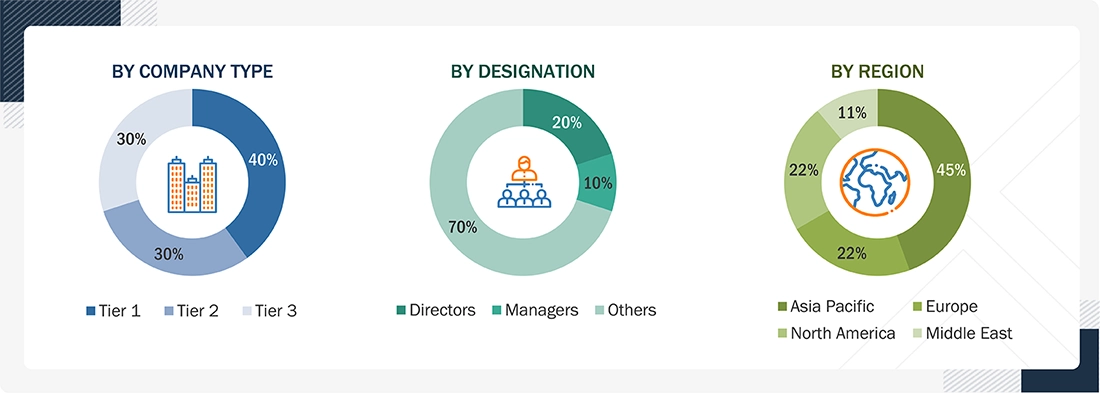
Extensive primary research was conducted after acquiring information regarding the Optical Satellite Communication market scenario through secondary research. Several primary interviews were conducted with market experts from both the demand and supply sides across major countries of North America, Europe, Asia Pacific, ROW which includes the Middle East & Africa, and Latin America. Primary data was collected through questionnaires, emails, and telephonic interviews.
To know about the assumptions considered for the study, download the pdf brochure
Market Size Estimation
The market sizing of the market was undertaken from the demand side. The market was upsized at a regional level based on procurements and modernizations in the land fixed, land mobile, airborne, naval, and portable platforms. Such procurements provide information on each platform's demand aspects of Optical satellite communication products. For each platform, all possible application areas where Optical satellite communication is integrated or installed were mapped.
Note: An analysis of technological, military funding, year-on-year launches, and operational cost were carried out to arrive at the CAGR and understand the market dynamics of all countries in the report. The market share for all type, component, application, and laser type was based on the recent and upcoming launches of Optical satellite communication products in every country from 2020 to 2028.
Data Triangulation
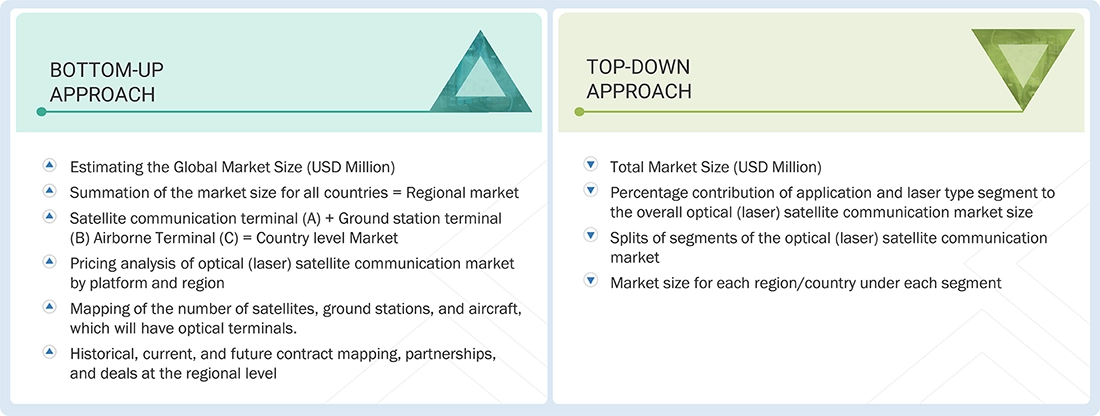
After arriving at the overall size from the market size estimation process explained above, the total market was split into several segments and subsegments. The data triangulation and market breakdown procedures explained below were implemented, wherever applicable, to complete the overall market engineering process and arrive at the exact statistics for various market segments and subsegments. The data was triangulated by studying various factors and trends from both the demand and supply sides. Along with this, the market size was validated using both the top-down and bottom-up approaches.
The following figure indicates the market breakdown structure and the data triangulation procedure that was implemented in the market engineering process to make this report on the Optical Satellite Communication market.
Market Definition
The optical satellite communication market refers to the sector that deals with developing, manufacturing, and deploying satellite communication systems that utilize optical technology for data transmission. Optical satellite communication (free-space optical communication (FSO) involves sending data through laser beams or infrared signals instead of traditional radio frequency (RF) signals used in most satellite communication systems. This technology offers high data transmission rates, low latency, and increased security for sensitive data transfer. With a growing demand for global connectivity and data-intensive applications, optical communication presents a potential solution to meet these needs. Despite challenges related to atmospheric conditions, advancements in technology are continuously improving its viability.
Optical Satellite communication consists of Satellite-To-Satellite Communication Payloads: Satellite-to-satellite communication payload encompasses inter-satellite links (ISLs) deployed within satellites to facilitate optical communication between these spaceborne platforms.
Ground -To- Satellite- Communication Terminals: Ground-to-satellite communication terminals encompass optical ground terminals, including optical ground stations and optical terminals, employed for laser communication between the terrestrial infrastructure and satellite systems.
Market Stakeholders
- Manufacturers of Optical satellite
- System Integrators
- Original Equipment Manufacturers (OEM)
- Service Providers
- Research Organizations
- Investors and Venture Capitalists
- Ministries of Defense
Report Objectives
- To define, describe, and forecast the size of the Optical satellite communication market based on type, component, application, laser type, and region.
- To indicate the size of the various segments of the Optical satellite communication market based on five regions North America, Europe, Asia Pacific, Rest of the world along with key countries in each of these regions.
- To identify and analyze key drivers, restraints, opportunities, and challenges influencing the growth of the market.
- To determine industry trends, market trends, and technology trends prevailing in the market
- To analyze micro markets concerning individual technological trends, prospects, and their contribution to the overall market
- To provide a detailed competitive landscape of the market and analyze competitive growth strategies such as product launches and developments, contracts, partnerships, agreements, and collaborations adopted by key players in the market.
- To identify the detailed financial positions, product portfolios, and key developments of leading companies in the market
- To strategically profile key market players and comprehensively analyze their market rank analysis and core competencies.
Available Customizations
MarketsandMarkets offers the following customizations for this market report:
- Additional country-level analysis of the Optical satellite communication Market
- Profiling of other market players (up to 5)
Product Analysis
- Product matrix, which provides a detailed comparison of the product portfolio of each company in the Optical satellite communication Market.
Get the Full Optical Satellite Communication Market Report
Full forecast, segment splits, and company analysis for all Optical Satellite Communication Market.
- Canada Optical Satellite Communication Market
- US Optical Satellite Communication Market
- UK Optical Satellite Communication Market
- Germany Optical Satellite Communication Market
- France Optical Satellite Communication Market
- Spain Optical Satellite Communication Market
- Italy Optical Satellite Communication Market
- Japan Optical Satellite Communication Market
- India Optical Satellite Communication Market
- China Optical Satellite Communication Market
- Australia Optical Satellite Communication Market
- Saudi Arabia Optical Satellite Communication Market
- UAE Optical Satellite Communication Market
Need a Tailored Report?
Customize this report to your needs
Get 10% FREE Customization
Customize This Report
