
South America Organic Acids Market (2025-2030)

The South America Organic Acids Market was valued at $1568.6 Million in 2025 and projected to reach to $2007.7 Million by 2030, representing a compound annual growth rate of 5.1%. South America's organic acids market is positioned for sustained growth through 2030, driven by expanding food processing industries in Brazil and Argentina, coupled with increasing regulatory support for natural food additives.


| Market Size in | USD 26.32 MN |
| Market Forecast in | |
| CAGR | |
| Forecast Period | |
| Units Considered | Value (USD MN) |
South America Organic Acids Market Trends and Insights
- In South America, the organic acids sector is driven by rising demand from food preservation, beverage acidulation, and pharmaceutical applications across Brazil, Argentina, and Chile.
- South America's market growth reflects increasing consumer preference for natural food additives and regulatory support for organic ingredient adoption in the region. The South America organic acids market demonstrates resilience through 2030, with a compound annual growth rate of 5.1% reflecting regional economic recovery and expanding food processing industries.
- In South America, citric acid, acetic acid, and lactic acid dominate applications in dairy, beverages, and meat processing sectors.
- South America's competitive landscape includes both multinational suppliers and emerging regional manufacturers capitalizing on cost advantages and proximity to key agricultural feedstock sources..
Key Market Statistics
- CAGR (2025-2030) 5.1% CAGR
- Market Size, 2025 ~USD 1568.6 Million
- Forecast, 2030 ~USD 2007.7 Million
- Geography South America
South America Organic Acids Market Overview
Market Valuation & Growth Trajectory :
South America's organic acids market is valued at USD 1,568.6 million in 2025, with a projected expansion to USD 2,007.7 million by 2030, representing a steady CAGR of 5.1% over the forecast period.
Brazil's Market Dominance :
Brazil leads South America's organic acids sector with a market size of USD 1,409.2 million, accounting for approximately 90% of the region's total market value and driving regional growth through food processing and beverage industries.
Key Application Drivers :
South America's organic acids demand is primarily driven by food preservation, beverage acidulation, and pharmaceutical applications, with increasing consumer preference for natural preservatives and clean-label products across the region.
Emerging Market Opportunities :
Argentina and Chile represent significant growth opportunities in South America, with combined market potential of USD 598.5 million, supported by expanding food & beverage manufacturing and rising health-conscious consumer segments.
South America Organic Acids Market Dynamics
- The region's beverage sector, particularly in carbonated and functional drinks, continues to fuel demand for citric and malic acids.
- Rising pharmaceutical applications and cosmetic formulations further strengthen market fundamentals across the region. The market outlook remains positive as South American manufacturers increasingly adopt organic acids for clean-label product development and natural preservation methods.
- Investment in production capacity, particularly in Brazil, combined with growing export opportunities to North America and Europe, will support the projected 5.1% CAGR through 2030.
- Consumer awareness of health benefits and regulatory shifts toward natural ingredients position South America as a key growth region in the global organic acids market..
Market Ecosystem
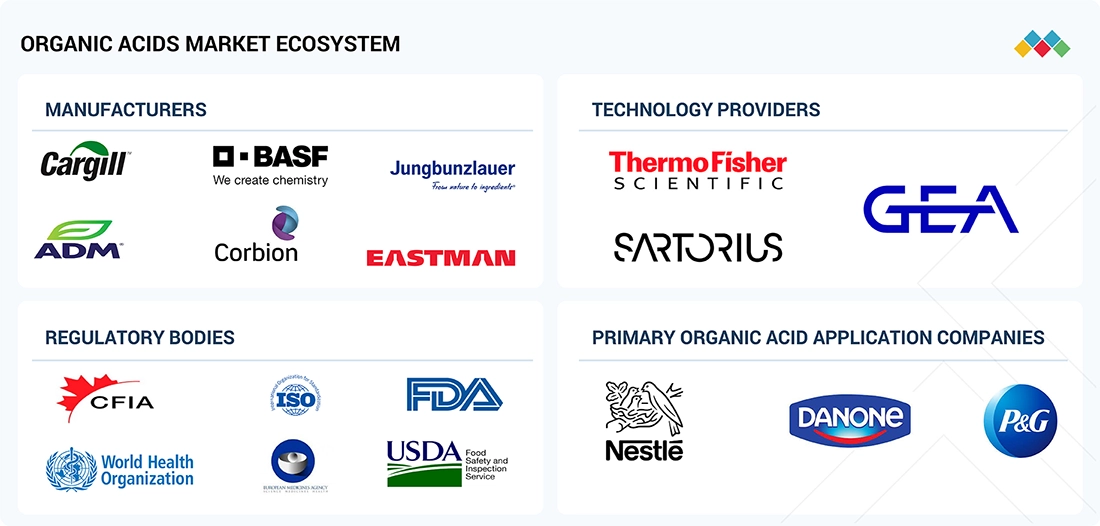
Organic Acids Market: COMMERCIAL USE CASES ACROSS INDUSTRIES
| COMPANY | USE CASE DESCRIPTION | BENEFITS |
|---|---|---|
 |
Organic acids and acid-based feed additives for poultry and swine nutrition | Enhanced gut health, improved feed efficiency, and reduced pathogen load in livestock |
 |
Lactic and citric acids for food preservation, flavor enhancement, and beverage formulation | Extended shelf life, balanced acidity, and improved product stability and taste consistency |
 |
Low-PCF formic acid for sustainable chemical and feed applications | Lower carbon footprint, improved sustainability performance, and compliance with green manufacturing goals |
 |
Circular lactic acid from biobased production | Reduced waste, improved resource efficiency, and strengthened position in sustainable biochemicals |
Logos and trademarks shown above are the property of their respective owners. Their use here is for informational and illustrative purposes only.
Related Ecosystem
Fandb Additives
- Dairy Products
- Bakery Products
- Polyglycerol Esters
- Microorganism
- Carbohydrates
- AZELIS HOLDINGS SA
- Archer-Daniels-Midland Company
- Amway
- UNILEVER PLC
- DuPont de Nemours, Inc.
Key Takeaways
- South America's organic acids market is valued at USD 1,568.6 million in 2025 and will reach USD 2,007.7 million by 2030, growing at 5.1% CAGR.
- In South America, citric acid, acetic acid, and lactic acid are the primary organic acids driving food and beverage applications.
- South America benefits from abundant agricultural feedstock and emerging regional manufacturers competing alongside multinational suppliers.
- Regulatory support for natural food additives and consumer demand for clean-label products are key growth catalysts in South America.
Organic Acids Market Report Scope
| Report Metric | Details |
|---|---|
| Base Year | 2025 |
| Fastest Growing Segment | LACTIC ACID (Type) |
| Forecast Period | 2025–2030 |
| Growth Rate | CAGR of 5.2% from 2025 to 2030 |
| Largest Segment | LIQUID (Form) |
| Market Size Base Year (Billions) | ~USD 15.17 (2025) |
| Revenue Forecast (Billions) | ~USD 19.54 (2030) |
| Segments Covered | Source, Type, Form, Application, Subtype |
South America Organic Acids Market Report Segmentation
5 segment dimensions are covered across the global market.
By Source
- Bio-Based
- Synthetic
By Type
- Acetic Acid
- Ascorbic Acid
- Citric Acid
- Formic Acid
- Fumaric Acid
- Gluconic Acid
- Lactic Acid
- Malic Acid
- Propionic Acid
By Form
- Dry
- Liquid
By Application
- Food & Beverages
- Industrial
- Pharmaceuticals
By Subtype
- Bakery And Confectionery
- Beverages
- Canned And Processed Foods
- Dairy Products
- Meat And Processed Meat
- Nutritional And Dietary Supplements
Target Audience
- Food & Beverage Manufacturers : South American F&B producers need regional market intelligence to optimize organic acids sourcing, understand local demand trends, and develop competitive product formulations aligned with regional consumer preferences.
- Organic Acids Producers & Suppliers : Manufacturers and distributors require detailed South America market data to identify growth opportunities, assess country-level demand, and develop targeted sales strategies for Brazil, Argentina, and Chile markets.
- Investment & Private Equity Firms : Investors evaluating South America's organic acids sector need comprehensive market sizing, growth projections, and regional opportunity analysis to support M&A decisions and portfolio company valuations.
- Pharmaceutical & Cosmetic Companies : Pharmaceutical and cosmetic manufacturers operating in South America require market insights on organic acids applications, regulatory compliance, and supplier landscapes to optimize sourcing and product development.
- Market Research & Consulting Professionals : Analysts and consultants need granular South America market data, country-level breakdowns, and forecast models to support client advisory services, competitive analysis, and strategic planning engagements.
Key Companies in the South America Organic Acids Market
| Company | HQ | Ownership | Strongest segments |
|---|---|---|---|
| AMWAY | Malaysia | Public Company | Health & Wellness (NUTRILITE, bodykey, XS),Beauty & Personal Care (ARTISTRY, G&H, GLISTER, SATINIQUE),Home & Living Solutions (eSpring, ATMOSPHERE, Amway Home), |
| TESSENDERLO GROUP | Belgium | Public Company | Agro (specialty fertilizers and crop protection),Bio-Valorization (gelatin, collagen, proteins, fats),Industrial Solutions (water treatment, industrial chemicals, piping), |
| AZELIS HOLDINGS SA | Belgium | Private Company | Industrial Specialties (coatings, plastics, lubricants, advanced materials),Food & Nutrition Ingredients,Personal Care & Home Care Ingredients, |
| BASF SE | Germany | Public Company | Chemicals,Materials,Industrial Solutions, |
| ADM | United States | Public Company | Ag Services and Oilseeds,Carbohydrate Solutions,Nutrition, |
| CARGILL, INCORPORATED | United States | Private Company | Grains and oilseeds origination, trading, and processing,Animal nutrition and feed (including aquaculture),Meat and poultry products, |
| CORBION | Netherlands | Public Company | Functional Ingredients & Solutions – Food preservation and functional blends,Lactic acid, lactates, and basic derivatives,Health & Nutrition – Algae-based omega-3 and specialty nutrition, |
| THE DOW CHEMICAL COMPANY | United States | Private Company | Packaging and Specialty Plastics (ethylene, propylene, aromatics, polyethylene, polyolefin elastomers, EVA),Industrial Intermediates and Infrastructure (ethylene derivatives, EPDM, cellulose ethers, acrylic emulsions),Performance Materials and Coatings (acrylics for coatings, textiles, adhesives, home and personal care), |
| EASTMAN CHEMICAL COMPANY | United States | Public Company | Additives & Functional Products,Advanced Materials,Chemical Intermediates, |
| DSM-FIRMENICH | Switzerland | Public Company | Health, Nutrition & Care,Taste, Texture & Health,Perfumery & Beauty, |
| POLYNT S.P.A. | Italy | Private Company | Organic anhydrides (phthalic, maleic, trimellitic, special anhydrides),Composite materials (unsaturated polyester resins, SMC/BMC, gel coats, bonding pastes),Plasticizers and special esters, |
| CELANESE CORPORATION | United States | Public Company | Engineered Materials (engineering polymers, elastomers, compounds),Acetyl Chain (acetic acid, VAM, acetates, emulsions),Specialty pharma and medical polymers, |
| TATE & LYLE | United Kingdom | Public Company | Sweeteners (bulk and specialty),Fibres,Stabilisers and functional systems, |
| HENAN JINDAN LACTIC ACID TECHNOLOGY CO., LTD. | China | Public Company | Lactic acid (food, industrial, pharma grades),Lactates (sodium, calcium, potassium, others),Esters (e.g., ethyl lactate and specialty esters), |
| AFYREN | France | Public Company | Flavors and fragrances applications,Food and feed applications,Life sciences applications, |
AMWAY
Amway is a public company based in Malaysia, founded in 1976, with 308 employees. The company operates in the direct selling and consumer goods industry.
TESSENDERLO GROUP
Tessenderlo Group is a Belgian public company founded in 1919 with 6,945 employees. The company operates across chemicals, agriculture, and specialty materials sectors.
AZELIS HOLDINGS SA
Azelis Holdings SA is a private Belgian company established in 2001 with 1,325 employees. The company specializes in specialty chemicals and ingredients.
BASF SE
BASF SE is a German public company founded in 1865 with 94,910 employees. As a global leader in the chemical industry, BASF produces a wide range of chemicals, plastics, and performance products.
ADM
ADM (Archer Daniels Midland) is a United States public company founded in 1902 with 41,147 employees. The company is a major processor of agricultural commodities and producer of food ingredients and animal feed.
CARGILL, INCORPORATED
Cargill, Incorporated is a privately held United States company founded in 1865 with 155,000 employees. The company is a global leader in agriculture, food, and industrial products and services.
CORBION
Corbion is a Dutch public company founded in 1903 with 2,410 employees. The company produces sustainable ingredients and biochemicals for food, packaging, and other industries.
THE DOW CHEMICAL COMPANY
The Dow Chemical Company is a United States private company founded in 1897 with 34,600 employees. The company is a major producer of chemicals, plastics, and agricultural products.
EASTMAN CHEMICAL COMPANY
Eastman Chemical Company is a United States public company founded in 1920 with 13,000 employees. The company manufactures specialty chemicals, advanced materials, and fibers for various industries.
DSM-FIRMENICH
DSM-Firmenich is a Swiss public company founded in 1902 with 26,873 employees. The company is a global leader in nutrition, health, and beauty ingredients and solutions.
POLYNT S.P.A.
Polynt S.P.A. is an Italian private company founded in 1955 with 1,125 employees. The company produces polyester resins, vinyl esters, and specialty chemicals.
CELANESE CORPORATION
Celanese Corporation is a United States public company founded in 1912 with 11,434 employees. The company manufactures specialty materials and chemicals for industrial and consumer applications.
TATE & LYLE
Tate & Lyle is a United Kingdom public company founded in 1903 with 4,840 employees. The company is a global provider of specialty food ingredients and solutions.
HENAN JINDAN LACTIC ACID TECHNOLOGY CO., LTD.
Henan Jindan Lactic Acid Technology Co., Ltd. is a Chinese public company founded in 2006 with 1,360 employees. The company specializes in the production of lactic acid and related biochemical products.
AFYREN
Afyren is a French public company founded in 2012 with 121 employees. The company develops and produces bio-based specialty chemicals and ingredients.
Countries within South America - compare and drill down
| Country | 2025 size (native) |
|---|---|
| Brazil | USD 1409.2 Million |
| Argentina | USD 382.7 Million |
| Rest Of South America | USD 215.8 Million |
Country market size visualization
Reasons to Buy this Report
- Regional Market Segmentation : Gain detailed insights into South America's organic acids market broken down by country (Brazil, Argentina, Chile) and application segments, enabling precise market targeting and localized business strategy development.
- Growth Opportunity Identification : Identify high-growth segments and emerging opportunities within South America's USD 1,568.6 million market, with forecasts through 2030 to support long-term investment and expansion planning decisions.
- Competitive Landscape Analysis : Understand regional competitive dynamics, key players, and market consolidation trends specific to South America's organic acids sector, enabling informed competitive positioning and partnership strategies.
- Regulatory & Compliance Insights : Access country-specific regulatory frameworks and compliance requirements for organic acids in food, beverage, and pharmaceutical applications across South American markets.
- Strategic Market Entry Planning : Leverage comprehensive South America market data to develop market entry strategies, assess market potential by country, and prioritize geographic expansion within the region's fastest-growing segments.
Frequently asked questions
What is the market size of organic acids in South America in 2025?
South America's organic acids market is valued at USD 1,568.6 million in 2025.
What is the projected market size for organic acids in South America by 2030?
South America's organic acids market is projected to reach USD 2,007.7 million by 2030.
What is the CAGR for the organic acids market in South America?
South America's organic acids market is expected to grow at a compound annual growth rate of 5.1% from 2025 to 2030.
Which organic acids dominate the South America market?
In South America, citric acid, acetic acid, and lactic acid are the dominant organic acids used in food preservation, beverage acidulation, and pharmaceutical applications.
What are the main drivers of growth in South America's organic acids market?
South America's organic acids market growth is driven by rising demand for natural food additives, regulatory support for clean-label products, expanding food processing industries, and abundant agricultural feedstock availability.
RESEARCH METHODOLOGY
The study employed two primary approaches to estimate the current size of the organic acids market. Exhaustive secondary research was conducted to gather information on the market, peer markets, and parent markets. The next step was to validate these findings, assumptions, and sizing with industry experts across the value chain through primary research. Both top-down and bottom-up approaches were employed to estimate the complete market size. After that, market breakdown and data triangulation were used to estimate the market size of segments and subsegments.
Secondary Research
This research study involved the extensive use of secondary sources, directories, and databases such as Bloomberg Businessweek and Factiva to identify and collect information useful for a technical, market-oriented, and commercial study of the market.
In the secondary research process, various sources such as annual reports, press releases & investor presentations of companies, white papers, food journals, certified publications, articles from recognized authors, directories, and databases were referred to for identifying and collecting information.
Secondary research was mainly used to obtain key information about the industry’s supply chain, the total pool of key players, and market classification and segmentation as per the industry trends to the bottom-most level, regional markets, and key developments from both market and technology-oriented perspectives.
Primary Research
Extensive primary research was conducted after obtaining information regarding the organic acids market scenario through secondary research. Several primary interviews were conducted with market experts from both the demand and supply sides across major countries of North America, Europe, Asia Pacific, South America, the Middle East, and Africa. Primary data was collected through questionnaires, emails, and telephonic interviews. The primary sources from the supply side included various industry experts, such as Chief X Officers (CXOs), Vice Presidents (VPs), Directors from business development, marketing, research, and development teams, and key opinion leaders. Primary interviews were conducted to gather insights such as market statistics, data on revenue collected from the products and services, market breakdowns, market size estimations, market forecasting, and data triangulation. Primary research also helped in understanding the various trends related to type, application, source, form, and function. Stakeholders from the demand side, such as research institutions and universities, and third-party vendors, were interviewed to understand the buyer’s perspective on the service, and their current usage of organic acid and the outlook of their business, which will affect the overall market.
Breakdown Of Primary Interviews
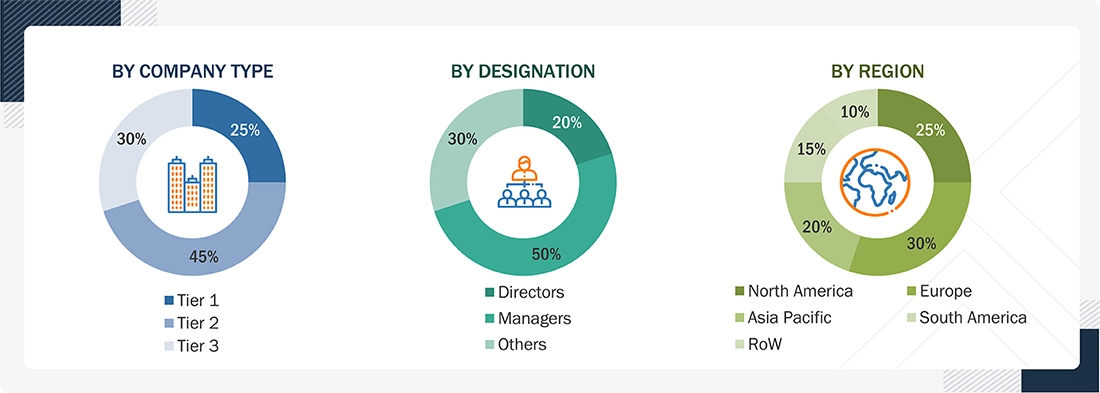
Note: The three tiers of the companies are defined based on their total revenues in 2023 or 2024, as per the availability of financial data: Tier 1: Revenue >USD 1 billion; Tier 2: USD 100 million ≤ Revenue ≤ USD 1 billion; Tier 3: Revenue < USD 100 million.
To know about the assumptions considered for the study, download the pdf brochure
| COMPANY NAME | DESIGNATION | |
|---|---|---|
| BASF SE (Germany) | R&D Expert | |
| Cargill, Incorporated (US) | Sales Manager | |
| ADM (US) | Manager | |
| Corbion (Netherlands) | Sales Manager | |
| Eastman Chemical Company (US) | Marketing Manager | |
Market Size Estimation
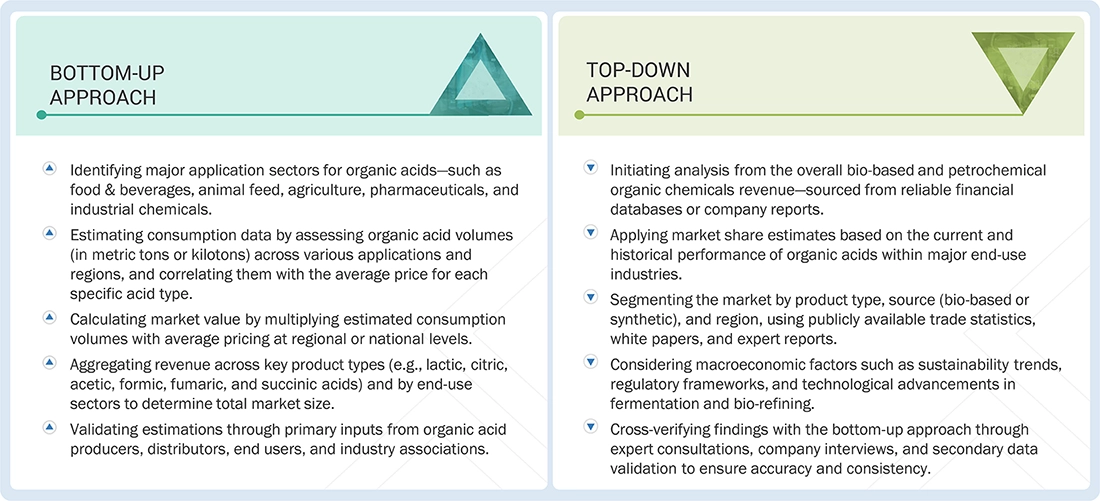
Both the top-down and bottom-up approaches were used to estimate and validate the total size of the organic acids market. These approaches were also used extensively to determine the size of various subsegments in the market. The research methodology used to estimate the market size includes the following details:
- The key players in the industry and the overall markets were identified through extensive secondary research.
- All shares, splits, and breakdowns were determined using secondary sources and verified through primary sources.
- All possible parameters that affect the market covered in this research study were accounted for, viewed in extensive detail, verified through primary research, and analyzed to obtain final quantitative and qualitative data.
- The research included the study of reports, reviews, and newsletters of top market players, along with extensive interviews for opinions from leaders, such as CEOs, directors, and marketing executives.
Organic Acids Market: Bottom-up & Top-down Approaches
Data Triangulation
After arriving at the overall market size from the estimation process explained above, the total market was split into several segments and subsegments. The data triangulation and market breakdown procedures were employed, wherever applicable, to estimate the overall organic acids market and arrive at the exact statistics for all segments and subsegments. The data was triangulated by studying various factors and trends from the demand and supply sides. The market size was also validated using both the top-down and bottom-up approaches.
Market Definition
Organic acids are types of organic compounds that have acidic properties. Chemically, organic acids are weak acids that contain a carbon atom in their compound, the most popular of which are carboxylic acids. These acids have the tendency to slowly dissolve in solvents and can dissolve iron oxides without damaging the base metal. The simplest form of organic acids is acetic and formic, which are less reactive compared to non-organic acids such as hydrochloric acid and sulfuric acid. Apart from containing the carboxyl (R-COOH) functional group, organic compounds that include the thiol (R-SH), enol (alkenols), and phenol (aromatic hydrocarbons-OH) groups are also considered under organic acids.
Stakeholders
- Raw material suppliers
- Organic acid manufacturers
- Technology & equipment providers
- End-use industries
- Research & academic institutions
- Investors & funding agencies
- Regulatory & certification bodies
- Distributors & traders
- Industry associations & consortia
- European communities
- World Health Organization (WHO)
- OECD-FAO Agricultural Outlook
- United States Department of Agriculture (USDA)
Report Objectives
- To determine, define, and project the size of the organic acids market, with respect to type, source, form, application, function, and regional markets, over five years, ranging from 2025 to 2030
- To identify the attractive opportunities in the market by determining the largest and fastest-growing segments across regions
- To provide detailed information about the key factors influencing the growth of the market (drivers, restraints, opportunities, and challenges)
- To analyze the micro markets with respect to individual growth trends, prospects, and their contribution to the total market
- To strategically profile key market players and comprehensively analyze their core competencies in each segment
- To track and analyze competitive developments, such as alliances, joint ventures, new product developments, mergers, and acquisitions, in the organic acids market
Get the Full Organic Acids Market Report
Full forecast, segment splits, and company analysis for all Organic Acids Market.
- US Organic Acids Market
- Canada Organic Acids Market
- Mexico Organic Acids Market
- Germany Organic Acids Market
- France Organic Acids Market
- Italy Organic Acids Market
- Spain Organic Acids Market
- UK Organic Acids Market
- China Organic Acids Market
- India Organic Acids Market
- Japan Organic Acids Market
- Brazil Organic Acids Market
- Argentina Organic Acids Market
- Rest Of Europe Organic Acids Market
- Rest Of Asia Pacific Organic Acids Market
- Rest Of South America Organic Acids Market
- Africa Organic Acids Market
- Middle East Organic Acids Market
Need a Tailored Report?
Customize this report to your needs
Get 10% FREE Customization
Customize This Report
