
Asia Pacific Organ-on-Chip Market (2024-2029)

The Asia Pacific Organ-on-Chip Market was valued at $4.19 Million in 2024 and projected to reach to $21.51 Million by 2029, representing a compound annual growth rate of CAGR 38.7%. The Asia Pacific organ-on-chip market is poised for exceptional growth, expanding from $4.19 million in 2024 to $21.51 million by 2029.


| Market Size in | USD 26.32 MN |
| Market Forecast in | |
| CAGR | |
| Forecast Period | |
| Units Considered | Value (USD MN) |
Asia Pacific Organ-on-Chip Market Trends and Insights
- Asia Pacific is emerging as a critical hub for microphysiological systems development, driven by increasing pharmaceutical R&D investments and growing adoption of alternatives to animal testing across the region.
- The 38.7% compound annual growth rate reflects Asia Pacific's commitment to advancing precision medicine and regulatory modernization. Asia Pacific's organ-on-chip sector benefits from strong government support, expanding biotech ecosystems, and rising collaboration between academic institutions and industry players.
- Key markets within Asia Pacific, including China, Japan, and South Korea, are investing heavily in microfluidics technology and tissue engineering capabilities.
- By 2029, Asia Pacific is expected to capture significant market share as regulatory frameworks evolve and pharmaceutical companies increasingly integrate organ-on-chip platforms into drug development pipelines..
Key Market Statistics
- CAGR (2024-2029) CAGR 38.7%
- Market Size, 2024 ~USD 4.19 Million
- Forecast, 2029 ~USD 21.51 Million
- Geography Asia Pacific
Asia Pacific Organ-on-Chip Market Overview
Rapid Market Expansion :
Asia Pacific organ-on-chip market is growing at 38.7% CAGR, nearly matching the global rate of 38.6%, demonstrating the region's strategic importance in microphysiological systems development and innovation.
China Leads Regional Growth :
China dominates Asia Pacific with $7.48 million in market size, followed by Japan ($5.61M) and India ($3.67M), positioning these nations as key innovation hubs for organ-on-chip technologies.
Pharmaceutical R&D Investment Surge :
Increasing pharmaceutical research and development investments across Asia Pacific are accelerating adoption of organ-on-chip platforms as cost-effective alternatives to traditional animal testing models.
Regulatory Shift Toward In Vitro Models :
Growing regulatory acceptance of microphysiological systems in Asia Pacific is driving pharmaceutical companies to integrate organ-on-chip technologies into their drug development pipelines.
Asia Pacific Organ-on-Chip Market Dynamics
- This trajectory reflects the region's commitment to advancing pharmaceutical innovation while reducing reliance on animal testing.
- Key drivers include substantial R&D investments from multinational pharmaceutical companies, government support for biotechnology initiatives, and increasing collaboration between academic institutions and industry players across China, Japan, India, and Australia. The region's competitive advantage lies in its skilled workforce, cost-effective manufacturing capabilities, and growing regulatory frameworks supporting alternative testing methods.
- As Asia Pacific continues to establish itself as a global pharmaceutical hub, organ-on-chip technologies are becoming integral to drug discovery and development processes.
- Strategic partnerships and technology transfer initiatives will further accelerate market penetration, positioning Asia Pacific as a critical growth engine for the global organ-on-chip market..
Market Ecosystem
Related Ecosystem
Pharmaceuticals
- Bioreactors
- Analytical Testing
- Bioanalytical Testing Services
- Cell Counters
- Data Management Services
- Thermo Fisher Scientific Inc.
- SANOFI
- Merck KGaA
- NOVARTIS
- Pfizer Inc.
Key Takeaways
- Asia Pacific organ-on-chip market valued at $4.19M in 2024, expanding to $21.51M by 2029 at 38.7% CAGR
- Asia Pacific is accelerating adoption of organ-on-chip technology as a replacement for traditional animal testing models
- Government initiatives and biotech investment across Asia Pacific are driving innovation in microphysiological systems
- Asia Pacific pharmaceutical companies are integrating organ-on-chip platforms into preclinical and clinical development workflows
Organ-on-Chip Market Report Scope
| Report Metric | Details |
|---|---|
| Base Year | 2024 |
| Fastest Growing Segment | DISEASE-BASED MODELS (Model Type) |
| Forecast Period | 2024-2029 |
| Growth Rate | CAGR of 38.6% from 2024 to 2029 |
| Largest Segment | ORGAN-BASED MODELS (Model Type) |
| Market Size Base Year (Billions) | ~USD 0.12 (2024) |
| Revenue Forecast (Billions) | ~USD 0.63 (2029) |
| Segments Covered | Organ Type, Model Type, Product & Service, Type, Application, Purpose, End User |
Asia Pacific Organ-on-Chip Market Report Segmentation
7 segment dimensions are covered across the global market.
By Organ Type
- Heart
- Intestine
- Kidney
- Liver
- Lung
- Other Organs
By Model Type
- Disease-Based Models
- Organ-Based Models
By Product & Service
- Products
- Services
By Type
- Consumables & Accessories
- Custom Services
- Instruments
- Software
- Standard Services
By Application
- Drug Discovery
- Physiological Model Development
- Stem Cell Research
- Tissue Regeneration & Regenerative Medicine
- Toxicology Research
By Purpose
- Research
- Therapeutics
By End User
- Academic & Research Institutes
- Cosmetics Industry
- Other End Users
- Pharmaceutical & Biotechnology Companies
Target Audience
- Pharmaceutical Companies : Pharmaceutical firms expanding R&D operations in Asia Pacific need detailed market intelligence to identify optimal locations for organ-on-chip integration and assess regional adoption rates for drug development.
- Biotech & MPS Developers : Organ-on-chip technology developers require Asia Pacific market data to prioritize regional expansion, identify partnership opportunities, and understand competitive dynamics in this rapidly growing market.
- Investment & Private Equity Firms : Investors seeking high-growth opportunities in Asia Pacific biotech need comprehensive market forecasts, regional trends, and competitive analysis to evaluate investment potential and portfolio companies.
- Government & Regulatory Bodies : Policymakers and regulatory agencies across Asia Pacific require market insights to develop supportive frameworks, allocate R&D funding, and position their nations as leaders in microphysiological systems innovation.
- Contract Research Organizations (CROs) : CROs operating in Asia Pacific need regional market data to expand service offerings, identify client demand for organ-on-chip services, and develop competitive positioning strategies.
Countries within Asia Pacific - compare and drill down
| Country | 2025 size (native) |
|---|---|
| China | USD 7.48 Million |
| Japan | USD 5.61 Million |
| India | USD 3.67 Million |
| Australia | USD 1.53 Million |
| South Korea | USD 0.88 Million |
| Rest Of Asia Pacific | USD 2.34 Million |
Country market size visualization
Reasons to Buy this Report
- Regional Market Sizing & Forecasts : Obtain precise market valuations for Asia Pacific and individual country-level data (China, Japan, India, Australia, South Korea) with detailed 2024-2029 projections to inform strategic expansion decisions.
- Competitive Landscape Analysis : Understand key players, market share distribution, and competitive positioning specific to Asia Pacific, enabling identification of partnership and acquisition opportunities in this high-growth region.
- Regulatory & Adoption Insights : Access country-specific regulatory frameworks, government initiatives, and pharmaceutical adoption rates across Asia Pacific to navigate market entry and compliance requirements effectively.
- Investment & Growth Opportunities : Identify high-potential segments, emerging applications, and investment hotspots within Asia Pacific's organ-on-chip ecosystem to capitalize on the 38.7% CAGR growth trajectory.
- Strategic Market Intelligence : Leverage comprehensive Asia Pacific market data to benchmark performance, assess competitive threats, and develop targeted go-to-market strategies for pharmaceutical, biotech, and research organizations.
Frequently asked questions
What is the current market size of organ-on-chip in Asia Pacific?
The Asia Pacific organ-on-chip market was valued at $4.19 million in 2024 and is projected to grow to $21.51 million by 2029.
What is the growth rate for organ-on-chip in Asia Pacific?
Asia Pacific's organ-on-chip market is growing at a compound annual growth rate (CAGR) of 38.7% from 2024 to 2029.
Which countries in Asia Pacific are leading organ-on-chip adoption?
China, Japan, and South Korea are among the leading markets in Asia Pacific, with significant investments in microfluidics and tissue engineering technologies.
What factors are driving growth in Asia Pacific's organ-on-chip market?
Key drivers include increasing pharmaceutical R&D investments, regulatory support for alternatives to animal testing, government initiatives, and expanding biotech ecosystems across Asia Pacific.
How is Asia Pacific's organ-on-chip market expected to evolve by 2029?
By 2029, Asia Pacific is expected to see wider pharmaceutical industry adoption, enhanced regulatory frameworks, and increased integration of organ-on-chip platforms into drug development pipelines.
RESEARCH METHODOLOGY
This study involved four major activities in estimating the historic, current and forecasted size of the organ-on-chip market. Exhaustive secondary research was carried out to collect information on the market, and its peer markets. The next step was to validate these findings, assumptions, and sizing with industry experts across the value chain through primary research. Top-down approach was employed to estimate the complete market size. After that, market breakdown and data triangulation procedures were used to estimate the market size of segments.
Secondary Research
The secondary sources referred to for this research study include publications from public sources, such as the National Institutes of Health (NIH), United States Food and Drug Administration (US FDA), National Center for Biotechnology Information (NCBI), ScienceDirect, European Medicines Agency (EMA), company websites among others. Secondary sources also include business magazines and research journals; press releases; and trade, business, and professional associations. Secondary data was collected and analyzed to arrive at the overall size of the global organ-on-chip market, which was validated through primary research.
Primary Research
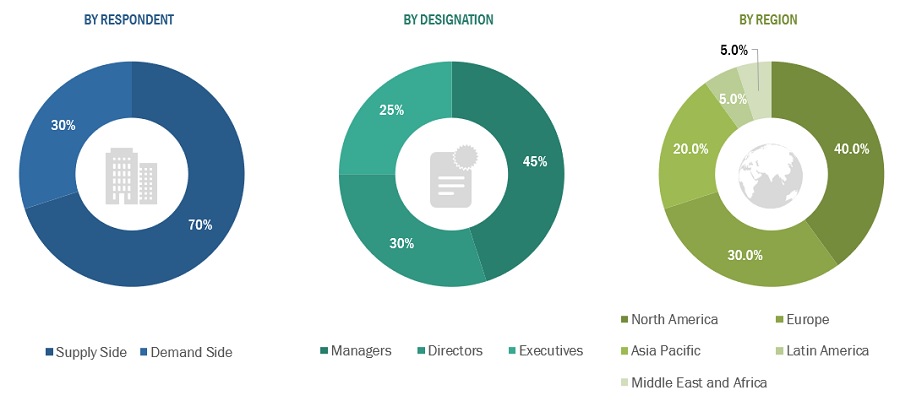
In-depth interviews were conducted with various primary respondents, including key industry participants, subject-matter experts (SMEs), C-level executives of key market players, and industry consultants, among other experts, to obtain and verify the critical qualitative and quantitative information as well as assess prospects of the market. Various primary sources from both the supply and demand sides of the market were interviewed to obtain qualitative and quantitative information.
To know about the assumptions considered for the study, download the pdf brochure
Market Size Estimation
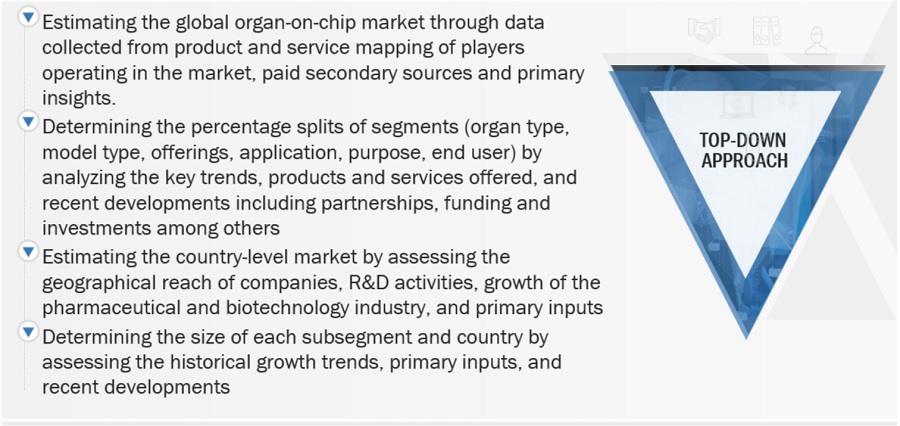
Top-down approach was used to estimate and validate the total size of the organ-on-chip market. These methods were also used extensively to estimate the size of various subsegments in the market. The research methodology used to estimate the market size includes the following:
- The key players in the industry and market have been identified through extensive secondary and primary research
- The revenues generated from the organ-on-chip business of leading players have been determined through primary research and paid secondary sources
- All percentage shares, splits, and breakdowns have been determined using internal analysis of product and service offerings, secondary sources, and verified from industry experts
Global Organ-on-chip Market Size: Top Down Approach
To know about the assumptions considered for the study, Request for Free Sample Report
Data Triangulation
After arriving at the overall market size from the market size estimation process, the total market was split into several segments. To complete the overall market engineering process and arrive at the exact statistics for all segments, data triangulation and market breakdown procedures were employed, wherever applicable. The data was triangulated by studying various factors and trends from both the demand and supply sides.
Market Definition
Organ-on-a-chip is a system that has natural miniature tissues grown inside microfluidic chips. It is a 3D microfluidic cell culture platform which mimics the mechanics, functions, and physiological responses of a respective organ. This platform is created with microfabrication techniques which creates hollow microchannel lined by living cells and tissues cultured within an organ-relevant physical context, which are continuously perfused with life-sustaining culture medium. According to the US FDA, the organ-chips are designed to accurately recreate the natural physiology and mechanical forces that cells experience in the human body. According to Wyss Institute, organ-on-chips are 3D micro fluidic devices that mimic the structure and functions of living human organs. This technology allows researchers to study the functioning of the organ and the effect of drugs on the organs without using animal models.
Key Stakeholders
- Pharmaceutical companies
- Biotechnology companies
- Research institutions & academic centers
- Regulatory agencies
- Private & government-funding organizations
Report Objectives
- To define, describe, and forecast the global organ-on-chip market by model type, organ type, by product and service, by application, by purpose, by end-user and region
- To strategically analyze micromarkets1 with respect to individual growth trends, prospects, and contributions to the overall organ-on-chip market
- To analyze the opportunities in the market for stakeholders and provide details of the competitive landscape for market leaders
- To provide detailed information regarding the major factors influencing the market growth, such as drivers, restraints, opportunities, and challenges
- To forecast the size of the market segments with respect to six main regions: North America, Europe, the Asia Pacific, Latin America, the Middle East, and Africa
- To strategically analyze the market structure and profile the key players of the global organ-on-chip market and comprehensively analyze their core competencies2
- To track and analyze competitive developments such as expansions, acquisitions, partnerships, collaborations, agreements, and product launches in the organ-on-chip market
Available Customizations
With the given market data, MarketsandMarkets offers customizations as per the company’s specific needs. The following customization options are available for this report:
Company Information
- Twenty five company profiles
Get the Full Organ-on-Chip Market Report
Full forecast, segment splits, and company analysis for all Organ-on-Chip Market.
- US Organ-on-Chip Market
- Canada Organ-on-Chip Market
- Germany Organ-on-Chip Market
- UK Organ-on-Chip Market
- France Organ-on-Chip Market
- Italy Organ-on-Chip Market
- Spain Organ-on-Chip Market
- China Organ-on-Chip Market
- Japan Organ-on-Chip Market
- India Organ-on-Chip Market
- Australia Organ-on-Chip Market
- South Korea Organ-on-Chip Market
- Brazil Organ-on-Chip Market
- Mexico Organ-on-Chip Market
- Rest Of Europe Organ-on-Chip Market
- Rest Of Asia Pacific Organ-on-Chip Market
- Rest Of Latin America Organ-on-Chip Market
Need a Tailored Report?
Customize this report to your needs
Get 10% FREE Customization
Customize This Report
