
India Pain Management Devices Market (2024-2029)

The India Pain Management Devices Market was valued at $46.1 Million in 2024 and projected to reach to $85.4 Million by 2029, representing a compound annual growth rate of 13.1%. India's pain management devices market is positioned for substantial growth, expanding from $46.1 million in 2024 to $85.4 million by 2029.


| Market Size in | USD 26.32 MN |
| Market Forecast in | |
| CAGR | |
| Forecast Period | |
| Units Considered | Value (USD MN) |
India Pain Management Devices Market Trends and Insights
- This 13.1% compound annual growth rate reflects India's rising healthcare expenditure, increasing prevalence of chronic pain conditions, and growing adoption of advanced pain management technologies across urban and semi-urban regions.
- India's expanding middle class and improving healthcare infrastructure are driving demand for both invasive and non-invasive pain relief solutions. The Indian market is characterized by a shift toward minimally invasive procedures and electrotherapy devices, supported by government healthcare initiatives and private sector investments.
- India's aging population and rising incidence of musculoskeletal disorders, arthritis, and cancer-related pain are key demand drivers.
- Between 2024 and 2029, India is expected to see increased penetration of nerve stimulation devices, radiofrequency ablation systems, and infusion pumps in both hospital and outpatient settings. Regulatory improvements and cost-effective manufacturing capabilities position India as both a growing market and a production hub for pain management devices.
- India's competitive pricing and expanding distribution networks are making advanced pain management solutions more accessible to patients across diverse socioeconomic segments..
Key Market Statistics
- CAGR (2024-2029) 13.1% CAGR
- Market Size, 2024 ~USD 46.1 Million
- Forecast, 2029 ~USD 85.4 Million
- Country India
India Pain Management Devices Market Overview
Rapid Market Expansion :
India's pain management devices market is growing at 13.1% CAGR, significantly outpacing the global growth rate of 9.1%, driven by increasing healthcare investments and rising chronic pain prevalence across the population.
Urban & Semi-Urban Penetration :
Growing adoption of advanced pain management technologies in urban and semi-urban regions is accelerating market growth, with improved healthcare infrastructure and rising awareness among middle-class consumers driving device utilization.
Healthcare Expenditure Growth :
India's rising healthcare expenditure and government initiatives to improve medical device accessibility are creating favorable conditions for pain management device manufacturers and distributors to expand their market presence.
Chronic Pain Epidemic :
Increasing prevalence of chronic pain conditions including arthritis, back pain, and neuropathic disorders among India's aging population is fueling demand for innovative and cost-effective pain management solutions.
India Pain Management Devices Market Dynamics
- This trajectory reflects structural shifts in healthcare consumption patterns, with rising disposable incomes enabling greater access to advanced therapeutic devices.
- The market benefits from India's large patient population, improving healthcare infrastructure, and increasing physician adoption of device-based pain management alternatives to pharmaceuticals. Government healthcare initiatives, including improved medical device regulations and insurance coverage expansion, are expected to accelerate market penetration beyond metropolitan areas.
- The competitive landscape will intensify as both domestic manufacturers and international players recognize India's growth potential, driving innovation in affordable, accessible pain management technologies tailored to local healthcare needs and economic conditions..
Market Ecosystem
Related Ecosystem
Key Takeaways
- India's pain management devices market will grow from $46.1M (2024) to $85.4M (2029) at a 13.1% CAGR, outpacing global growth.
- India's rising prevalence of chronic pain conditions and aging population are primary drivers of market expansion through 2029.
- Minimally invasive technologies and electrotherapy devices are gaining traction in India due to cost-effectiveness and improved patient outcomes.
- India's regulatory improvements and manufacturing capabilities position the country as a key regional hub for pain management device production and distribution.
Pain Management Devices Market Report Scope
| Report Metric | Details |
|---|---|
| Base Year | 2024 |
| Fastest Growing Segment | NEUROSTIMULATION DEVICES (Type) |
| Forecast Period | 2024-2029 |
| Growth Rate | CAGR of 9.1% from 2024 to 2029 |
| Largest Segment | PRESCRIPTION-BASED (Mode Of Purchase) |
| Market Size Base Year (Billions) | ~USD 3.78 (2024) |
| Revenue Forecast (Billions) | ~USD 5.84 (2029) |
| Segments Covered | Type, Application, Mode Of Purchase, End User |
India Pain Management Devices Market Report Segmentation
4 segment dimensions are covered across the global market.
By Type
- Ablation Devices
- Cryoablation Ablation Devices
- Cryotherapy Ablation Devices
- External Infusion Pumps
- Infusion Pumps
- Intrathecal Infusion Pumps
- Intrathecal Infusion Pumps (Implantable)
- Neurostimulation Devices
- Radiofrequency Ablation Devices
- Spinal Cord Stimulators
- Transcutaneous Electrical Nerve Stimulators
- Ultrasound Ablation Deices
- Ultrasound Ablation Devices
By Application
- Cancer Pain
- Facial Pain & Migraine
- Musculoskeletal Pain
- Neuropathic Pain
- Other Applications
By Mode Of Purchase
- Over-The-Counter
- Prescription-Based
By End User
- Home Care Settings
- Homecare Settings
- Hospitals & Clinics
- Other End Users
- Physiotherapy Centers
INDIA: PAIN MANAGEMENT DEVICES MARKET, BY END USER, 2022–2029
| Segment | 2022 | 2023 | 2024 | 2025 | 2026 | 2027 | 2028 | 2029 | CAGR (%) |
|---|---|---|---|---|---|---|---|---|---|
| HOME CARE SETTINGS | 6.4 | 7.7 | 8.5 | 9.5 | 10.6 | 11.8 | 13.1 | 14.6 | 11.4 |
| HOSPITALS & CLINICS | 36.1 | 43.5 | 48.3 | 53.7 | 59.7 | 66.5 | 74 | 82.4 | 11.3 |
| OTHER END USERS | 4.1 | 4.8 | 5.2 | 5.7 | 6.3 | 6.9 | 7.5 | 8.2 | 9.4 |
| PHYSIOTHERAPY CENTERS | 14.8 | 17.7 | 19.6 | 21.6 | 23.9 | 26.4 | 29.2 | 32.3 | 10.6 |
| TOTAL | 61.4 | 73.7 | 81.6 | 90.5 | 100.4 | 111.5 | 123.8 | 137.6 | 11 |
Target Audience
- Medical Device Manufacturers : Manufacturers seeking to expand into India's high-growth pain management market need detailed market sizing, competitive landscape analysis, and regional penetration data to optimize product positioning and manufacturing strategies.
- Healthcare Investors & PE Firms : Investment professionals evaluating opportunities in India's healthcare sector require validated market forecasts, growth drivers, and risk assessments to make informed capital deployment decisions in pain management device companies.
- Hospital & Clinic Operators : Healthcare facility administrators need market intelligence on device adoption trends, patient demand patterns, and reimbursement scenarios to make procurement decisions and service expansion plans aligned with market growth.
- Distributors & Importers : Distribution partners require India-specific market data, regional demand forecasts, and competitive dynamics to identify high-potential product categories, negotiate supplier terms, and optimize inventory management strategies.
- Healthcare Consultants & Advisors : Consulting firms advising healthcare clients on market entry, product launches, or strategic positioning in India need authoritative market data and trend analysis to deliver credible recommendations and business cases.
Reasons to Buy this Report
- Market Size & Growth Validation : Obtain precise market valuation ($46.1M in 2024) and verified 5-year forecast ($85.4M by 2029) specific to India, enabling accurate business planning and investment decisions in this high-growth emerging market.
- Competitive Intelligence for India : Understand India-specific market dynamics, regional penetration patterns, and competitive positioning to identify white-space opportunities and develop targeted go-to-market strategies for urban and semi-urban segments.
- Regulatory & Reimbursement Insights : Access India-specific regulatory landscape, insurance coverage trends, and government healthcare policy impacts on device adoption, enabling compliant market entry and optimized pricing strategies.
- Customer Segmentation Data : Leverage detailed insights into India's patient demographics, physician preferences, and healthcare facility types to tailor product development, marketing messaging, and distribution channel strategies effectively.
- Risk Mitigation & Forecasting : Reduce market entry risks with comprehensive India-specific analysis of growth drivers, barriers, and emerging trends, supporting confident capital allocation and long-term strategic planning in this high-potential market.
Frequently asked questions
What is the current size of India's pain management devices market?
India's pain management devices market was valued at $46.1 million in 2024 and is projected to reach $85.4 million by 2029.
What is the expected growth rate for India's pain management devices market?
India's pain management devices market is expected to grow at a compound annual growth rate (CAGR) of 13.1% from 2024 to 2029.
What are the main drivers of growth in India's pain management devices market?
Key drivers include India's rising healthcare expenditure, increasing prevalence of chronic pain conditions, aging population, improving healthcare infrastructure, and growing adoption of minimally invasive technologies.
Which pain management device types are most popular in India?
India shows strong demand for nerve stimulation devices, radiofrequency ablation systems, infusion pumps, and electrotherapy devices, particularly in urban and semi-urban healthcare settings.
How is India positioned in the global pain management devices market?
India is emerging as both a significant growth market and a regional manufacturing hub, leveraging cost-effective production capabilities and expanding distribution networks to serve the Asia Pacific region.
RESEARCH METHODOLOGY
This study involved the extensive use of both primary and secondary sources. The research process involved the study of various factors affecting the industry to identify the segmentation types, industry trends, key players, competitive landscape, fundamental market dynamics, and key player strategies.
Secondary Research
The secondary research process involves the widespread use of secondary sources, directories, databases (such as Bloomberg Businessweek, Factiva, and D&B Hoovers), white papers, annual reports, company house documents, investor presentations, SEC filings of companies and publications from government sources [such as National Institutes of Health (NIH), US FDA, US Census Bureau, World Health Organization (WHO), Centers for Disease Control and Prevention (CDC), Global Burden of Disease Study , International Diabetes Federation (IDF), and Centers for Medicare and Medicaid Services (CMS) were referred to identify and collect information for the global pain management devices market study. It was also used to obtain important information about the key players and market classification & segmentation according to industry trends to the bottom-most level and key developments related to market and technology perspectives. A database of the key industry leaders was also prepared using secondary research.
Primary Research
In the primary research process, various sources from both the supply and demand sides were interviewed to obtain qualitative and quantitative information for this report. The primary sources from the supply side include industry experts such as CEOs, vice presidents, marketing and sales directors, technology & innovation directors, and related key executives from various key companies and organizations in the pain management devices market. The primary sources from the demand side include hospitals & clinics, physiotherapy clinics and home care settings. Primary research was conducted to validate the market segmentation, identify key players in the market, and gather insights on key industry trends & key market dynamics.
A breakdown of the primary respondents is provided below:
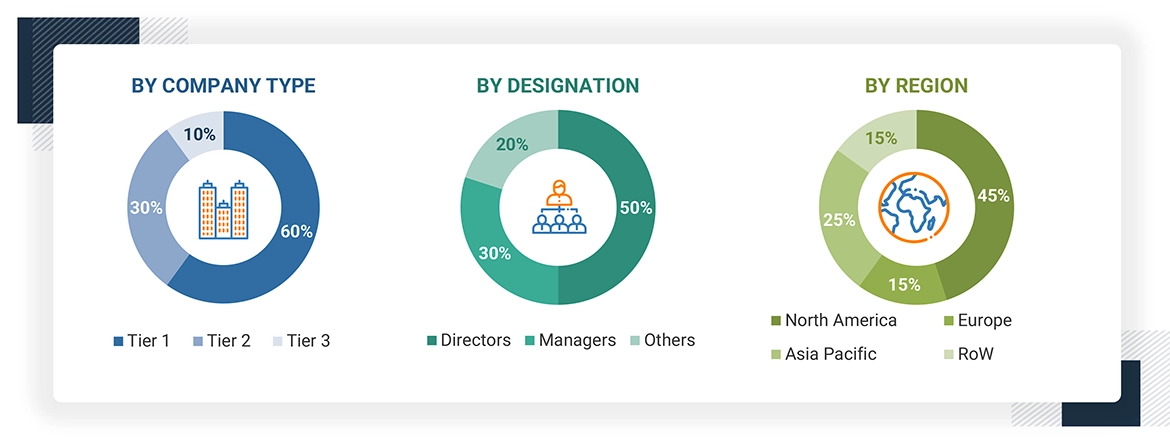
*C-level primaries include CEOs, CFOs, COOs, and VPs.
*Others include sales managers, marketing managers, business development managers, product managers, distributors, and suppliers.
Note: Companies are classified into tiers based on their total revenue. As of 2023, Tier 1 = >USD 10.00 billion, Tier 2 = USD 1.00 billion to USD 10.00 billion, and Tier 3 = < USD 1.00 billion.
Source: MarketsandMarkets Analysis
To know about the assumptions considered for the study, download the pdf brochure
Market Size Estimation
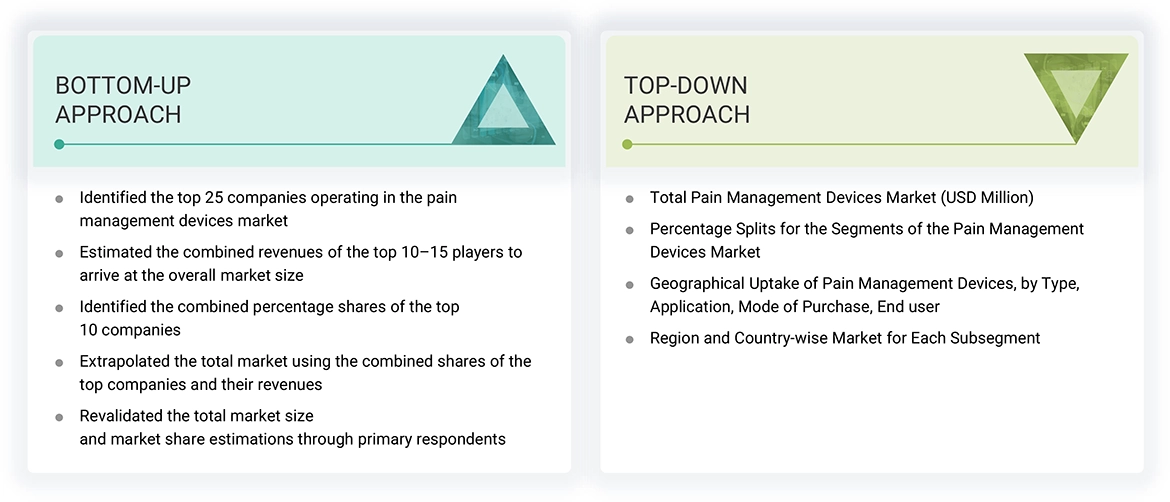
For the global market value, annual revenues were calculated based on the revenue mapping of major product manufacturers and OEMs active in the global pain management devices market. All the major product manufacturers were identified at the global and/or country/regional level. Revenue mapping for the respective business segments/sub-segments was done for the major players (who contribute at least 70-75% of the market share at the global level). Also, the global pain management devices market was split into various segments and sub-segments based on:
- List of major players operating in the pain management devices products market at the regional and/or country level
- Product mapping of various pain management devices manufacturers at the regional and/or country level
- Mapping of annual revenue generated by listed major players from pain management devices(or the nearest reported business unit/product category)
- Revenue mapping of major players to cover at least 70-75% of the global market share as of 2023
- Extrapolation of the revenue mapping of the listed major players to derive the global market value of the respective segments/subsegments
- Summation of the market value of all segments/subsegments to arrive at the global point-of-care diagnostics market
The above-mentioned data was consolidated and added with detailed inputs and analysis from MarketsandMarkets and presented in this report.
Data Triangulation
After arriving at the overall size of the global pain management devices market through the above-mentioned methodology, this market was split into several segments and subsegments. The data triangulation and market breakdown procedures were employed, wherever applicable, to complete the overall market engineering process and arrive at the exact market value data for the key segments and subsegments. The extrapolated market data was triangulated by studying various macro indicators and regional trends from both demand- and supply-side participants.
Market Definition
Pain management devices are used to manage chronic and acute pain in patients suffering from various types of disease conditions, such as cancer, neurological disorders, and musculoskeletal disorders. These devices restore the ability to do everyday activities, decrease the need for oral pain medications, and improve the quality of life of patients suffering from these conditions
Stakeholders
- Medical device manufacturers and distributors
- Pain management devices manufacturers
- Infusion pump and related instrument manufacturing companies
- Suppliers and distributors of pain management devices
- Hospitals and ambulatory surgery centers
- Clinics
- Home healthcare agencies
- Research and consulting firms
- Contract manufacturing organizations
- Venture capitalists
Report Objectives
- To define, measure, and describe the global pain management devices market by type, application, mode of purchase ,end user, and region
- To provide detailed information about the major factors influencing the market growth (drivers, restraints, challenges, and opportunities)
- To strategically analyze the regulatory scenario, pricing, value chain analysis, supply chain analysis, ecosystem analysis, technology analysis, Porter’s Five Forces analysis, and patent analysis
- To analyze micromarkets with respect to individual growth trends, prospects, and contributions to the overall market
- To analyze market opportunities for stakeholders and provide details of the competitive landscape for key players
- To forecast the size of market segments in North America, Europe, Asia Pacific, Latin America, and the Middle East & Africa
- To strategically analyze the market structure, profile the key players in the global pain management devices market, and comprehensively analyze their core competencies
- To track and analyze company developments such as acquisitions, partnerships, expansions, and product launches and approvals in the pain management devices market
Get the Full Pain Management Devices Market Report
Full forecast, segment splits, and company analysis for all Pain Management Devices Market.
- Canada Pain Management Devices Market
- US Pain Management Devices Market
- Germany Pain Management Devices Market
- France Pain Management Devices Market
- UK Pain Management Devices Market
- Italy Pain Management Devices Market
- Spain Pain Management Devices Market
- China Pain Management Devices Market
- Japan Pain Management Devices Market
- Australia Pain Management Devices Market
- South Korea Pain Management Devices Market
- Brazil Pain Management Devices Market
- Mexico Pain Management Devices Market
- Rest Of Europe Pain Management Devices Market
- Rest Of Asia Pacific Pain Management Devices Market
- Rest Of Latin America Pain Management Devices Market
- GCC Countries Pain Management Devices Market
Need a Tailored Report?
Customize this report to your needs
Get 10% FREE Customization
Customize This Report
