
UK Pain Management Devices Market (2024-2029)

The UK Pain Management Devices Market was valued at $61.3 Million in 2024 and projected to reach to $112.4 Million by 2029, representing a compound annual growth rate of 12.9%. The UK pain management devices market is poised for sustained growth through 2029, driven by demographic shifts, increased chronic pain prevalence, and enhanced healthcare funding.


| Market Size in | USD 26.32 MN |
| Market Forecast in | |
| CAGR | |
| Forecast Period | |
| Units Considered | Value (USD MN) |
UK Pain Management Devices Market Trends and Insights
- The UK market is driven by increasing prevalence of chronic pain conditions, aging demographics, and rising healthcare expenditure across the nation.
- In 2024, the UK established itself as a significant market within Europe, with strong adoption of advanced pain relief technologies including neuromodulation devices, transcutaneous electrical nerve stimulation (TENS) units, and infusion pumps. The UK's pain management devices sector is projected to grow at a compound annual growth rate (CAGR) of 12.9% through 2029, outpacing global averages.
- This accelerated growth reflects the UK's emphasis on innovative healthcare solutions, favorable reimbursement policies, and increasing patient awareness of non-pharmacological pain management options.
- The UK market benefits from a well-established National Health Service (NHS) infrastructure and private healthcare sector that collectively drive device adoption and clinical integration. By 2029, the UK pain management devices market is expected to nearly double in value, reflecting sustained demand for both established and emerging technologies.
- The UK's regulatory environment, supported by the Medicines and Healthcare products Regulatory Agency (MHRA), continues to facilitate market entry for innovative solutions while maintaining safety standards..
Key Market Statistics
- CAGR (2024-2029) 12.9% CAGR
- Market Size, 2024 ~USD 61.3 Million
- Forecast, 2029 ~USD 112.4 Million
- Country UK
UK Pain Management Devices Market Overview
Market Valuation Growth :
The UK pain management devices market is valued at £61.3 million in 2024, with a projected expansion to £112.4 million by 2029, representing a robust 12.9% CAGR—significantly outpacing the global average of 9.1%.
Aging Population Driver :
The UK's aging demographic profile is a primary catalyst for market expansion, with an increasing prevalence of chronic pain conditions among elderly populations driving demand for innovative pain management solutions.
Healthcare Investment Surge :
Rising healthcare expenditure across the UK National Health Service and private sector is accelerating adoption of advanced pain management devices, positioning the nation as a significant European market leader.
European Market Position :
The UK has established itself as a prominent market within Europe, demonstrating strong adoption rates and clinical acceptance of pain management technologies among healthcare providers and patients.
UK Pain Management Devices Market Dynamics
- NHS initiatives promoting non-pharmacological pain management solutions are accelerating device adoption across hospitals and primary care settings.
- The market benefits from strong regulatory frameworks, advanced healthcare infrastructure, and growing patient awareness of device-based therapies as alternatives to opioid medications.
- Technological innovations in neuromodulation and wearable pain management devices are expected to further expand market opportunities.
- Private healthcare expansion and increasing out-of-pocket spending on pain management solutions will complement NHS-driven growth, creating a dynamic market environment for device manufacturers and healthcare providers..
Market Ecosystem
Related Ecosystem
Key Takeaways
- The UK pain management devices market is valued at £61.3 million in 2024 and is projected to reach £112.4 million by 2029, representing an 83% increase over the forecast period.
- The UK market is growing at a 12.9% CAGR, significantly outpacing the global average of 9.1%, indicating strong regional demand and market maturity.
- The UK's aging population, combined with rising chronic pain prevalence, is driving sustained demand for innovative neuromodulation and electrical stimulation devices.
- The UK's robust NHS infrastructure and private healthcare sector create favorable conditions for device adoption, reimbursement, and clinical integration through 2029.
Pain Management Devices Market Report Scope
| Report Metric | Details |
|---|---|
| Base Year | 2024 |
| Fastest Growing Segment | NEUROSTIMULATION DEVICES (Type) |
| Forecast Period | 2024-2029 |
| Growth Rate | CAGR of 9.1% from 2024 to 2029 |
| Largest Segment | PRESCRIPTION-BASED (Mode Of Purchase) |
| Market Size Base Year (Billions) | ~USD 3.78 (2024) |
| Revenue Forecast (Billions) | ~USD 5.84 (2029) |
| Segments Covered | Type, Application, Mode Of Purchase, End User |
UK Pain Management Devices Market Report Segmentation
4 segment dimensions are covered across the global market.
By Type
- Ablation Devices
- Cryoablation Ablation Devices
- Cryotherapy Ablation Devices
- External Infusion Pumps
- Infusion Pumps
- Intrathecal Infusion Pumps
- Intrathecal Infusion Pumps (Implantable)
- Neurostimulation Devices
- Radiofrequency Ablation Devices
- Spinal Cord Stimulators
- Transcutaneous Electrical Nerve Stimulators
- Ultrasound Ablation Deices
- Ultrasound Ablation Devices
By Application
- Cancer Pain
- Facial Pain & Migraine
- Musculoskeletal Pain
- Neuropathic Pain
- Other Applications
By Mode Of Purchase
- Over-The-Counter
- Prescription-Based
By End User
- Home Care Settings
- Homecare Settings
- Hospitals & Clinics
- Other End Users
- Physiotherapy Centers
UK: PAIN MANAGEMENT DEVICES MARKET, BY END USER, 2022–2029
| Segment | 2022 | 2023 | 2024 | 2025 | 2026 | 2027 | 2028 | 2029 | CAGR (%) |
|---|---|---|---|---|---|---|---|---|---|
| HOME CARE SETTINGS | 8.1 | 9.8 | 10.9 | 12.1 | 13.4 | 14.9 | 16.6 | 18.5 | 11.2 |
| HOSPITALS & CLINICS | 48.5 | 58.2 | 64.5 | 71.6 | 79.5 | 88.3 | 98.2 | 109.2 | 11.1 |
| OTHER END USERS | 5.1 | 6 | 6.6 | 7.2 | 7.8 | 8.5 | 9.3 | 10.2 | 9.2 |
| PHYSIOTHERAPY CENTERS | 19.3 | 23.1 | 25.4 | 28 | 30.9 | 34.1 | 37.7 | 41.6 | 10.4 |
| TOTAL | 81 | 97.1 | 107.4 | 118.8 | 131.6 | 145.8 | 161.7 | 179.4 | 10.8 |
Target Audience
- Medical Device Manufacturers : Manufacturers need UK-specific market data to assess market entry feasibility, identify growth segments, understand competitive dynamics, and develop localized commercialization strategies for pain management device portfolios.
- Healthcare Providers & NHS Trusts : Hospital networks and NHS procurement teams require market intelligence to evaluate device adoption trends, benchmark spending patterns, justify capital investments, and optimize pain management service delivery across UK facilities.
- Investment & Private Equity Firms : Investors targeting the UK healthcare sector need validated market sizing, growth projections, and regional performance metrics to evaluate acquisition targets, fund allocation decisions, and portfolio company growth potential.
- Distributors & Healthcare Suppliers : UK-based and international distributors require market forecasts and regional demand data to optimize inventory management, negotiate supplier contracts, identify high-growth product categories, and plan sales expansion.
- Healthcare Consultants & Analysts : Consulting firms and research analysts need UK market data to support client advisory work, competitive intelligence reports, market entry strategies, and evidence-based recommendations for healthcare stakeholders.
Reasons to Buy this Report
- Market Size & Growth Validation : Obtain precise UK market valuation data (£61.3M in 2024) and verified 5-year forecasts to support investment decisions, business expansion strategies, and competitive positioning within the high-growth UK pain management sector.
- Regional Performance Benchmarking : Compare UK market performance against global trends (12.9% vs 9.1% CAGR) to identify growth acceleration opportunities and understand why the UK outperforms international markets in pain device adoption.
- Healthcare Provider Insights : Access UK-specific data on NHS adoption patterns, private sector penetration, and clinical acceptance rates to inform product development, reimbursement strategies, and go-to-market approaches for healthcare institutions.
- Demographic & Regulatory Intelligence : Understand UK-specific aging demographics, healthcare expenditure trends, and regulatory environment to identify market entry barriers, compliance requirements, and opportunities for device manufacturers and distributors.
- Competitive Strategy Development : Leverage UK market segmentation data to identify unmet clinical needs, emerging device categories, and competitive gaps that inform product innovation, partnership opportunities, and market share expansion strategies.
Frequently asked questions
What is the current size of the UK pain management devices market in 2024?
The UK pain management devices market is valued at £61.3 million in 2024, establishing the UK as a significant market within Europe for pain relief technologies.
What is the projected market size for the UK pain management devices market by 2029?
The UK pain management devices market is forecast to reach £112.4 million by 2029, representing nearly an 83% increase from 2024 levels.
What is the growth rate (CAGR) for the UK pain management devices market?
The UK pain management devices market is expected to grow at a compound annual growth rate (CAGR) of 12.9% from 2024 to 2029, outpacing the global average of 9.1%.
What factors are driving growth in the UK pain management devices market?
Key growth drivers in the UK include an aging population, increasing prevalence of chronic pain conditions, rising healthcare expenditure, favorable NHS reimbursement policies, and growing patient awareness of non-pharmacological pain management solutions.
Which pain management device types are most prevalent in the UK market?
The UK market shows strong adoption of neuromodulation devices, transcutaneous electrical nerve stimulation (TENS) units, infusion pumps, and other advanced pain relief technologies supported by both NHS and private healthcare sectors.
RESEARCH METHODOLOGY
This study involved the extensive use of both primary and secondary sources. The research process involved the study of various factors affecting the industry to identify the segmentation types, industry trends, key players, competitive landscape, fundamental market dynamics, and key player strategies.
Secondary Research
The secondary research process involves the widespread use of secondary sources, directories, databases (such as Bloomberg Businessweek, Factiva, and D&B Hoovers), white papers, annual reports, company house documents, investor presentations, SEC filings of companies and publications from government sources [such as National Institutes of Health (NIH), US FDA, US Census Bureau, World Health Organization (WHO), Centers for Disease Control and Prevention (CDC), Global Burden of Disease Study , International Diabetes Federation (IDF), and Centers for Medicare and Medicaid Services (CMS) were referred to identify and collect information for the global pain management devices market study. It was also used to obtain important information about the key players and market classification & segmentation according to industry trends to the bottom-most level and key developments related to market and technology perspectives. A database of the key industry leaders was also prepared using secondary research.
Primary Research
In the primary research process, various sources from both the supply and demand sides were interviewed to obtain qualitative and quantitative information for this report. The primary sources from the supply side include industry experts such as CEOs, vice presidents, marketing and sales directors, technology & innovation directors, and related key executives from various key companies and organizations in the pain management devices market. The primary sources from the demand side include hospitals & clinics, physiotherapy clinics and home care settings. Primary research was conducted to validate the market segmentation, identify key players in the market, and gather insights on key industry trends & key market dynamics.
A breakdown of the primary respondents is provided below:
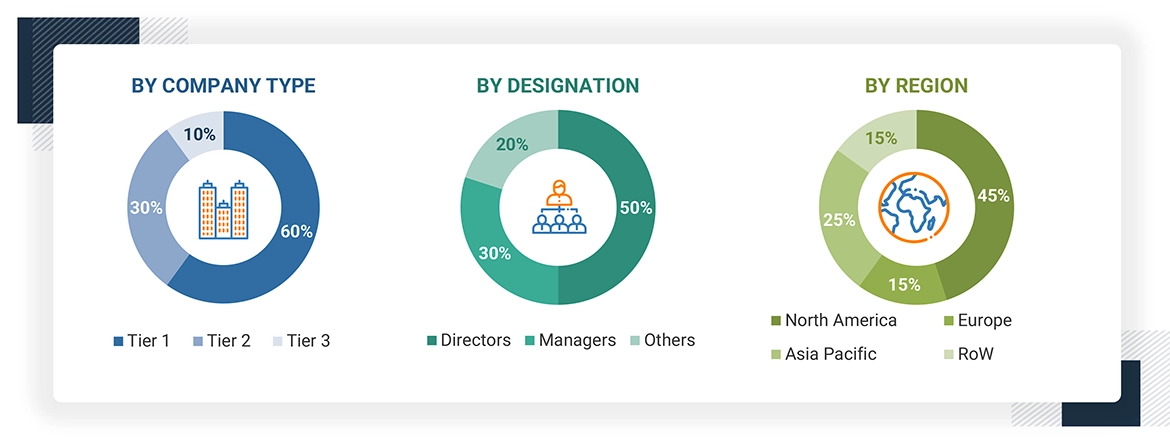
*C-level primaries include CEOs, CFOs, COOs, and VPs.
*Others include sales managers, marketing managers, business development managers, product managers, distributors, and suppliers.
Note: Companies are classified into tiers based on their total revenue. As of 2023, Tier 1 = >USD 10.00 billion, Tier 2 = USD 1.00 billion to USD 10.00 billion, and Tier 3 = < USD 1.00 billion.
Source: MarketsandMarkets Analysis
To know about the assumptions considered for the study, download the pdf brochure
Market Size Estimation
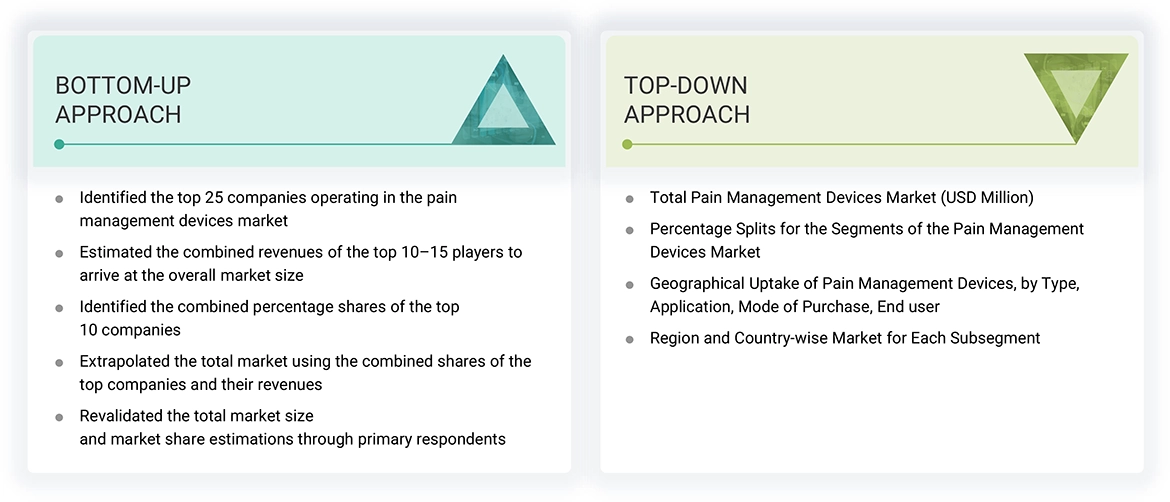
For the global market value, annual revenues were calculated based on the revenue mapping of major product manufacturers and OEMs active in the global pain management devices market. All the major product manufacturers were identified at the global and/or country/regional level. Revenue mapping for the respective business segments/sub-segments was done for the major players (who contribute at least 70-75% of the market share at the global level). Also, the global pain management devices market was split into various segments and sub-segments based on:
- List of major players operating in the pain management devices products market at the regional and/or country level
- Product mapping of various pain management devices manufacturers at the regional and/or country level
- Mapping of annual revenue generated by listed major players from pain management devices(or the nearest reported business unit/product category)
- Revenue mapping of major players to cover at least 70-75% of the global market share as of 2023
- Extrapolation of the revenue mapping of the listed major players to derive the global market value of the respective segments/subsegments
- Summation of the market value of all segments/subsegments to arrive at the global point-of-care diagnostics market
The above-mentioned data was consolidated and added with detailed inputs and analysis from MarketsandMarkets and presented in this report.
Data Triangulation
After arriving at the overall size of the global pain management devices market through the above-mentioned methodology, this market was split into several segments and subsegments. The data triangulation and market breakdown procedures were employed, wherever applicable, to complete the overall market engineering process and arrive at the exact market value data for the key segments and subsegments. The extrapolated market data was triangulated by studying various macro indicators and regional trends from both demand- and supply-side participants.
Market Definition
Pain management devices are used to manage chronic and acute pain in patients suffering from various types of disease conditions, such as cancer, neurological disorders, and musculoskeletal disorders. These devices restore the ability to do everyday activities, decrease the need for oral pain medications, and improve the quality of life of patients suffering from these conditions
Stakeholders
- Medical device manufacturers and distributors
- Pain management devices manufacturers
- Infusion pump and related instrument manufacturing companies
- Suppliers and distributors of pain management devices
- Hospitals and ambulatory surgery centers
- Clinics
- Home healthcare agencies
- Research and consulting firms
- Contract manufacturing organizations
- Venture capitalists
Report Objectives
- To define, measure, and describe the global pain management devices market by type, application, mode of purchase ,end user, and region
- To provide detailed information about the major factors influencing the market growth (drivers, restraints, challenges, and opportunities)
- To strategically analyze the regulatory scenario, pricing, value chain analysis, supply chain analysis, ecosystem analysis, technology analysis, Porter’s Five Forces analysis, and patent analysis
- To analyze micromarkets with respect to individual growth trends, prospects, and contributions to the overall market
- To analyze market opportunities for stakeholders and provide details of the competitive landscape for key players
- To forecast the size of market segments in North America, Europe, Asia Pacific, Latin America, and the Middle East & Africa
- To strategically analyze the market structure, profile the key players in the global pain management devices market, and comprehensively analyze their core competencies
- To track and analyze company developments such as acquisitions, partnerships, expansions, and product launches and approvals in the pain management devices market
Get the Full Pain Management Devices Market Report
Full forecast, segment splits, and company analysis for all Pain Management Devices Market.
- Canada Pain Management Devices Market
- US Pain Management Devices Market
- Germany Pain Management Devices Market
- France Pain Management Devices Market
- Italy Pain Management Devices Market
- Spain Pain Management Devices Market
- China Pain Management Devices Market
- Japan Pain Management Devices Market
- India Pain Management Devices Market
- Australia Pain Management Devices Market
- South Korea Pain Management Devices Market
- Brazil Pain Management Devices Market
- Mexico Pain Management Devices Market
- Rest Of Europe Pain Management Devices Market
- Rest Of Asia Pacific Pain Management Devices Market
- Rest Of Latin America Pain Management Devices Market
- GCC Countries Pain Management Devices Market
Need a Tailored Report?
Customize this report to your needs
Get 10% FREE Customization
Customize This Report
