
Europe PCR Technologies Market (2024-2029)

The Europe PCR Technologies Market was valued at $3916.1 Million in 2024 and projected to reach to $5948.6 Million by 2029, representing a compound annual growth rate of 7.2%. Europe's PCR Technologies Market is positioned for sustained expansion through 2029, driven by increasing prevalence of infectious diseases, growing demand for personalized medicine, and continuous technological advancements in molecular diagnostics.


| Market Size in | USD 26.32 MN |
| Market Forecast in | |
| CAGR | |
| Forecast Period | |
| Units Considered | Value (USD MN) |
Europe PCR Technologies Market Trends and Insights
- This expansion reflects Europe's strong healthcare infrastructure, advanced diagnostic capabilities, and increasing adoption of molecular testing across clinical and research settings.
- Europe maintains a mature market position with established regulatory frameworks and high-quality laboratory standards driving consistent demand for PCR-based solutions. The European market benefits from significant investment in genomic research, infectious disease surveillance, and personalized medicine initiatives throughout 2024-2029.
- Europe's emphasis on precision diagnostics and early disease detection supports sustained growth in PCR technology adoption.
- Regulatory support from European health authorities and integration of PCR technologies into routine clinical workflows further accelerate market expansion across the region..
Key Market Statistics
- CAGR (2024-2029) 7.2% CAGR
- Market Size, 2024 ~USD 3916.1 Million
- Forecast, 2029 ~USD 5948.6 Million
- Geography Europe
Europe PCR Technologies Market Overview
Market Valuation & Growth :
Europe's PCR Technologies Market is valued at $3,916.1 million in 2024, with a robust CAGR of 7.2% projected through 2029, reaching $5,948.6 million. This growth trajectory reflects strong demand for molecular diagnostics across the region.
Advanced Healthcare Infrastructure :
Europe benefits from mature healthcare systems, stringent regulatory frameworks, and well-established diagnostic networks. This infrastructure supports widespread adoption of PCR technologies in clinical laboratories, hospitals, and research institutions across the continent.
Molecular Testing Expansion :
Increasing adoption of molecular testing for infectious diseases, genetic disorders, and oncology applications is driving market growth. European healthcare providers are integrating PCR-based diagnostics as standard protocols in clinical practice.
Regional Market Leadership :
Germany leads European adoption with $1,815.0 million in market size, followed by the UK ($1,263.97 million) and France ($1,028.2 million), demonstrating strong concentration of PCR technology investment in Western Europe's major economies.
Europe PCR Technologies Market Dynamics
- The region's mature regulatory environment and high healthcare spending support accelerated adoption of PCR-based testing across clinical and research sectors. Key growth catalysts include rising investments in genomic research, expansion of diagnostic capabilities in emerging European markets, and integration of PCR technologies with digital health platforms.
- European healthcare systems' emphasis on precision diagnostics and early disease detection will continue to propel market growth, with established players and innovative startups competing to enhance testing accuracy and turnaround times..
Market Ecosystem
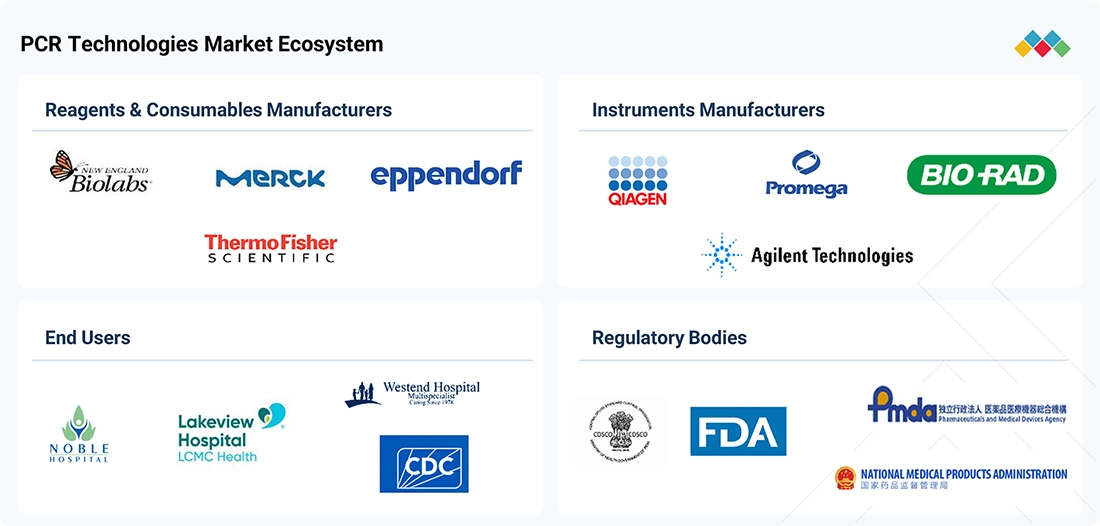
PCR TECHNOLOGIES MARKET: COMMERCIAL USE CASES ACROSS INDUSTRIES
| COMPANY | USE CASE DESCRIPTION | BENEFITS |
|---|---|---|
 |
Supports pharmaceutical, university research, food, consumer, and diagnostic applications through PCR, qPCR, dPCR, reagents, and laboratory solutions | Enables high-throughput testing, precise molecular analysis, sample processing, and workflow efficiency |
 |
Provides PCR-based molecular diagnostic solutions for clinical testing, infectious disease detection, oncology, and decentralized diagnostics | Delivers automated, rapid, standardized, and high-volume molecular testing |
 |
Offers PCR, qPCR, and ddPCR systems, reagents, and consumables for research, diagnostics, biotechnology, and environmental applications | Supports sensitive detection, accurate quantification, reproducibility, and flexible PCR workflows |
Logos and trademarks shown above are the property of their respective owners. Their use here is for informational and illustrative purposes only.
Related Ecosystem
Analytical And Scientific Instrumentation
- Environmental Testing
- Gas Chromatography
- Polymerase Chain Reaction (PCR)
- Automated Liquid Handling Systems
- Flow Cytometry
- Thermo Fisher Scientific Inc.
- Danaher Corporation
- Agilent Technologies, Inc.
- Shimadzu Corporation
- Merck KGaA
Biotechnology
- Reagents
- Polymerase Chain Reaction (PCR)
- Stem Cells
- Assay Kits
- Flow Cytometers
- Thermo Fisher Scientific Inc.
- Merck KGaA
- Danaher Corporation
- Agilent Technologies, Inc.
- Bio-Rad Laboratories, Inc.
Key Takeaways
- Europe's PCR Technologies Market is valued at $3,916.1 million in 2024 and will reach $5,948.6 million by 2029, representing a 7.2% CAGR.
- Europe's mature healthcare infrastructure and regulatory frameworks create a stable environment for PCR technology adoption and innovation.
- Increased investment in genomic research and personalized medicine drives sustained demand for advanced PCR solutions across Europe.
- Europe's focus on infectious disease surveillance and early diagnostics supports consistent market expansion through 2029.
PCR Technologies Market Report Scope
| Report Metric | Details |
|---|---|
| Base Year | 2024 |
| Fastest Growing Segment | DIGITAL PCR (Technique) |
| Forecast Period | 2024-2029 |
| Growth Rate | CAGR of 7% from 2024 to 2029 |
| Largest Segment | REAGENTS AND CONSUMABLES (Product) |
| Market Size Base Year (Billions) | ~USD 14.59 (2024) |
| Revenue Forecast (Billions) | ~USD 20.46 (2029) |
| Segments Covered | Product, Technique, Application, End User |
Europe PCR Technologies Market Report Segmentation
4 segment dimensions are covered across the global market.
By Product
- Instruments
- Reagents And Consumables
- Software And Services
By Technique
- Conventional Pcr
- Digital Pcr
- Hot-Start Pcr
- Multiplex Pcr
- Other Pcr Techniques
- Other Pcr Technologies
- Real-Time Pcr
- Reverse Transcriptase Pcr
- Reverse Transcription Pcr
By Application
- Diagnostic Applications
- Environmental Applications
- Gene Expression Analysis
- Genetic Sequencing
- Genotyping
- Nucleic Acid Detection
- Nucleic Acid Synthesis
- Other Applications
- Standard Validation/ Verification
- Standard Validation/Verification
By End User
- Academia & Government Organisations
- Academic And Government Organizations
- Diagnostic Laboratories
- Diagnostic Labs
- Hospital Laboratories
- Hospital Labs
- Other End Users
- Pharma-Biotech Companies
- Pharma-Biotech Companies
EUROPE: PCR TECHNOLOGIES MARKET, BY END USER, 2022–2030
| Segment | 2022 | 2023 | 2024 | 2025 | 2026 | 2027 | 2028 | 2029 | 2030 | CAGR (%) |
|---|---|---|---|---|---|---|---|---|---|---|
| ACADEMIC AND GOVERNMENT ORGANIZATIONS | 784.8 | 770.4 | 814.3 | 871.3 | 933 | 999.8 | 1072 | 1150.2 | 1234.8 | 7.2 |
| DIAGNOSTIC LABORATORIES | 1094.7 | 1044.3 | 1105.6 | 1188.7 | 1278.6 | 1375.7 | 1480.9 | 1594.6 | 1717.8 | 7.6 |
| HOSPITAL LABORATORIES | 850.3 | 804 | 843.6 | 898.8 | 958 | 1021.5 | 1089.7 | 1162.7 | 1241.1 | 6.6 |
| OTHER END USERS | 704.7 | 664.5 | 702.5 | 755 | 811.7 | 872.9 | 939 | 1010.5 | 1087.7 | 7.6 |
| PHARMA-BIOTECH COMPANIES | 437 | 417.4 | 438.7 | 467.8 | 499.2 | 532.8 | 568.9 | 607.7 | 649.4 | 6.8 |
| TOTAL | 3871.6 | 3700.5 | 3904.7 | 4181.7 | 4480.5 | 4802.7 | 5150.5 | 5525.7 | 5930.9 | 7.2 |
Target Audience
- Diagnostic Equipment Manufacturers : PCR instrument and reagent manufacturers need Europe-specific market data to optimize product portfolios, identify regional demand patterns, and develop localized go-to-market strategies for this mature, regulated market.
- Healthcare Providers & Laboratories : Clinical laboratories and hospital networks require market insights to benchmark their PCR testing capabilities, evaluate technology investments, and understand competitive positioning within their regional markets.
- Investment & Private Equity Firms : Investors evaluating opportunities in European healthcare diagnostics need comprehensive market sizing, growth projections, and competitive analysis to assess acquisition targets and portfolio company performance.
- Regulatory & Policy Bodies : European health authorities and policy makers utilize market data to understand diagnostic technology adoption rates, identify gaps in testing infrastructure, and develop evidence-based healthcare policies.
- Research Institutions & Biotech Companies : Academic and biotech organizations need market intelligence on PCR technology trends, funding opportunities, and commercialization pathways to guide R&D investments and partnership development in Europe.
Countries within Europe - compare and drill down
| Country | 2025 size (native) |
|---|---|
| Germany | USD 1815 Million |
| France | USD 1028.2 Million |
| UK | USD 1263.97 Million |
| Italy | USD 535.28 Million |
| Spain | USD 398.21 Million |
| Rest Of Europe | USD 908.01 Million |
Country market size visualization
Reasons to Buy this Report
- Regional Market Segmentation : Gain detailed insights into Europe's PCR market dynamics, including country-level breakdowns for Germany, UK, France, Italy, Spain, and Rest of Europe, enabling targeted market entry and expansion strategies.
- Competitive Landscape Analysis : Understand the competitive positioning of PCR technology providers across European markets, identifying key players, market share distribution, and strategic opportunities in this mature healthcare region.
- Regulatory & Compliance Insights : Access comprehensive analysis of European regulatory frameworks, CE marking requirements, and compliance standards that impact PCR technology adoption and market accessibility across different European countries.
- Growth Opportunity Identification : Identify high-growth segments and emerging opportunities within Europe's PCR market, including applications in infectious disease diagnostics, oncology, and genetic testing that drive revenue expansion.
- Strategic Investment Guidance : Leverage detailed market forecasts and trend analysis to make informed investment decisions, partnerships, and product development strategies tailored to Europe's evolving healthcare landscape through 2029.
Frequently asked questions
What is the current size of Europe's PCR Technologies Market?
Europe's PCR Technologies Market was valued at $3,916.1 million in 2024 and is expected to grow to $5,948.6 million by 2029.
What is the projected growth rate for PCR Technologies in Europe?
Europe's PCR Technologies Market is projected to grow at a compound annual growth rate (CAGR) of 7.2% from 2024 to 2029.
What factors are driving growth in Europe's PCR Technologies Market?
Key drivers include Europe's advanced healthcare infrastructure, increased investment in genomic research, rising demand for personalized medicine, and enhanced infectious disease surveillance capabilities.
How does Europe's PCR market compare to other regions?
Europe maintains a mature, well-regulated market with established laboratory standards and strong healthcare integration, positioning it as a stable and consistent growth region for PCR technologies.
Which applications are most prominent in Europe's PCR market?
Europe's PCR market is driven by clinical diagnostics, infectious disease testing, genomic research, and personalized medicine applications across hospitals, diagnostic laboratories, and research institutions.
RESEARCH METHODOLOGY
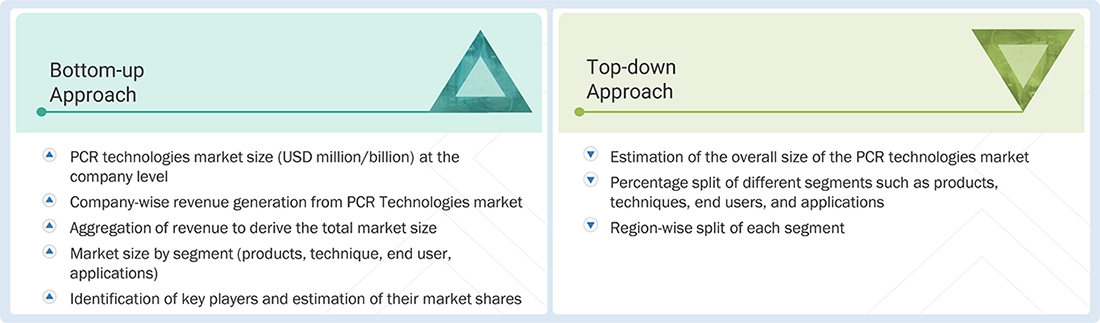
The PCR technologies market size was estimated through a combination of extensive secondary and primary research, followed by data validation and triangulation. Secondary research drew on company reports, financial filings, industry databases, publications, and other credible sources to assess market structure, the competitive landscape, product offerings, and industry trends. Primary research involved interviews with supply- and demand-side stakeholders to validate market assumptions, pricing trends, adoption patterns, and market estimates. Top-down and bottom-up approaches, market segmentation, and data triangulation were used to develop market estimates across key segments, regions, and countries.
Secondary Research
Secondary research drew on company annual reports, SEC filings, investor presentations, industry databases, white papers, company websites, and relevant industry publications. These sources informed analysis of company revenues, product portfolios, market positioning, technological developments, and market trends across the PCR technologies ecosystem.
Primary Research
Primary research included both supply-side and demand-side participants. Supply-side interviews involved senior executives, sales and marketing leaders, product managers, and regional representatives from PCR technology providers. Demand-side discussions involved diagnostic laboratories, hospitals, research institutions, pharmaceutical and biotechnology companies, and other PCR technology users. The findings were used to validate market-sizing assumptions, purchasing patterns, technology adoption, and key market drivers and restraints.
A breakdown of the primary respondents is provided below:
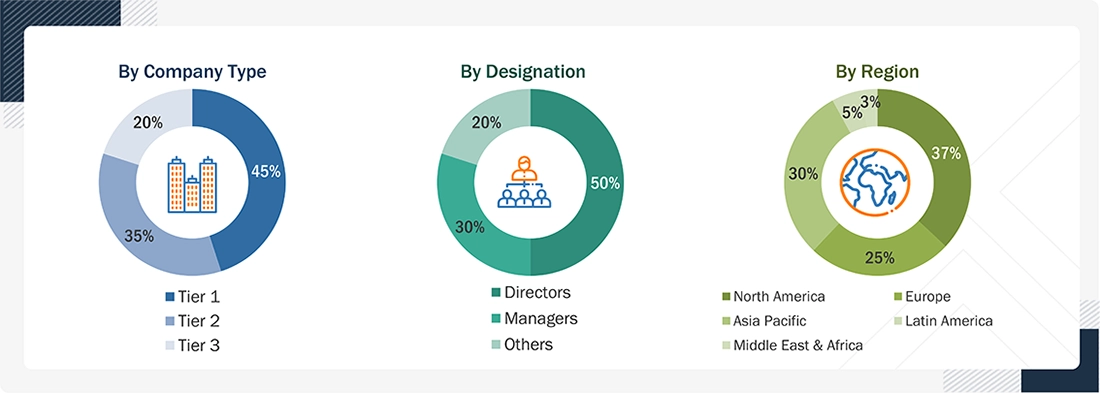
*Others include sales managers, marketing managers, business development managers, product managers, distributors, and suppliers.
Note: Companies are classified into tiers based on their total revenue. As of 2023, Tier 1 = >USD 1 billion, Tier 2 = <USD 500 million, and Tier 3 = <USD 100 million.
To know about the assumptions considered for the study, download the pdf brochure
Market Size Estimation
This research involves a revenue-sharing review of the leading players in the PCR technologies market. Primary and secondary research methods were used to identify key players in the industry and to gain a basic understanding of their financial performance and market share. Primary research consisted of more detailed interviews with CEOs, directors, and senior marketing executives, whereas secondary research relied primarily on annual and financial reports issued by the major players in the industry. A segment-based strategy was used to determine market value across the globe, and the revenue details of the leading solution providers were further used to differentiate between sources and services.
Procedures Covered:
Identify the companies around the world that are leading the PCR technologies industry and note their respective annual revenues or specific product category/business division.
The revenue mapping of the key competitors, based on 2024, represents a major share of the market for this analysis and is thus extrapolated to the total global value for the PCR technologies market.
PCR Technologies Market : Top-Down and Bottom-Up Approach
Data Triangulation
The PCR technologies market is segmented into segments and subsegments based on the methodology adopted in this report. Data triangulation and the segmentation process are then undertaken to ensure the accuracy of data for all segments. Drivers and trends have been identified from both the supply and demand sides. The results obtained from both the top-down and bottom-up approaches have been used to derive the results of the PCR technologies market analysis.
Market Definition
The PCR (Polymerase Chain Reaction) technologies market spans the biotechnology and healthcare industries, offering products and services related to PCR techniques. PCR is a molecular biology technique that enables targeted amplification of DNA sequences, allowing genetic material to be examined. This market encompasses several subcomponents, including equipment such as thermal cyclers and real-time PCR machines, and consumables such as reagents, enzymes, primers, and kits for PCR. Applications of PCR include research, clinical diagnostics, genetic testing, forensic analysis, and environmental studies. Key drivers of this market include technological advances, such as digital PCR and multiplex PCR, which improve instrument sensitivity and specificity. Future growth is expected due to increased research activity, a rising incidence of genetic disorders, and ongoing innovation in biotechnology.
Key Stakeholders
- Manufacturers and distributors of PCR technology devices
- Healthcare institutions (hospitals and clinics)
- Diagnostic centers
- Healthcare institutions (hospital labs)
- Research institutions
- Research and consulting firms
- Contract research organizations (CROs) and contract manufacturing organizations (CMOs)
- Academic medical centers and universities
- Market research and consulting firms
- Clinical research organizations
- Pharma-biotech companies
- Group purchasing organizations (GPOs)
- Medical research laboratories
- Academic medical centers and universities
- Accountable care organizations (ACOs)
Report Objectives
- To define, describe, and forecast the global PCR technologies market based on product, application, technique, end user, and region
- To provide detailed information regarding the major factors influencing the market growth (such as drivers, restraints, opportunities, and challenges)
- To strategically analyze micromarkets1 with respect to individual growth trends, prospects, and contributions to the total market
- To analyze opportunities in the market for stakeholders and provide details of the competitive landscape for market leaders
- To profile the key market players and comprehensively analyze their market share and core competencies2
- To forecast the revenue of the market segments in five main regions: North America (the US and Canada), Europe (Germany, France, the UK, Italy, Spain, and Rest of Europe), the Asia Pacific (China, Japan, India, South Korea, Australia, and Rest of Asia Pacific), Latin America (Brazil, Mexico, and Rest of Latin America), and the Middle East & Africa (GCC Countries and the Rest of Middle East & Africa)
- To track and analyze competitive developments such as product launches and approvals, agreements, partnerships, expansions, acquisitions, and collaborations in the PCR technologies market
Available customizations:
With the market data, MarketsandMarkets offers customizations as per the company’s requirements. The following customization options are available for the global PCR technologies market
Product Analysis
- Product matrix, which compares product portfolios of the top 5 companies.
Company Information
- In-depth profiling of additional market players (up to 5)
Geographic Analysis
-
Further breakdown of the Rest of Europe's PCR technologies market: Russia, Belgium, the Netherlands, Switzerland, Austria, Finland, Sweden, Poland, and Portugal among other
-
Further breakdown of the Rest of Asia Pacific PCR technologies market Singapore, Taiwan, New Zealand, Philippines, Malaysia, and other APAC countries
-
Further breakdown of the Rest of Latin America PCR technologies market Argentina, Chile, Columbia and among others
Get the Full PCR Technologies Market Report
Full forecast, segment splits, and company analysis for all PCR Technologies Market.
- Canada PCR Technologies Market
- US PCR Technologies Market
- Germany PCR Technologies Market
- France PCR Technologies Market
- UK PCR Technologies Market
- Italy PCR Technologies Market
- Spain PCR Technologies Market
- China PCR Technologies Market
- Japan PCR Technologies Market
- India PCR Technologies Market
- Australia PCR Technologies Market
- South Korea PCR Technologies Market
- Brazil PCR Technologies Market
- Mexico PCR Technologies Market
- Rest Of Europe PCR Technologies Market
- Rest Of Asia Pacific PCR Technologies Market
- Rest Of Latin America PCR Technologies Market
Need a Tailored Report?
Customize this report to your needs
Get 10% FREE Customization
Customize This Report
