
Japan POP Treatment and Management / Pelvic Organ Prolapse Market (2025-2030)

The Japan POP Treatment and Management / Pelvic Organ Prolapse Market was valued at $2.83 Million in 2025 and projected to reach to $3.94 Million by 2030, representing a compound annual growth rate of 6.8%. Japan's pelvic organ prolapse treatment market is poised for steady growth driven by demographic shifts and increased clinical awareness.


| Market Size in | USD 26.32 MN |
| Market Forecast in | |
| CAGR | |
| Forecast Period | |
| Units Considered | Value (USD MN) |
Japan POP Treatment and Management / Pelvic Organ Prolapse Market Trends and Insights
- Japan's aging demographic profile and rising prevalence of POP among postmenopausal women are driving demand for both conservative and surgical treatment options across the country.
- The Japanese healthcare system's emphasis on minimally invasive procedures and advanced medical devices is shaping market growth through 2030. In Japan, the POP market benefits from strong healthcare infrastructure, high patient awareness, and robust reimbursement mechanisms that support adoption of innovative therapies.
- Japan's aging population—among the oldest globally—creates sustained demand for pelvic floor rehabilitation, pessary devices, and surgical interventions.
- Between 2025 and 2030, Japan is expected to see increased investment in specialized gynecological centers and expanded access to pelvic floor physical therapy, further accelerating market penetration and clinical outcomes..
Key Market Statistics
- CAGR (2025-2030) 6.8% CAGR
- Market Size, 2025 ~USD 2.83 Million
- Forecast, 2030 ~USD 3.94 Million
- Country Japan
Japan POP Treatment and Management / Pelvic Organ Prolapse Market Overview
Aging Population Driving Demand :
Japan's rapidly aging demographic, with over 29% of the population aged 65+, is significantly increasing POP prevalence and treatment demand among postmenopausal women across the nation.
Market Growth Trajectory :
The Japan POP treatment market is expanding at a CAGR of 6.8%, growing from USD 2.83 million in 2025 to USD 3.94 million by 2030, outpacing the global average of 6.6%.
Dual Treatment Approach :
Japanese healthcare providers are increasingly adopting both conservative management options and minimally invasive surgical interventions to address varying severity levels of pelvic organ prolapse.
Healthcare Infrastructure Advancement :
Japan's advanced medical technology adoption and well-established healthcare system are facilitating improved diagnosis, treatment accessibility, and patient outcomes in POP management.
Japan POP Treatment and Management / Pelvic Organ Prolapse Market Dynamics
- The aging population combined with improved diagnostic capabilities is expanding the patient base seeking treatment.
- Healthcare providers are investing in both conservative therapies and surgical solutions to meet diverse patient needs across urban and rural regions. The market outlook remains positive as Japanese healthcare institutions prioritize women's health initiatives and adopt advanced treatment modalities.
- Reimbursement policies supporting POP interventions, coupled with rising patient education and healthcare accessibility, will continue to fuel market expansion through 2030.
- Strategic partnerships between medical device manufacturers and Japanese hospitals are expected to enhance treatment availability..
Market Ecosystem
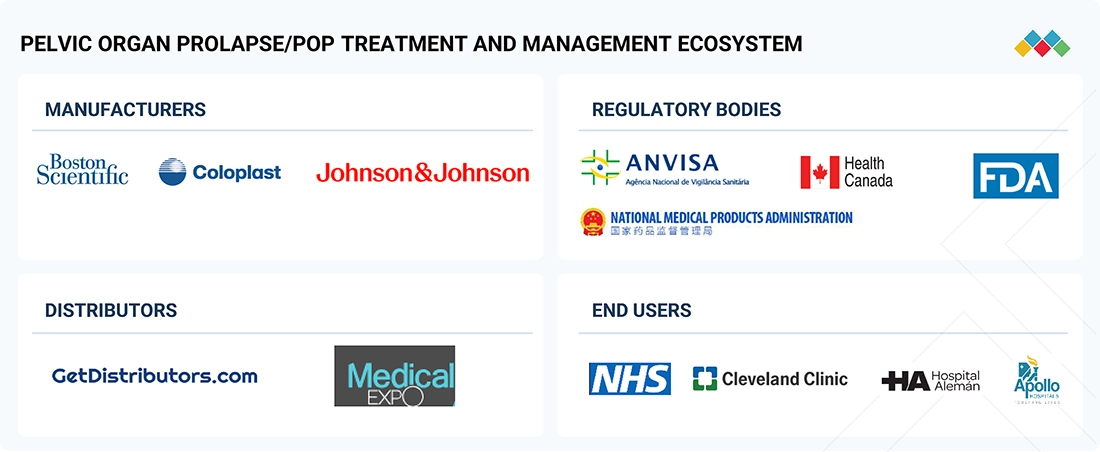
POP Treatment and Management / Pelvic Organ Prolapse Market: COMMERCIAL USE CASES ACROSS INDUSTRIES
| COMPANY | USE CASE DESCRIPTION | BENEFITS |
|---|---|---|
 |
Offers advanced POP treatment solutions, including Y-shaped meshes like Upsylon and vaginal positioning devices for sacrocolpopexy and other surgical repairs of pelvic organ prolapse | Provides robust anatomical support, enables minimally invasive procedures, and enhances surgical precision, leading to reduced recovery time, improved patient outcomes, and lower complication rates |
 |
Delivers a portfolio of biologic and synthetic grafts, such as Axis Dermis allograft and Restorelle Y-Mesh, for transvaginal or transabdominal pelvic floor reconstruction in treating pelvic organ prolapse | Supports the body's natural regenerative processes, minimizes tissue trauma, and offers versatile options for customized repairs, resulting in durable prolapse correction, enhanced comfort, and optimized long-term efficacy |
 |
Provides robotic-assisted surgical systems like the da Vinci platform for minimally invasive procedures addressing pelvic organ prolapse, including sacrocolpopexy and hysteropexy | Improves surgeon visualization and dexterity, facilitates precise tissue manipulation, and shortens hospital stays, delivering superior clinical results, faster patient recovery, and high satisfaction in prolapse management |
 |
Focuses on non-surgical management with Milex silicone pessaries designed for supporting prolapsed organs and alleviating symptoms in pelvic organ prolapse patients | Offers customizable, removable support devices that maintain organ position without surgery, reduces urinary incontinence, and improves daily function, promoting conservative treatment success and quality of life |
 |
Supplies innovative mesh implants like ARTISYN Y-Shaped Mesh for prolapse correction through surgical augmentation techniques | Ensures effective vaginal vault suspension, lightweight and flexible design for natural movement, and integration with advanced surgical methods, achieving reliable prolapse resolution with minimal discomfort and sustained durability |
Logos and trademarks shown above are the property of their respective owners. Their use here is for informational and illustrative purposes only.
Related Ecosystem
Medical Devices
- Polymerase Chain Reaction (PCR)
- Magnetic Resonance Imaging (MRI)
- Disposable Autoinjectors
- Pulse Oximeters
- Blood Pressure Monitors
- Medtronic plc
- Abbott Laboratories
- Stryker Corporation
- Becton, Dickinson and Company
- CONMED Corporation
Key Takeaways
- Japan's POP market is valued at USD 2.83 million in 2025 and will reach USD 3.94 million by 2030, growing at 6.8% CAGR.
- Japan's rapidly aging population drives sustained demand for both conservative management and surgical treatment options for pelvic organ prolapse.
- Japan's advanced healthcare infrastructure and strong reimbursement policies support adoption of minimally invasive procedures and innovative medical devices.
- Expansion of specialized gynecological centers and pelvic floor physical therapy services in Japan will accelerate market growth through 2030.
POP Treatment and Management / Pelvic Organ Prolapse Market Report Scope
| Report Metric | Details |
|---|---|
| Base Year | 2025 |
| Fastest Growing Segment | SACROCOLPOPEXY (Type) |
| Forecast Period | 2025–2030 |
| Growth Rate | CAGR of 6.6% from 2025 to 2030 |
| Largest Segment | SURGICAL (Treatment) |
| Market Size Base Year (Billions) | ~USD 0.77 (2025) |
| Revenue Forecast (Billions) | ~USD 1.06 (2030) |
| Segments Covered | Product, Treatment, Type, Application, End User |
Japan POP Treatment and Management / Pelvic Organ Prolapse Market Report Segmentation
5 segment dimensions are covered across the global market.
By Product
- Biological Grafts
- Diagnostic & Assessment Tools
- Pelvic Floor Therapy Devices
- Robotic Surgery Systems
- Sutures
- Synthetic Mesh
- Vaginal Pessaries
By Treatment
- Non-Surgical
- Surgical
By Type
- Colpocleisis
- Colporrhaphy
- Pelvic Floor Muscle Therapy
- Sacrocolpopexy
- Sacrohysteropexy
- Uterosacral Or Sacrospinous Ligament Fixation
- Vaginal Pessary Management
By Application
- Cystocele
- Enterocele
- Rectocele
- Urethrocele
- Uterine Prolapse
By End User
- Ambulatory Surgery Centers
- Hospitals
- Other End Users
- Specialty Clinics
JAPAN: PELVIC ORGAN PROLAPSE/PELVIC FLOOR RECONSTRUCTION MARKET, BY END USER, 2023–2030
| Segment | 2023 | 2024 | 2025 | 2026 | 2027 | 2028 | 2029 | 2030 | CAGR (%) |
|---|---|---|---|---|---|---|---|---|---|
| AMBULATORY SURGERY CENTERS | 5.8 | 6.3 | 6.8 | 7.4 | 8.1 | 8.8 | 9.7 | 10.6 | 9.2 |
| HOSPITALS | 14.7 | 15.6 | 16.7 | 17.9 | 19.1 | 20.5 | 22 | 23.7 | 7.3 |
| OTHER END USERS | 2.5 | 2.7 | 2.8 | 3 | 3.2 | 3.4 | 3.6 | 3.9 | 6.4 |
| SPECIALTY CLINICS | 7.1 | 7.6 | 8.2 | 8.8 | 9.4 | 10.2 | 11 | 12 | 8 |
| TOTAL | 30.1 | 32.2 | 34.5 | 37.1 | 39.9 | 43 | 46.4 | 50.2 | 7.8 |
Target Audience
- Medical Device Manufacturers : Need Japan-specific market data to develop localized product strategies, identify distribution partnerships, and forecast revenue potential for POP treatment devices in this high-growth demographic market.
- Healthcare Providers & Hospital Networks : Require market insights to justify investment in POP treatment infrastructure, staff training, and surgical capabilities while understanding patient demand trends across Japanese regions.
- Pharmaceutical & Biotech Companies : Seek Japan market intelligence to evaluate opportunities for conservative treatment options, clinical trial recruitment, and product launch strategies targeting postmenopausal women.
- Healthcare Consultants & Advisors : Need comprehensive Japan market data to advise clients on market entry strategies, competitive positioning, and investment opportunities in the growing POP treatment sector.
- Insurance & Reimbursement Specialists : Require detailed Japan market analysis to understand treatment adoption rates, cost structures, and reimbursement trends for POP management to inform coverage policies and pricing strategies.
Key Companies in the Japan POP Treatment and Management / Pelvic Organ Prolapse Market
| Company | HQ | Ownership | Strongest segments |
|---|---|---|---|
| BOSTON SCIENTIFIC CORPORATION | United States | Public Company | Cardiovascular (CRM, structural heart, peripheral interventions, LAAC),MedSurg Endoscopy (GI, pancreaticobiliary, single-use scopes, infection prevention),Urology and Pelvic Health, |
| COOPERCOMPANIES | United States | Public Company | Spherical contact lenses,Toric and multifocal contact lenses,Fertility consumables, equipment, and services, |
| JOHNSON & JOHNSON | United States | Public Company | Oncology,Immunology,Neuroscience and Other Innovative Medicine, |
| GE HEALTHCARE | United States | Public Company | Imaging,Advanced Visualization Solutions (AVS),Patient Care Solutions (PCS), |
| INTEGRA LIFESCIENCES CORPORATION | United States | Public Company | Neurosurgery & Neurocritical Care (Codman Specialty Surgical),ENT, Navigation & Surgical Instrumentation,Tissue Technologies – Wound, Skin & Reconstruction, |
| FEG TEXTILTECHNIK FORSCHUNGS- UND ENTWICKLUNGSGESELLSCHAFT MBH | Germany | Private Company | Contract R&D and prototyping,Process engineering and scale-up services,Consulting, testing, and training, |
BOSTON SCIENTIFIC CORPORATION
Boston Scientific Corporation is a publicly traded medical device company founded in 1979 and headquartered in the United States. With 59,000 employees, the company develops and manufactures a broad range of medical devices and technologies for various healthcare applications.
COOPERCOMPANIES
Cooper Companies is a publicly traded medical device company founded in 1958 and headquartered in the United States. With 15,000 employees, the company operates in the contact lens and eye care markets.
JOHNSON & JOHNSON
Johnson & Johnson is a publicly traded multinational healthcare company founded in 1886 and based in the United States. With 138,200 employees, the company operates across pharmaceuticals, medical devices, and consumer health segments.
GE HEALTHCARE
GE Healthcare is a publicly traded medical technology company founded in 2022 and headquartered in the United States. The company employs 54,000 people and provides healthcare imaging, monitoring, and diagnostic solutions.
INTEGRA LIFESCIENCES CORPORATION
Integra LifeSciences Corporation is a publicly traded medical device company founded in 1989 and based in the United States. With 4,427 employees, the company develops and manufactures surgical instruments and regenerative medicine products.
FEG TEXTILTECHNIK FORSCHUNGS- UND ENTWICKLUNGSGESELLSCHAFT MBH
FEG Textiltechnik Forschungs- und Entwicklungsgesellschaft mbH is a privately held company founded in 1991 and headquartered in Germany. The company specializes in textile technology research and development.
Reasons to Buy this Report
- Japan-Specific Market Sizing : Access precise valuation data for Japan's POP market with verified 2025 baseline (USD 2.83M) and 2030 forecasts, enabling accurate budget allocation and revenue projections for Japan operations.
- Demographic Insights & Opportunity Assessment : Understand Japan's unique aging demographic profile and its direct correlation to POP prevalence among postmenopausal women, identifying high-potential patient segments and geographic markets.
- Competitive Positioning Strategy : Benchmark your Japan market strategy against the 6.8% CAGR growth rate and identify competitive advantages in both conservative and surgical treatment segments specific to Japanese healthcare preferences.
- Reimbursement & Regulatory Landscape : Gain insights into Japan's healthcare reimbursement policies, regulatory environment, and treatment adoption patterns to optimize market entry and product positioning strategies.
- Growth Forecasting & Investment Planning : Leverage 5-year market projections to inform investment decisions, resource allocation, and long-term strategic planning for Japan's expanding POP treatment and management sector.
Frequently asked questions
What is the current market size of POP treatment in Japan?
Japan's pelvic organ prolapse treatment and management market is valued at USD 2.83 million in 2025.
What is the projected market size for POP treatment in Japan by 2030?
Japan's POP market is forecast to reach USD 3.94 million by 2030, representing 39% growth over the forecast period.
What is the CAGR for Japan's POP market?
Japan's pelvic organ prolapse market is expected to grow at a compound annual growth rate of 6.8% from 2025 to 2030.
What factors are driving growth in Japan's POP market?
Japan's aging population, increased patient awareness, advanced healthcare infrastructure, strong reimbursement mechanisms, and expansion of specialized gynecological services are key growth drivers.
What treatment options are most prevalent in Japan's POP market?
Japan's market includes conservative management through pelvic floor physical therapy, pessary devices, and minimally invasive surgical interventions supported by the country's advanced healthcare system.
RESEARCH METHODOLOGY
The study involved major activities in estimating the current market size for the POP Treatment and Management / Pelvic Organ Prolapse market. Exhaustive secondary research was done to collect information on the POP Treatment and Management / Pelvic Organ Prolapse industry. The next step was to validate these findings, assumptions, and sizing with industry experts across the value chain using primary research. Different approaches, such as top-down and bottom-up, were employed to estimate the total market size. After that, the market breakup and data triangulation procedures were used to estimate the market size of the segments and subsegments of the POP Treatment and Management / Pelvic Organ Prolapse market.
The four steps involved in estimating the market size are:
Secondary Research
The secondary research process involved the widespread use of secondary sources, directories, databases (such as Bloomberg Businessweek, Factiva, and D&B Hoovers), white papers, annual reports, investor presentations, SEC filings of companies and publications from government sources [such as National Institutes of Health (NIH), US FDA, US Census Bureau, World Health Organization (WHO), Global Burden of Disease Study, and Centers for Medicare and Medicaid Services (CMS)] to identify and collect information for the global POP Treatment and Management / Pelvic Organ Prolapse market study. Secondary sources were also used to obtain important information about the key players, market classification & segmentation according to industry trends to the bottom-most level, and key developments related to market and technology perspectives. A database of the key industry leaders was also prepared using secondary research.
Primary Research
In the primary research process, various sources from both the supply and demand sides were interviewed to obtain qualitative and quantitative information for this report. The primary sources from the supply side included industry experts such as CEOs, vice presidents, marketing and sales directors, technology & innovation directors, and related key executives from various key companies and organizations in the POP Treatment and Management / Pelvic Organ Prolapse market. The primary sources from the demand side included pharmaceutical companies, biotechnology companies, CROs, medical device companies, and research academics and universities. Primary research was conducted to validate the market segmentation, identify key players in the market, and gather insights on key industry trends & key market dynamics.
The following is a breakdown of the primary respondents:
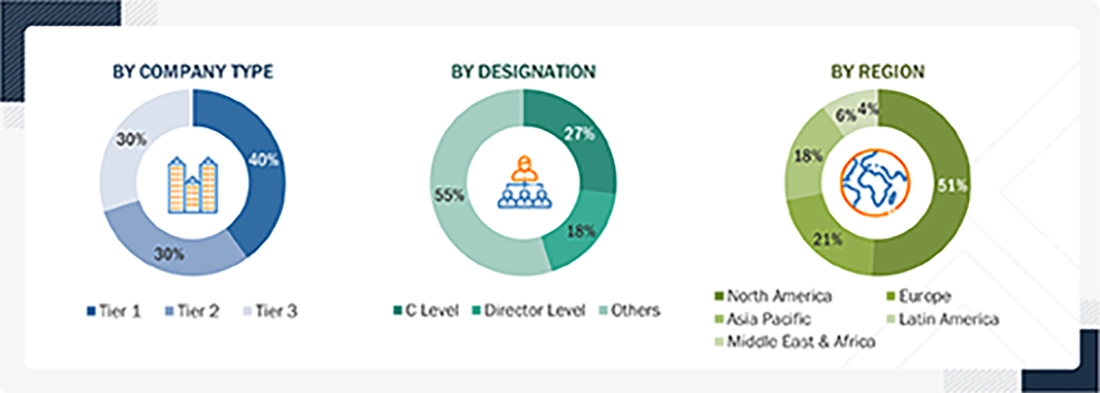
Note 1: Other designations include sales, marketing, and product managers.
Note 2: Companies are classified into tiers based on their total revenues. As of 2024, Tier 1 = >USD 100 million, Tier 2 = USD 10 million to USD 100 million, and Tier 3 = < USD 10 million.
To know about the assumptions considered for the study, download the pdf brochure
Market Size Estimation
For the global market value, annual revenues were calculated based on the revenue mapping of major product manufacturers and OEMs active in the global POP Treatment and Management / Pelvic Organ Prolapse market. All the major service providers were identified at the global and/or country/regional level. Revenue mapping for the respective business segments/subsegments was done for the major players. The global POP Treatment and Management / Pelvic Organ Prolapse market was split into various segments and sub-segments based on:
- List of major players operating in the products market at the regional and/or country level
- Product mapping of POP Treatment and Management / Pelvic Organ Prolapse providers at the regional and/or country level
- Mapping of annual revenue generated by listed major players from POP Treatment and Management / Pelvic Organ Prolapse (or the nearest reported business unit/product category)
- Extrapolation of the revenue mapping of the listed major players to derive the global market value of the respective segments/subsegments
- Summation of the market value of all segments/subsegments to arrive at the global POP Treatment and Management / Pelvic Organ Prolapse market
- The above-mentioned data was consolidated and added with detailed inputs and analysis from MarketsandMarkets and presented in this report.
The research methodology used to estimate the market size includes the following:

Data Triangulation
After arriving at the overall market size by applying the processes mentioned above, the total market was split into several segments. To complete the overall market engineering process and arrive at the exact statistics for all segments and subsegments, data triangulation and market breakdown procedures were employed, wherever applicable. The data was triangulated by studying various factors and trends from both the demand and supply sides.
Market Definition
Pelvic organ prolapse (POP) is a condition in which the pelvic organs—such as the vagina, uterus, bladder, or rectum—descend from their normal anatomical positions. This occurs when the pelvic floor, composed of muscles, ligaments, and connective tissues that provide structural support to these organs, is weakened or stretched. The pelvic floor functions as a supportive structure beneath the pelvic organs. When these supportive structures lose strength or elasticity, the organs may shift out of place or protrude into the vaginal canal. Common causes of pelvic floor weakening include childbirth, aging, and other factors that increase intra-abdominal pressure.
Stakeholders
- Pelvic Organ Prolapse Product Manufacturers
- Research and Consulting Firms
- Distributors of Pelvic Organ Prolapse Devices
- Private Insurance Companies
- Gynecologists and Urogynecologists
- Healthcare Institutes (Hospitals, Medical Schools, Diagnostic Centers, and Outpatient Clinics)
- Research Institutes
- Venture Capitalists
Report Objectives
- To define, describe, segment, and forecast the global POP Treatment and Management / Pelvic Organ Prolapse market by product, treatment, application, end user, and region
- To provide detailed information regarding the major factors influencing market growth (such as drivers, restraints, opportunities, and challenges)
- To analyze the micromarkets with respect to individual growth trends, prospects, and contributions to the overall POP Treatment and Management / Pelvic Organ Prolapse market
- To analyze market opportunities for stakeholders and provide details of the competitive landscape for key players
- To forecast the size of the market segments with respect to five regions: North America, Europe, Asia Pacific, Latin America, and the Middle East & Africa
- To profile the key players and comprehensively analyze their product portfolios, market positions, and core competencies
- To benchmark players within the market using the proprietary company evaluation matrix framework, which analyzes market players on various parameters within the broad categories of business and product excellence
- To study the impact of AI/Gen AI on the market, along with the macroeconomic outlook for each region
Get the Full POP Treatment and Management / Pelvic Organ Prolapse Market Report
Full forecast, segment splits, and company analysis for all POP Treatment and Management / Pelvic Organ Prolapse Market.
- US POP Treatment and Management / Pelvic Organ Prolapse Market
- Canada POP Treatment and Management / Pelvic Organ Prolapse Market
- Germany POP Treatment and Management / Pelvic Organ Prolapse Market
- France POP Treatment and Management / Pelvic Organ Prolapse Market
- UK POP Treatment and Management / Pelvic Organ Prolapse Market
- Italy POP Treatment and Management / Pelvic Organ Prolapse Market
- Spain POP Treatment and Management / Pelvic Organ Prolapse Market
- China POP Treatment and Management / Pelvic Organ Prolapse Market
- India POP Treatment and Management / Pelvic Organ Prolapse Market
- Australia POP Treatment and Management / Pelvic Organ Prolapse Market
- South Korea POP Treatment and Management / Pelvic Organ Prolapse Market
- Brazil POP Treatment and Management / Pelvic Organ Prolapse Market
- Mexico POP Treatment and Management / Pelvic Organ Prolapse Market
- Rest Of Europe POP Treatment and Management / Pelvic Organ Prolapse Market
- Rest Of Asia Pacific POP Treatment and Management / Pelvic Organ Prolapse Market
- Rest Of Latin America POP Treatment and Management / Pelvic Organ Prolapse Market
Need a Tailored Report?
Customize this report to your needs
Get 10% FREE Customization
Customize This Report
