
Brazil Peracetic Acid Market (2025-2030)

The Brazil Peracetic Acid Market was valued at $22.5 Million in 2025 and projected to reach to $34.7 Million by 2030, representing a compound annual growth rate of 9.08%. Brazil's peracetic acid market is positioned for sustained expansion through 2030, supported by the country's dominant position in global agricultural exports and increasing regulatory pressure for safer, more effective disinfection solutions.


| Market Size in | USD 26.32 MN |
| Market Forecast in | |
| CAGR | |
| Forecast Period | |
| Units Considered | Value (USD MN) |
Brazil Peracetic Acid Market Trends and Insights
- This expansion reflects Brazil's increasing demand for disinfection and sterilization solutions across food processing, healthcare, and water treatment sectors.
- Brazil's strong agricultural and food export industries are driving adoption of peracetic acid as a preferred antimicrobial agent due to its efficacy and environmental safety profile. The 9.08% compound annual growth rate (CAGR) positions Brazil as a high-growth market within South America's chemical sector.
- Brazil's regulatory environment and industrial modernization initiatives are accelerating peracetic acid penetration in manufacturing and sanitation applications.
- Between 2025 and 2030, Brazil is expected to see significant capacity investments and increased commercial availability, supported by rising awareness of sustainable disinfection alternatives among Brazilian enterprises..
Key Market Statistics
- CAGR (2025-2030) 9.08% CAGR
- Market Size, 2025 ~USD 22.5 Million
- Forecast, 2030 ~USD 34.7 Million
- Country Brazil
Brazil Peracetic Acid Market Overview
Market Valuation Growth :
Brazil's peracetic acid market is valued at USD 22.5 million in 2025, with a strong CAGR of 9.08%, significantly outpacing the global growth rate of 8.5%, indicating Brazil's accelerating market momentum.
Agricultural & Food Export Driver :
Brazil's robust agricultural and food export industries are primary catalysts for peracetic acid adoption, as producers require advanced disinfection solutions to meet international food safety standards and export compliance requirements.
Multi-Sector Demand :
Peracetic acid demand spans critical sectors in Brazil including food processing facilities, healthcare institutions, and water treatment plants, creating diversified revenue streams and reducing market concentration risk.
Forecast Expansion :
The market is projected to reach USD 34.7 million by 2030, representing a 54% increase over five years, driven by rising awareness of sustainable disinfection alternatives and stricter regulatory standards in Brazil.
Brazil Peracetic Acid Market Dynamics
- The food processing sector, particularly in meat, dairy, and beverage production, continues to drive significant demand as companies invest in advanced sterilization technologies to maintain export competitiveness and meet stringent international food safety protocols. Beyond agriculture, Brazil's healthcare and water treatment sectors are emerging as growth catalysts, with hospitals and municipal water authorities increasingly adopting peracetic acid for its superior antimicrobial efficacy and environmentally favorable degradation profile.
- Government initiatives promoting sustainable industrial practices and rising consumer awareness of food safety will further accelerate market penetration across Brazil's industrial landscape..
Market Ecosystem
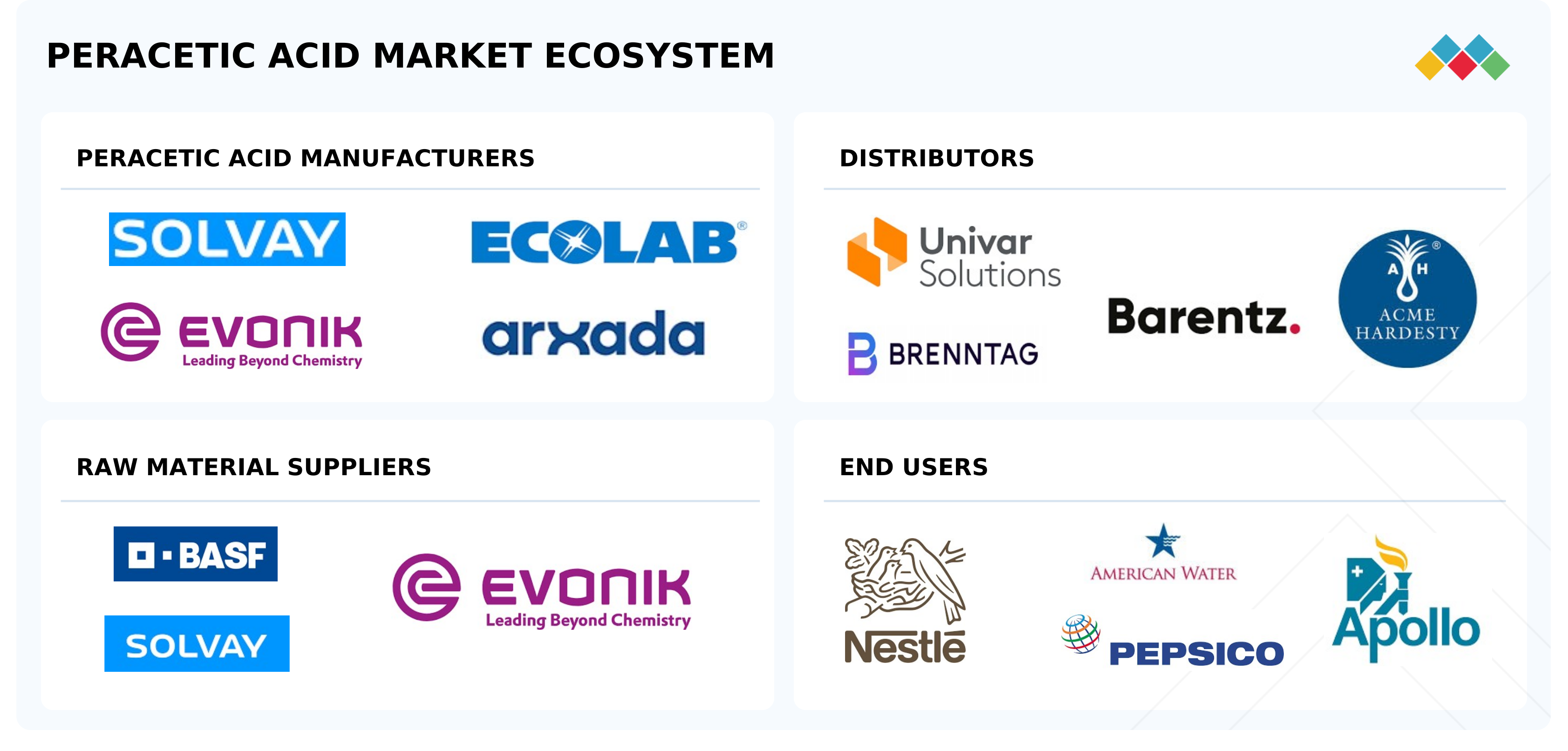
Peracetic Acid Market: COMMERCIAL USE CASES ACROSS INDUSTRIES
| COMPANY | USE CASE DESCRIPTION | BENEFITS |
|---|---|---|
 |
Sanitizing production lines, tanks, and packaging | Improves shelf life and food safety |
 |
Sterilization of surgical instruments, endoscopes, and dental tools | Broad antimicrobial action (bacteria, viruses, spores) |
 |
Disinfection of municipal wastewater | Rapid disinfection without harmful byproducts |
 |
Slimicide for controlling biofilm in paper mills | Controls slime and microbial growth sustainably |
 |
Disinfection of textiles (linens, uniforms, towels) | Broad-spectrum kill of bacteria, fungi, spores, and viruses |
Logos and trademarks shown above are the property of their respective owners. Their use here is for informational and illustrative purposes only.
Related Ecosystem
Bulk Chemicals And Inorganics
- Corrosion Inhibitors
- Glycol Ethers
- Acetic Acid
- Acetone
- Ammonium Nitrate
- Basf se
- DOW CHEMICAL COMPANY
- Exxon Mobil Corporation
- AZELIS HOLDINGS SA
- Sinopec limited
Speciality Chemicals
- Corrosion Inhibitors
- Polyetheretherketone (PEEK)
- Acrylonitrile Butadiene Styrene (ABS)
- Epoxy Resin
- Polycarbonate
- Basf se
- DOW CHEMICAL COMPANY
- Evonik industries ag
- Clariant ag.
- Solvay sa
Water Purification
- Corrosion Inhibitors
- Cartridge Filters
- Fiberglass
- Reverse Osmosis
- Acetone
- Veolia
- Kemira oyj
- SOLENIS
- Basf se
- CALGON CARBON CORPORATION
Key Takeaways
- Brazil's peracetic acid market is valued at USD 22.5 million in 2025 and will reach USD 34.7 million by 2030, representing a 9.08% CAGR.
- Brazil's food processing and agricultural export sectors are primary demand drivers for peracetic acid adoption.
- Brazil's regulatory push toward sustainable disinfection solutions is accelerating market penetration across multiple industries.
- Brazil is positioned as a high-growth market within South America, with significant investment opportunities through 2030.
Peracetic Acid Market Report Scope
| Report Metric | Details |
|---|---|
| Base Year | 2025 |
| Fastest Growing Segment | –LAUNDRIES (End-Use Industry) |
| Forecast Period | 2025–2030 |
| Growth Rate | CAGR of 8.5% from 2025 to 2030 |
| Largest Segment | 5–15% GRADE (Grade) |
| Market Size Base Year (Billions) | ~USD 1.11 (2025) |
| Revenue Forecast (Billions) | ~USD 1.67 (2030) |
| Segments Covered | Grade, Application, End-Use Industry |
Brazil Peracetic Acid Market Report Segmentation
3 segment dimensions are covered across the global market.
By Grade
- 5–15% Grade
- <5% Grade
- >15% Grade
By Application
- Disinfectant
- Sanitizer
- Sterilant
By End-Use Industry
- Food & Beverage
- Healthcare
- Pulp & Paper
- Water Treatment
- –Agriculture
- –Breweries
- –Laundries
- –Laundry
- –Wineries
BRAZIL: PERACETIC ACID MARKET, BY APPLICATION, 2025–2030
| Segment | 2025 | 2026 | 2027 | 2028 | 2029 | 2030 | CAGR (%) |
|---|---|---|---|---|---|---|---|
| DISINFECTANT | 7.89 | 8.54 | 9.25 | 10.03 | 10.9 | 11.85 | 8.47 |
| OTHERS | 4.75 | 5.23 | 5.77 | 6.36 | 7.03 | 7.78 | 10.36 |
| SANITIZER | 4.42 | 4.75 | 5.11 | 5.5 | 5.93 | 6.41 | 7.69 |
| STERILANT | 5.39 | 5.91 | 6.49 | 7.13 | 7.85 | 8.66 | 9.93 |
| TOTAL | 22.46 | 24.44 | 26.62 | 29.04 | 31.72 | 34.7 | 9.08 |
Target Audience
- Chemical Manufacturers & Suppliers : Peracetic acid producers and distributors need Brazil-specific market data to identify growth opportunities, assess competitive positioning, and develop localized supply chain and distribution strategies for this expanding market.
- Food & Beverage Companies : Brazilian and international F&B processors require insights into peracetic acid adoption trends, regulatory compliance requirements, and supplier options to optimize sterilization processes and maintain export competitiveness.
- Healthcare & Pharmaceutical Operators : Hospital networks, clinics, and pharmaceutical manufacturers in Brazil need market intelligence on disinfection solution adoption, efficacy comparisons, and cost-benefit analyses to upgrade sterilization protocols.
- Water Treatment & Utilities : Municipal and industrial water treatment facilities in Brazil require data on peracetic acid effectiveness, regulatory compliance, and market availability to evaluate adoption of advanced disinfection technologies.
- Investment & Private Equity Firms : Investors targeting Brazil's chemical and industrial sectors need comprehensive market forecasts, growth drivers, and competitive dynamics to evaluate investment opportunities in peracetic acid producers and related businesses.
Key Companies in the Brazil Peracetic Acid Market
| Company | HQ | Ownership | Strongest segments |
|---|---|---|---|
| HELM AG | Germany | Private Company | Basic chemicals, acids and lyes, and industrial specialties,Plastics and polyurethanes,Crop protection and fertilizers, |
| NALCO COMPANY | United States | Private Company | Industrial water treatment programs,Process improvement chemicals,Equipment, monitoring, and digital solutions, |
| STERIS CORPORATION | United States | Public Company | Healthcare infection prevention & capital equipment,Applied Sterilization Technologies (contract sterilization),Life Sciences (pharma/biopharma solutions), |
| SOLVAY | Belgium | Public Company | Soda ash and derivatives,Sodium bicarbonate,Hydrogen peroxide, |
| EVONIK INDUSTRIES AG | Germany | Public Company | Advanced Technologies,Custom Solutions,Infrastructure, |
| ECOLAB INC. | United States | Public Company | Global Water,Global Institutional & Specialty,Global Pest Elimination, |
| MITSUBISHI GAS CHEMICAL COMPANY | Japan | Public Company | Basic chemicals (methanol, formalin, hydrogen peroxide, ammonium hydroxide),Functional chemicals and performance chemicals,Engineering plastics and resins (polycarbonate, polyacetal, unsaturated polyester, molding compounds), |
| NATIONAL PEROXIDE LIMITED | India | Public Company | Investment income (equity, debt, strategic holdings),Leasing income,Chemicals trading, |
| KEMIRA OYJ | Finland | Public Company | Water Solutions,Packaging & Hygiene Solutions,Fiber Essentials, |
HELM AG
HELM AG is a German private company founded in 1900 with 1,430 employees.
NALCO COMPANY
NALCO COMPANY is a United States-based private company founded in 1928 with 12,495 employees.
STERIS CORPORATION
STERIS CORPORATION is a publicly traded United States company founded in 1985 with 17,937 employees.
SOLVAY
SOLVAY is a Belgian public company founded in 1863 with 8,400 employees.
EVONIK INDUSTRIES AG
EVONIK INDUSTRIES AG is a German public company founded in 1847 with 30,643 employees.
ECOLAB INC.
ECOLAB INC. is a publicly traded United States company founded in 1923 with 48,000 employees.
MITSUBISHI GAS CHEMICAL COMPANY
MITSUBISHI GAS CHEMICAL COMPANY is a Japanese public company founded in 1918 with 8,319 employees.
NATIONAL PEROXIDE LIMITED
NATIONAL PEROXIDE LIMITED is an Indian public company founded in 1954.
KEMIRA OYJ
KEMIRA OYJ is a Finnish public company founded in 1920 with 4,871 employees.
Reasons to Buy this Report
- Localized Market Intelligence : Gain Brazil-specific insights on market size, growth trajectories, and sector-wise demand patterns that differ from global trends, enabling precise investment and expansion decisions in this high-growth market.
- Competitive Positioning Data : Understand Brazil's unique competitive landscape, including local and international players, market share distribution, and strategic positioning opportunities specific to the Brazilian peracetic acid sector.
- Sector-Specific Opportunity Analysis : Identify high-potential segments within Brazil's food processing, healthcare, and water treatment industries with detailed demand forecasts and adoption rates to prioritize market entry or expansion strategies.
- Regulatory & Compliance Framework : Access Brazil-specific regulatory requirements, food safety standards, and environmental compliance guidelines that influence peracetic acid adoption and create market opportunities for compliant suppliers.
- Strategic Growth Planning : Leverage Brazil's 9.08% CAGR and USD 12.2 million growth opportunity (2025-2030) to develop targeted go-to-market strategies, partnership models, and investment roadmaps tailored to Brazilian market dynamics.
Frequently asked questions
What is the current size of Brazil's peracetic acid market?
Brazil's peracetic acid market is valued at USD 22.5 million in 2025 and is expected to grow to USD 34.7 million by 2030.
What is the growth rate of peracetic acid demand in Brazil?
Brazil's peracetic acid market is growing at a compound annual growth rate (CAGR) of 9.08% from 2025 to 2030.
Which industries in Brazil are driving peracetic acid consumption?
Brazil's food processing, agricultural export, healthcare, and water treatment sectors are the primary drivers of peracetic acid demand.
Why is peracetic acid gaining traction in Brazil?
Brazil's adoption of peracetic acid is driven by its effectiveness as a disinfectant, environmental safety profile, and regulatory support for sustainable antimicrobial solutions.
How does Brazil's market compare to the global peracetic acid market?
Brazil's 9.08% CAGR outpaces the global market growth rate of 8.5%, positioning Brazil as a faster-growing regional market within South America.
RESEARCH METHODOLOGY
The study involved four major activities to estimate the current size of the peracetic acid market. Exhaustive secondary research was conducted to gather information on the market. The next step was to conduct primary research to validate these findings, assumptions, and sizing with the industry experts across the value chain. Both top-down and bottom-up approaches were used to estimate the total market size. The market size of segments and subsegments was then estimated using market breakdown and data triangulation.
Secondary Research
Secondary sources include annual reports of companies, press releases, investor presentations, white papers, articles by recognized authors, and databases, such as D&B, Bloomberg, Chemical Weekly, and Factiva, and publications and databases from associations.
Primary Research
Extensive primary research was carried out after gathering information about the peracetic acid market through secondary research. In the primary research process, experts from the supply and demand sides have been interviewed to obtain qualitative and quantitative information and validate the data for this report. Questionnaires, emails, and telephonic interviews were used to collect primary data. Primary sources from the supply side include industry experts, such as chief executive officers (CEOs), vice presidents (VPs), marketing directors, technology and innovation directors, and related key executives from various key companies and organizations operating in the peracetic acid market. Primary interviews were conducted to obtain information such as market statistics, revenue data collected from the products and services, market breakdowns, market size estimations, market forecasting, and data triangulation. Primary research also assisted in comprehending the various trends associated with grade, application, end-use industry and region.
Breakdown of Primary Interviews
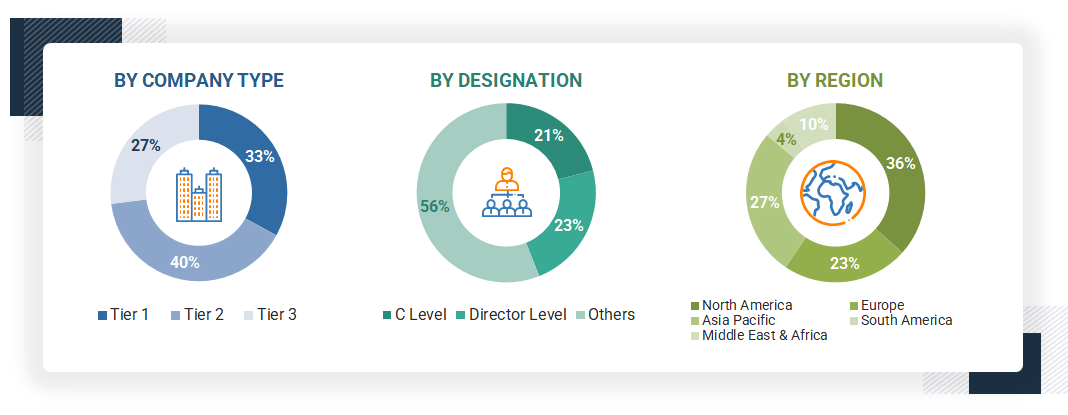
Note: Tier 1, Tier 2, and Tier 3 companies are classified based on their market revenue in 2023/2024, available in the public domain, product portfolios, and geographical presence.
Other designations include consultants and sales, marketing, and procurement managers.
To know about the assumptions considered for the study, download the pdf brochure
| COMPANY NAME | DESIGNATION | |
|---|---|---|
| Solvay | Sales Manager | |
| Evonik Industries AG | Project Manager | |
| MITSUBISHI GAS CHEMICAL COMPANY, INC. | Individual Industry Expert | |
| Ecolab Inc. | Manager | |
Market Size Estimation
Both top-down and bottom-up approaches were used to estimate and validate the total size of the peracetic acid market. These methods were also used extensively to estimate the size of various subsegments in the market. The research methodology used to estimate the market size includes the following:
- The key players in the industry have been identified through extensive secondary research.
- The supply chain of the industry has been determined through primary and secondary research.
- All percentage shares, splits, and breakdowns have been determined using secondary sources and verified through primary sources.
- All possible parameters that affect the markets covered in this research study have been accounted for, viewed in extensive detail, verified through primary research, and analyzed to obtain the final quantitative and qualitative data.
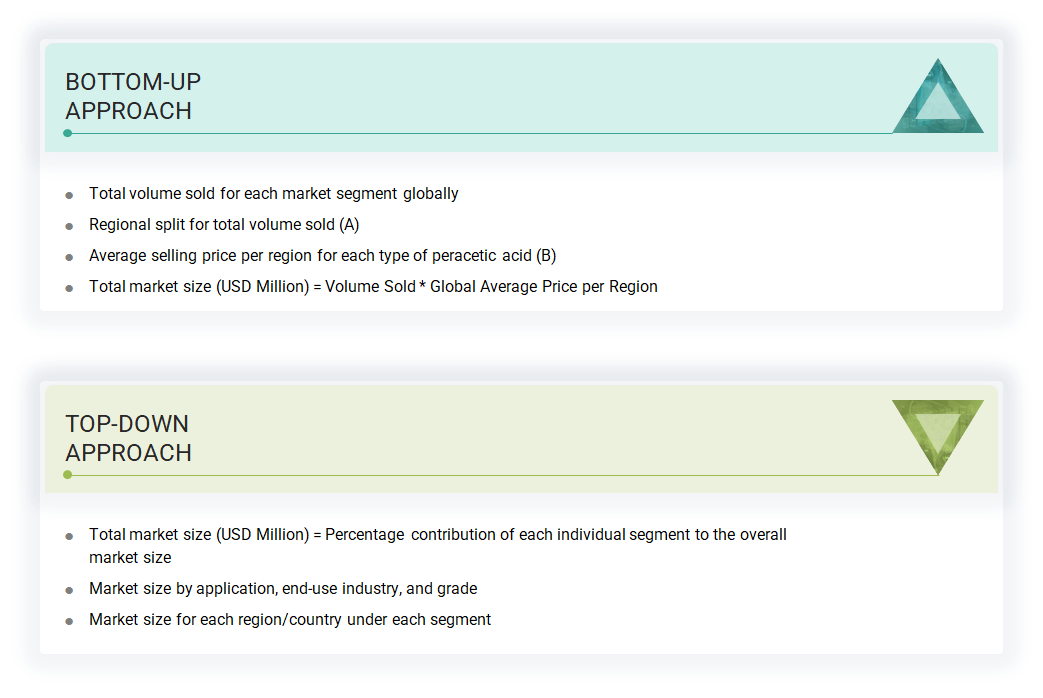
Data Triangulation
After arriving at the overall market size, the market has been split into several segments. To complete the overall market engineering process and arrive at the exact statistics for all segments, the data triangulation and market breakdown procedures have been employed, wherever applicable. The data was triangulated by studying various factors and trends from the demand and supply sides. Along with this, the market size was validated using both the top-down and bottom-up approaches.
Market Definition
Peracetic acid (PAA), also known as peroxyacetic acid, is a colorless, pungent-smelling organic compound widely used as a powerful biocide and oxidizing agent. It is produced through the reaction of acetic acid and hydrogen peroxide in the presence of an acidic catalyst. Available in concentrations ranging from below 5% to 35%, it is extensively used in food & beverage sanitation, healthcare sterilization, water treatment, and pulp & paper industries. Known for its strong antimicrobial efficacy and environmentally friendly decomposition into acetic acid, water, and oxygen, peracetic acid is considered a superior disinfectant, aligning well with sustainability goals and stringent regulatory standards.
Stakeholders
- Peracetic Acid Manufacturers
- Raw Material Suppliers
- Manufacturing Technology Providers
- Industry Associations
- End Users such as Healthcare, Water Treatment, Food, and Pulp & Paper Sectors
- Traders, Distributors, and Suppliers of Peracetic Acid
- Government and Research Agencies and Regional Organizations
Report Objectives
- To analyze and forecast the size of the global peracetic acid market in terms of value and volume
- To provide detailed information about the important drivers, restraints, challenges, and opportunities influencing market growth
- To define, describe, and segment the market based on grade, application, end-use industry, and region
- To forecast the size of the market segments based on regions such as Asia Pacific, North America, Europe, the Middle East & Africa, and South America
- To strategically analyze the segmented markets with respect to individual growth trends, prospects, and contributions to the overall market
- To identify and analyze opportunities for stakeholders in the market
- To analyze competitive developments such as expansions, partnerships & collaborations, mergers & acquisitions, agreements, and product launches in the market
- To strategically profile the key companies and comprehensively analyze their core competencies
Get the Full Peracetic Acid Market Report
Full forecast, segment splits, and company analysis for all Peracetic Acid Market.
- Italy Peracetic Acid Market
- Russia Peracetic Acid Market
- UAE Peracetic Acid Market
- Saudi Arabia Peracetic Acid Market
- South Africa Peracetic Acid Market
- South America Peracetic Acid Market
- China Peracetic Acid Market
- India Peracetic Acid Market
- Japan Peracetic Acid Market
- South Korea Peracetic Acid Market
- Canada Peracetic Acid Market
- Mexico Peracetic Acid Market
- US Peracetic Acid Market
- Germany Peracetic Acid Market
- UK Peracetic Acid Market
- France Peracetic Acid Market
Need a Tailored Report?
Customize this report to your needs
Get 10% FREE Customization
Customize This Report
