
Germany Photoacoustic Imaging Market (2024-2029)

The Germany Photoacoustic Imaging Market was valued at $8.57 Million in 2024 and projected to reach to $11.17 Million by 2029, representing a compound annual growth rate of 5.4%. Germany's photoacoustic imaging market is poised for steady expansion, supported by the country's commitment to healthcare innovation and diagnostic excellence.


| Market Size in | USD 26.32 MN |
| Market Forecast in | |
| CAGR | |
| Forecast Period | |
| Units Considered | Value (USD MN) |
Germany Photoacoustic Imaging Market Trends and Insights
- Germany's advanced healthcare infrastructure and strong medical technology sector position the country as a key player in photoacoustic imaging adoption across Europe.
- The market in Germany is driven by increasing investment in diagnostic imaging technologies and growing clinical applications in oncology and dermatology. The German photoacoustic imaging market benefits from robust research institutions and a highly regulated medical device environment that ensures product quality and safety.
- Germany's emphasis on precision medicine and early disease detection is accelerating the integration of photoacoustic imaging into clinical workflows.
- Between 2024 and 2029, Germany is expected to maintain a compound annual growth rate of 5.4%, reflecting sustained demand from hospitals, diagnostic centers, and research facilities throughout the country. Key factors supporting Germany's market expansion include government healthcare spending, collaboration between academic institutions and industry, and the presence of leading medical technology manufacturers.
- Germany's commitment to innovation in medical imaging positions it as a regional hub for photoacoustic imaging development and commercialization..
Key Market Statistics
- CAGR (2024-2029) 5.4% CAGR
- Market Size, 2024 ~USD 8.57 Million
- Forecast, 2029 ~USD 11.17 Million
- Country Germany
Germany Photoacoustic Imaging Market Overview
Market Valuation :
Germany's photoacoustic imaging market is valued at $8.57 million in 2024, with a projected CAGR of 5.4% through 2029, reaching $11.17 million by forecast end.
Healthcare Infrastructure Advantage :
Germany's advanced healthcare infrastructure and world-class medical technology sector provide a robust foundation for rapid adoption and integration of photoacoustic imaging technologies.
Diagnostic Imaging Investment :
Increasing investment in diagnostic imaging capabilities across German hospitals and research institutions is driving market expansion and clinical adoption of photoacoustic solutions.
European Market Leadership :
Germany positions itself as a key player in photoacoustic imaging adoption across Europe, leveraging its strong medical device manufacturing and innovation ecosystem.
Germany Photoacoustic Imaging Market Dynamics
- The 5.4% CAGR reflects growing clinical recognition of photoacoustic imaging's advantages in non-invasive diagnostics, particularly in oncology and vascular imaging applications.
- German healthcare providers are increasingly investing in advanced imaging modalities to enhance patient outcomes and operational efficiency. The market outlook remains positive as German medical technology companies continue to develop next-generation photoacoustic systems and expand their product portfolios.
- Collaboration between academic institutions, hospitals, and device manufacturers will accelerate technology adoption.
- Regulatory support and reimbursement pathways in Germany are expected to strengthen, further facilitating market penetration and establishing the country as a European hub for photoacoustic imaging innovation..
Market Ecosystem
Related Ecosystem
Medical Devices
- Polymerase Chain Reaction (PCR)
- Magnetic Resonance Imaging (MRI)
- Disposable Autoinjectors
- Pulse Oximeters
- Blood Pressure Monitors
- Medtronic plc
- Abbott Laboratories
- Stryker Corporation
- Becton, Dickinson and Company
- CONMED Corporation
Key Takeaways
- Germany's photoacoustic imaging market is valued at $8.57 million in 2024 and is forecast to reach $11.17 million by 2029, representing a 5.4% CAGR.
- Germany's advanced healthcare infrastructure and strong regulatory framework support widespread adoption of photoacoustic imaging technologies.
- Clinical applications in oncology and dermatology are primary growth drivers in Germany's photoacoustic imaging market.
- Germany's research institutions and medical technology manufacturers position the country as a regional leader in photoacoustic imaging innovation.
Photoacoustic Imaging Market Report Scope
| Report Metric | Details |
|---|---|
| Base Year | 2024 |
| Fastest Growing Segment | HOSPITALS & IMAGING CENTERS (End User) |
| Forecast Period | 2024-2029 |
| Growth Rate | CAGR of 5.5% from 2024 to 2029 |
| Largest Segment | PHOTOACOUSTIC IMAGING (Technology) |
| Market Size Base Year (Billions) | ~USD 0.08 (2024) |
| Revenue Forecast (Billions) | ~USD 0.11 (2029) |
| Segments Covered | Product, Technology, Type, Application, End User |
Germany Photoacoustic Imaging Market Report Segmentation
5 segment dimensions are covered across the global market.
By Product
- Imaging Systems
- Software & Accessories
- Transducers
By Technology
- Photoacoustic Imaging
- Photoacoustic Microscope
- Photoacoustic Microscopy
- Photoacoustic Tomography
By Type
- Clinical/Clinical Research
- Preclinical Research
By Application
- Hematology
- Oncology
- Other Applications
- Veterinary Applications
By End User
- Academic & Research Institutes
- Hospitals & Imaging Centers
Target Audience
- Medical Device Manufacturers : Manufacturers seeking to expand photoacoustic imaging product portfolios in Germany need market-specific data to identify growth opportunities, competitive positioning, and regulatory pathways in Europe's largest healthcare market.
- Healthcare Providers & Hospitals : German hospitals and diagnostic centers require market insights to justify capital investments in photoacoustic imaging technology, understand adoption trends, and benchmark against peer institutions.
- Investment & Private Equity Firms : Investors evaluating opportunities in German medical technology need detailed market sizing, growth projections, and competitive analysis to assess portfolio companies and identify acquisition targets.
- Research Institutions & Universities : German academic medical centers and research organizations need market data to support grant applications, commercialization strategies, and collaboration opportunities in photoacoustic imaging innovation.
- Healthcare Consultants & Advisors : Consulting firms advising German healthcare clients require country-specific market intelligence to develop strategic recommendations, competitive analyses, and technology adoption roadmaps.
Reasons to Buy this Report
- Market-Specific Sizing Data : Access precise valuation figures for Germany's photoacoustic imaging market with detailed 2024-2029 forecasts, enabling accurate budget allocation and investment planning for German market entry.
- Competitive Landscape Intelligence : Understand Germany's unique healthcare infrastructure advantages and identify key competitors and market leaders operating within the German photoacoustic imaging ecosystem.
- Growth Driver Analysis : Gain insights into Germany-specific factors driving market expansion, including diagnostic imaging investments, regulatory environment, and healthcare provider adoption patterns.
- Regional Market Positioning : Benchmark Germany's performance against broader European trends and identify opportunities to leverage the country's position as a key European hub for medical technology innovation.
- Strategic Decision Support : Make informed decisions regarding market entry, partnership development, and product localization strategies tailored specifically to Germany's healthcare market dynamics and customer requirements.
Frequently asked questions
What is the current size of Germany's photoacoustic imaging market?
Germany's photoacoustic imaging market was valued at $8.57 million in 2024 and is expected to grow to $11.17 million by 2029.
What is the projected growth rate for photoacoustic imaging in Germany?
Germany's photoacoustic imaging market is projected to grow at a compound annual growth rate (CAGR) of 5.4% from 2024 to 2029.
Which clinical applications drive Germany's photoacoustic imaging market?
Primary clinical applications in Germany include oncology and dermatology, where photoacoustic imaging is used for early disease detection and precision diagnostics.
What factors support photoacoustic imaging adoption in Germany?
Germany's advanced healthcare infrastructure, strong regulatory environment, government healthcare spending, and collaboration between research institutions and industry support market growth.
How does Germany's market compare to the global photoacoustic imaging market?
Germany's 5.4% CAGR is slightly below the global average of 5.5%, reflecting the country's mature healthcare market and steady, sustainable growth trajectory.
RESEARCH METHODOLOGY
The study involved four major activities in estimating the current size of the photoacoustic imaging market. Exhaustive secondary research was done to collect information on the market, peer, and parent markets. The next step was to validate these findings, assumptions, and sizing with industry experts across the value chain through primary research. Both top-down and bottom-up approaches were employed to estimate the complete market size. After that, market breakdown and data triangulation were used to estimate the market size of segments and subsegments.
Secondary Research
The secondary research process involves the widespread use of secondary sources, directories, databases (such as Bloomberg Businessweek, Factiva, and D&B Hoovers), white papers, annual reports, company house documents, investor presentations, and SEC filings of companies. Secondary research was used to identify and collect information useful for the extensive, technical, market-oriented, and commercial photoacoustic imaging market study. It was also used to obtain important information about the key players and market classification & segmentation according to industry trends to the bottom-most level and key developments related to market and technology perspectives. A database of the key industry leaders was also prepared using secondary research.
Primary Research
In the primary research process, various sources from both the supply and demand sides were interviewed to obtain qualitative and quantitative information for this report. The primary sources from the supply side include industry experts such as CEOs, vice presidents, marketing and sales directors, technology & innovation directors, and related key executives from various key companies and organizations in the photoacoustic imaging market. The primary sources from the demand side include hospitals and imaging centers, research institutes and academia, among others. Primary research was conducted to validate the market segmentation, identify key players in the market, and gather insights on key industry trends & key market dynamics.
A breakdown of the primary respondents is provided below:
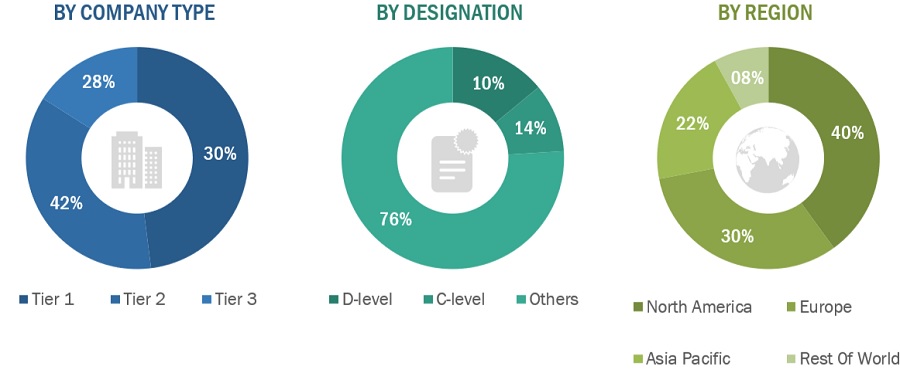
*Others include sales managers, marketing managers, business development managers, product managers, distributors, and suppliers.
Note: Companies are classified into tiers based on their total revenue. As of 2023, Tier 1 = >USD 1,000 million, Tier 2 = USD 500–1,000 million, and Tier 3 = <USD 500 million.
To know about the assumptions considered for the study, download the pdf brochure
Market Estimation Methodology
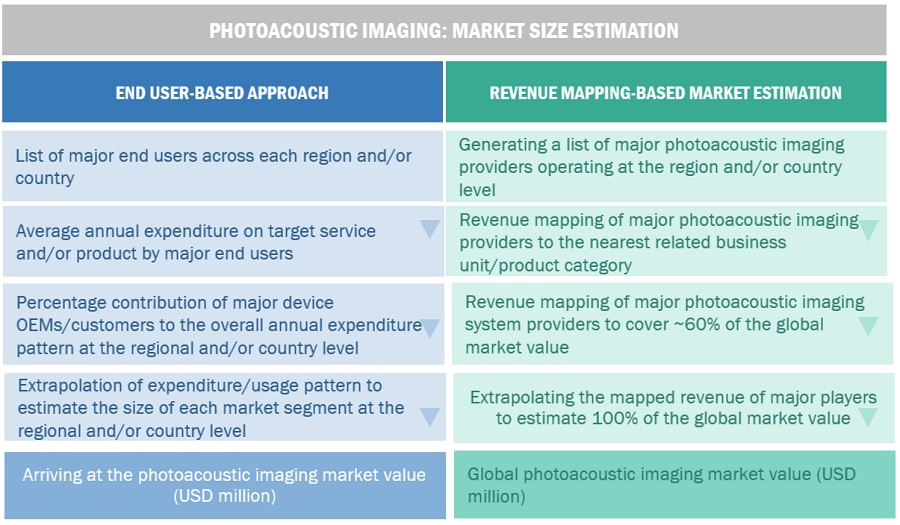
In this report, the global photoacoustic imaging market's size was determined using the revenue share analysis of leading players. For this purpose, key players in the market were identified, and their revenues from the photoacoustic imaging business were determined through various insights gathered during the primary and secondary research phases. Secondary research included the study of the annual and financial reports of the top market players. In contrast, primary research included extensive interviews with key opinion leaders, such as CEOs, directors, and marketing executives.
To calculate the global market value, segmental revenues were calculated based on the revenue mapping of major solution/service providers. This process involved the following steps:
- A list of major players operating in the photoacoustic imaging market at the regional/country level
- Product mapping of various manufacturers for each type of photoacoustic imaging product at the regional/country level
- Mapping of annual revenue generated by listed major players from photoacoustic imaging products segments (or the nearest reported business unit/product category)
- Revenue mapping of major players to cover at least ~60% of the global market share as of 2023
- Extrapolation of the revenue mapping of the listed major players to derive the global market value of the respective segments/subsegments
- Summation of the market value of all segments/subsegments to arrive at the global photoacoustic imaging market
To know about the assumptions considered for the study, Request for Free Sample Report
Data Triangulation
After arriving at the overall market size from the market size estimation process explained above, the photoacoustic imaging market was split into segments and subsegments. Data triangulation and market breakdown procedures were employed to complete the overall market engineering process and arrive at the exact statistics for all segments and subsegments. The data was triangulated by studying various factors and trends from both the demand and supply sides. Additionally, the photoacoustic imaging market was validated using both top-down and bottom-up approaches.
Market Definition
The photoacoustic imaging market refers to the industry segment focused on the development, production, and commercialization of imaging devices and technologies that utilize photoacoustic principles. Photoacoustic imaging combines the advantages of optical and ultrasound imaging techniques, allowing for high-resolution imaging of biological tissues with deep penetration depths. This market encompasses various stakeholders, including manufacturers of photoacoustic imaging systems, research institutions, healthcare providers, and regulatory bodies.
Key Stakeholders
- Photoacoustic imaging manufacturers, suppliers, and providers
- Hospitals and imaging firms
- Contract research organizations (CROs)
- Academic & private research institutions
- Research & development (R&D) companies
- Academic institutions & private research institutions
- Regulatory agencies
- Quality control & assurance companies
- Contract manufacturing organizations (CMOs)
- Environmental & safety regulatory bodies
Objectives of the Study
- To define, describe, and forecast the photoacoustic imaging market based on product, technology, type, application, end-user, and region
- To provide detailed information regarding the major factors influencing the growth potential of the photoacoustic imaging market (drivers, restraints, opportunities, challenges, and trends)
- To analyze the micromarkets with respect to individual growth trends, future prospects, and contributions to the photoacoustic imaging market
- To analyze key growth opportunities in the photoacoustic imaging market for key stakeholders and provide details of the competitive landscape for market leaders
- To forecast the size of market segments and/or subsegments with respect to five major regions, namely, North America (US and Canada), Europe (Germany, France, the UK,and the RoE), Asia Pacific (Japan, China, India, and the RoAPAC), Rest of world.
- To profile the key players in the global photoacoustic imaging market and comprehensively analyze their market shares and core competencies
- To track and analyze the competitive developments undertaken in the global photoacoustic imaging market, such as product launches; agreements; expansions; and mergers & acquisitions.
Available Customizations
With the given market data, MarketsandMarkets offers customizations per the company’s specific needs. The following customization options are available for the present photoacoustic imaging market report:
Product Analysis
- Product matrix, which gives a detailed comparison of the product portfolios of the top five companies
Company Information
- Detailed analysis and profiling of additional market players (up to five)
Geographic Analysis
- Further breakdown of the Rest of Europe photoacoustic imaging into Russia, Belgium, the Netherlands, Switzerland, Austria, Finland, Sweden, Poland, and Portugal, among others
- Further breakdown of the Rest of Asia Pacific photoacoustic imaging into Singapore, Taiwan, New Zealand, Philippines, Malaysia, and other APAC countries
Get the Full Photoacoustic Imaging Market Report
Full forecast, segment splits, and company analysis for all Photoacoustic Imaging Market.
Need a Tailored Report?
Customize this report to your needs
Get 10% FREE Customization
Customize This Report
