
Saudi Arabia Polyols Market (2025-2030)

The Saudi Arabia Polyols Market was valued at $69.5 Million in 2025 and projected to reach to $83.8 Million by 2030, representing a compound annual growth rate of 3.8%. Saudi Arabia's polyols market is positioned for steady growth through 2030, driven by expanding demand from the foam, adhesive, and coating sectors.


| Market Size in | USD 26.32 MN |
| Market Forecast in | |
| CAGR | |
| Forecast Period | |
| Units Considered | Value (USD MN) |
Saudi Arabia Polyols Market Trends and Insights
- South Africa's polyols sector is driven by demand from the foam, adhesive, and coating industries, which remain critical end-use segments across the region.
- In 2025, South Africa's market reflects steady industrial activity, with polyols serving as essential raw materials for polyurethane production and specialty applications. By 2030, South Africa is expected to experience moderate but consistent growth as manufacturing capacity expands and downstream industries recover.
- South Africa's polyols market benefits from regional trade dynamics within the Middle East Africa segment, though growth remains constrained by competition from imported products and raw material cost volatility.
- South Africa's chemical sector continues to invest in polyol-based solutions for construction, automotive, and consumer goods applications, positioning the country as a key market within the broader African polyols landscape..
Key Market Statistics
- CAGR (2025-2030) 3.8% CAGR
- Market Size, 2025 ~USD 69.5 Million
- Forecast, 2030 ~USD 83.8 Million
- Country Saudi Arabia
Saudi Arabia Polyols Market Overview
Market Size & Growth :
Saudi Arabia's polyols market is valued at USD 69.5 million in 2025 and is projected to reach USD 83.8 million by 2030, growing at a CAGR of 3.8%, outpacing regional averages.
Key End-Use Industries :
Demand is primarily driven by the foam, adhesive, and coating industries, which are critical segments supported by Saudi Arabia's construction, automotive, and manufacturing sectors.
Industrial Activity :
Saudi Arabia's polyols market reflects steady industrial activity in 2025, supported by Vision 2030 initiatives and increased investment in diversified manufacturing and construction projects.
Regional Competitiveness :
With a 3.8% CAGR compared to the global rate of 5.1%, Saudi Arabia presents a stable, growing market with opportunities for strategic expansion and localized production capabilities.
Saudi Arabia Polyols Market Dynamics
- The Kingdom's Vision 2030 economic diversification strategy is catalyzing investments in manufacturing infrastructure and construction projects, creating sustained demand for polyol-based products.
- Industrial activity remains robust as domestic industries modernize and increase production capacity. The market outlook is supported by growing automotive and construction sectors, coupled with rising demand for high-performance materials.
- Strategic investments in petrochemical facilities and manufacturing hubs will further strengthen polyol consumption.
- While growth rates remain moderate compared to global benchmarks, Saudi Arabia's market offers stable, predictable expansion opportunities for suppliers and manufacturers targeting the Gulf region..
Market Ecosystem
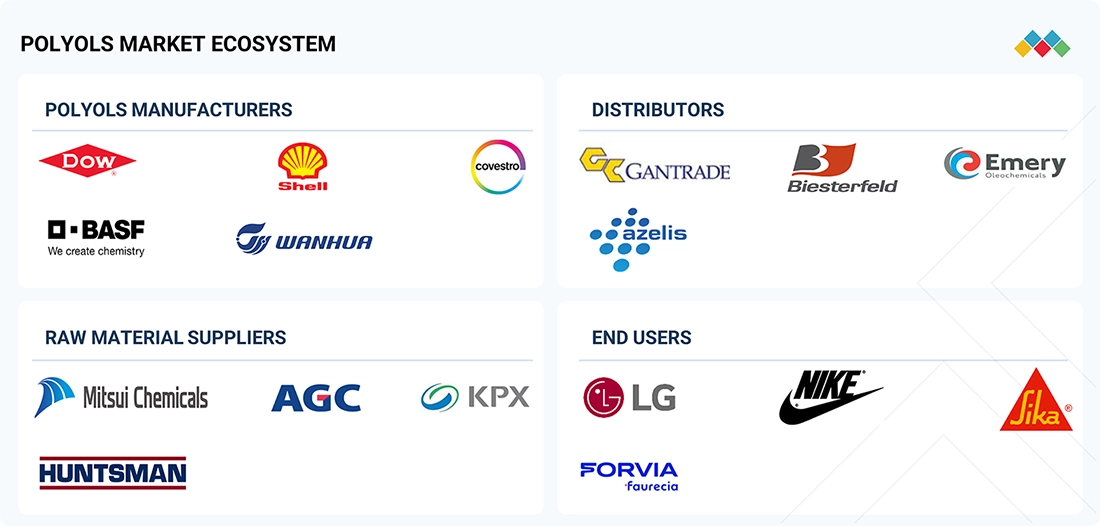
POLYOLS MARKET: COMMERCIAL USE CASES ACROSS INDUSTRIES
| COMPANY | USE CASE DESCRIPTION | BENEFITS |
|---|---|---|
 |
Covestro developed a sustainable cast polyurethane elastomer for offshore wind energy applications using Cardyon®, a CO2-based polyol. The solution was designed to deliver high durability, mechanical stability, and resistance to hydrolysis in harsh marine environments, while reducing dependence on fossil-based feedstocks and supporting environmental sustainability. | The CO2-based elastomer delivers excellent performance under dynamic loading, resists hydrolysis, and reduces the carbon footprint. It demonstrates the feasibility of using captured CO2 in demanding industrial applications, promoting circularity and sustainability across renewable energy sectors. |
 |
Huntsman produced TEROL® polyester polyols from recycled PET bottles to manufacture rigid polyurethane insulation foams. The goal was to divert plastic waste from landfills, improve building energy efficiency, and meet insulation performance and fire safety regulations for residential, commercial, and industrial applications. | TEROL® polyols improve compressive strength, thermal insulation, and flame-retardant performance while converting more than one billion PET bottles annually into valuable materials. This approach reduces plastic waste, lowers building energy consumption, and supports scalable, circular, and environmentally compliant construction solutions. |
 |
BASF engineered low-emission Lupranol® polyether polyols to reduce aldehyde emissions from polyurethane foams used in automotive interiors. The goal was to help OEMs meet strict VOC regulations while maintaining foam properties, including resilience, durability, and processability, for components such as headrests, seats, and insulation panels. | Low-emission polyols reduce formaldehyde and acetaldehyde by up to 20%, meeting VDA276 and BMW GS 97014-3 standards. The solution improves in-cabin air quality without affecting foam processing, supporting regulatory compliance and healthier environments for vehicle occupants. |
Logos and trademarks shown above are the property of their respective owners. Their use here is for informational and illustrative purposes only.
Related Ecosystem
Resins And Polymers
- Polycarbonate
- Acrylonitrile Butadiene Styrene (ABS)
- Epoxy Resin
- Light Commercial Vehicles (LCVs)
- Polypropylene (PP)
- Basf se
- DOW CHEMICAL COMPANY
- Solvay sa
- Saudi arabia basic industries corporation (sabic)
- DuPont de Nemours, Inc.
Key Takeaways
- South Africa's polyols market is valued at USD 69.5 million in 2025 and will reach USD 83.8 million by 2030.
- South Africa experiences a 3.8% CAGR, reflecting moderate but steady growth driven by foam and adhesive applications.
- South Africa's market growth is supported by regional manufacturing expansion and downstream industrial demand.
- South Africa faces competitive pressures from imports and raw material cost fluctuations affecting market dynamics.
Polyols Market Report Scope
| Report Metric | Details |
|---|---|
| Base Year | 2025 |
| Fastest Growing Segment | BUILDING & CONSTRUCTION (End-Use Industry) |
| Forecast Period | 2025–2030 |
| Growth Rate | CAGR of 5.1% from 2025 to 2030 |
| Largest Segment | POLYETHER POLYOLS (Type) |
| Market Size Base Year (Billions) | ~USD 16.84 (2025) |
| Revenue Forecast (Billions) | ~USD 21.59 (2030) |
| Segments Covered | Type, Application, End-Use Industry |
Saudi Arabia Polyols Market Report Segmentation
3 segment dimensions are covered across the global market.
By Type
- Polyester Polyols
- Polyether Polyols
By Application
- Case
- Coatings, Adhesives, Sealants, And Elastomers (Case)
- Flexible Polyurethane Foam
- Rigid Polyurethane Foam
By End-Use Industry
- Automotive
- Building & Construction
- Electronics
- Furnishing
- Other End-Use Industries
- Packaging
Target Audience
- Chemical Manufacturers : Polyol producers and chemical companies need Saudi Arabia-specific market data to assess demand, plan production capacity, and identify localization opportunities.
- Foam & Adhesive Producers : End-use manufacturers in foam, adhesive, and coating sectors require market insights to forecast raw material demand and optimize supply chain strategies in Saudi Arabia.
- Investment & Private Equity : Investors evaluating opportunities in Saudi Arabia's chemical sector need accurate market sizing and growth projections to assess portfolio companies and acquisition targets.
- Business Development Executives : Corporate strategists and BD teams need Saudi Arabia polyols market intelligence to identify partnerships, distribution channels, and expansion opportunities in the Kingdom.
- Market Research & Consulting Firms : Research organizations and consultants require detailed Saudi Arabia market data to support client advisory services, competitive analysis, and industry benchmarking reports.
Key Companies in the Saudi Arabia Polyols Market
| Company | HQ | Ownership | Strongest segments |
|---|---|---|---|
| HEXION INC | United States | Private Company | Engineered wood and industrial adhesives,Formaldehyde and derivative products,Melamine-based resins and specialty monomers, |
| MOL GROUP | Hungary | Public Company | Fuels (gasoline, diesel, heating oil, bunker, autogas, JET A-1),Petrochemicals and black products (bitumen, HFO, petrolcoke, residues),Retail convenience and mobility services (Fresh Corner, car/bike sharing, fleet), |
| DOW | United States | Public Company | Packaging & Specialty Plastics,Industrial Intermediates & Infrastructure,Performance Materials & Coatings, |
| COVESTRO AG | Germany | Public Company | Performance Materials (MDI, TDI, polyols, base polycarbonates),Solutions & Specialties (specialty polycarbonates, TPU, films, elastomers, coatings precursors), |
| BASF SE | Germany | Public Company | Chemicals,Materials,Industrial Solutions, |
| HUNTSMAN INTERNATIONAL LLC | United States | Private Company | MDI and Polyurethane Systems,Polyols, TPU, and Related Intermediates,Amines, Maleic Anhydride, and Carbonates, |
| SHELL | United Kingdom | Public Company | Integrated Gas (including LNG and GTL),Upstream (oil, gas, NGLs),Marketing (mobility, lubricants, commercial fuels), |
| STEPAN COMPANY | United States | Public Company | Surfactants,Polymers,Specialty Products, |
| WANHUA CHEMICAL GROUP | China | Public Company | Polyurethane (isocyanates, polyether polyols, TPU, nylon elastomers),Petrochemicals (olefin derivatives, ethylene, caustic soda, specialty PVC, chlorine products),Fine Chemicals and New Materials (specialty isocyanates, amines, PMMA, polyolefin elastomers, membranes, SAP, cable materials), |
| REPSOL S.A. | Spain | Public Company | Industrial (refining, trading, wholesale fuels & gas, hydrogen, sustainable/synthetic fuels),Upstream (oil & gas exploration and production, low-carbon geological solutions),Customer (mobility/gas stations, retail electricity & gas, lubricants, LPG, aviation, apps/tools), |
| PCC SE | Germany | Private Company | Polyols and polyurethane systems,Surfactants and derivatives,Chlorine, monochloroacetic acid, and chlorine derivatives, |
| LANXESS | Germany | Public Company | Consumer Protection,Specialty Additives,Advanced Intermediates, |
| SHANDONG LONGHUA NEW MATERIAL CO., LTD. | China | Public Company |
HEXION INC
HEXION INC is a private company headquartered in the United States with 2,600 employees, tracing its origins to 1857.
MOL GROUP
MOL GROUP is a Hungarian public company founded in 1991 with 24,744 employees.
DOW
DOW is a major public chemical company based in the United States, founded in 1897 and employing 34,600 people.
COVESTRO AG
COVESTRO AG is a German public company founded in 1863 with 17,806 employees.
BASF SE
BASF SE is a German public company founded in 1865 and is one of the world's largest chemical producers with 106,428 employees.
HUNTSMAN INTERNATIONAL LLC
HUNTSMAN INTERNATIONAL LLC is a private chemical company based in the United States, founded in 1970 with 6,000 employees.
SHELL
SHELL is a major public energy and chemical company headquartered in the United Kingdom, founded in 1897 with 84,000 employees.
STEPAN COMPANY
STEPAN COMPANY is a public chemical company based in the United States, founded in 1932 with 2,328 employees.
WANHUA CHEMICAL GROUP
WANHUA CHEMICAL GROUP is a Chinese public company founded in 1978 with 30,772 employees.
REPSOL S.A.
REPSOL S.A. is a Spanish public energy and chemical company founded in 1927 with 24,523 employees.
PCC SE
PCC SE is a private chemical company based in Germany, founded in 1993 with 3,115 employees.
LANXESS
LANXESS is a German public chemical company founded in 1863 with 11,630 employees.
SHANDONG LONGHUA NEW MATERIAL CO., LTD.
SHANDONG LONGHUA NEW MATERIAL CO., LTD. is a Chinese public company founded in 2011 with 615 employees.
Reasons to Buy this Report
- Accurate Market Sizing : Obtain precise valuation data for Saudi Arabia's polyols market (USD 69.5M in 2025) with reliable 5-year forecasts to support investment and expansion decisions.
- Sector-Specific Insights : Understand demand drivers across foam, adhesive, and coating industries specific to Saudi Arabia's industrial landscape and Vision 2030 initiatives.
- Competitive Benchmarking : Compare Saudi Arabia's 3.8% CAGR against global 5.1% growth to identify market positioning and competitive opportunities in the region.
- Strategic Planning : Leverage detailed market intelligence to develop targeted go-to-market strategies, capacity planning, and partnership opportunities in Saudi Arabia.
- Risk Mitigation : Make informed decisions with comprehensive market analysis covering industrial trends, growth catalysts, and economic factors specific to the Saudi Arabian polyols sector.
Frequently asked questions
What is the current size of South Africa's polyols market?
South Africa's polyols market is estimated at USD 69.5 million in 2025, based on verified market data.
What is the projected market size for South Africa's polyols by 2030?
South Africa's polyols market is forecast to reach USD 83.8 million by 2030, representing growth from the 2025 baseline.
What is the CAGR for South Africa's polyols market?
South Africa's polyols market is expected to grow at a compound annual growth rate of 3.8% between 2025 and 2030.
Which industries drive demand for polyols in South Africa?
South Africa's polyols demand is primarily driven by foam manufacturing, adhesives, coatings, and polyurethane production across construction and automotive sectors.
What challenges does South Africa's polyols market face?
South Africa's polyols market faces challenges including import competition, raw material cost volatility, and manufacturing capacity constraints.
RESEARCH METHODOLOGY
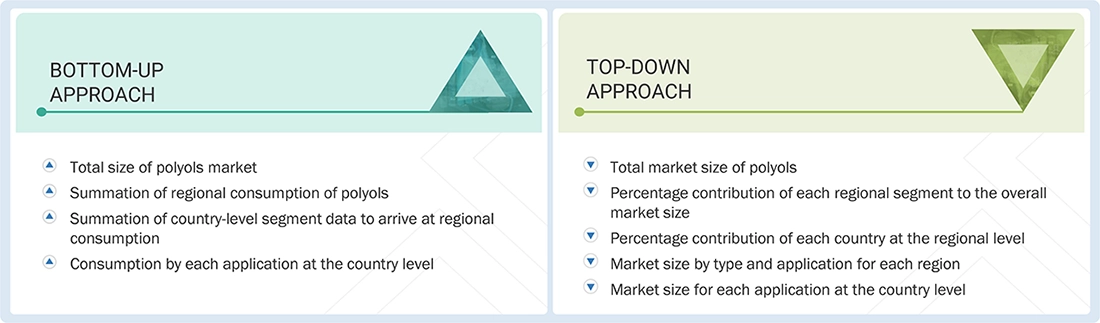
The study involved four major activities to estimate the current size of the global polyols market. Exhaustive secondary research was carried out to collect information on the market, the peer product market, and the parent product group market. The next step was to validate these findings, assumptions, and sizes with the industry experts across the value chain of polyols through primary research. The top-down and bottom-up approaches were employed to estimate the overall size of the polyols market. After that, market breakdown and data triangulation procedures were used to determine the size of different market segments.
Secondary Research
The market for companies offering polyols was arrived at through secondary data available through paid and unpaid sources, analyzing the product portfolios of major companies in the ecosystem, and rating the companies by their performance and quality. For this study, various secondary sources, such as Business Standard, Bloomberg, the World Bank, and Factiva, were referred to identify and collect information on the polyols market. In the secondary research process, various secondary sources were referred to identify and collect information related to the study. Secondary sources included annual reports, press releases, and investor presentations of polyols vendors, forums, certified publications, and whitepapers. Secondary research was used to obtain critical information on the industry’s value chain, the total pool of key players, market classification, and segmentation from market- and technology-oriented perspectives.
Primary Research
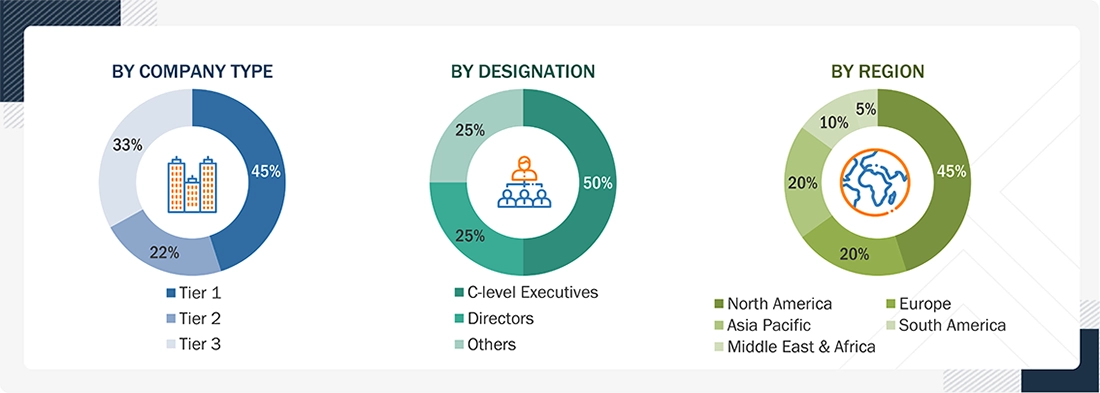
In the primary research process, various primary sources from the supply and demand sides were interviewed to obtain qualitative and quantitative information for this report. The primary sources from the supply side included industry experts, such as chief executive officers (CEOs), vice presidents (VPs), marketing directors, technology and innovation directors, and related key executives from several key companies and organizations operating in the polyols market. After the complete market engineering (calculations for market statistics, market breakdown, market size estimations, market forecasting, and data triangulation), extensive primary research was conducted to gather information and verify and validate the critical numbers arrived at.
Primary research was also conducted to identify the segmentation types, industry trends, competitive landscape of polyols offered by various market players, and key market dynamics, such as drivers, restraints, opportunities, challenges, trends, and key player strategies. In the complete market engineering process, the top-down and bottom-up approaches and several data triangulation methods were extensively used to perform the market estimation and market forecasting for the overall market segments and subsegments listed in this report. Extensive qualitative and quantitative analysis was performed throughout the market engineering process to list key information/insights throughout the report.
To know about the assumptions considered for the study, download the pdf brochure
Market Size Estimation
The top-down and bottom-up approaches were used to estimate and validate the size of the global polyols market. These approaches were also used extensively to estimate the size of various dependent market segments. The research methodology used to estimate the market size included the following:
Data Triangulation
After arriving at the overall market size using the market size estimation processes, the market was split into several segments and subsegments. The data triangulation and market breakup procedures were employed, wherever applicable, to complete the overall market engineering process and arrive at the exact statistics of each market segment and subsegment. The data was triangulated by studying various factors and trends from the demand and supply sides.
Market Definition
According to the Polyurethane Manufacturers Association (PMA), a polyol is a chemical compound containing more than one reactive hydroxyl (–OH) group per molecule. These hydroxyl groups are vital for the polyol’s role in polyurethane production because they chemically react with di- or poly-isocyanates to create urethane linkages. This reaction forms the core of polyurethane polymers, which are used in many applications, including flexible and rigid foams, coatings, adhesives, sealants, and elastomers. The number and arrangement of hydroxyl groups within a polyol molecule determine its reactivity and functionality, directly impacting the physical, mechanical, and thermal properties of the final polyurethane material.
Key Stakeholders
- Raw material suppliers
- Polyol manufacturers
- Retailers and distributors
- Research & development entities
- Industry associations and regulatory bodies
- End users
Report Objectives
- To define, describe, and forecast the size of the global polyols market, by type, application, and end-use industry, in terms of value and volume
- To forecast the market size of segments for North America, Europe, Asia Pacific, South America, and the Middle East & Africa, along with their respective countries, in terms of value and volume
- To provide detailed information on the significant drivers, restraints, opportunities, and challenges influencing the market
- To strategically analyze micromarkets concerning individual growth trends, prospects, and their contribution to the market
- To assess the growth opportunities in the market for stakeholders and provide details on the competitive landscape for market leaders
- To strategically profile key players and comprehensively analyze their market shares and core competencies
- To analyze competitive developments, such as acquisitions, product launches, investments, expansions, and agreements in the polyols market
- To provide the impact of AI/Gen AI on the market
- To provide the macroeconomic outlook for each region covered under the study, and the impact of the 2025 US tariff on the market
Available customizations:
With the given market data, MarketsandMarkets offers customizations according to client-specific needs.
The following customization options are available for the polyols report:
Product Analysis
- A product matrix that gives a detailed comparison of the product portfolio of each company
Regional Analysis
- A further breakdown of the polyols market for additional countries
Company Information
- Detailed analysis and profiling of additional market players (up to five)
Get the Full Polyols Market Report
Full forecast, segment splits, and company analysis for all Polyols Market.
- South America Polyols Market
- Rest Of Europe Polyols Market
- Rest Of Asia Pacific Polyols Market
- China Polyols Market
- India Polyols Market
- Japan Polyols Market
- South Korea Polyols Market
- Thailand Polyols Market
- Indonesia Polyols Market
- Germany Polyols Market
- UK Polyols Market
- France Polyols Market
- Italy Polyols Market
- Russia Polyols Market
- Turkey Polyols Market
- Canada Polyols Market
- Mexico Polyols Market
- US Polyols Market
- UAE Polyols Market
- South Africa Polyols Market
- Brazil Polyols Market
- Argentina Polyols Market
- GCC Countries Polyols Market
- –Rest Of The GCC Countries Polyols Market
- Rest Of South America Polyols Market
Need a Tailored Report?
Customize this report to your needs
Get 10% FREE Customization
Customize This Report
