
Mexico Preclinical Imaging Market (2024-2029)

The Mexico Preclinical Imaging Market was valued at $5.6 Million in 2024 and projected to reach to $6.8 Million by 2029, representing a compound annual growth rate of CAGR 3.8%. Mexico's preclinical imaging market is positioned for moderate but consistent growth through 2029, driven by expanding research capabilities and pharmaceutical sector development.


| Market Size in | USD 26.32 MN |
| Market Forecast in | |
| CAGR | |
| Forecast Period | |
| Units Considered | Value (USD MN) |
Mexico Preclinical Imaging Market Trends and Insights
- Mexico's market growth is driven by increasing investment in research infrastructure, rising pharmaceutical development activities, and growing adoption of advanced imaging technologies in academic and contract research organizations.
- The market in Mexico remains smaller than global counterparts but reflects steady demand for preclinical imaging solutions in drug discovery and development pipelines. The preclinical imaging sector in Mexico benefits from regional pharmaceutical expansion and collaboration with international research institutions.
- Mexico's strategic position in Latin America positions it as an emerging hub for preclinical research, supported by government initiatives and private sector investment in life sciences.
- Between 2024 and 2029, Mexico's market is expected to experience moderate but consistent growth as laboratories upgrade imaging capabilities and research institutions expand their preclinical testing capacities..
Key Market Statistics
- CAGR (2024-2029) CAGR 3.8%
- Market Size, 2024 ~USD 5.6 Million
- Forecast, 2029 ~USD 6.8 Million
- Country Mexico
Mexico Preclinical Imaging Market Overview
Market Valuation :
Mexico's preclinical imaging market reached $5.6 million in 2024, with steady growth projected to $6.8 million by 2029, reflecting increasing adoption of imaging technologies in research institutions.
Research Infrastructure Investment :
Growing government and private sector investment in Mexico's research infrastructure is driving demand for advanced preclinical imaging systems in universities and research centers.
Pharmaceutical Development Growth :
Rising pharmaceutical development activities in Mexico, including contract research organization (CRO) expansion, are accelerating the need for preclinical imaging capabilities.
Technology Adoption Trends :
Mexican academic institutions and contract research organizations are increasingly adopting advanced imaging technologies to enhance drug discovery and development processes.
Mexico Preclinical Imaging Market Dynamics
- The country's growing role as a regional research hub and increasing collaboration with international pharmaceutical companies are creating new opportunities for imaging technology deployment.
- Investment in research infrastructure and the establishment of advanced CRO facilities are expected to sustain market expansion.
- However, growth remains constrained by budget limitations in academic institutions and the need for technology localization.
- Strategic partnerships and government support for research initiatives will be critical to accelerating market penetration in the coming years..
Market Ecosystem

Preclinical Imaging Market: COMMERCIAL USE CASES ACROSS INDUSTRIES
| COMPANY | USE CASE DESCRIPTION | BENEFITS |
|---|---|---|
 |
Use of PET/MRI, PET/SPECT/CT, and micro-MRI systems for oncology, neurology, and cardiovascular preclinical research. | High-resolution multimodal imaging enables the detection of biomarkers earlier, improves disease modeling, and reduces animal usage. |
 |
Optical/bioluminescence/fluorescence imaging for tracking tumor burden, cell trafficking, and gene expression in vivo. | Real-time molecular imaging accelerates drug discovery, reduces study timelines, and allows non-terminal longitudinal studies. |
 |
In vivo confocal endomicroscopy for preclinical tissue micro-architecture assessment. | Provides cellular-level imaging without the need for invasive biopsy, thereby improving tissue-level validation in drug toxicology. |
 |
Ultra-high-frequency ultrasound & photoacoustic imaging for cardiovascular, oncology, and developmental biology. | Enables non-invasive functional imaging (blood flow, oxygenation) with unmatched resolution for small animals. |
 |
Preclinical PET/CT and PET/SPECT platforms for high-sensitivity molecular imaging. | High detector sensitivity supports low-dose protocols and cost-efficient radiotracer studies. |
Logos and trademarks shown above are the property of their respective owners. Their use here is for informational and illustrative purposes only.
Related Ecosystem
Diagnostic Imaging
- Magnetic Resonance Imaging (MRI)
- Computed Tomography (CT)
- CT Scanners
- Nuclear Imaging
- Positron Emission Tomography
- Siemens healthineers
- PHILIPS HEALTHCARE
- CANON INC.
- FUJIFILM Holdings Corporation
- UNITED IMAGING HEALTHCARE CO., LTD.
Medical Devices
- Polymerase Chain Reaction (PCR)
- Magnetic Resonance Imaging (MRI)
- Disposable Autoinjectors
- Pulse Oximeters
- Blood Pressure Monitors
- Medtronic plc
- Abbott Laboratories
- Stryker Corporation
- Becton, Dickinson and Company
- CONMED Corporation
Key Takeaways
- Mexico's preclinical imaging market is valued at $5.6 million in 2024 with projected growth to $6.8 million by 2029.
- Mexico experiences a 3.8% CAGR, reflecting steady but moderate expansion in preclinical research infrastructure.
- Mexico's market growth is supported by pharmaceutical development activities and international research collaborations.
- Mexico's emerging position in Latin America creates opportunities for laboratory modernization and imaging technology adoption.
Preclinical Imaging Market Report Scope
| Report Metric | Details |
|---|---|
| Base Year | 2024 |
| Fastest Growing Segment | NUCLEAR IMAGING SYSTEMS (Type) |
| Forecast Period | 2024–2029 |
| Growth Rate | CAGR of 5% from 2024 to 2029 |
| Largest Segment | PHARMACEUTICAL & BIOTECHNOLOGY COMPANIES (End User) |
| Market Size Base Year (Billions) | ~USD 4 (2024) |
| Revenue Forecast (Billions) | ~USD 5.1 (2029) |
| Segments Covered | Product, Type, Application, End User |
Mexico Preclinical Imaging Market Report Segmentation
4 segment dimensions are covered across the global market.
By Product
- Imaging Systems
- Reagents
- Software
By Type
- Barium-Based Contrast Agents
- Bioluminescence Imaging Systems
- Fluorescence Imaging Systems
- Gadolinium-Based Contrast Agents
- Gallium-67-Based Spect Probes
- Gastrografin-Based Contrast Agents
- Gold Nanoparticles
- Iodine-131-Based Spect Probes
- Iodine-Based Contrast Agents
- Iron-Based Contrast Agents
- Magnetic Particle Imaging Systems
- Manganese-Based Contrast Agents
- Micro-Ct Systems
- Micro-Mri Systems
- Micro-Ultrasound Systems
- Nuclear Imaging Systems
- Optical Imaging Systems
- Other Optical Imaging Systems
- Other Spect Probes
- Photoacoustic Imaging Systems
- Technetium-99M-Based Spect Probes
- Thallium-201-Based Spect Probes
By Application
- Cardiology
- Immunology & Inflammation
- Infectious Diseases
- Neurology
- Oncology
- Other Applications
By End User
- Academic & Research Centers
- Imaging Centers
- Other End Users
- Pharmaceutical & Biotechnology Companies
MEXICO: PRECLINICAL IMAGING MARKET, BY END USER, 2023–2029
| Segment | 2023 | 2024 | 2025 | 2026 | 2027 | 2028 | 2029 | CAGR (%) |
|---|---|---|---|---|---|---|---|---|
| ACADEMIC & RESEARCH CENTERS | 8.83 | 9.25 | 9.69 | 10.15 | 10.64 | 11.15 | 11.68 | 4.8 |
| IMAGING CENTERS | 4.96 | 5.22 | 5.49 | 5.78 | 6.08 | 6.39 | 6.72 | 5.2 |
| OTHER END USERS | 2.21 | 2.28 | 2.36 | 2.44 | 2.52 | 2.61 | 2.69 | 3.4 |
| PHARMACEUTICAL & BIOTECHNOLOGY COMPANIES | 39.16 | 40.92 | 42.76 | 44.68 | 46.68 | 48.77 | 50.95 | 4.5 |
| TOTAL | 55.16 | 57.67 | 60.3 | 63.05 | 65.91 | 68.91 | 72.04 | 4.6 |
Target Audience
- Medical Device Manufacturers : Preclinical imaging equipment manufacturers need Mexico-specific market data to identify expansion opportunities, assess demand for advanced imaging systems, and develop localized sales strategies.
- Pharmaceutical and Biotech Companies : Drug developers and biotech firms require insights into Mexico's research capabilities and imaging technology adoption to optimize preclinical research operations and CRO partnerships.
- Contract Research Organizations : CROs operating in Mexico need market intelligence to justify technology investments, benchmark service offerings, and identify growth opportunities in the expanding Mexican research sector.
- Research Institutions and Universities : Academic research centers in Mexico require market data to support funding proposals, justify equipment procurement, and understand technology trends in preclinical imaging.
- Investment and Consulting Firms : Investors and consultants need Mexico-specific market analysis to evaluate investment opportunities, assess market viability, and develop strategic recommendations for healthcare technology clients.
Key Companies in the Mexico Preclinical Imaging Market
| Company | HQ | Ownership | Strongest segments |
|---|---|---|---|
| PATHEON INC | Netherlands | Private Company | Optical Imaging (Bioluminescance),PET,SPECT, |
| ANALOGIC CORPORATION | United States | Private Company | MRI,PET,SPECT, |
| XILINX, INC. | United States | Private Company | Optical Imaging (Bioluminescance),PET,SPECT, |
| GUERBET GROUP | France | InvalidIdentifier | PET,SPECT,MRI, |
| BRUKER CORPORATION | United States | Public Company | MRI,PET,SPECT, |
| REVVITY, INC. | United States | Public Company | Optical Imaging (Bioluminescance),PET,SPECT, |
| OPTISCAN IMAGING LTD. | Australia | Public Company | Optical Imaging (Bioluminescance),PET,SPECT, |
PATHEON INC
Patheon Inc. is a Netherlands-based private company with 9,100 employees operating in the pharmaceutical and life sciences sector.
ANALOGIC CORPORATION
Analogic Corporation is a United States-based private company founded in 1967 with 1,510 employees, specializing in medical and aerospace technology solutions.
XILINX, INC.
Xilinx, Inc. is a United States-based private company founded in 1984 with 4,890 employees, operating in the semiconductor and programmable logic industry.
GUERBET GROUP
Guerbet Group is a France-based company in the medical imaging and pharmaceutical sector.
BRUKER CORPORATION
Bruker Corporation is a United States-based public company founded in 1960 with 11,085 employees, providing scientific instruments and analytical solutions.
REVVITY, INC.
Revvity, Inc. is a United States-based public company founded in 1937 with 11,000 employees, operating in the life sciences and diagnostics industry.
OPTISCAN IMAGING LTD.
Optiscan Imaging Ltd. is an Australia-based public company founded in 1994 with 9 employees, specializing in optical imaging technology.
Reasons to Buy this Report
- Market-Specific Growth Insights : Understand Mexico's unique 3.8% CAGR trajectory and identify growth drivers specific to the Mexican market, including pharmaceutical development acceleration and research infrastructure expansion.
- Investment Opportunity Assessment : Evaluate market entry strategies and investment potential in Mexico's preclinical imaging sector with detailed valuation data and five-year forecasts tailored to the Mexican landscape.
- Competitive Landscape Analysis : Gain insights into Mexico-specific competitive dynamics, key players, and market positioning strategies to inform business development and partnership decisions in the region.
- Regulatory and Infrastructure Context : Access Mexico-focused analysis of research infrastructure development, regulatory environment, and institutional adoption patterns affecting preclinical imaging technology deployment.
- Regional Market Differentiation : Distinguish Mexico's market characteristics from broader Latin American trends and global markets to develop targeted go-to-market strategies and resource allocation plans.
Frequently asked questions
What is the current size of Mexico's preclinical imaging market?
Mexico's preclinical imaging market was valued at $5.6 million in 2024 and is expected to reach $6.8 million by 2029.
What is the growth rate for preclinical imaging in Mexico?
Mexico's preclinical imaging market is projected to grow at a CAGR of 3.8% from 2024 to 2029.
What factors are driving growth in Mexico's preclinical imaging market?
Mexico's market growth is driven by increased pharmaceutical development, investment in research infrastructure, and adoption of advanced imaging technologies in research institutions.
How does Mexico's preclinical imaging market compare to other Latin American countries?
Mexico represents a significant market within Latin America, with steady growth supported by its pharmaceutical sector and emerging research capabilities.
What imaging technologies are most used in Mexico's preclinical research?
Mexico's preclinical imaging sector utilizes various technologies including microCT, MRI, ultrasound, and optical imaging systems for drug discovery and development applications.
RESEARCH METHODOLOGY
This market research study utilized extensive secondary sources, directories, and databases to identify and collect information relevant to this technical, market-oriented, and financial analysis of the preclinical imaging market. In-depth interviews were conducted with various primary respondents, including key industry participants, subject-matter experts (SMEs), C-level executives of key market players, and industry consultants, among other experts, to gather and verify critical qualitative and quantitative information, as well as to assess market prospects. The size of the preclinical imaging market was estimated through various secondary research approaches and triangulated with inputs from primary research to arrive at the final market size.
Secondary Research
The secondary research process involved the widespread use of secondary sources, directories, databases (such as Bloomberg Businessweek, Factiva, and D&B Hoovers), white papers, annual reports, company house documents, investor presentations, and SEC filings of companies. Secondary research was employed to identify and collect information relevant to the comprehensive, technical, market-oriented, and commercial study of the preclinical imaging market. It was also used to obtain important information about key players, market classification, and segmentation according to industry trends, as well as key developments related to market and technology perspectives, down to the most detailed level. A database of the key industry leaders was also prepared using secondary research.
Primary Research
Extensive primary research was conducted after acquiring a basic understanding of the global preclinical imaging market scenario through secondary research. Several primary interviews were conducted with market experts from both the demand side (hospital personnel, department heads, hospital directors, corporate personnel) and supply side (such as C-level and D-level executives, technology experts, software developers, marketing and sales managers, among others) across five major regions: North America, Europe, the Asia Pacific, Latin America, and the Middle East & Africa. This primary data was collected through questionnaires, e-mails, online surveys, personal interviews, and telephonic interviews.
Breakdown of Primary Interviews
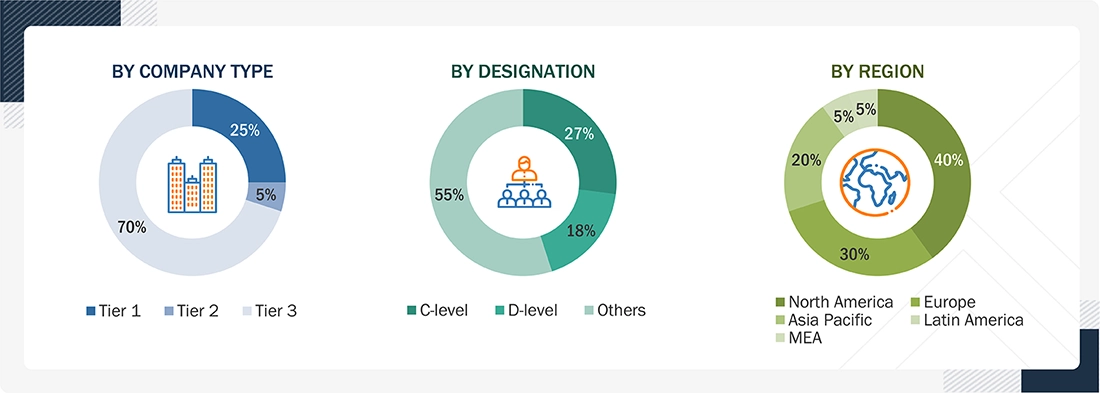
Note: Tiers are defined based on the total revenues of companies. As of 2024, Tier 1 = >USD 1 billion, Tier 2 = USD 500 million to USD 1 billion, and Tier 3 = < USD 500 million.
To know about the assumptions considered for the study, download the pdf brochure
Market Size Estimation
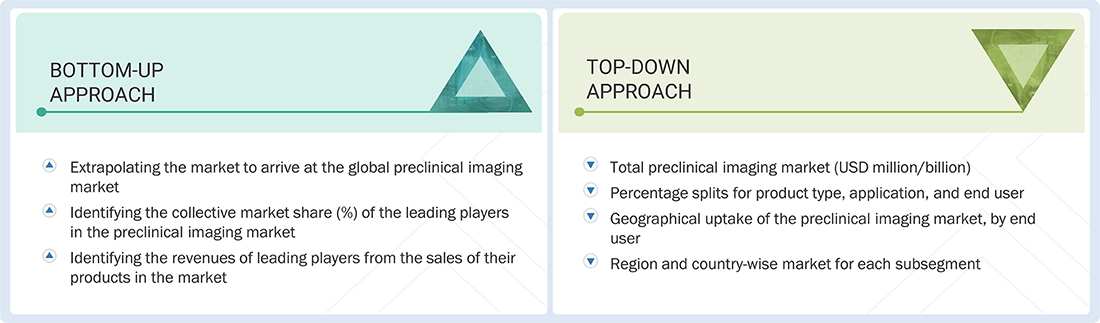
Both top-down and bottom-up approaches were used to estimate and validate the total size of the global preclinical imaging market. These methods were also used extensively to estimate the size of various subsegments in the market. The research methodology used to estimate the market size includes the following:
- Key players in the global preclinical imaging market were identified through secondary research, and their global market shares were determined through primary and secondary research.
- The research methodology included the study of the annual and quarterly financial reports and regulatory filings, data books of major market players, and interviews with industry experts for detailed market insights.
- All percentage shares, splits, and breakdowns for the global preclinical imaging market were determined by using secondary sources and verified through primary sources.
- All key macroindicators affecting the revenue growth of market segments and subsegments have been accounted for, viewed in extensive detail, verified through primary research, and analyzed to get validated and verified quantitative and qualitative data.
- The gathered market data was consolidated and added with detailed inputs and analysis and presented in this report.
Global Preclinical Imaging Market: Bottom-up and Top-down Approach
Data Triangulation
After arriving at the overall market size, from the market size estimation process explained above, the preclinical imaging market was split into segments and subsegments. To complete the overall market engineering process and to arrive at the exact statistics for all segments and subsegments, data triangulation and market breakdown procedures were employed, wherever applicable. The data was triangulated by studying various factors and trends from both the demand and supply sides in the preclinical imaging market.
Market Definition
Preclinical imaging involves the application of molecular imaging for the assessment of anatomical, physiological, and functional parameters in live animal models during preclinical studies. Preclinical imaging systems and reagents are utilized to visualize living animals in order to assess the safety and efficacy of novel drug procedures or other medical treatments for human applications. During preclinical studies, a variety of different imaging modalities are utilized, such as optical imaging systems, nuclear imaging systems (micro-PET and micro-SPECT), micro-MRI, micro-ultrasound systems, and micro-CT imaging systems.
Stakeholders
- Preclinical Imaging Instrument Manufacturers, Suppliers, and Imaging Software Providers
- Pharmaceutical and Biotechnology Companies
- Preclinical Imaging Reagent Manufacturers and Suppliers
- Contract Research Organizations (CROs)
- Research and Development (R&D) Companies
- Government Research Laboratories
- Independent Research Laboratories
- Government and Independent Regulatory Authorities
- Medical Research Laboratories
- Academic Medical Institutes and Universities
- Market Research and Consulting Service Providers
Report Objectives
- To define, describe, and forecast the preclinical imaging market by product type, application, end user, and region
- To provide detailed information regarding the major factors influencing the market growth (such as drivers, restraints, opportunities, and challenges)
- To strategically analyze micromarkets with respect to individual growth trends, prospects, and contributions to the overall market
-
To analyze the opportunities in the market for stakeholders and provide details of
the competitive landscape for preclinical imaging market leaders - To profile the key players in the market and comprehensively analyze their market shares and core competencies
-
To forecast the size of the market segments with respect to five main regions:
North America, the Asia Pacific, Europe, Latin America, and the Middle East & Africa - To track and analyze competitive developments, such as partnerships, acquisitions, product launches & approvals, and expansions
- To benchmark players within the preclinical imaging market using the Competitive Evaluation Matrix, which analyzes market players on various parameters within the broad categories of business strategy, market share, and product offering
Get the Full Preclinical Imaging Market Report
Full forecast, segment splits, and company analysis for all Preclinical Imaging Market.
- US Preclinical Imaging Market
- Canada Preclinical Imaging Market
- Germany Preclinical Imaging Market
- UK Preclinical Imaging Market
- France Preclinical Imaging Market
- Italy Preclinical Imaging Market
- Spain Preclinical Imaging Market
- Japan Preclinical Imaging Market
- China Preclinical Imaging Market
- India Preclinical Imaging Market
- Brazil Preclinical Imaging Market
Need a Tailored Report?
Customize this report to your needs
Get 10% FREE Customization
Customize This Report
