
Europe Precision-Guided Munition Market (2025-2030)

The Europe Precision-Guided Munition Market was valued at $8452.2 Million in 2025 and projected to reach to $11441.9 Million by 2030, representing a compound annual growth rate of 6.2%. Europe's precision-guided munition market is positioned for robust growth through 2030, supported by sustained defence modernization initiatives and NATO's strategic priorities.


| Market Size in | USD 26.32 MN |
| Market Forecast in | |
| CAGR | |
| Forecast Period | |
| Units Considered | Value (USD MN) |
Europe Precision-Guided Munition Market Trends and Insights
- This growth trajectory reflects Europe's increasing defence modernization initiatives and heightened geopolitical tensions driving investment in advanced munition systems.
- Europe's market expansion is supported by NATO commitments, regional security concerns, and substantial government defence budgets across key nations. The European precision-guided munition sector benefits from established aerospace and defence manufacturing capabilities and technological expertise concentrated in Western Europe.
- Europe's defence procurement strategies emphasize interoperability and standardization, creating demand for advanced guidance systems and smart munitions.
- Between 2025 and 2030, Europe is expected to see accelerated adoption of precision-guided systems across air, land, and naval platforms, driven by modernization programmes and operational requirements in contested environments. Europe's market dynamics are shaped by regulatory frameworks, export controls, and collaborative defence initiatives within the EU and NATO.
- The region's focus on indigenous capability development and technology sovereignty further supports sustained investment in precision munition development and production throughout the forecast period..
Key Market Statistics
- CAGR (2025-2030) 6.2% CAGR
- Market Size, 2025 ~USD 8452.2 Million
- Forecast, 2030 ~USD 11441.9 Million
- Geography Europe
Europe Precision-Guided Munition Market Overview
Strong Regional Growth Trajectory :
Europe's precision-guided munition market is expanding at 6.2% CAGR, outpacing the global average of 5.9%, driven by NATO modernization programs and increased defence spending across member states.
UK and Germany Lead Market :
The UK (USD 2,288.9M) and Germany (USD 1,961.4M) represent the largest European markets, accounting for over 50% of regional demand due to advanced military capabilities and strategic defence investments.
Geopolitical Tensions Fuel Investment :
Heightened security concerns in Eastern Europe and NATO expansion initiatives are accelerating procurement cycles for precision-guided systems across European defence ministries and allied forces.
Substantial Market Expansion Forecast :
The European market is projected to grow from USD 8,452.2M in 2025 to USD 11,441.9M by 2030, representing a USD 2,989.7M increase driven by modernization and operational requirements.
Europe Precision-Guided Munition Market Dynamics
- Key European nations are increasing procurement budgets to upgrade aging systems and integrate next-generation technologies, particularly in response to evolving regional security dynamics.
- France, Germany, and the UK are leading investment cycles, with collaborative European defence programs accelerating technology development and standardization across allied forces. The forecast period will witness intensified focus on interoperability, advanced targeting systems, and autonomous capabilities.
- European manufacturers are expanding production capacity to meet both domestic and allied requirements, while government contracts provide stable revenue streams.
- Strategic partnerships between European defence contractors and international suppliers are expected to enhance technological capabilities and market competitiveness throughout the region..
Market Ecosystem
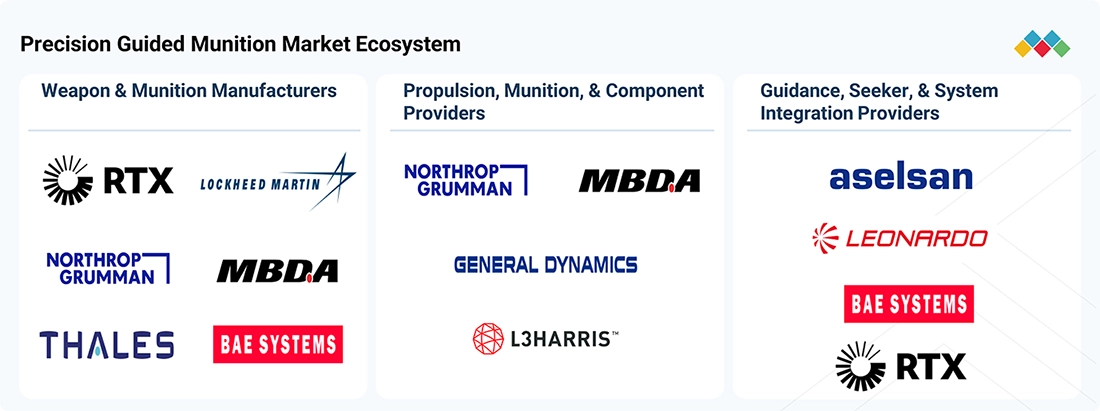
PRECISION GUIDED MUNITION MARKET: COMMERCIAL USE CASES ACROSS INDUSTRIES
| COMPANY | USE CASE DESCRIPTION | BENEFITS |
|---|---|---|
 |
RTX’s Excalibur is a 155 mm guided artillery round used against selected ground targets. It uses GPS/INS guidance and can be fired from systems such as the M777A2 and M109A6. | Improves accuracy of artillery fire | Can reduce the number of rounds needed for a target | Supports longer-range artillery missions | Can reduce effects outside the target area |
 |
Lockheed Martin’s GMLRS is used with HIMARS and M270 launchers for surface-to-surface strikes. The rockets are used against selected point and area targets at long range. | Supports long-range fire missions | Can reduce the number of rounds needed for a target | Can be used against point and area targets | Works with mobile HIMARS and M270 launchers |
 |
MBDA’s Brimstone missile is used by the UK Royal Air Force against fixed and moving ground targets. It has been used in combat and can be used during day and night operations. | Can strike fixed and moving targets | Supports day and night use | Can be launched from aircraft | Can reduce effects outside the target area |
Logos and trademarks shown above are the property of their respective owners. Their use here is for informational and illustrative purposes only.
Related Ecosystem
Defence Platforms And Systems
- Sensors
- Unmanned Ground Vehicles (UGV)
- Fighter Aircraft
- Special Mission Aircraft
- Antennas
- Thales group
- BAE Systems plc
- LOCKHEED MARTIN CORPORATION
- Northrop Grumman Corporation
- L3Harris Technologies, Inc.
Key Takeaways
- Europe's precision-guided munition market grows from USD 8,452.2 million in 2025 to USD 11,441.9 million by 2030 at a 6.2% CAGR.
- NATO modernization commitments and regional security threats are primary drivers of Europe's precision munition market expansion.
- Europe's established defence industrial base and technology sovereignty initiatives support sustained investment in advanced munition systems.
- European procurement emphasizes interoperability and standardization, creating consistent demand for precision-guided munition platforms across member nations.
Precision-Guided Munition Market Report Scope
| Report Metric | Details |
|---|---|
| Base Year | 2025 |
| Fastest Growing Segment | LOITERING MUNITIONS (Product) |
| Forecast Period | 2025-2030 |
| Growth Rate | CAGR of 5.9% from 2025 to 2030 |
| Largest Segment | AUTONOMOUS (Mode Of Operation) |
| Market Size Base Year (Billions) | ~USD 37.32 (2025) |
| Revenue Forecast (Billions) | ~USD 49.71 (2030) |
| Segments Covered | Product, Type, System, Launch Platform, Mode Of Operation, Speed, Range |
Europe Precision-Guided Munition Market Report Segmentation
7 segment dimensions are covered across the global market.
By Product
- Guided Ammunition
- Guided Rockets
- Interceptor Misisiles
- Interceptor Missiles
- Loitering Munitions
- Tactical Missiles
- Torpedoes
By Type
- Air-To-Surface
- Alternator
- Batteries
- Blast Warheads
- Continuous Rod Warheads
- Electric
- Eo/Ir
- Expendable
- Fragmentation Warheads
- Glide Bombs
- Global Positioning Systems
- Guided Artillery Shells
- Guided Mortars
- Hybrid
- Inertial Navigation Systems
- Kinetic Energy Penetrators
- Laser/Lidar
- Liquid
- Manpad Interceptors
- Mobile Air Defense Interceptors
- Multi-Mode
- Radar
- Ramjet
- Recoverable
- Scramjet
- Smart Submunition
- Smart Submunitions
- Solid
- Subsea-To-Surface
- Surface-To-Subsea
- Surface-To-Surface
- Terrain Contour Matching Radar
- Thermobaric/Shaped Charge Warheads
- Turbojet
By System
- Guidance & Navigation Systems
- Power Supply Systems
- Propulsion Systems
- Target Acquisition Systems
- Warheads
By Launch Platform
- Airborne
- Land
- Naval
By Mode Of Operation
- Autonomous
- Semi-Autonomous
By Speed
- Hypersonic
- Subsonic
- Supersonic
By Range
- Extended Range
- Long Range
- Medium Range
- Short Range
Target Audience
- Defence Contractors & Manufacturers : Strategic planning and market expansion decisions require detailed European market segmentation, competitive dynamics, and country-specific procurement trends to optimize product development and sales strategies.
- Government & Military Procurement Officials : Defence ministry decision-makers need comprehensive market intelligence on technology trends, supplier capabilities, and regional spending patterns to inform budget allocation and capability modernization programs.
- Investment & Private Equity Firms : Investors evaluating European defence sector opportunities require detailed market sizing, growth forecasts, and regional dynamics to assess portfolio companies and identify acquisition targets with strong growth potential.
- Technology & Systems Integrators : Companies developing advanced munition systems and integration platforms need European market insights to identify partnership opportunities, customer requirements, and technology gaps across NATO and allied nations.
- Strategic Consultants & Analysts : Consulting firms advising defence clients require granular European market data, competitive intelligence, and geopolitical context to develop informed recommendations on market positioning and growth strategies.
Countries within Europe - compare and drill down
| Country | 2025 size (native) |
|---|---|
| UK | USD 2288.9 Million |
| France | USD 1809 Million |
| Germany | USD 1961.4 Million |
| Italy | USD 338.2 Million |
| Russia | USD 4113.1 Million |
| Rest Of Europe | USD 931.4 Million |
Country market size visualization
Reasons to Buy this Report
- Regional Market Segmentation : Detailed breakdown of Europe's precision-guided munition market by country, including UK, France, Germany, Italy, Russia, and Rest of Europe, enabling targeted market entry and competitive positioning strategies.
- Growth Driver Analysis : Comprehensive insights into European-specific growth catalysts including NATO modernization programs, geopolitical tensions, defence budget increases, and regulatory frameworks shaping procurement decisions.
- Competitive Landscape Intelligence : Identify leading European defence contractors, their market share, technological capabilities, and strategic partnerships to benchmark competitive positioning and identify collaboration opportunities.
- Investment Opportunity Assessment : Evaluate market expansion potential across European nations with detailed forecasts through 2030, supporting capital allocation decisions and long-term business strategy development in the region.
- Regulatory & Procurement Insights : Navigate complex European defence procurement processes, export regulations, and standardization requirements across NATO and EU member states to accelerate market penetration and contract wins.
Frequently asked questions
What is the current market size of precision-guided munitions in Europe?
Europe's precision-guided munition market is valued at USD 8,452.2 million in 2025, with expectations to reach USD 11,441.9 million by 2030.
What is the projected growth rate for Europe's precision-guided munition market?
Europe's precision-guided munition market is projected to grow at a compound annual growth rate of 6.2% from 2025 to 2030.
What factors are driving growth in Europe's precision-guided munition market?
Europe's market growth is driven by NATO modernization commitments, heightened geopolitical tensions, regional security concerns, and substantial government defence budgets supporting advanced munition procurement.
How does Europe's defence industrial base support the precision-guided munition market?
Europe's established aerospace and defence manufacturing capabilities, technological expertise, and focus on technology sovereignty enable sustained development and production of advanced precision-guided munition systems.
What role do regulatory frameworks play in Europe's precision-guided munition market?
Europe's regulatory frameworks, export controls, and collaborative defence initiatives within the EU and NATO shape procurement strategies and standardization requirements that influence market dynamics and interoperability standards.
RESEARCH METHODOLOGY
This study involved four major activities to estimate the current size of the precision guided munition market. Exhaustive secondary research was conducted to gather information on the market, its adjacent markets, and its parent market. The next step involved validating these findings, assumptions, and sizing with industry experts across the value chain through primary research. Demand-side analysis was conducted to estimate the overall market size. Thereafter, data triangulation procedures were employed to estimate the sizes of various segments and subsegments within the precision guided munition market.
Secondary Research
During the secondary research process, various sources were consulted to identify and collect information for this study. The secondary sources included government sources, such as SIPRI; corporate filings, including annual reports, press releases, and investor presentations; white papers, journals, and certified publications; and articles from recognized authors, directories, and databases.
Primary Research
Extensive primary research was conducted after acquiring information on the precision guided munition market through secondary research. Several primary interviews were conducted with market experts from the demand and supply sides across major countries of North America, Europe, Asia Pacific, the Middle East, and the Rest of the World. Primary data was collected through questionnaires, emails, and telephonic interviews.
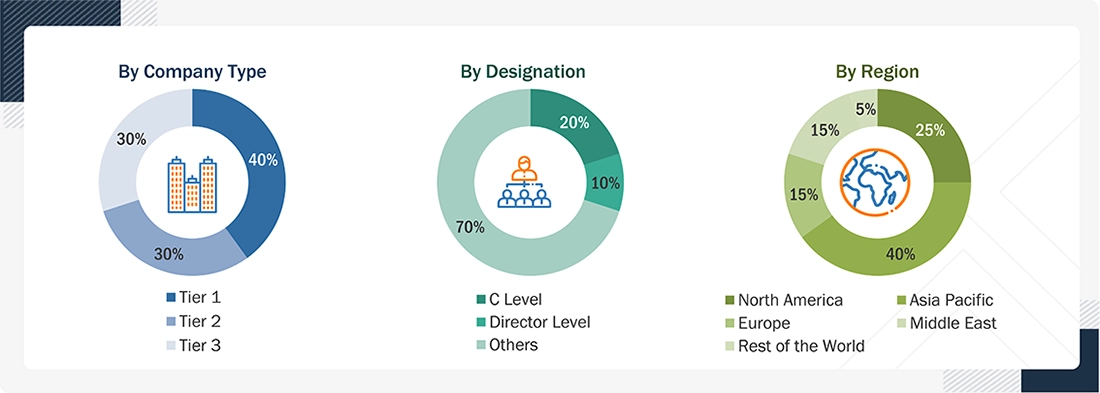
To know about the assumptions considered for the study, download the pdf brochure
Market Size Estimation
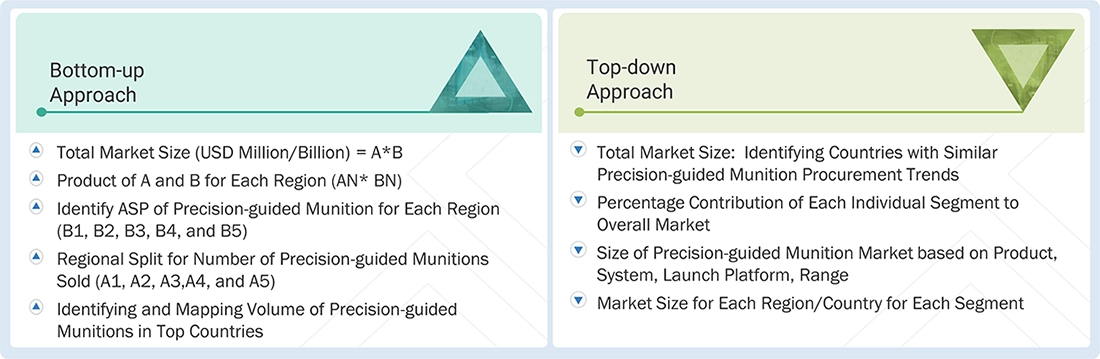
Top-down and bottom-up approaches were used to estimate and validate the size of the precision guided munition market. The research methodology used to estimate the size of the market included the following details:
- Key players were identified through secondary research, and their market ranking was determined through primary and secondary research. This included a study of annual and financial reports of the top market players and extensive interviews with leaders, including CEOs, directors and marketing executives.
- All percentage shares, splits and breakdowns were determined using secondary sources and verified through primary sources. All possible parameters that affect the market covered in this research study were accounted for, viewed in extensive detail, verified through primary research, and analyzed to obtain the final quantitative and qualitative data. This data was consolidated, enhanced with detailed input, analyzed by MarketsandMarkets and presented in this report.
Precision Guided Munition Market: Top-Down and Bottom-Up Approach
Data Triangulation
After arriving at the overall size of the precision-guided munition market from the market size estimation process explained above, the total market was split into several segments and subsegments. The data triangulation and market breakdown procedures were implemented, wherever applicable, to complete the overall market engineering process and arrive at the exact statistics for various market segments and subsegments. The data were triangulated by studying various factors and trends from both the demand and supply sides. Along with this, the market size was validated using both top-down and bottom-up approaches. The following figure indicates the market breakdown structure and data triangulation procedures that were implemented in the market engineering process for this report on the precision guided munition market.
Market Definition
The precision guided munition market includes guided weapon systems designed to engage selected targets using onboard or integrated guidance, navigation, target acquisition, and control technologies. These weapons can correct their flight path after launch or during the terminal phase to improve the accuracy of target engagement. The market includes tactical missiles, interceptor missiles, guided rockets, medium- and large-caliber guided ammunition, torpedoes, and loitering munitions.
A weapon is considered within the market when it meets the following conditions:
- Uses a guidance or navigation system during flight or terminal engagement
- Can make trajectory or course corrections after launch
- Uses onboard or external target acquisition or homing support, where applicable
- Is designed for precision engagement of a selected target
- Can operate in autonomous or semi-autonomous mode
- Can be launched from land, airborne, or naval platforms
Key Stakeholders
- Armed Forces
- Defense Regulatory Bodies
- Ministry of Defense
- Ammunition Dealers
- Original Equipment Manufacturers
- Subcomponent Manufacturers
- Technology Support Providers
Report Objectives
- To define, describe, segment, and forecast the size of the precision guided munition market based on product, system, mode of operation, range, speed, and region
- To forecast the size of the various segments of the market based on five major regions, namely, North America, Europe, Asia Pacific, the Middle East, and the Rest of the World (RoW), along with major countries in each of these regions
- To identify and analyze key drivers, restraints, opportunities, and challenges influencing the growth of the market
- To identify industry trends, market trends, and technology trends currently prevailing in the market
- To provide an overview of the regulatory landscape with respect to precision-guided munitions across regions
- To analyze micromarkets with respect to individual growth trends, prospects, and their contribution to the overall market
- To analyze opportunities in the market for stakeholders by identifying key market trends
- To profile key market players and comprehensively analyze their market share and core competencies
- To evaluate the degree of competition in the market by analyzing recent developments, such as contracts, agreements, and acquisitions adopted by leading market players
- To identify detailed financial positions, key products, and unique selling points of leading companies in the market
- To provide a detailed competitive landscape of the market, along with market share analysis and revenue analysis of key players.
Available customizations:
MarketsandMarkets offers the following customizations for this market report:
- Additional country-level analysis of the precision guided munition market
- Profiling of other market players (up to five)
Product Analysis
- Product matrix, which provides a detailed comparison of the product portfolios of each company in the precision guided munition market
Get the Full Precision-Guided Munition Market Report
Full forecast, segment splits, and company analysis for all Precision-Guided Munition Market.
- Canada Precision-Guided Munition Market
- US Precision-Guided Munition Market
- UK Precision-Guided Munition Market
- France Precision-Guided Munition Market
- Germany Precision-Guided Munition Market
- Italy Precision-Guided Munition Market
- Russia Precision-Guided Munition Market
- China Precision-Guided Munition Market
- India Precision-Guided Munition Market
- Japan Precision-Guided Munition Market
- South Korea Precision-Guided Munition Market
- Australia Precision-Guided Munition Market
- Saudi Arabia Precision-Guided Munition Market
- Israel Precision-Guided Munition Market
- Turkey Precision-Guided Munition Market
- Rest Of Europe Precision-Guided Munition Market
- Rest Of Asia Pacific Precision-Guided Munition Market
- Rest Of Middle East Precision-Guided Munition Market
Need a Tailored Report?
Customize this report to your needs
Get 10% FREE Customization
Customize This Report
