
Middle East Precision Irrigation Market (2024-2029)

The Middle East Precision Irrigation Market was valued at $69.1 Million in 2024 and projected to reach to $109.2 Million by 2029, representing a compound annual growth rate of 9.6%. The Middle East precision irrigation market is positioned for significant expansion, driven by critical water resource constraints and increasing agricultural productivity demands.


| Market Size in | USD 26.32 MN |
| Market Forecast in | |
| CAGR | |
| Forecast Period | |
| Units Considered | Value (USD MN) |
Middle East Precision Irrigation Market Trends and Insights
- The Middle East's arid climate and water scarcity challenges are driving widespread adoption of advanced irrigation technologies that optimize water usage and enhance crop yields.
- In the Middle East, precision irrigation solutions-including drip systems, soil moisture sensors, and automated controllers-are becoming essential for sustainable agricultural development and food security. The Middle East market is expanding at a compound annual growth rate of 9.6%, outpacing global averages as regional governments and agricultural enterprises invest in water-efficient farming practices.
- The Middle East's strategic focus on reducing water consumption while maintaining productivity is accelerating the deployment of precision irrigation across both large-scale commercial farms and smallholder operations.
- By 2029, the Middle East is expected to see increased integration of IoT and AI-driven irrigation management systems, positioning the region as a key growth hub for precision agriculture technology..
Key Market Statistics
- CAGR (2024-2029) 9.6% CAGR
- Market Size, 2024 ~USD 69.1 Million
- Forecast, 2029 ~USD 109.2 Million
- Country Middle East
Middle East Precision Irrigation Market Overview
Water Scarcity Driving Adoption :
The Middle East's severe water scarcity and arid climate conditions are accelerating the adoption of precision irrigation technologies that reduce water consumption by up to 40% compared to traditional methods.
Strong CAGR Performance :
The Middle East precision irrigation market is growing at 9.6% CAGR, outpacing the global average of 8.5%, reflecting the region's urgent need for sustainable agricultural solutions.
Government Support & Subsidies :
Middle Eastern governments are implementing agricultural modernization initiatives and providing subsidies for precision irrigation adoption to enhance food security and reduce water dependency.
Drip & Micro-Irrigation Dominance :
Drip irrigation and micro-irrigation systems are the preferred technologies in the Middle East, offering superior water efficiency and compatibility with the region's diverse crop cultivation patterns.
Middle East Precision Irrigation Market Dynamics
- With a projected growth from $69.1 million in 2024 to $109.2 million by 2029, the region demonstrates strong market momentum as farmers and agribusinesses invest in water-efficient technologies.
- Government initiatives promoting sustainable agriculture and food self-sufficiency are catalyzing market penetration across UAE, Saudi Arabia, and other Gulf states. Future growth will be supported by technological advancements in IoT-enabled irrigation systems, declining equipment costs, and rising awareness of climate-resilient farming practices.
- The integration of smart sensors and data analytics will enable precision farmers to optimize water usage further.
- Investment in agricultural infrastructure and public-private partnerships will accelerate market development, positioning the Middle East as a regional leader in precision agriculture adoption..
Market Ecosystem
Related Ecosystem
Farm Equipment And Irrigation
- Sensors
- Hydroponics
- Aeroponics
- Camera Systems
- Global Positioning System (GPS)
- MSK FARM MACHINERY CORPORATION
- MITSUBISHI CHEMICAL AGRI DREAM
- MITSUBISHI AGRICULTURAL MACHINERY
- RIVULIS IRRIGATION
- AGCO Corporation
Key Takeaways
- The Middle East precision irrigation market will grow from $69.1M (2024) to $109.2M (2029) at a 9.6% CAGR.
- Water scarcity and climate conditions in the Middle East are primary drivers of precision irrigation adoption.
- The Middle East is increasingly adopting IoT and AI-enabled irrigation systems for enhanced farm management.
- Government initiatives and sustainability mandates across the Middle East are accelerating market expansion.
Precision Irrigation Market Report Scope
| Report Metric | Details |
|---|---|
| Base Year | 2024 |
| Fastest Growing Segment | FERTIGATION SENSORS (Sensor) |
| Forecast Period | 2024-2029 |
| Growth Rate | CAGR of 8.5% from 2024 to 2029 |
| Largest Segment | SURFACE (Application) |
| Market Size Base Year (Billions) | ~USD 4.18 (2024) |
| Revenue Forecast (Billions) | ~USD 6.29 (2029) |
| Segments Covered | Type, Technology Type, Component, Sensor, End Use, Agriculture Type, Open-Field Agriculture Type, Cereals & Grains Type, Oilseeds & Pulses Type, Vegetable Type, Fruit & Nut Type, Nonagriculture Type, Sprinkler Irrigation, Drip Irrigation, Agriculture, Open-Field Agriculture, Cereal & Grain, Oilseed & Pulse, Vegetable, Fruit & Nut, Nonagriculture, Application |
Middle East Precision Irrigation Market Report Segmentation
22 segment dimensions are covered across the global market.
By Type
- Center Pivot Sprinklers
- Drip Irrigation
- Lateral Move/Linear Sprinklers
- Lateral/Linear Move Sprinklers
- Other Types
- Sprinkler Irrigation
- Subsurface Drip Irrigation
- Surface Drip Irrigation
- Traditional Sprinklers
By Technology Type
- AI & ML Algorithms In Irrigation
- Cloud Computing & Data Analytics
- Gps- & Gis-Based Irrigation Systems
- Gps- And Gis-Based Irrigation Systems
- IoT-Based Precision Irrigation
By Component
- Controllers
- Other Components
- Sensors
- Sprinkles
- Valves
- Water Flow Meters
By Sensor
- Fertigation Sensors
- Other Sensors
- Rain/Freeze Sensors
- Soil Moisture Sensors
- Temperature Sensors
By End Use
- Agriculture
- Nonagriculture
By Agriculture Type
- Controlled Environment Agriculture
- Open-Field Agriculture
By Open-Field Agriculture Type
- Cereals & Grains
- Fruits & Nuts
- Oilseeds & Pulses
- Plantation Crops
- Vegetables
By Cereals & Grains Type
- Maize
- Other Cereals & Grains
- Rice
- Wheat
By Oilseeds & Pulses Type
- Cotton
- Groundnut
- Other Oilseeds & Pulses
- Rapeseed
- Soybean
By Vegetable Type
- Brassicas
- Other Vegetables
- Roots & Tubers
By Fruit & Nut Type
- Berries
- Citrus Fruits
- Other Fruits & Nuts
By Nonagriculture Type
- Golf Courses
- Residential
- Turfs & Landscapes
By Sprinkler Irrigation
- Center Pivot Sprinklers
- Lateral/Linear Move Sprinklers
- Traditional Sprinklers
By Drip Irrigation
- Subsurface Drip Irrigation
- Surface Drip Irrigation
By Agriculture
- Controlled Environment Agriculture
- Open-Field Agriculture
By Open-Field Agriculture
- Cereals & Grains
- Fruits & Nuts
- Oilseeds & Pulses
- Plantation Crops
- Vegetables
By Cereal & Grain
- Maize
- Other Cereals & Grains
- Rice
- Wheat
By Oilseed & Pulse
- Cotton
- Groundnut
- Other Oilseeds & Pulses
- Rapeseed
- Soybean
By Vegetable
- Brassicas
- Other Vegetables
- Root & Tubers
- Roots & Tubers
By Fruit & Nut
- Berries
- Citrus Fruits
- Other Fruits & Nuts
By Nonagriculture
- Golf Courses
- Residential
- Turfs & Landscapes
By Application
- Subsurface
- Surface
Target Audience
- Agricultural Equipment Manufacturers : Manufacturers need Middle East-specific market data to identify growth opportunities, localize product offerings, and develop distribution strategies for the region's high-growth irrigation segment.
- Agricultural Technology Investors : Investors require detailed market analysis to evaluate investment potential in Middle Eastern agritech companies, assess regional growth drivers, and benchmark returns against global markets.
- Government & Policy Makers : Regional policymakers need market intelligence to design effective agricultural subsidies, water conservation programs, and food security initiatives aligned with market realities.
- Farm Operators & Agribusinesses : Large-scale farmers and agribusinesses need market insights to make informed technology adoption decisions, understand ROI potential, and identify leading solution providers in the Middle East.
- Consulting & Research Firms : Consultants require comprehensive Middle East market data to support client advisory services, feasibility studies, and strategic recommendations in the precision agriculture sector.
Reasons to Buy this Report
- Regional Market Sizing & Forecasts : Obtain precise market valuation data specific to the Middle East ($69.1M in 2024) with detailed 5-year forecasts to support strategic planning and investment decisions in the region.
- Competitive Landscape Analysis : Understand key players, market share distribution, and competitive strategies tailored to Middle Eastern market dynamics, regulatory environment, and customer preferences.
- Water Scarcity & Climate Insights : Access region-specific analysis of how water constraints and climate conditions are reshaping irrigation technology adoption patterns and creating unique market opportunities.
- Government Policy & Incentive Tracking : Stay informed on Middle Eastern government subsidies, agricultural modernization programs, and regulatory frameworks driving precision irrigation investment and market growth.
- Technology Adoption Trends : Identify which precision irrigation technologies (drip, micro, smart sensors) are gaining traction in the Middle East and forecast future technology preferences by country and crop type.
Frequently asked questions
What is the current size of the Middle East precision irrigation market?
The Middle East precision irrigation market was valued at $69.1 million in 2024 and is expected to reach $109.2 million by 2029.
What is the growth rate of the Middle East precision irrigation market?
The Middle East precision irrigation market is growing at a compound annual growth rate (CAGR) of 9.6% from 2024 to 2029.
Why is precision irrigation important in the Middle East?
The Middle East faces significant water scarcity and arid climate conditions, making precision irrigation critical for optimizing water usage, reducing waste, and maintaining agricultural productivity.
What technologies are driving growth in the Middle East precision irrigation market?
The Middle East market is being driven by adoption of drip irrigation systems, soil moisture sensors, automated controllers, and emerging IoT and AI-powered irrigation management solutions.
Which factors are supporting the Middle East precision irrigation market expansion?
Government sustainability initiatives, water conservation mandates, increasing agricultural investment, and the need for food security are key factors supporting growth in the Middle East market.
RESEARCH METHODOLOGY
The study involved two major approaches in estimating the current size of the precision irrigation market. Exhaustive secondary research was done to collect information on the market, peer, and parent markets. The next step was to validate these findings, assumptions, and sizing with industry experts across the value chain through primary research. Both top-down and bottom-up approaches were employed to estimate the complete market size. After that, market breakdown and data triangulation were used to estimate the market size of segments and subsegments.
Secondary Research
This research study involved the extensive use of secondary sources—directories and databases such as Bloomberg Businessweek and Factiva—to identify and collect information useful for a technical, market-oriented, and commercial study of the market.
In the secondary research process, various sources such as annual reports, press releases & investor presentations of companies, white papers, food journals, certified publications, articles from recognized authors, directories, and databases were referred to identify and collect information.
Secondary research was mainly used to obtain key information about the industry’s supply chain, the total pool of key players, and market classification and segmentation as per the industry trends to the bottom-most level, regional markets, and key developments from both market- and technology-oriented perspectives.
Primary Research
Extensive primary research was conducted after obtaining information regarding the precision irrigation market scenario through secondary research. Several primary interviews were conducted with market experts from both the demand and supply sides across major countries of North America, Europe, Asia Pacific, South America, and the Rest of the World. Primary data was collected through questionnaires, emails, and telephonic interviews. The primary sources from the supply side included various industry experts, such as Chief X Officers (CXOs), Vice Presidents (VPs), Directors from business development, marketing, research, and development teams, and related key executives from distributors and key opinion leaders. Primary interviews were conducted to gather insights such as market statistics, data on revenue collected from the products and services, market breakdowns, market size estimations, market forecasting, and data triangulation. Primary research also helped in understanding the various trends related to precision irrigation type, technology, component, end use, and region. Stakeholders from the demand side, such as farm associations, dealers, distributors, and government agencies, were interviewed to understand the demand side perspective on the suppliers, products, and their current usage of precision irrigation and the outlook of their business, which will affect the overall market.
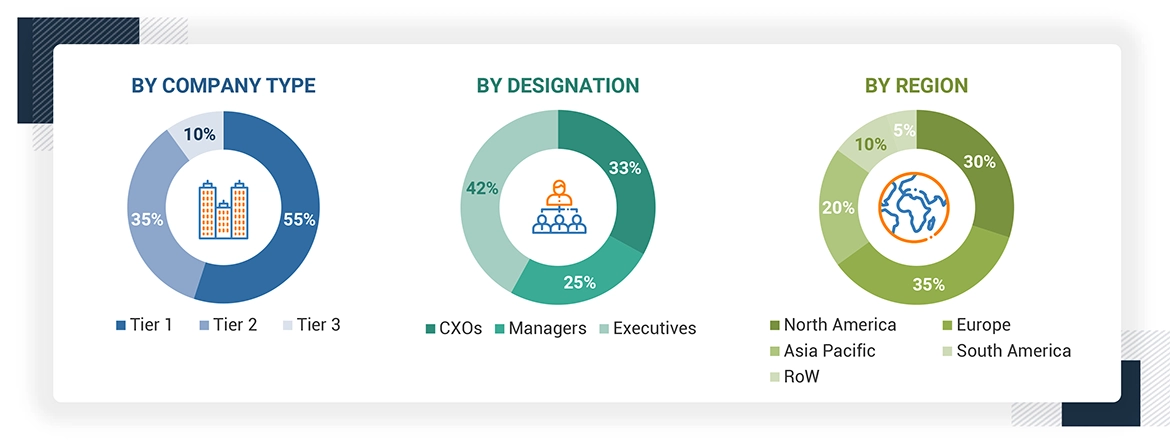
Note: The three tiers of the companies are defined based on their total revenues in 2022 or 2023, as per the availability of financial data: Tier 1: Revenue > USD 1 billion; Tier 2: USD 100 million ≤ Revenue ≤ USD 1 billion; Tier 3: Revenue < USD 100 million.
|
COMPANY NAME |
DESIGNATION |
|
NETAFIM (Israel) |
Regional Sales Representative |
|
Rivulis (Israel) |
State Manager |
|
Valmont Industries, Inc. (US) |
Manager |
|
AZUD (Spain) |
Agronomist |
|
Mahindra Irrigation (India) |
Sales & Marketing Manager |
|
Lindsay Corporation (US) |
Sales Manager |
To know about the assumptions considered for the study, download the pdf brochure
Precision Irrigation Market Size Estimation
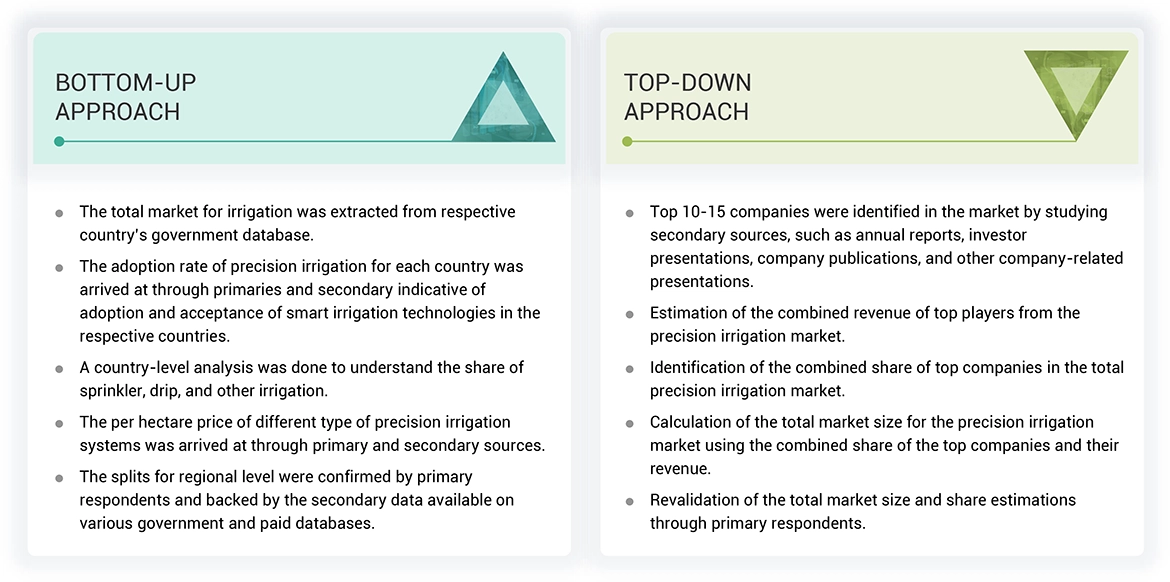
Both the top-down and bottom-up approaches were used to estimate and validate the total size of the precision irrigation market. These approaches were also used extensively to determine the size of various subsegments in the market. The research methodology used to estimate the market size includes the following details:
- The key players in the industry and the overall markets were identified through extensive secondary research.
- All shares, splits, and breakdowns were determined using secondary sources and verified through primary sources.
- All possible parameters that affect the market covered in this research study were accounted for, viewed in extensive detail, verified through primary research, and analyzed to obtain final quantitative and qualitative data.
- The research included the study of reports, reviews, and newsletters of top market players, along with extensive interviews for opinions from leaders, such as CXOs, directors, and marketing executives.
Precision Irrigation Market : Top-Down and Bottom-Up Approach
Data Triangulation
After arriving at the overall market size from the estimation process explained above, the total market was split into several segments and subsegments. Data triangulation and market breakdown procedures were employed, wherever applicable, to estimate the overall precision irrigation market and arrive at the exact statistics for all segments and subsegments. The data was triangulated by studying various factors and trends from the demand and supply sides. Along with this, the market size was validated using both the top-down and bottom-up approaches.
Market Definition
According to Utah State University, precision irrigation involves technology and specialized equipment to improve the efficiency and effectiveness of agriculture irrigation management. This management process is beneficial in allocating water based on spatial variability throughout fields and can sometimes conserve water and improve crop quality.
Precision irrigation is a sustainable farming method that delivers water and nutrients directly to plants at the right time and location, in carefully controlled amounts. This approach ensures optimal growing conditions by providing plants with the necessary resources in a precise, timely manner. Precision irrigation might be used for a range of irrigation systems (sprinkler, drip, and others), including the appropriate sensing, control, and decision support requirements.
Stakeholders
- Supply side: Precision irrigation component manufacturers, drip irrigation technology providers, irrigation consultants & service providers, suppliers, and distributors
- Demand side: Farmers, agricultural warehouse owners, horticultural cooperative societies, importers, and exporters
- Regulatory side: Concerned government authorities, commercial research & development (R&D) institutions, and other regulatory bodies
- Associations and industry bodies such as the Food and Agricultural Organization (FAO) - AQUASTAT, Environmental Protection Agency (EPA), the International Commission on Irrigation and Drainage (ICID), among others.
Report Objectives
MARKET INTELLIGENCE
- Determining and projecting the size of the precision irrigation market based on type, technology type, end use, and region from 2024 to 2029
- Identifying the attractive opportunities in the market by determining the largest and fastest-growing segments across the key regions
- Analyzing the demand-side factors based on the following:
- Impact of macro and microeconomic factors on the market
- Shifts in demand patterns across different subsegments and regions
Available Customizations
With the given market data, MarketsandMarkets offers customizations according to company-specific scientific needs.
The following customization options are available for the report:
PRODUCT ANALYSIS
- Product Matrix, which gives a detailed comparison of the product portfolio of each company.
GEOGRAPHIC ANALYSIS
With the given market data, MarketsandMarkets offers customizations according to company-specific scientific needs.
- Further breakdown of the Rest of Europe precision irrigation market into key countries.
- Further breakdown of the Rest of Asia Pacific precision irrigation market into key countries.
- Further breakdown of the Rest of South America precision irrigation market into key countries.
COMPANY INFORMATION
- Detailed analyses and profiling of additional market players (up to five)
Get the Full Precision Irrigation Market Report
Full forecast, segment splits, and company analysis for all Precision Irrigation Market.
- US Precision Irrigation Market
- Canada Precision Irrigation Market
- Mexico Precision Irrigation Market
- France Precision Irrigation Market
- Germany Precision Irrigation Market
- Italy Precision Irrigation Market
- Netherlands Precision Irrigation Market
- Spain Precision Irrigation Market
- UK Precision Irrigation Market
- Australia Precision Irrigation Market
- China Precision Irrigation Market
- India Precision Irrigation Market
- Japan Precision Irrigation Market
- Argentina Precision Irrigation Market
- Brazil Precision Irrigation Market
- Israel Precision Irrigation Market
- Rest Of Europe Precision Irrigation Market
- Rest Of Asia Pacific Precision Irrigation Market
- Africa Precision Irrigation Market
- Rest Of South America Precision Irrigation Market
- Rest Of Middle East Precision Irrigation Market
Need a Tailored Report?
Customize this report to your needs
Get 10% FREE Customization
Customize This Report
