
UK Process Oil Market (2025-2030)

The UK Process Oil Market was valued at $69 Million in 2025 and projected to reach to $71.3 Million by 2030, representing a compound annual growth rate of 0.7%. The UK process oil market faces a period of structural stagnation, with the 0.7% CAGR reflecting the maturity of the industrial base and limited new demand drivers.


| Market Size in | USD 26.32 MN |
| Market Forecast in | |
| CAGR | |
| Forecast Period | |
| Units Considered | Value (USD MN) |
UK Process Oil Market Trends and Insights
- The UK market demonstrates relatively stable demand dynamics, with growth constrained by mature industrial infrastructure and shifting regulatory pressures toward sustainable alternatives.
- The UK's process oil sector serves critical applications across manufacturing, chemical processing, and industrial lubrication, though the market faces headwinds from environmental compliance requirements and the transition toward bio-based and synthetic alternatives. The UK process oil market's subdued growth trajectory contrasts with broader European and global expansion, indicating sector-specific challenges within the UK economy.
- Between 2025 and 2030, the UK market will experience incremental expansion driven by maintenance demand from established industrial operations and selective adoption in specialized applications.
- The UK's regulatory environment, particularly around emissions and sustainability, continues to shape purchasing decisions and product innovation within the process oil sector..
Key Market Statistics
- CAGR (2025-2030) 0.7% CAGR
- Market Size, 2025 ~USD 69 Million
- Forecast, 2030 ~USD 71.3 Million
- Country UK
UK Process Oil Market Overview
Modest Growth Trajectory :
The UK process oil market is valued at £69.0 million in 2025 and is projected to reach £71.3 million by 2030, representing a conservative CAGR of 0.7%, reflecting mature market saturation and limited expansion opportunities.
Regulatory Headwinds :
UK market growth is constrained by increasingly stringent environmental regulations and the government's commitment to net-zero emissions, driving industrial operators toward sustainable and bio-based alternatives over conventional process oils.
Mature Industrial Base :
The UK's established manufacturing and chemical processing sectors demonstrate stable but stagnant demand, with limited new industrial capacity additions and consolidation among existing operators limiting market expansion potential.
Sustainability Shift :
Growing pressure from UK regulatory bodies and corporate sustainability initiatives is accelerating the transition toward eco-friendly process oil formulations, reshaping product portfolios and competitive dynamics across the market.
UK Process Oil Market Dynamics
- Regulatory pressures, particularly around environmental compliance and carbon reduction targets, are reshaping market dynamics and pushing operators toward sustainable alternatives.
- The market will likely experience consolidation among suppliers as companies adapt to stricter standards and shifting customer preferences.
- Growth opportunities remain limited to niche applications and bio-based product segments that align with the UK's sustainability agenda and net-zero commitments..
Market Ecosystem
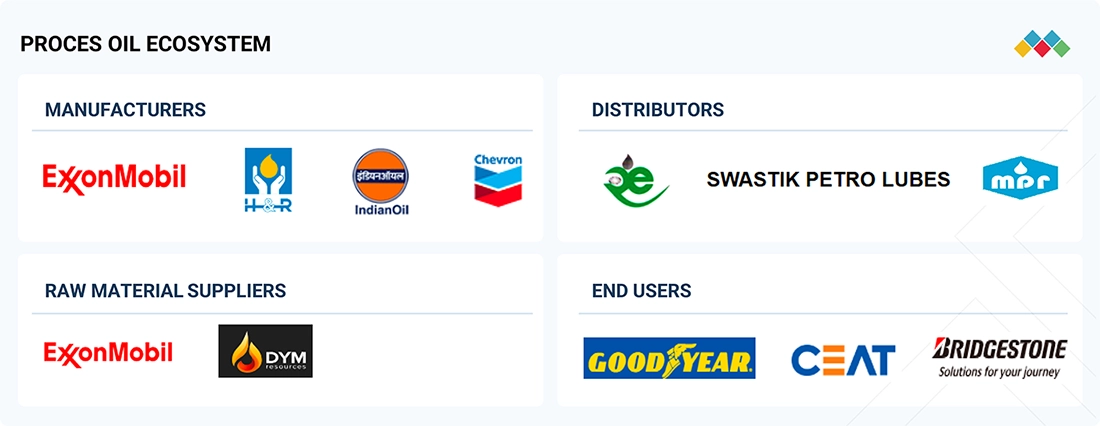
PROCESS OIL MARKET: COMMERCIAL USE CASES ACROSS INDUSTRIES
| COMPANY | USE CASE DESCRIPTION | BENEFITS |
|---|---|---|
 |
Manufactures process oils for a wide range of applications including tire and rubber compounds, polymers, plastics, adhesives, and industrial lubricants, ensuring optimal processability and material performance. | Enhances flexibility and durability, improves processing efficiency, ensures consistent quality, and supports safer manufacturing operations |
 |
Supplies paraffinic and naphthenic process oils for polymer processing, construction materials, personal care formulations, and specialty industrial applications, designed to improve flow, stability, and compatibility with additives | Improves processing efficiency, enhances product uniformity, supports long-lasting performance, and enables smoother production workflows |
 |
Provides process oils for high-performance polymers, rubber, tire manufacturing, and industrial materials, with a focus on both conventional and eco-friendly grades for sustainable applications. | Supports advanced formulations, enhances mechanical and thermal stability, ensures uniform quality, and contributes to sustainability and compliance goals. |
 |
Produces process oils for consumer and industrial applications such as plastics, rubbers, adhesives, and specialty formulations, supporting high-performance material requirements | Increases product consistency and reliability, improves durability, enhances formulation versatility, and strengthens end-product performance |
 |
Offers process oils for specialty and high-performance industrial applications, including polymers, rubber compounds, adhesives, and automotive materials. | Improves heat resistance and flexibility, enhances wear and performance under harsh conditions, supports innovation, and enables high-value product development |
Logos and trademarks shown above are the property of their respective owners. Their use here is for informational and illustrative purposes only.
Related Ecosystem
Bulk Chemicals And Inorganics
- Corrosion Inhibitors
- Glycol Ethers
- Acetic Acid
- Acetone
- Ammonium Nitrate
- Basf se
- DOW CHEMICAL COMPANY
- Exxon Mobil Corporation
- AZELIS HOLDINGS SA
- Sinopec limited
Lubricants
- Polyalkylene Glycol (PAG)
- Tankers
- Exxon Mobil Corporation
- AZELIS HOLDINGS SA
- Chevron Corporation
- PETROLIAM NASIONAL BERHAD (NATIONAL PETROLEUM LIMITED)
- Idemitsu Kosan Co.,Ltd.
Speciality Chemicals
- Corrosion Inhibitors
- Polyetheretherketone (PEEK)
- Acrylonitrile Butadiene Styrene (ABS)
- Epoxy Resin
- Polycarbonate
- Basf se
- DOW CHEMICAL COMPANY
- Evonik industries ag
- Clariant ag.
- Solvay sa
Key Takeaways
- The UK process oil market is valued at £69.0 million in 2025 with a forecast of £71.3 million by 2030, growing at a modest 0.7% CAGR.
- The UK market exhibits slower growth compared to global trends, reflecting mature industrial demand and regulatory constraints specific to the UK economy.
- Environmental regulations and sustainability mandates are reshaping the UK process oil landscape, driving adoption of alternative formulations.
- The UK process oil sector remains dependent on maintenance and replacement cycles within established manufacturing and chemical processing industries.
Process Oil Market Report Scope
| Report Metric | Details |
|---|---|
| Base Year | 2025 |
| Fastest Growing Segment | DEFOAMER (Function) |
| Forecast Period | 2025–2030 |
| Growth Rate | CAGR of 2.8% from 2025 to 2030 |
| Largest Segment | EXTENDER OIL (Function) |
| Market Size Base Year (Billions) | ~USD 5.37 (2025) |
| Revenue Forecast (Billions) | ~USD 6.16 (2030) |
| Segments Covered | Type, Function, Application |
UK Process Oil Market Report Segmentation
3 segment dimensions are covered across the global market.
By Type
- Aromatic
- Naphthenic
- Non-Carcinogenic
- Paraffinic
By Function
- Defoamer
- Extender Oil
- Other Functions
- Plasticizer
- Solvent
By Application
- Other Applications
- Personal Care
- Polymer
- Textile
- Tire & Rubber
UK: PROCESS OIL MARKET, BY APPLICATION, 2025–2030
| Segment | 2025 | 2026 | 2027 | 2028 | 2029 | 2030 | CAGR (%) |
|---|---|---|---|---|---|---|---|
| OTHER APPLICATIONS | 5 | 5.1 | 5.2 | 5.2 | 5.3 | 5.4 | 1.6 |
| PERSONAL CARE | 11.1 | 11 | 10.9 | 10.8 | 10.8 | 10.7 | -0.7 |
| POLYMER | 14.7 | 14.7 | 14.7 | 14.7 | 14.7 | 14.9 | 0.2 |
| TEXTILE | 7.1 | 7.1 | 7.2 | 7.3 | 7.3 | 7.4 | 0.9 |
| TIRE & RUBBER | 31.1 | 31.6 | 32 | 32.3 | 32.6 | 32.9 | 1.1 |
| TOTAL | 69 | 69.4 | 69.8 | 70.3 | 70.7 | 71.3 | 0.7 |
Target Audience
- UK Chemical Manufacturers : Need detailed market data to understand demand trends, regulatory requirements, and competitive positioning within the UK process oil sector to optimize production and supply chain strategies.
- Industrial Oil Suppliers : Require UK-specific market insights to identify growth opportunities, assess market saturation, and develop targeted sales strategies for sustainable product offerings aligned with regulatory trends.
- Investment & Private Equity Firms : Seek accurate UK market valuations and growth forecasts to evaluate acquisition targets, assess portfolio company performance, and identify consolidation opportunities in the process oil sector.
- Regulatory & Policy Advisors : Need comprehensive market data to understand industry impact of UK environmental policies, net-zero commitments, and sustainability regulations on process oil demand and market structure.
- Strategic Business Planners : Require localized UK market intelligence to inform business expansion, product diversification, and market entry decisions with confidence in region-specific growth projections and competitive dynamics.
Key Companies in the UK Process Oil Market
| Company | HQ | Ownership | Strongest segments |
|---|---|---|---|
| CALUMET SPECIALTY PRODUCTS PARTNERS | United States | Public Company | Specialty Products and Solutions,Montana/Renewables,Performance Brands, |
| PETROBRAS | Brazil | Public Company | Exploration & Production (crude oil, NGL, gas),Refining, Transportation & Marketing,Gas & Low Carbon Energies, |
| AZELIS HOLDINGS SA | Belgium | Private Company | Industrial specialties (coatings, plastics, lubricants, advanced materials),Food and nutrition ingredients,Personal care and home care ingredients, |
| SHELL | United Kingdom | Public Company | Integrated Gas (LNG and GTL),Upstream (Oil, Gas, NGLs),Marketing (Mobility, Lubricants, Commercial Fuels), |
| EXXON MOBIL CORPORATION | United States | Public Company | Upstream (crude oil and natural gas),Energy Products (fuels, aromatics, catalysts, licensing),Chemical Products (olefins, polyolefins, intermediates), |
| CHEVRON CORPORATION | United States | Public Company | Upstream (crude oil and natural gas, including LNG),Downstream refining and marketing (fuels and lubricants),Chemicals and additives, |
| IDEMITSU KOSAN CO., LTD. | Japan | Public Company | Fuel Oil (incl. sustainable aviation fuel, synthetic fuel, biofuels, carbon offset fuel, service stations),Basic Chemicals (olefins and aromatics),Functional Materials (lubricants, functional chemicals, electronic materials, bitumen, agri-bio), |
| INDIAN OIL CORPORATION LTD. | India | Public Company | Sale of Petroleum Products,Sale of Gas,Sale of Petrochemicals, |
| GANDHAR OIL REFINERY (INDIA) LIMITED | India | Public Company | White oils, waxes, and jellies (consumer and healthcare focused),Lubricants (automotive and industrial oils),Process and insulating oils (transformer and rubber processing oils), |
| HF SINCLAIR CORPORATION | United States | Public Company | Refining (gasoline, diesel, jet fuel, asphalt, other fuels),Marketing (branded and licensed stations, other marketing activities),Lubricants & Specialties (base oils, specialty lubricants, chemicals, waxes), |
| REPSOL | Spain | Public Company | Upstream (oil and gas exploration and production, low-carbon geological solutions),Industrial (refining, trading, transport, wholesale fuels, hydrogen, sustainable and synthetic fuels),Customer (mobility/gas stations, power and gas retail, lubricants, LPG, biofuels, apps), |
| HINDUSTAN PETROLEUM CORPORATION LIMITED | India | Public Company | High-speed diesel and motor spirit (retail and direct),LPG (domestic and commercial),Aviation turbine fuel and industrial middle distillates, |
| PANAMA PETROCHEM LTD. | India | Public Company | White/liquid paraffin & petroleum jellies (pharma/cosmetic grade),Rubber process oils & industrial oils,Textile oils and specialty textile auxiliaries, |
| NYNAS AB | Sweden | Private Company | Bituminous binders and solutions,Naphthenic base oils,Process oils, |
CALUMET SPECIALTY PRODUCTS PARTNERS
Calumet Specialty Products Partners is a United States-based public company founded in 1919 with 1,540 employees, operating in the specialty products sector.
PETROBRAS
Petrobras is a Brazilian public company established in 1953 with 43,199 employees, operating as a major energy corporation.
AZELIS HOLDINGS SA
Azelis Holdings SA is a Belgian private company founded in 2001 with 1,325 employees, providing specialty chemicals and services.
SHELL
Shell is a United Kingdom-based public company founded in 1897 with 84,000 employees, operating as a global energy and petrochemicals corporation.
EXXON MOBIL CORPORATION
Exxon Mobil Corporation is a United States-based public company founded in 1870 with 57,900 employees, operating as a major integrated oil and gas company.
CHEVRON CORPORATION
Chevron Corporation is a United States-based public company founded in 1879 with 43,039 employees, operating as a global energy company.
IDEMITSU KOSAN CO., LTD.
Idemitsu Kosan Co., Ltd. is a Japanese public company founded in 1911 with 14,392 employees, operating in the petroleum and energy sector.
INDIAN OIL CORPORATION LTD.
Indian Oil Corporation Ltd. is an Indian public company founded in 1959 with 29,941 employees, operating as a major oil and gas corporation.
GANDHAR OIL REFINERY (INDIA) LIMITED
Gandhar Oil Refinery (India) Limited is an Indian public company founded in 1992 with 410 employees, operating in the petroleum refining sector.
HF SINCLAIR CORPORATION
HF Sinclair Corporation is a United States-based public company founded in 1947 with 5,165 employees, operating in the energy and refining industry.
REPSOL
Repsol is a Spanish public company founded in 1927 with 24,881 employees, operating as an integrated energy company.
HINDUSTAN PETROLEUM CORPORATION LIMITED
Hindustan Petroleum Corporation Limited is an Indian public company founded in 1910 with 8,049 employees, operating in the petroleum and energy sector.
PANAMA PETROCHEM LTD.
Panama Petrochem Ltd. is an Indian public company founded in 1975 with 191 employees, operating in the petrochemicals sector.
NYNAS AB
Nynas AB is a Swedish private company founded in 1928 with 600 employees, operating in the specialty oils and bitumen sector.
Reasons to Buy this Report
- Accurate UK Market Sizing : Obtain precise valuation data specific to the UK market (£69.0M in 2025), enabling accurate budget allocation and investment decisions tailored to the British industrial landscape.
- Regulatory Compliance Insights : Understand UK-specific environmental regulations and net-zero requirements shaping the process oil sector, helping businesses align product strategies with compliance mandates and avoid costly penalties.
- Competitive Positioning Strategy : Identify market consolidation trends and competitive dynamics unique to the UK, enabling suppliers to optimize positioning and capture share in a mature, regulated market environment.
- Sustainability Transition Planning : Access detailed insights on the shift toward bio-based and sustainable process oils in the UK, supporting product development and market entry strategies for eco-friendly alternatives.
- Long-Term Forecast Reliability : Leverage UK-specific growth projections through 2030 to inform strategic planning, capital expenditure decisions, and market entry timing with confidence in localized market intelligence.
Frequently asked questions
What is the current size of the UK process oil market?
The UK process oil market is estimated at £69.0 million in 2025 and is expected to reach £71.3 million by 2030.
What is the growth rate of the UK process oil market?
The UK process oil market is projected to grow at a compound annual growth rate (CAGR) of 0.7% between 2025 and 2030.
What factors are driving growth in the UK process oil market?
Growth in the UK process oil market is primarily driven by maintenance demand from established industrial operations, specialized application requirements, and selective replacement cycles within manufacturing and chemical processing sectors.
What challenges does the UK process oil market face?
The UK process oil market faces challenges from stringent environmental regulations, sustainability mandates, the transition toward bio-based and synthetic alternatives, and a mature industrial base with limited expansion opportunities.
How does the UK process oil market compare to global trends?
The UK process oil market grows at 0.7% CAGR, significantly slower than the global market's 2.8% CAGR, reflecting the UK's mature industrial infrastructure and stricter regulatory environment.
RESEARCH METHODOLOGY
This research encompassed four primary actions to assess the current market size of process oil. Comprehensive secondary research was conducted to gather information on the market, the peer market, and the parent market. The subsequent stage involved corroborating these findings, assumptions, and dimensions with industry specialists across the oil value chain through primary research. The total market size is ascertained with both top-down and bottom-up methodologies. Subsequently, market segmentation analysis and data triangulation were employed to ascertain the dimensions of the market segments and sub-segments.
Secondary Research
The research approach employed to assess and project the process oil market initiates with the collection of revenue data from prominent suppliers using secondary research. During the secondary research, many sources, including D&B Hoover's, Bloomberg BusinessWeek, Factiva, the World Bank, and industry magazines, were used to identify and compile information for this study. The secondary sources comprised annual reports, press releases, and investor presentations from corporations; white papers; accredited periodicals; writings by esteemed authors; announcements from regulatory agencies; trade directories; and databases. Vendor offerings have been considered to ascertain market segmentation.
Primary Research
The process oil market comprises several stakeholders, such as manufacturers, suppliers, traders, associations, and regulatory organizations, in the supply chain. In the process oil market, the demand side includes tire manufacturers, rubber goods producers, polymer and plastic processors, textile manufacturers, personal care product manufacturers, and adhesives and sealants producers, all of which use process oils to improve processing efficiency and material performance. Demand is further supported by automotive component manufacturers, construction material producers, and other industrial manufacturers that rely on rubber- and polymer-based formulations. The supply side consists of oil refiners, petrochemical companies, integrated energy companies, and specialty oil producers that manufacture process oils from petroleum, natural gas, or coal tar feedstocks. Base oil producers, along with specialty chemical manufacturers, supply a range of conventional and compliant process oil grades, while distributors, traders, and wholesalers support market access by managing storage, logistics, and regional supply networks. Various primary sources from both the supply and demand sides of the market
were interviewed to obtain qualitative and quantitative information. The following is the breakdown of the primary respondents:
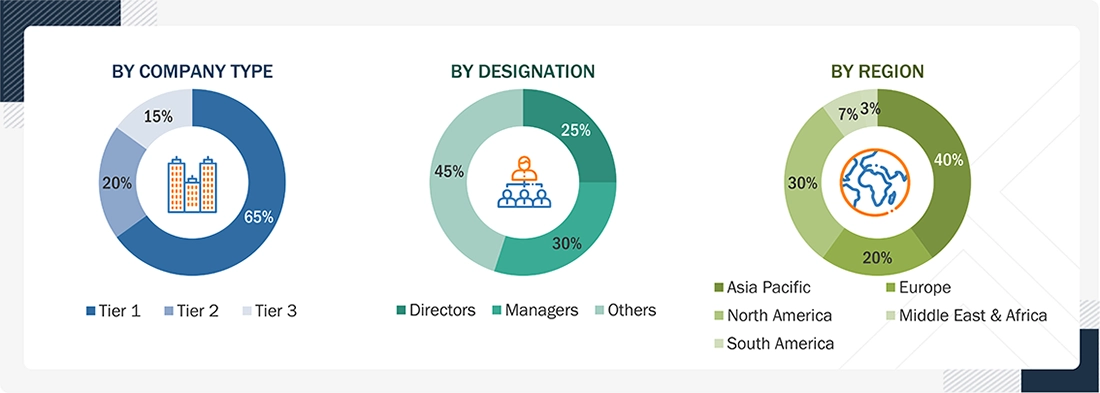
Note: Tiers of companies are based on their revenue in 2024. Tier 1: company revenue greater than USD 1 billion; Tier 2: company revenue between USD 100 million and USD 1 billion; and Tier 3: company revenue less than USD 100 million.
To know about the assumptions considered for the study, download the pdf brochure
Market Size Estimation
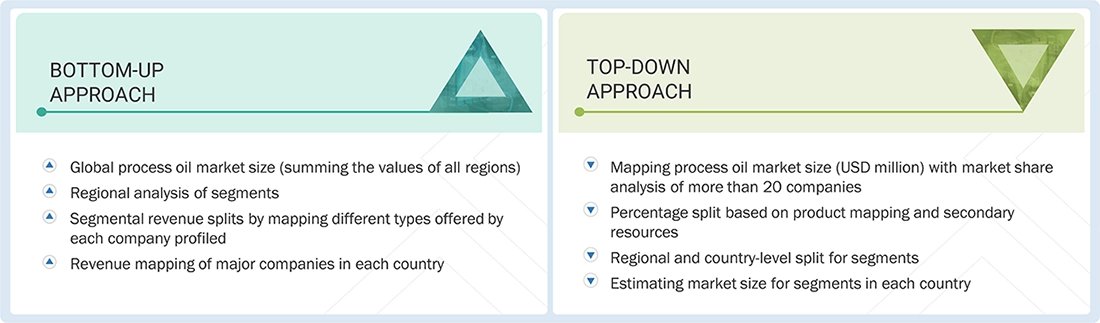
Both the top-down and bottom-up approaches were used to estimate and validate the total size of the process oil market. These methods were also widely used to determine the sizes of various market sub-segments. The research methodology used to estimate the market size included the following:
- The key players were identified through extensive primary and secondary research.
- The value chain and market size of the process oil market, in terms of value, were determined through primary and secondary research.
- All percentage shares, splits, and breakdowns were determined using secondary sources and verified through primary sources.
- All possible parameters that affect the market covered in this research study were accounted for, viewed in extensive detail, verified through primary research, and analyzed to obtain the final quantitative and qualitative data.
- The research included the study of reports, reviews, and newsletters of top market players, along with extensive interviews for opinions from key leaders, such as CEOs, directors, and marketing executives.
Process Oil Market : Top-Down and Bottom-Up Approach
Data Triangulation
After arriving at the overall market size using the market size estimation processes as explained above, the market was split into several segments and sub-segments. To complete the overall market engineering process and obtain the exact statistics for each market segment and subsegment, data triangulation and market breakdown procedures were employed, as applicable. The market size was calculated globally by summing country- and regional-level data.
Market Definition
Process oil is a petroleum-derived, synthetic, or bio-based oil used as a functional additive in industrial and manufacturing processes to support efficient production and consistent product quality. It is primarily incorporated to perform roles such as extending base materials, improving flexibility and flow, acting as a plasticizing medium, serving as a solvent to enhance formulation stability, and controlling surface behavior through defoaming and related functions. Process oils are selected based on their type and production technology to match specific processing and performance requirements, and they are widely used across applications such as tire and rubber products, polymer formulations, personal care products, textiles, and other industrial uses. While not a structural component of the final product, process oil plays a critical role in enabling smooth processing, uniform ingredient dispersion, and reliable performance for end users across the automotive, construction-related manufacturing, industrial manufacturing, energy, pharmaceuticals, and oil and gas industries.
Key Stakeholders
- Process Oil Manufacturers
- Process Oil Suppliers
- Process Oil Traders, Distributors, and Suppliers
- Investment Banks and Private Equity Firms
- Raw Material Suppliers
- Government and Research Organizations
- Consulting Companies/Consultants in the Chemicals and Materials Sectors
- Industry Associations
- Contract Manufacturing Organizations (CMOs)
- NGOs, Governments, Investment Banks, Venture Capitalists, and Private Equity Firms
Report Objectives
- To define, describe, and forecast the size of the process oil market in terms of value
- To provide detailed information regarding the key factors, such as drivers, restraints, opportunities, and industry-specific challenges, influencing the growth of the process oil market
- To analyze and forecast the size of various segments (application, viscosity, and type) of the process oil market based on five major regions—North America, Asia Pacific, Europe, the Middle East & Africa, and South America, along with key countries in each of these regions
- To strategically profile the key players in the market and comprehensively analyze their core competencies
Available customizations:
With the given market data, MarketsandMarkets offers customizations according to client-specific needs.
The following customization options are available for the report:
- Additional country-level analysis of the process oil market
- Profiling of additional market players (up to 5)
Product Analysis
- Product matrix, which gives a detailed comparison of the product portfolio of each company.
Get the Full Process Oil Market Report
Full forecast, segment splits, and company analysis for all Process Oil Market.
- China Process Oil Market
- Japan Process Oil Market
- India Process Oil Market
- South Korea Process Oil Market
- Indonesia Process Oil Market
- Thailand Process Oil Market
- Canada Process Oil Market
- Mexico Process Oil Market
- US Process Oil Market
- Russia Process Oil Market
- Germany Process Oil Market
- France Process Oil Market
- Spain Process Oil Market
- Italy Process Oil Market
- Brazil Process Oil Market
- Argentina Process Oil Market
- Rest Of Europe Process Oil Market
- Rest Of Asia Pacific Process Oil Market
- GCC Countries Process Oil Market
- –Rest Of GCC Countries Process Oil Market
Need a Tailored Report?
Customize this report to your needs
Get 10% FREE Customization
Customize This Report
