
Germany Product Lifecycle Management Market (2026-2031)

The Germany Product Lifecycle Management Market was valued at $2822.3 Million in 2026 and projected to reach to $4107.6 Million by 2031, representing a compound annual growth rate of 7.8%. Germany's Product Lifecycle Management market is poised for steady growth driven by the country's world-class manufacturing ecosystem and commitment to digital innovation.


| Market Size in | USD 26.32 MN |
| Market Forecast in | |
| CAGR | |
| Forecast Period | |
| Units Considered | Value (USD MN) |
Germany Product Lifecycle Management Market Trends and Insights
- Germany's manufacturing-centric economy and strong automotive and industrial sectors are driving adoption of advanced PLM solutions to enhance product development efficiency and reduce time-to-market.
- The country's emphasis on Industry 4.0 and digital transformation initiatives positions Germany as a key market for PLM technologies across Europe. Germany's PLM market growth is supported by increasing investments in smart manufacturing, supply chain digitalization, and collaborative product design platforms.
- German enterprises are leveraging PLM systems to manage complex product portfolios and comply with stringent regulatory requirements.
- Between 2026 and 2031, Germany is expected to see accelerated adoption among mid-market manufacturers and engineering firms seeking to optimize product lifecycle processes and improve cross-functional collaboration..
Key Market Statistics
- CAGR (2026-2031) 7.8% CAGR
- Market Size, 2026 ~USD 2822.3 Million
- Forecast, 2031 ~USD 4107.6 Million
- Country Germany
Germany Product Lifecycle Management Market Overview
Strong Manufacturing Base :
Germany's robust manufacturing sector, particularly in automotive and industrial engineering, is a primary driver for PLM adoption. Companies are leveraging advanced PLM solutions to streamline product development cycles and maintain competitive advantage in global markets.
Market Valuation Growth :
The German PLM market is valued at USD 2,822.3 million in 2026 and is expected to reach USD 4,107.6 million by 2031, demonstrating a steady CAGR of 7.8% over the forecast period.
Digital Transformation Initiative :
German enterprises are increasingly investing in Industry 4.0 and digital transformation initiatives, creating strong demand for integrated PLM systems that enhance collaboration, reduce time-to-market, and improve product quality.
Below Global Growth Rate :
While Germany's PLM market grows at 7.8% CAGR, it trails the global average of 9.8%, indicating opportunities for accelerated adoption and market penetration in emerging PLM technologies and cloud-based solutions.
Germany Product Lifecycle Management Market Dynamics
- The automotive, machinery, and industrial sectors are increasingly adopting PLM solutions to enhance product development efficiency, reduce time-to-market, and maintain quality standards in competitive global markets.
- Investment in Industry 4.0 technologies and smart manufacturing practices continues to fuel demand for integrated PLM platforms. Looking ahead to 2031, the German PLM market will benefit from growing adoption of cloud-based solutions, artificial intelligence integration, and collaborative product development tools.
- However, the market growth rate of 7.8% remains below the global average, suggesting untapped potential for vendors to accelerate penetration through localized solutions, enhanced support services, and integration with existing German enterprise systems..
Market Ecosystem
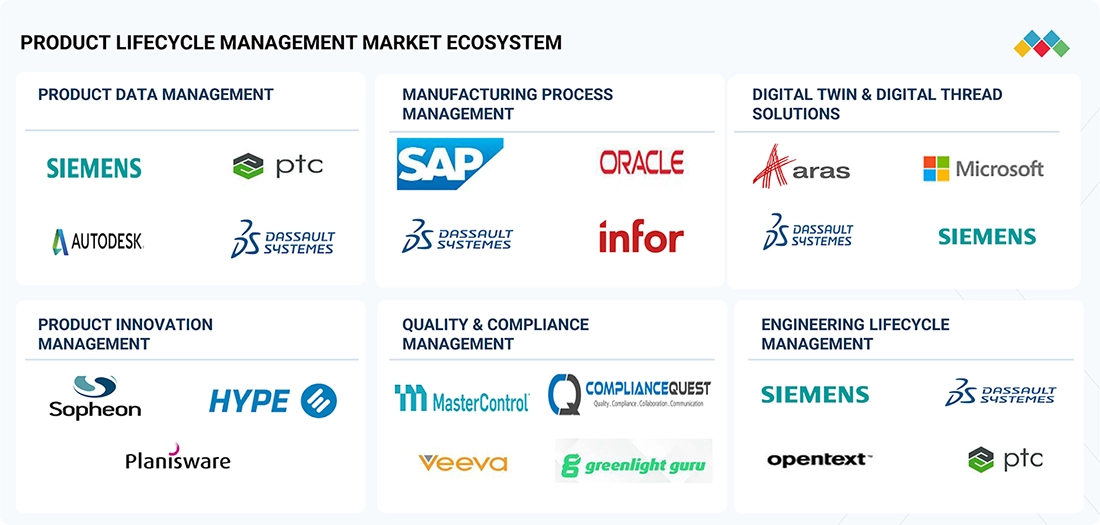
PRODUCT LIFECYCLE MANAGEMENT MARKET: COMMERCIAL USE CASES ACROSS INDUSTRIES
| COMPANY | USE CASE DESCRIPTION | BENEFITS |
|---|---|---|
 |
Achieving a 73% drop in production-based engineering changes at KOEL with PTC Windchill | Throughput time for engineering changes reduced from months to days l Engineering, manufacturing, service, and ERP systems connected for collaborative product development l Planned extension into quality management with Windchill Quality Solutions |
 |
Improving engineering change management efficiency at Vaillant Group with PTC Windchill and SAP MDG-M | Average engineering change notice (ECN) process run time reduced by approximately 25% within one year of PLM-driven process implementation |
 |
Reducing line build rework and accelerating engineering changes at Welbilt with Windchill in the cloud | 30% improvement in time to implement engineering change notices and orders l 30% reduction in line build rework through improved BOM and design accuracy l Decreased reliance on paper-based and manual processes |
 |
Speeding time to market at EnerSys with Windchill PLM in the PTC Cloud | Faster time to value and lower total cost of ownership through SaaS-managed PLM l Reduced cost of rework through improved part disposition and change management l Improved time to market through unified bills of materials across teams |
Logos and trademarks shown above are the property of their respective owners. Their use here is for informational and illustrative purposes only.
Related Ecosystem
Software And Services
- Natural Language Processing (NLP)
- Machine Learning
- Supply Chain Management
- Predictive Analytics
- Image Sensors
- International Business Machines Corporation
- MICROSOFT CORPORATION
- Oracle Corporation
- SAP SE
- Amazon.com, Inc.
Key Takeaways
- Germany's PLM market will expand from USD 2,822.3 million in 2026 to USD 4,107.6 million by 2031 at a 7.8% CAGR.
- Germany's automotive and industrial manufacturing sectors are primary drivers of PLM solution adoption and investment.
- Industry 4.0 initiatives and digital transformation strategies are accelerating PLM technology deployment across German enterprises.
- Germany's mid-market manufacturers are increasingly adopting cloud-based and collaborative PLM platforms to enhance product development efficiency.
Product Lifecycle Management Market Report Scope
| Report Metric | Details |
|---|---|
| Base Year | 2026 |
| Fastest Growing Segment | DIGITAL TWIN & DIGITAL THREAD SOLUTIONS (Software) |
| Forecast Period | 2026–2031 |
| Growth Rate | CAGR of 9.8% from 2026 to 2031 |
| Largest Segment | SOFTWARE (Offering) |
| Market Size Base Year (Billions) | ~USD 36.67 (2026) |
| Revenue Forecast (Billions) | ~USD 58.52 (2031) |
| Segments Covered | Offering, Service, Software, Software Type |
Germany Product Lifecycle Management Market Report Segmentation
4 segment dimensions are covered across the global market.
By Offering
- Services
- Software
By Service
- Managed Services
- Professional Services
By Software
- Digital Twin & Digital Thread Solutions
- Engineering Lifecycle Management (Elm)
- Manufacturing Process Management (Mpm)
- Other Plm Software
- Product Data Management (Pdm)
- Product Innovation Management (Pim)
- Quality & Compliance Management
- Service Lifecycle Management (Slm)
By Software Type
- Digital Twin & Digital Thread Solutions
- Engineering Lifecycle Management (Elm)
- Manufacturing Process Management (Mpm)
- Other Plm Software
- Product Data Management (Pdm)
- Product Innovation Management (Pim)
- Quality & Compliance Management
- Service Lifecycle Management (Slm)
Target Audience
- PLM Software Vendors : Vendors need Germany-specific market data to develop localized product strategies, identify high-growth segments within automotive and industrial sectors, and optimize sales and marketing investments in this key European market.
- Manufacturing Enterprises : German manufacturers require insights into PLM market trends and best practices to make informed technology investments, benchmark against competitors, and align PLM adoption with Industry 4.0 initiatives.
- System Integrators & Consultants : Integration partners need Germany-focused market intelligence to identify client opportunities, develop industry-specific PLM implementation methodologies, and position services for manufacturing and automotive clients.
- Investment & Private Equity Firms : Investors evaluating opportunities in German manufacturing technology require detailed market sizing, growth projections, and sector dynamics to assess investment potential and portfolio company performance.
- Government & Economic Development Agencies : Policy makers and economic development organizations need market data to support digital transformation initiatives, manufacturing competitiveness programs, and technology adoption incentives in Germany.
Key Companies in the Germany Product Lifecycle Management Market
| Company | HQ | Ownership | Strongest segments |
|---|---|---|---|
| HINDUJA GLOBAL SOLUTIONS LIMITED | India | Public Company | Contact center outsourcing (voice and omnichannel),Back office BPM and transaction processing,Technology services (AI, automation, cybersecurity, analytics, cloud), |
| SIEMENS | Germany | Public Company | Digital Industries (automation, PLM, simulation),Smart Infrastructure (electrification, buildings, grid),Mobility (rail systems, automation, services), |
| DASSAULT SYSTèMES | France | Public Company | 3D Modeling (CATIA, SOLIDWORKS, GEOVIA, BIOVIA),PLM & Collaboration (ENOVIA, CENTRIC PLM, 3DEXCITE, 3DEXPERIENCE collaboration),Simulation & Manufacturing (SIMULIA, DELMIA, 3DVIA), |
| PTC | United States | Public Company | PLM (Windchill, Arena, FlexPLM, Servigistics, Arbortext),CAD and Product Development (Creo, Onshape, Mathcad),Industrial IoT and Connectivity (ThingWorx, Kepware, Kepware Edge, KEPServerEX), |
| SAP | Germany | Public Company | SAP S/4HANA and core ERP,Human Experience Management (SAP SuccessFactors),SAP Business Technology Platform & Business AI, |
| ORACLE | United States | Public Company | Cloud Applications (Fusion ERP/EPM/SCM/HCM, NetSuite, Oracle Health, CX),Database and Middleware (Oracle Database, MySQL, Java, middleware tools),Cloud Infrastructure (compute, storage, networking, Autonomous Database on OCI), |
| AUTODESK | United States | Public Company | AutoCAD & AutoCAD LT,AEC/BIM (Revit, Civil 3D, BIM Collaborate Pro, Autodesk Build, BuildingConnected, Tandem),Manufacturing & Product Design (Fusion, Inventor, PD&M Collection, Vault), |
| IBM | United States | Public Company | Software (Hybrid Cloud & AI Platforms),Consulting (Strategy, Technology, Intelligent Operations),Infrastructure (Servers, Storage, Hybrid Cloud Lifecycle Services), |
| INFOR | United States | Private Company | Data Integration & Engineering,API & Application Integration,MDM and Customer/Business 360 Applications, |
| HCL TECH | India | Public Company | IT and Business Services,Engineering and R&D Services,HCL Software and IP-led offerings, |
| ATOS | France | Public Company | Cloud, Infrastructure and Digital Workplace Services,Application and Digital Business Platforms,Cybersecurity, Advanced Computing and AI, |
| LECTRA | France | Public Company | SaaS, PLM, CAD, and data solutions,Connected and intelligent cutting equipment,Services, consulting, training, support and maintenance, |
HINDUJA GLOBAL SOLUTIONS LIMITED
Hinduja Global Solutions Limited is an Indian public company founded in 1973 that employs 17,110 people. The company operates as a diversified business group with interests spanning multiple sectors.
SIEMENS
Siemens is a German multinational public company founded in 1847 with 310,312 employees. The company operates across electrification, automation, and digitalization sectors globally.
DASSAULT SYSTèMES
Dassault Systèmes is a French public company founded in 1981 with 25,724 employees. The company develops 3D design, simulation, and digital lifecycle management software solutions.
PTC
PTC is a United States-based public company founded in 1985 with 7,000 employees. The company provides product lifecycle management and industrial IoT software solutions.
SAP
SAP is a German multinational public company founded in 1972 with 111,038 employees. The company develops enterprise resource planning and business management software.
ORACLE
Oracle is a United States-based public company founded in 1977 with 141,000 employees. The company provides database software, cloud computing services, and enterprise solutions.
AUTODESK
Autodesk is a United States-based public company founded in 1982 with 14,300 employees. The company develops design, engineering, and construction software for professionals.
IBM
IBM is a United States-based public company founded in 1911 with 264,300 employees. The company provides information technology services, cloud solutions, and enterprise software.
INFOR
Infor is a United States-based private company founded in 1993 with 5,200 employees. The company develops enterprise resource planning and business management software solutions.
HCL TECH
HCL Tech is an Indian public company founded in 1976. The company provides information technology services and solutions to global clients.
ATOS
Atos is a French multinational public company founded in 1982 with 57,624 employees. The company provides digital transformation, cloud, and cybersecurity services.
LECTRA
Lectra is a French public company founded in 1973 with 2,800 employees. The company provides software and digital solutions for fashion, automotive, and furniture industries.
Reasons to Buy this Report
- Localized Market Intelligence : Gain deep insights specific to Germany's manufacturing landscape, including sector-specific PLM adoption trends in automotive, machinery, and industrial engineering that directly impact your business strategy.
- Competitive Positioning Data : Understand Germany's 7.8% CAGR relative to the global 9.8% benchmark, identifying growth acceleration opportunities and competitive gaps in the German market for strategic planning.
- Investment Decision Support : Access comprehensive market sizing (USD 2,822.3M in 2026 to USD 4,107.6M in 2031) to support investment decisions, resource allocation, and market entry strategies in Germany's PLM sector.
- Industry 4.0 Alignment : Leverage Germany-specific data on digital transformation and Industry 4.0 adoption to align your PLM solutions with the country's manufacturing modernization priorities and regulatory requirements.
- Vendor and Partner Strategy : Identify partnership opportunities, distribution channels, and customer segments within Germany's manufacturing ecosystem to optimize go-to-market strategies and revenue growth.
Frequently asked questions
What is the current size of Germany's PLM market in 2026?
Germany's Product Lifecycle Management market is valued at USD 2,822.3 million in 2026.
What is the projected market size for Germany's PLM market by 2031?
Germany's PLM market is projected to reach USD 4,107.6 million by 2031.
What is the CAGR for Germany's PLM market from 2026 to 2031?
Germany's PLM market is expected to grow at a compound annual growth rate of 7.8% between 2026 and 2031.
Which industries are driving PLM adoption in Germany?
Germany's automotive, industrial manufacturing, and engineering sectors are the primary drivers of PLM solution adoption and investment.
How is Industry 4.0 influencing Germany's PLM market?
Germany's Industry 4.0 initiatives and digital transformation strategies are accelerating the deployment of advanced PLM technologies to optimize product development and manufacturing processes.
RESEARCH METHODOLOGY
This research study on the product lifecycle management market involved extensive secondary sources, directories, IEEE Communication-Efficient: Algorithms and Systems, International Journal of Innovation and Technology Management, and paid databases. Primary sources were mainly industry experts from the core and related industries, preferred product lifecycle management providers, third-party service providers, consulting service providers, end users, and other commercial enterprises. In-depth interviews with primary respondents, including key industry participants and subject matter experts, were conducted to obtain and verify critical qualitative and quantitative information and assess the market’s prospects.
Secondary Research
In the secondary research process, various sources were referred to to identify and collect information for this study. Secondary sources included annual reports, press releases, and investor presentations of companies; white papers, journals, and certified publications; and articles from recognized authors, directories, and databases. The data was also collected from other secondary sources, such as journals, government websites, blogs, and vendors’ websites. Additionally, the product lifecycle management spending of various countries was extracted from the respective sources.
Primary Research
In the primary research process, various sources from the supply and demand sides were interviewed to obtain qualitative and quantitative information on the market. The primary sources from the supply side included various industry experts, such as Chief Experience Officers (CXOs), Vice Presidents (VPs), and directors specializing in business development, marketing, and product lifecycle management service providers. It also included key executives from product lifecycle management vendors, system integrators (SIs), professional service providers, industry associations, and other key opinion leaders.
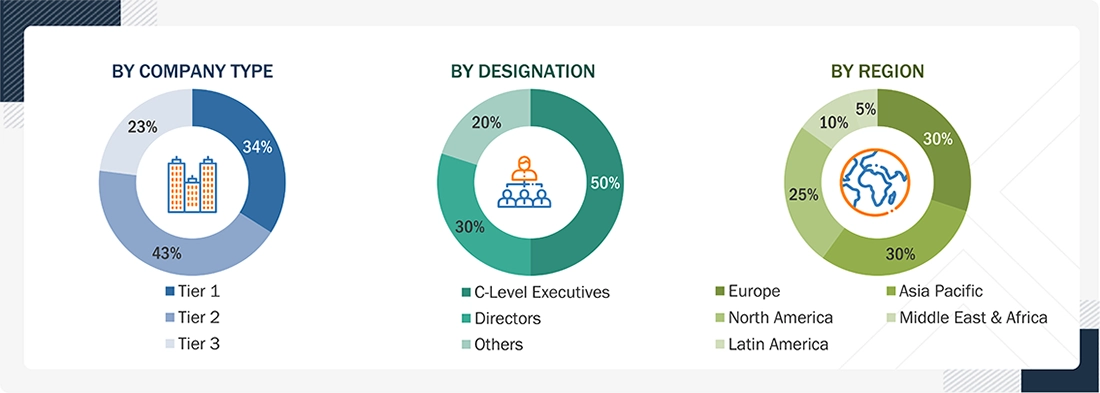
Note: Tier 1 companies’ revenues are more than USD 10 billion; tier 2 companies’ revenues range between USD 1 and 10 billion; and tier 3 companies’ revenues range between USD 500 million and USD 1 billion. Other designations include sales managers, marketing managers, and product managers.
Source: Industry Experts
To know about the assumptions considered for the study, download the pdf brochure
Market Size Estimation
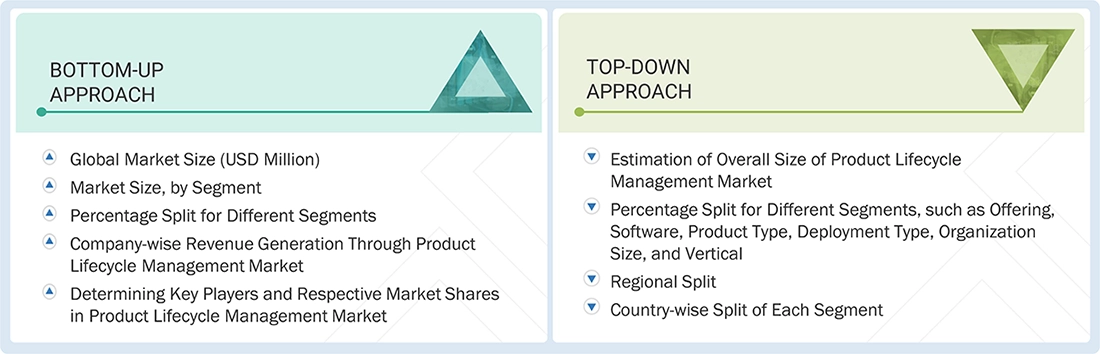
Multiple approaches were adopted to estimate and forecast the product lifecycle management market. The first approach involved estimating the market size by companies’ revenue generated through the sale of product lifecycle management products.
Market Size Estimation Methodology: Top-down Approach
The top-down approach prepared an exhaustive list of all the vendors offering products in the product lifecycle management market. The revenue contribution of the market vendors was estimated through annual reports, press releases, funding, investor presentations, paid databases, and primary interviews. Each vendor’s offerings were evaluated based on platform, degree of customization, type, application, end user, and region. The markets were triangulated through primary and secondary research. The primary procedure included extensive interviews for key insights from industry leaders, such as CIOs, CEOs, VPs, directors, and marketing executives. The market numbers were further triangulated with the existing MarketsandMarkets’ repository for validation.
Market Size Estimation Methodology: Bottom-up Approach
The bottom-up approach identified the adoption rate of the product lifecycle management products among different verticals in key countries, considering their regions contributing the most to the market share. For cross-validation, the adoption of product lifecycle management products among enterprises and other use cases for their regions was identified and extrapolated. Use cases identified in different areas were weighed for the market size calculation.
Based on the market numbers, the regional split was determined by primary and secondary sources. The procedure included an analysis of the product lifecycle management market’s regional penetration. Based on secondary research, the regional spending on Information and Communications Technology (ICT), socioeconomic analysis of each country, strategic vendor analysis of major product lifecycle management service providers, and organic and inorganic business development activities of regional and global players were estimated.
Product Lifecycle Management Market : Top-Down and Bottom-Up Approach
Data Triangulation
After determining the overall market size using the market size estimation processes as explained above, the market was split into several segments and subsegments. Data triangulation and market breakup procedures were employed, wherever applicable, to complete the overall market engineering process and arrive at the exact statistics of each market segment and subsegment. The overall market size was then used in the top-down procedure to estimate the size of other individual markets via percentage splits of the market segmentation.
Market Definition
The product lifecycle management (PLM) market comprises software platforms and services that enable organizations to manage product-related information, processes, and collaboration throughout the entire product lifecycle—from concept and design to manufacturing, service, and end-of-life. The market includes solutions such as product data management (PDM), manufacturing process management, digital twin & digital thread solutions, product innovation management, quality & compliance management, engineering lifecycle management, service lifecycle management, and other PLM software. These platforms integrate engineering, manufacturing, quality, supply chain, and service functions within a unified environment, enabling organizations to improve product quality, accelerate innovation, reduce time-to-market, strengthen regulatory compliance, and enhance lifecycle traceability. The increasing adoption of cloud computing, artificial intelligence (AI), digital twins, model-based systems engineering (MBSE), and software-defined product development is further transforming PLM into a strategic enabler of enterprise-wide digital transformation and connected product innovation.
Key Stakeholders
- PLM Software Providers
- Cloud Infrastructure & Technology Providers
- System Integrators and Consulting Service Providers
- CAD/CAE/CAM and Engineering Software Vendors
- Manufacturing and Industrial Enterprises
- Automotive & Transportation Companies
- Aerospace & Defense Organizations
- Electronics & Semiconductor Manufacturers
- Healthcare & Medical Device Companies
- Energy & Utilities Companies
- Retail & Consumer Goods Manufacturers
- Architecture, Engineering & Construction (AEC) Firms
- IT & Telecom Equipment Manufacturers
- Suppliers and Contract Manufacturers
- Regulatory Bodies and Standards Organizations
- Research Institutions and Industry Associations
Report Objectives
- To define, describe, and forecast the product lifecycle management market based on offering, software type, product type, deployment type, vertical, and region
- To forecast the market size of the five major regional segments: North America, Europe, Asia Pacific, the Middle East & Africa, and Latin America
- To strategically analyze the market subsegments with respect to individual growth trends, prospects, and contributions to the total market
- To provide detailed information related to the major factors influencing market growth (drivers, restraints, opportunities, and challenges)
- To strategically analyze macro and micro markets with respect to growth trends, prospects, and their contribution to the overall market
- To analyze industry trends, patents, innovations, and pricing data related to the market
- To analyze the opportunities in the market for stakeholders and provide details of the competitive landscape for major players
- To profile key players in the market and comprehensively analyze their market share/ranking and core competencies
- To track and analyze competitive developments, such as mergers & acquisitions, product developments, and partnerships & collaborations, in the market
Available customizations:
With the given market data, MarketsandMarkets offers customizations as per the company’s specific needs. The following customization options are available for the report:
Product Analysis
- The product matrix provides a detailed comparison of the product portfolio of each company.
Regional Analysis
- Further breakup of the North America product lifecycle management market
- Further breakup of the Europe product lifecycle management market
- Further breakup of the Asia Pacific product lifecycle management market
- Further breakup of the Middle East & Africa product lifecycle management market
- Further breakup of the Latin America product lifecycle management market
Company Information
- Detailed analysis and profiling of additional market players (up to five)
Get the Full Product Lifecycle Management Market Report
Full forecast, segment splits, and company analysis for all Product Lifecycle Management Market.
- US Product Lifecycle Management Market
- Canada Product Lifecycle Management Market
- UK Product Lifecycle Management Market
- France Product Lifecycle Management Market
- Italy Product Lifecycle Management Market
- China Product Lifecycle Management Market
- India Product Lifecycle Management Market
- Japan Product Lifecycle Management Market
- South Korea Product Lifecycle Management Market
- Saudi Arabia Product Lifecycle Management Market
- UAE Product Lifecycle Management Market
- South Africa Product Lifecycle Management Market
- Brazil Product Lifecycle Management Market
- Mexico Product Lifecycle Management Market
- Rest Of Europe Product Lifecycle Management Market
- Rest Of Apac Product Lifecycle Management Market
- GCC Product Lifecycle Management Market
- Rest Of Mea Product Lifecycle Management Market
Need a Tailored Report?
Customize this report to your needs
Get 10% FREE Customization
Customize This Report
