
Italy Quality Management System (QMS) Software Market (2026-2031)

The Italy Quality Management System (QMS) Software Market was valued at $131.5 Million in 2026 and projected to reach to $229.5 Million by 2031, representing a compound annual growth rate of 11.8%. Italy's Quality Management System Software Market is positioned for steady growth as manufacturers modernize quality processes to meet EU regulations and international standards.


| Market Size in | USD 26.32 MN |
| Market Forecast in | |
| CAGR | |
| Forecast Period | |
| Units Considered | Value (USD MN) |
Italy Quality Management System (QMS) Software Market Trends and Insights
- This expansion reflects South Africa's increasing adoption of digital quality assurance solutions across manufacturing, pharmaceuticals, and regulated industries.
- South Africa's market growth is driven by heightened compliance requirements, digital transformation initiatives, and the need for operational excellence in competitive sectors. The South Africa QMS software landscape is characterized by rising demand for cloud-based and integrated quality solutions that enable real-time monitoring and traceability.
- South Africa's enterprises are investing in automation and data-driven quality management to reduce defects, improve customer satisfaction, and meet international standards.
- Between 2026 and 2031, South Africa's market will benefit from increased awareness of quality management benefits, expansion of manufacturing capabilities, and regulatory pressures that mandate standardized quality protocols across industries..
Key Market Statistics
- CAGR (2026-2031) 11.8% CAGR
- Market Size, 2026 ~USD 131.5 Million
- Forecast, 2031 ~USD 229.5 Million
- Country Italy
Italy Quality Management System (QMS) Software Market Overview
Strong Manufacturing Base :
Italy's robust manufacturing sector, particularly in automotive, machinery, and consumer goods, is driving significant QMS software adoption to maintain quality standards and regulatory compliance across production facilities.
EU Regulatory Compliance :
Stringent European Union quality directives and CE marking requirements are compelling Italian manufacturers to implement advanced QMS solutions for traceability, documentation, and audit management.
SME Digital Transformation :
Italy's large population of small and medium-sized enterprises is increasingly investing in cloud-based QMS platforms to streamline operations, reduce costs, and compete in global markets.
Pharmaceutical & Food Safety :
Italy's significant pharmaceutical and food processing industries require sophisticated QMS software to meet GMP, HACCP, and ISO standards, creating sustained demand for quality management solutions.
Italy Quality Management System (QMS) Software Market Dynamics
- The country's diverse industrial base—spanning automotive, pharmaceuticals, food production, and machinery—creates consistent demand for integrated QMS platforms.
- Digital transformation initiatives among Italian SMEs, coupled with increasing focus on supply chain transparency and traceability, are accelerating software adoption.
- The market benefits from Italy's export-oriented economy, where quality assurance directly impacts competitiveness in global markets.
- Investment in Industry 4.0 technologies further supports QMS software integration with production systems..
Market Ecosystem
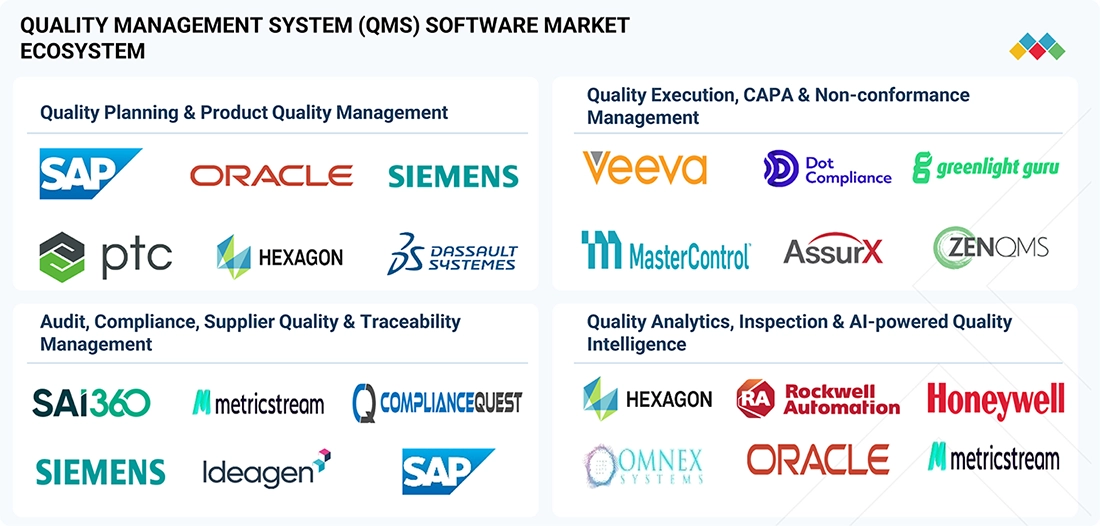
QUALITY AND LIFECYCLE MANAGEMENT SOFTWARE MARKET: COMMERCIAL USE CASES ACROSS INDUSTRIES
| COMPANY | USE CASE DESCRIPTION | BENEFITS |
|---|---|---|
 |
Siemens and Georg Fischer Automotive transform enterprise quality management through IBS QMS deployment | Standardized quality management processes across all manufacturing sites | Successful rollout across 9 production facilities in Europe and 2 plants in China | Improved transparency and visibility across enterprise quality operations | Optimized end-to-end product lifecycle management | Simplified quality data tracking and management processes | Reduced reaction times for quality issues and corrective actions | Increased process stability and operational efficiency |
 |
Veeva Systems and EMD Serono advance proactive quality risk management with Veeva QMS | Unified quality and risk management within a single platform | Transitioned from reactive to proactive risk management practices | Established a single source of truth for quality and risk data | Improved enterprise-wide transparency into risk exposure and quality events | Standardized risk scoring, categorization, and tolerance methodologies | Enhanced ability to identify root causes and potential failure risks | Strengthened preventive action management through risk-based controls |
 |
MasterControl and Thermo Fisher Scientific drive global quality harmonization through enterprise QMS standardization | Unified quality operations across 700+ global sites | Supported quality management for 80,000 employees worldwide | Established a single enterprise-wide quality ecosystem | Improved visibility and analytics across quality processes | Reduced system fragmentation and site-level customization complexity | Accelerated deployment and scalability of quality initiatives | Enhanced collaboration between IT, quality, compliance, and site teams |
 |
Honeywell and SGS Life Sciences accelerate global digital quality transformation with TrackWise Digital | Digitalization of 25,000+ paper forms and SOPs | Deployment across 17 global testing laboratories | Rollout to 12 sites across 7 countries within 2019 | Chicago site go-live completed within 3 months | Improved cycle times for quality event management | Enhanced global visibility into quality events, trends, and compliance metrics | Eliminated manual monthly KPI reporting through real-time dashboards |
 |
PTC Arena and EVERSANA strengthen life sciences quality operations through cloud-native QMS deployment | Reduced training report generation from hours to minutes | Eliminated spreadsheet-dependent quality management processes | Accelerated customer onboarding and go-live deployments | Automated complaint handling and audit management activities | Improved regulatory compliance and data integrity | Enabled secure customer-specific quality workspaces | Increased operational efficiency through workflow automation |
Logos and trademarks shown above are the property of their respective owners. Their use here is for informational and illustrative purposes only.
Related Ecosystem
Key Takeaways
- South Africa's QMS software market is valued at USD 131.5 million in 2026 and will reach USD 229.5 million by 2031, representing an 11.8% CAGR.
- South Africa's manufacturing and pharmaceutical sectors are primary drivers of QMS adoption, fueled by compliance and quality standardization requirements.
- Cloud-based and integrated QMS solutions are gaining traction in South Africa as enterprises prioritize real-time visibility and data-driven decision-making.
- South Africa's market growth is supported by digital transformation initiatives and increasing regulatory pressures across regulated industries.
Quality Management System (QMS) Software Market Report Scope
| Report Metric | Details |
|---|---|
| Base Year | 2026 |
| Fastest Growing Segment | ASIA PACIFIC (Professional Service) |
| Forecast Period | 2026–2031 |
| Growth Rate | CAGR of 11.7% from 2026 to 2031 |
| Largest Segment | CLOUD (Deployment Mode) |
| Market Size Base Year (Billions) | ~USD 11.75 (2026) |
| Revenue Forecast (Billions) | ~USD 20.43 (2031) |
| Segments Covered | Offering, Solution, Deployment Mode, Organization Size, Service, Vertical, Professional Service, Solution Type |
Italy Quality Management System (QMS) Software Market Report Segmentation
8 segment dimensions are covered across the global market.
By Offering
- Services
- Solutions
By Solution
- Audit Management
- Bill Of Material Management
- Change Management
- Change Management/Change Control
- Complaint Management
- Corrective & Preventive Action (Capa) Management
- Cost Management
- Document & Product Data Management
- Document Control & Management
- Governance & Compliance Management
- Lifecycle Analytics Management
- Non-Conformance & Deviation Management
- Other Solutions
- Quality Analytics & Intelligence
- Quality Management
- Quality Planning & Design
- Supplier Quality Management
- Training Management
By Deployment Mode
- Cloud
- Cloud-Based
- Hybrid
- On-Premises
By Organization Size
- Large Enterprises
- Small & Medium-Sized Enterprises
- Smes
By Service
- Managed Services
- Professional Services
By Vertical
- Aerospace & Defence
- Aerospace & Defense
- Automotive & Transport
- Automotive & Transportation
- Consumer Goods & Retail
- Energy & Utilities
- Food & Beverages
- Healthcare & Life Sciences
- Industrial Manufacturing
- It & Telecom
- Other Verticals
- Retail & Consumer Goods
- Semiconductor & Electronics
By Professional Service
- Consulting & Strategy
- Implementation & Integration
- Support And Maintenance
By Solution Type
- Audit Management
- Change Management/Change Control
- Complaint Management
- Corrective & Preventive Action (Capa) Management
- Document Control & Management
- Non-Conformance & Deviation Management
- Quality Analytics & Intelligence
- Quality Planning & Design
- Supplier Quality Management
- Training Management
Target Audience
- QMS Software Vendors : Vendors need Italy-specific market data to develop localized solutions, understand regulatory requirements, and identify high-potential customer segments for market entry and expansion.
- Manufacturing Companies : Italian manufacturers require insights into QMS software capabilities and market trends to select appropriate solutions that ensure EU compliance and operational efficiency.
- Private Equity & Investors : Investors evaluating opportunities in Italy's digital transformation and quality tech sectors need market sizing, growth projections, and competitive dynamics for investment decisions.
- Pharmaceutical & Food Producers : Regulated industry players need detailed market analysis to benchmark QMS investments, understand compliance technology trends, and optimize quality management strategies.
- Consultants & System Integrators : Implementation partners require Italy market intelligence to advise clients on QMS selection, identify emerging technologies, and position service offerings effectively.
Key Companies in the Italy Quality Management System (QMS) Software Market
| Company | HQ | Ownership | Strongest segments |
|---|---|---|---|
| INFOR INC | United States | Private Company | Quality Analytics & Intelligence,CAPA Management,Supplier Quality Management, |
| FREUDENBERG GROUP | Germany | Private Company | Quality Analytics & Intelligence,CAPA Management,Supplier Quality Management, |
| HEXAGON | Sweden | Public Company | Quality Analytics & Intelligence,CAPA Management,Supplier Quality Management, |
| VEEVA SYSTEMS | United States | Public Company | Quality Analytics & Intelligence,CAPA Management,Supplier Quality Management, |
| SIEMENS | Germany | Public Company | Quality Analytics & Intelligence,CAPA Management,Supplier Quality Management, |
| HONEYWELL INTERNATIONAL | United States | Public Company | Quality Analytics & Intelligence,CAPA Management,Supplier Quality Management, |
| DASSAULT SYSTèMES | France | Public Company | Quality Analytics & Intelligence,CAPA Management,Supplier Quality Management, |
| PTC | United States | Public Company | Quality Analytics & Intelligence,CAPA Management,Supplier Quality Management, |
| SAP | Germany | Public Company | Quality Analytics & Intelligence,CAPA Management,Supplier Quality Management, |
| ORACLE | United States | Public Company | Quality Analytics & Intelligence,CAPA Management,Supplier Quality Management, |
| IDEAGEN | United Kingdom | Private Company | Quality Analytics & Intelligence,CAPA Management,Supplier Quality Management, |
| QAD | United States | Private Company | Quality Analytics & Intelligence,CAPA Management,Supplier Quality Management, |
| ROCKWELL AUTOMATION | United States | Public Company | Quality Analytics & Intelligence,CAPA Management,Supplier Quality Management, |
| SOFTEXPERT | Brazil | Private Company | Quality Analytics & Intelligence,CAPA Management,Supplier Quality Management, |
INFOR INC
Infor Inc is a private software company founded in 1993 in the United States with 5,200 employees. The company provides enterprise resource planning and business management solutions.
FREUDENBERG GROUP
Freudenberg Group is a German private company founded in 1849 with 50,968 employees. The company operates across multiple industrial sectors including sealing technologies, vibration control, and specialty chemicals.
HEXAGON
Hexagon is a Swedish public company founded in 1975 with 16,118 employees. The company provides digital solutions and enterprise software for industrial, geospatial, and construction applications.
VEEVA SYSTEMS
Veeva Systems is a United States-based public company founded in 2007 with 7,928 employees. The company provides cloud-based software solutions for the life sciences industry, including pharmaceutical and medical device companies.
SIEMENS
Siemens is a German public company founded in 1847 with 310,312 employees. The company is a global leader in electrification, automation, and digitalization across industrial, infrastructure, and mobility sectors.
HONEYWELL INTERNATIONAL
Honeywell International is a United States-based public company founded in 1885 with 101,000 employees. The company provides diversified technology and manufacturing solutions for aerospace, building technologies, performance materials, and safety applications.
DASSAULT SYSTèMES
Dassault Systèmes is a French public company founded in 1981 with 25,724 employees. The company develops 3D design, simulation, and digital lifecycle management software for product development and manufacturing.
PTC
PTC is a United States-based public company founded in 1985 with 7,000 employees. The company provides software solutions for product lifecycle management, computer-aided design, and industrial IoT applications.
SAP
SAP is a German public company founded in 1972 with 111,038 employees. The company is a global leader in enterprise resource planning software and cloud-based business solutions.
ORACLE
Oracle is a United States-based public company founded in 1977 with 141,000 employees. The company provides database software, cloud computing solutions, and enterprise applications for businesses worldwide.
IDEAGEN
Ideagen is a United Kingdom-based private company founded in 1993 with 697 employees. The company provides software solutions for quality, compliance, and risk management across various industries.
QAD
QAD is a United States-based private company founded in 1979 with 1,940 employees. The company provides enterprise resource planning and supply chain management software for manufacturing and distribution industries.
ROCKWELL AUTOMATION
Rockwell Automation is a United States-based public company founded in 1903 with 26,000 employees. The company provides industrial automation, information, and power management solutions for manufacturing and infrastructure sectors.
SOFTEXPERT
SoftExpert is a Brazil-based private company founded in 1995 with 170 employees. The company provides business process management and compliance software solutions for regulated industries.
Reasons to Buy this Report
- Market Size & Growth Trajectory : Detailed analysis of Italy's QMS market expanding from USD 131.5M to USD 229.5M (2026-2031) at 11.8% CAGR, enabling accurate investment and expansion planning decisions.
- Regulatory & Compliance Insights : Comprehensive understanding of EU directives, CE marking requirements, and Italian-specific quality standards driving QMS adoption across regulated industries.
- Competitive Landscape Analysis : Identification of key market players, solution providers, and competitive positioning within Italy's QMS software ecosystem to inform go-to-market strategies.
- Industry-Specific Opportunities : Targeted insights into high-growth sectors including automotive, pharmaceuticals, food processing, and machinery manufacturing with distinct QMS requirements and adoption patterns.
- SME Penetration Strategy : Data-driven guidance on capturing Italy's substantial SME segment through cloud-based, cost-effective QMS solutions aligned with digital transformation initiatives.
Frequently asked questions
What is the current size of South Africa's QMS software market?
South Africa's Quality Management System software market is valued at USD 131.5 million in 2026 and is expected to grow to USD 229.5 million by 2031.
What is the projected growth rate for South Africa's QMS market?
South Africa's QMS software market is projected to grow at a compound annual growth rate (CAGR) of 11.8% from 2026 to 2031.
Which industries in South Africa are driving QMS software adoption?
South Africa's manufacturing, pharmaceutical, food and beverage, and automotive sectors are primary drivers of QMS software adoption due to stringent compliance and quality requirements.
What are the key trends in South Africa's QMS software market?
South Africa's QMS market is experiencing increased adoption of cloud-based solutions, integration with enterprise systems, automation of quality processes, and emphasis on real-time data analytics and traceability.
What factors are contributing to growth in South Africa's QMS market?
South Africa's QMS market growth is driven by digital transformation initiatives, regulatory compliance pressures, demand for operational efficiency, and the need for integrated quality management across supply chains.
RESEARCH METHODOLOGY
This research study on the quality management system software market involved extensive secondary sources, including directories, IEEE Communication-Efficient: Algorithms and Systems, and the International Journal of Innovation and Technology Management, as well as paid databases. Primary sources were mainly industry experts from core and related industries, preferred quality management system software providers, third-party service providers, consulting service providers, end users, and other commercial enterprises. In-depth interviews with primary respondents, including key industry participants and subject matter experts, were conducted to gather and verify critical qualitative and quantitative information, as well as assess the market’s prospects.
Secondary Research
In the secondary research process, various sources were referred to identify and collect information for this study. Secondary sources included annual reports, press releases, and investor presentations of companies; white papers, journals, and certified publications; and articles from recognized authors, directories, and databases. The data was also collected from other secondary sources, such as journals, government websites, blogs, and vendors’ websites. Additionally, the quality management system software spending of various countries was extracted from the respective sources.
Primary Research
In the primary research process, various sources from the supply and demand sides were interviewed to obtain qualitative and quantitative information on the market. The primary sources from the supply side included various industry experts, such as chief experience officers (CXOs), vice presidents (VPs), and directors specializing in business development, marketing, and quality management system software services. It also included key executives from quality management system software vendors, system integrators (SIs), professional service providers, industry associations, and other key opinion leaders.
Breakup of Primary Profiles:
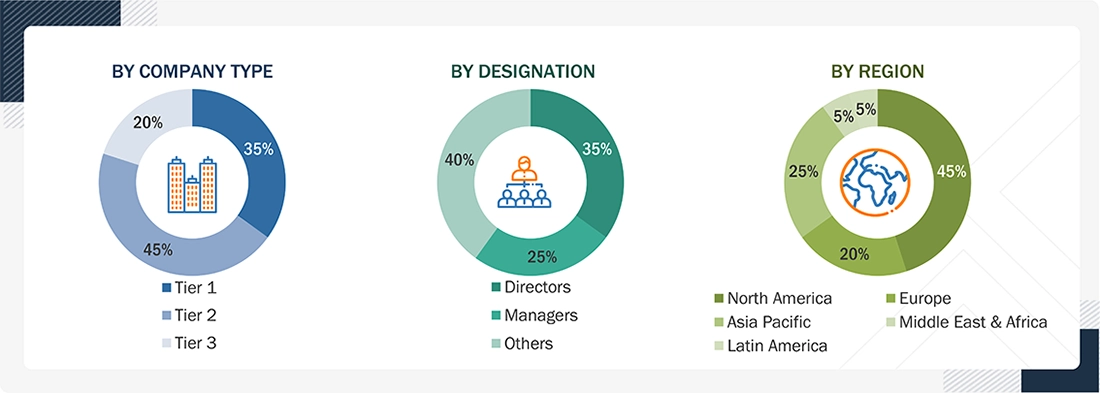
Note: Tier 1 companies’ revenues are more than USD 10 billion; tier 2 companies’ revenues range between USD 1 and 10 billion; and tier 3 companies’ revenues range between USD 500 million and USD 1 billion. Other designations include sales, marketing, and product managers.
Source: Industry Experts
To know about the assumptions considered for the study, download the pdf brochure
Market Size Estimation
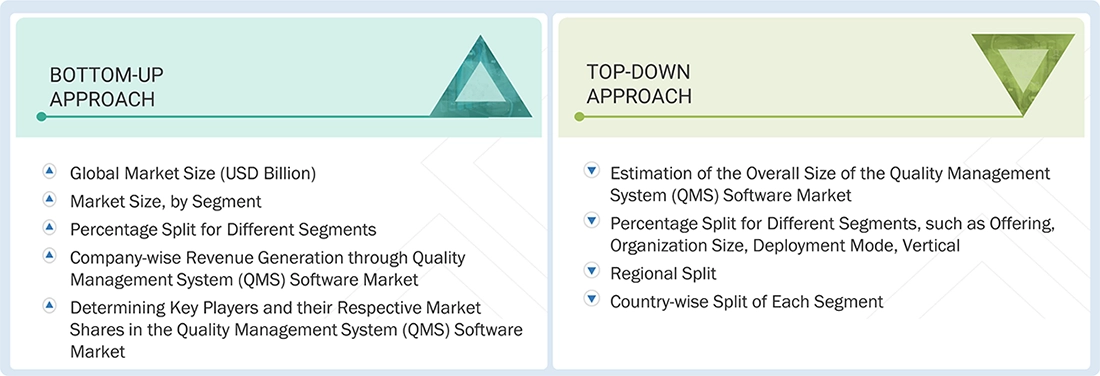
Multiple approaches were adopted to estimate and forecast the quality management system software market. The first approach involved estimating the market size based on companies’ revenue from the sale of quality management system software products.
Market Size Estimation Methodology: Top-down Approach
The top-down approach prepared an exhaustive list of all the vendors offering products in the quality management system software market. The revenue contribution of the market vendors was estimated through annual reports, press releases, funding, investor presentations, paid databases, and primary interviews. Each vendor’s offerings were evaluated based on offering, solution, deployment mode, organization size, vertical, and region. The markets were triangulated through primary and secondary research. The primary procedure included extensive interviews for key insights from industry leaders, such as CIOs, CEOs, VPs, directors, and marketing executives. The market numbers were further triangulated with the existing MarketsandMarkets’ repository for validation.
Market Size Estimation Methodology: Bottom-up Approach
The bottom-up approach identified the adoption rate of quality management system software products across different verticals in key countries, considering the regions that contribute the most to the market share. For cross-validation, the adoption of quality management system software products among enterprises and other use cases for their regions was identified and extrapolated. Use cases identified in different areas were weighed for the market size calculation.
Based on the market numbers, the regional split was determined by primary and secondary sources. The procedure included an analysis of the quality management system software market’s regional penetration. Based on secondary research, the regional spending on Information and Communications Technology (ICT), socioeconomic analysis of each country, strategic vendor analysis of major quality management system software service providers, and organic and inorganic business development activities of regional and global players were estimated.
Quality and Lifecycle Management Software Market : Top-Down and Bottom-Up Approach
Data Triangulation
After determining the overall market size using the market size estimation processes as explained above, the market was split into several segments and subsegments. Data triangulation and market breakup procedures were employed, wherever applicable, to complete the overall market engineering process and arrive at the exact statistics of each market segment and subsegment. The overall market size was then used in the top-down approach to estimate the size of other individual markets by applying percentage splits to the market segmentation.
Market Definition
The Quality Management System (QMS) software market consists of software solutions that help organizations digitalize, automate, and manage quality processes to ensure product quality, regulatory compliance, operational efficiency, and continuous improvement. These platforms provide capabilities such as document control, CAPA management, audit management, supplier quality management, complaint handling, training management, change control, and quality analytics, while integrating with enterprise systems such as ERP, MES, and PLM. QMS software is widely adopted across industries including manufacturing, life sciences, healthcare, automotive, aerospace and defense, food and beverage, and electronics to streamline quality operations, reduce compliance risks, and improve overall business performance.
Key Stakeholders
- QMS Software Platform Providers
- Cloud-based QMS Solution Providers
- Quality Analytics and Intelligence Software Providers
- Supplier Quality Management Solution Providers
- CAPA and Non-conformance Management Software Vendors
- Audit, Compliance, and Document Management Solution Providers
- Enterprise Resource Planning (ERP) Software Providers
- Manufacturing Execution System (MES) Providers
- Product Lifecycle Management (PLM) Software Providers
- Cloud Infrastructure Providers and Hyperscalers
- Artificial Intelligence and Automation Technology Providers for Quality Management
- System Integrators and QMS Implementation Partners
- Validation, Compliance, and Quality Consulting Service Providers
- Managed QMS Service Providers
- Manufacturing Enterprises and Industrial Organizations
Report Objectives
- To define and describe the quality management system software market based on offering (solutions and services), solution (document control & management, corrective & preventive action (CAPA) management, non-conformance & deviation management, audit management, training management, supplier quality management, change management/change control, complaint management, quality analytics & intelligence, quality planning & design), organization size (large enterprises, small & medium-sized enterprises), deployment mode (on-premises, cloud-based, hybrid), and vertical
- To provide detailed information on major factors influencing market growth (drivers, restraints, opportunities, and challenges) across quality management system software, supplier quality management, audit management, and aftermarket transformation.
- To strategically analyze micro markets with respect to individual growth trends, adoption patterns, and their contribution to the overall quality management system software market.
- To analyze market opportunities for stakeholders and present a comprehensive competitive landscape of leading quality management system software vendors, OEM aftermarket players, and service providers.
- To project the market size and its submarkets in terms of value (USD million) across five key regions (North America, Europe, Asia Pacific, Middle East & Africa, Latin America), along with an analysis of their respective major countries.
- To strategically profile leading companies and provide an in-depth evaluation of their core competencies, product portfolios, technology capabilities, and market positioning.
- To examine competitive developments, including product launches, software upgrades, partnerships, integrations, strategic expansions, and mergers & acquisitions across the quality management system software ecosystem.
Available customizations:
With the given market data, MarketsandMarkets offers customizations as per the company’s specific needs. The following customization options are available for the report:
Product Analysis
- The product matrix provides a detailed comparison of the product portfolio of each company.
Geographical Analysis
- Further breakup of the North American quality management system software market
- Further breakup of the European quality management system software market
- Further breakup of the Asia Pacific quality management system software market
- Further breakup of the Middle East & African quality management system software market
- Further breakup of the Latin American quality management system software market
Company Information
- Detailed analysis and profiling of additional market players (up to five)
Get the Full Quality Management System (QMS) Software Market Report
Full forecast, segment splits, and company analysis for all Quality Management System (QMS) Software Market.
- South Africa Quality Management System (QMS) Software Market
- Brazil Quality Management System (QMS) Software Market
- Mexico Quality Management System (QMS) Software Market
- US Quality Management System (QMS) Software Market
- Canada Quality Management System (QMS) Software Market
- UK Quality Management System (QMS) Software Market
- Germany Quality Management System (QMS) Software Market
- France Quality Management System (QMS) Software Market
- China Quality Management System (QMS) Software Market
- India Quality Management System (QMS) Software Market
- Japan Quality Management System (QMS) Software Market
- South Korea Quality Management System (QMS) Software Market
- Saudi Arabia Quality Management System (QMS) Software Market
- UAE Quality Management System (QMS) Software Market
Need a Tailored Report?
Customize this report to your needs
Get 10% FREE Customization
Customize This Report
