
Rest Of Mea Quality Management System (QMS) Software Market (2026-2031)

The Rest Of Mea Quality Management System (QMS) Software Market was valued at $106 Million in 2026 and projected to reach to $176.5 Million by 2031, representing a compound annual growth rate of 10.7%. The Rest Of Mea Quality Management System software market is poised for sustained growth through 2031, driven by intensifying regulatory pressures and organizational emphasis on quality standardization.


| Market Size in | USD 26.32 MN |
| Market Forecast in | |
| CAGR | |
| Forecast Period | |
| Units Considered | Value (USD MN) |
Rest Of Mea Quality Management System (QMS) Software Market Trends and Insights
- Rest Of Mea's QMS software adoption is driven by increasing regulatory compliance requirements and digital transformation initiatives across manufacturing, healthcare, and service sectors.
- The region's growing emphasis on operational excellence and quality assurance is positioning Rest Of Mea as an emerging market for QMS solutions. Rest Of Mea demonstrates a compound annual growth rate (CAGR) of 10.7% throughout the forecast period, reflecting strong demand for integrated quality management platforms.
- Rest Of Mea's market growth is supported by rising awareness of quality standards, investment in enterprise software infrastructure, and the need for real-time quality monitoring across distributed operations.
- Organizations in Rest Of Mea are increasingly recognizing QMS software as critical for maintaining competitive advantage and meeting international quality benchmarks..
Key Market Statistics
- CAGR (2026-2031) 10.7% CAGR
- Market Size, 2026 ~USD 106 Million
- Forecast, 2031 ~USD 176.5 Million
- Country Rest Of Mea
Rest Of Mea Quality Management System (QMS) Software Market Overview
Market Valuation Growth :
Rest Of Mea QMS software market valued at USD 106.0 million in 2026, expanding to USD 176.5 million by 2031, representing a robust 10.7% CAGR driven by regional digital transformation initiatives.
Regulatory Compliance Drivers :
Increasing regulatory compliance requirements across manufacturing, healthcare, and service sectors in Rest Of Mea are accelerating QMS software adoption as organizations prioritize quality assurance and operational excellence.
Sector-Specific Expansion :
Manufacturing, healthcare, and service industries in Rest Of Mea are leading QMS software implementation, with organizations seeking integrated solutions to streamline quality processes and reduce operational risks.
Digital Transformation Momentum :
Rest Of Mea enterprises are increasingly investing in digital transformation initiatives, positioning QMS software as a critical enabler for modernizing quality management infrastructure and enhancing competitive positioning.
Rest Of Mea Quality Management System (QMS) Software Market Dynamics
- Manufacturing and healthcare sectors are leading adoption, with enterprises recognizing QMS software as essential for compliance, risk mitigation, and operational efficiency.
- Digital transformation initiatives across the region are creating favorable conditions for market expansion, as organizations modernize legacy systems and implement cloud-based quality management solutions.
- The 10.7% CAGR reflects growing market maturity and increasing awareness of QMS benefits among mid-market and enterprise organizations in Rest Of Mea..
Market Ecosystem
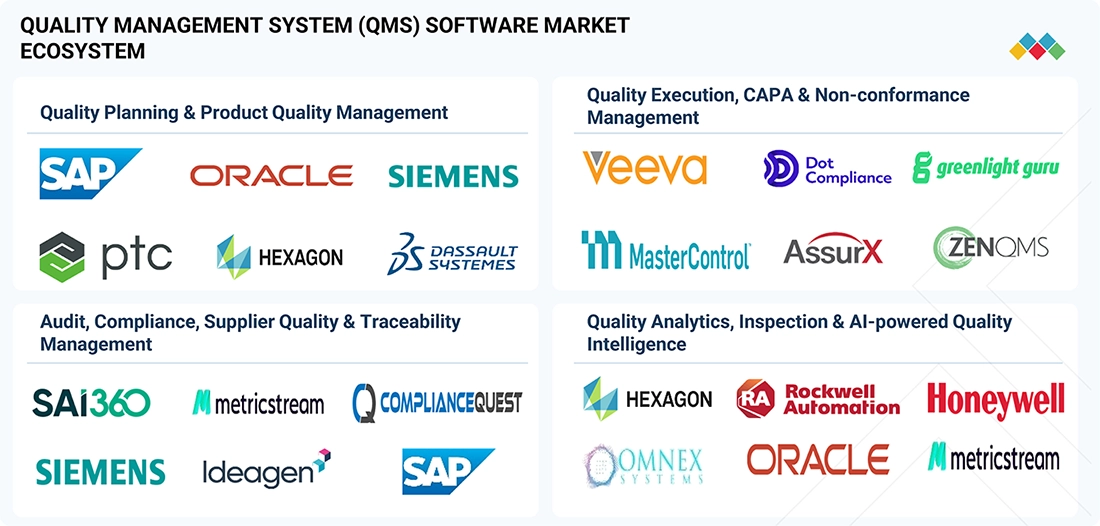
QUALITY AND LIFECYCLE MANAGEMENT SOFTWARE MARKET: COMMERCIAL USE CASES ACROSS INDUSTRIES
| COMPANY | USE CASE DESCRIPTION | BENEFITS |
|---|---|---|
 |
Siemens and Georg Fischer Automotive transform enterprise quality management through IBS QMS deployment | Standardized quality management processes across all manufacturing sites | Successful rollout across 9 production facilities in Europe and 2 plants in China | Improved transparency and visibility across enterprise quality operations | Optimized end-to-end product lifecycle management | Simplified quality data tracking and management processes | Reduced reaction times for quality issues and corrective actions | Increased process stability and operational efficiency |
 |
Veeva Systems and EMD Serono advance proactive quality risk management with Veeva QMS | Unified quality and risk management within a single platform | Transitioned from reactive to proactive risk management practices | Established a single source of truth for quality and risk data | Improved enterprise-wide transparency into risk exposure and quality events | Standardized risk scoring, categorization, and tolerance methodologies | Enhanced ability to identify root causes and potential failure risks | Strengthened preventive action management through risk-based controls |
 |
MasterControl and Thermo Fisher Scientific drive global quality harmonization through enterprise QMS standardization | Unified quality operations across 700+ global sites | Supported quality management for 80,000 employees worldwide | Established a single enterprise-wide quality ecosystem | Improved visibility and analytics across quality processes | Reduced system fragmentation and site-level customization complexity | Accelerated deployment and scalability of quality initiatives | Enhanced collaboration between IT, quality, compliance, and site teams |
 |
Honeywell and SGS Life Sciences accelerate global digital quality transformation with TrackWise Digital | Digitalization of 25,000+ paper forms and SOPs | Deployment across 17 global testing laboratories | Rollout to 12 sites across 7 countries within 2019 | Chicago site go-live completed within 3 months | Improved cycle times for quality event management | Enhanced global visibility into quality events, trends, and compliance metrics | Eliminated manual monthly KPI reporting through real-time dashboards |
 |
PTC Arena and EVERSANA strengthen life sciences quality operations through cloud-native QMS deployment | Reduced training report generation from hours to minutes | Eliminated spreadsheet-dependent quality management processes | Accelerated customer onboarding and go-live deployments | Automated complaint handling and audit management activities | Improved regulatory compliance and data integrity | Enabled secure customer-specific quality workspaces | Increased operational efficiency through workflow automation |
Logos and trademarks shown above are the property of their respective owners. Their use here is for informational and illustrative purposes only.
Related Ecosystem
Key Takeaways
- Rest Of Mea's QMS software market will grow from USD 106.0 million (2026) to USD 176.5 million (2031), representing a 10.7% CAGR.
- Rest Of Mea is experiencing increased regulatory compliance pressures driving QMS software adoption across manufacturing and healthcare sectors.
- Rest Of Mea organizations are prioritizing digital transformation and real-time quality monitoring capabilities in their QMS investments.
- Rest Of Mea's emerging market status presents significant growth opportunities for QMS vendors targeting regional expansion and localization strategies.
Quality Management System (QMS) Software Market Report Scope
| Report Metric | Details |
|---|---|
| Base Year | 2026 |
| Fastest Growing Segment | CLOUD-BASED (Deployment Mode) |
| Forecast Period | 2026–2031 |
| Growth Rate | CAGR of 11.7% from 2026 to 2031 |
| Largest Segment | SOLUTIONS (Offering) |
| Market Size Base Year (Billions) | ~USD 11.75 (2026) |
| Revenue Forecast (Billions) | ~USD 20.43 (2031) |
| Segments Covered | Organization Size, Deployment Mode, Vertical, Offering |
Rest Of Mea Quality Management System (QMS) Software Market Report Segmentation
4 segment dimensions are covered across the global market.
By Organization Size
- Large Enterprises
- Small & Medium-Sized Enterprises
By Deployment Mode
- Cloud-Based
- Hybrid
- On-Premises
By Vertical
- Aerospace & Defense
- Automotive & Transportation
- Energy & Utilities
- Food & Beverages
- Healthcare & Life Sciences
- Industrial Manufacturing
- It & Telecom
- Other Verticals
- Retail & Consumer Goods
- Semiconductor & Electronics
By Offering
- Services
- Solutions
Target Audience
- QMS Software Vendors & Solution Providers : Vendors require Rest Of Mea-specific market intelligence to develop localized product strategies, identify high-potential customer segments, and optimize sales and marketing investments in this growing regional market.
- Enterprise Quality & Operations Leaders : Quality directors and operations executives in Rest Of Mea need market insights to benchmark QMS software investments, evaluate vendor solutions, and justify digital transformation budgets aligned with regional growth trends.
- Manufacturing & Healthcare Organizations : Manufacturing and healthcare enterprises in Rest Of Mea require market data to assess QMS software ROI, understand competitive offerings, and make informed technology procurement decisions supporting compliance and efficiency goals.
- Management Consulting & Systems Integrators : Consultants and integrators serving Rest Of Mea clients need regional market intelligence to advise on QMS software selection, implementation strategies, and digital transformation roadmaps aligned with local market dynamics.
- Investment & Private Equity Firms : Investors evaluating opportunities in Rest Of Mea's technology sector require market sizing, growth forecasts, and sector analysis to assess QMS software market attractiveness and identify acquisition or investment targets.
Key Companies in the Rest Of Mea Quality Management System (QMS) Software Market
| Company | HQ | Ownership | Strongest segments |
|---|---|---|---|
| INFOR INC | United States | Private Company | Quality Analytics & Intelligence,CAPA Management,Supplier Quality Management, |
| FREUDENBERG GROUP | Germany | Private Company | Quality Analytics & Intelligence,CAPA Management,Supplier Quality Management, |
| HEXAGON | Sweden | Public Company | Quality Analytics & Intelligence,CAPA Management,Supplier Quality Management, |
| VEEVA SYSTEMS | United States | Public Company | Quality Analytics & Intelligence,CAPA Management,Supplier Quality Management, |
| SIEMENS | Germany | Public Company | Quality Analytics & Intelligence,CAPA Management,Supplier Quality Management, |
| HONEYWELL INTERNATIONAL | United States | Public Company | Quality Analytics & Intelligence,CAPA Management,Supplier Quality Management, |
| DASSAULT SYSTèMES | France | Public Company | Quality Analytics & Intelligence,CAPA Management,Supplier Quality Management, |
| PTC | United States | Public Company | Quality Analytics & Intelligence,CAPA Management,Supplier Quality Management, |
| SAP | Germany | Public Company | Quality Analytics & Intelligence,CAPA Management,Supplier Quality Management, |
| ORACLE | United States | Public Company | Quality Analytics & Intelligence,CAPA Management,Supplier Quality Management, |
| IDEAGEN | United Kingdom | Private Company | Quality Analytics & Intelligence,CAPA Management,Supplier Quality Management, |
| QAD | United States | Private Company | Quality Analytics & Intelligence,CAPA Management,Supplier Quality Management, |
| ROCKWELL AUTOMATION | United States | Public Company | Quality Analytics & Intelligence,CAPA Management,Supplier Quality Management, |
| SOFTEXPERT | Brazil | Private Company | Quality Analytics & Intelligence,CAPA Management,Supplier Quality Management, |
INFOR INC
Infor Inc is a private software company founded in 1993 in the United States with 5,200 employees. The company provides enterprise resource planning and business management solutions.
FREUDENBERG GROUP
Freudenberg Group is a German private company founded in 1849 with 50,968 employees. The company operates across multiple industrial sectors including sealing technologies, vibration control, and specialty chemicals.
HEXAGON
Hexagon is a Swedish public company founded in 1975 with 16,118 employees. The company provides digital solutions and enterprise software for industrial, geospatial, and construction applications.
VEEVA SYSTEMS
Veeva Systems is a United States-based public company founded in 2007 with 7,928 employees. The company provides cloud-based software solutions for the life sciences industry, including pharmaceutical and medical device companies.
SIEMENS
Siemens is a German public company founded in 1847 with 310,312 employees. The company is a global leader in electrification, automation, and digitalization across industrial, infrastructure, and mobility sectors.
HONEYWELL INTERNATIONAL
Honeywell International is a United States-based public company founded in 1885 with 101,000 employees. The company provides diversified technology and manufacturing solutions for aerospace, building technologies, performance materials, and safety applications.
DASSAULT SYSTèMES
Dassault Systèmes is a French public company founded in 1981 with 25,724 employees. The company develops 3D design, simulation, and digital lifecycle management software for product development and manufacturing.
PTC
PTC is a United States-based public company founded in 1985 with 7,000 employees. The company provides software solutions for product lifecycle management, computer-aided design, and industrial IoT applications.
SAP
SAP is a German public company founded in 1972 with 111,038 employees. The company is a global leader in enterprise resource planning software and cloud-based business solutions.
ORACLE
Oracle is a United States-based public company founded in 1977 with 141,000 employees. The company provides database software, cloud computing solutions, and enterprise applications for businesses worldwide.
IDEAGEN
Ideagen is a United Kingdom-based private company founded in 1993 with 697 employees. The company provides software solutions for quality, compliance, and risk management across various industries.
QAD
QAD is a United States-based private company founded in 1979 with 1,940 employees. The company provides enterprise resource planning and supply chain management software for manufacturing and distribution industries.
ROCKWELL AUTOMATION
Rockwell Automation is a United States-based public company founded in 1903 with 26,000 employees. The company provides industrial automation, information, and power management solutions for manufacturing and infrastructure sectors.
SOFTEXPERT
SoftExpert is a Brazil-based private company founded in 1995 with 170 employees. The company provides business process management and compliance software solutions for regulated industries.
Reasons to Buy this Report
- Regional Market Sizing & Forecasts : Obtain precise market valuation data specific to Rest Of Mea, including 2026 baseline (USD 106.0M) and 2031 projections (USD 176.5M), enabling accurate budget allocation and investment planning for regional expansion strategies.
- Sector-Specific Insights : Gain detailed understanding of QMS software adoption patterns across manufacturing, healthcare, and service sectors within Rest Of Mea, identifying high-growth verticals and tailoring go-to-market strategies accordingly.
- Regulatory Compliance Landscape : Understand region-specific regulatory drivers and compliance requirements influencing QMS software adoption in Rest Of Mea, enabling vendors to position solutions aligned with local regulatory frameworks and customer priorities.
- Competitive Positioning Strategy : Benchmark market performance against global CAGR (11.7%) and identify Rest Of Mea-specific growth opportunities, competitive gaps, and differentiation strategies for capturing market share in this emerging region.
- Digital Transformation Opportunities : Leverage insights on Rest Of Mea's digital transformation momentum to identify enterprise modernization trends, cloud adoption patterns, and technology investment priorities shaping QMS software demand through 2031.
Frequently asked questions
What is the market size of QMS software in Rest Of Mea in 2026?
Rest Of Mea's Quality Management System software market is valued at USD 106.0 million in 2026.
What is the projected market size for Rest Of Mea QMS software by 2031?
Rest Of Mea's QMS software market is forecast to reach USD 176.5 million by 2031.
What is the CAGR for Rest Of Mea's QMS software market?
Rest Of Mea's QMS software market is expected to grow at a compound annual growth rate of 10.7% from 2026 to 2031.
What are the primary drivers of QMS software adoption in Rest Of Mea?
Rest Of Mea's QMS software adoption is primarily driven by regulatory compliance requirements, digital transformation initiatives, and the need for real-time quality monitoring across operations.
Which industries in Rest Of Mea are leading QMS software adoption?
Rest Of Mea's manufacturing, healthcare, and service sectors are leading the adoption of Quality Management System software solutions.
RESEARCH METHODOLOGY
This research study on the quality management system software market involved extensive secondary sources, including directories, IEEE Communication-Efficient: Algorithms and Systems, and the International Journal of Innovation and Technology Management, as well as paid databases. Primary sources were mainly industry experts from core and related industries, preferred quality management system software providers, third-party service providers, consulting service providers, end users, and other commercial enterprises. In-depth interviews with primary respondents, including key industry participants and subject matter experts, were conducted to gather and verify critical qualitative and quantitative information, as well as assess the market’s prospects.
Secondary Research
In the secondary research process, various sources were referred to identify and collect information for this study. Secondary sources included annual reports, press releases, and investor presentations of companies; white papers, journals, and certified publications; and articles from recognized authors, directories, and databases. The data was also collected from other secondary sources, such as journals, government websites, blogs, and vendors’ websites. Additionally, the quality management system software spending of various countries was extracted from the respective sources.
Primary Research
In the primary research process, various sources from the supply and demand sides were interviewed to obtain qualitative and quantitative information on the market. The primary sources from the supply side included various industry experts, such as chief experience officers (CXOs), vice presidents (VPs), and directors specializing in business development, marketing, and quality management system software services. It also included key executives from quality management system software vendors, system integrators (SIs), professional service providers, industry associations, and other key opinion leaders.
Breakup of Primary Profiles:
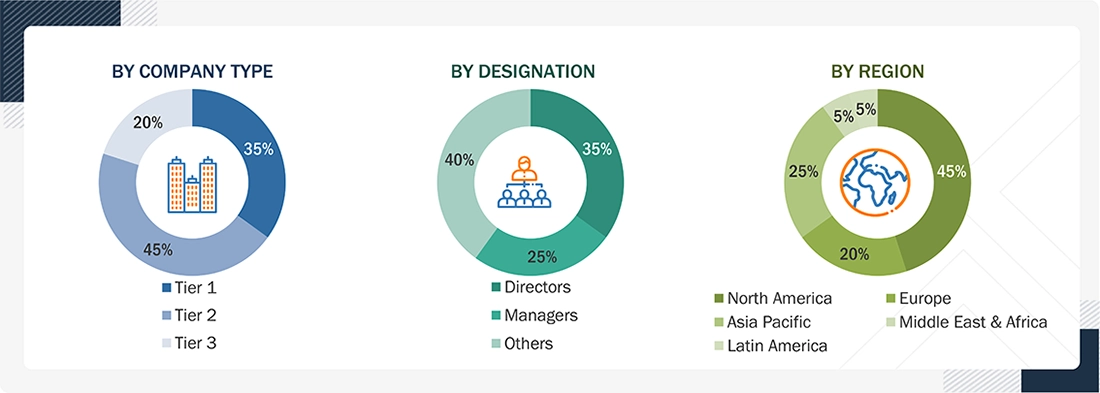
Note: Tier 1 companies’ revenues are more than USD 10 billion; tier 2 companies’ revenues range between USD 1 and 10 billion; and tier 3 companies’ revenues range between USD 500 million and USD 1 billion. Other designations include sales, marketing, and product managers.
Source: Industry Experts
To know about the assumptions considered for the study, download the pdf brochure
Market Size Estimation
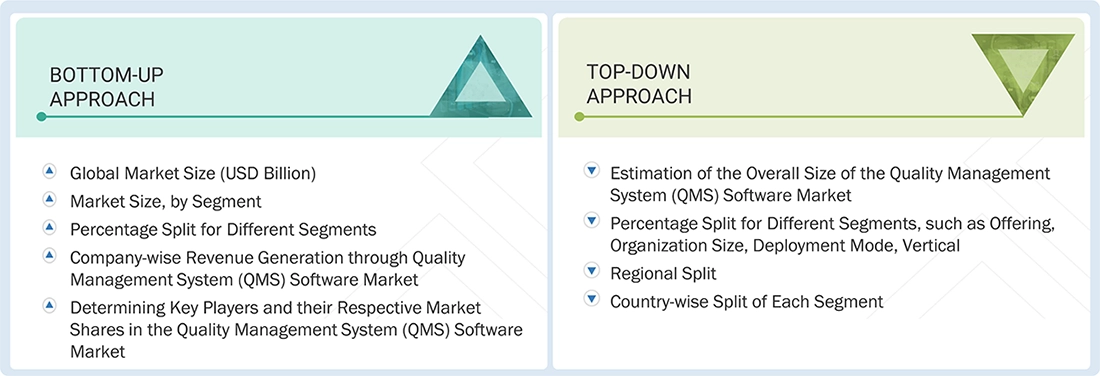
Multiple approaches were adopted to estimate and forecast the quality management system software market. The first approach involved estimating the market size based on companies’ revenue from the sale of quality management system software products.
Market Size Estimation Methodology: Top-down Approach
The top-down approach prepared an exhaustive list of all the vendors offering products in the quality management system software market. The revenue contribution of the market vendors was estimated through annual reports, press releases, funding, investor presentations, paid databases, and primary interviews. Each vendor’s offerings were evaluated based on offering, solution, deployment mode, organization size, vertical, and region. The markets were triangulated through primary and secondary research. The primary procedure included extensive interviews for key insights from industry leaders, such as CIOs, CEOs, VPs, directors, and marketing executives. The market numbers were further triangulated with the existing MarketsandMarkets’ repository for validation.
Market Size Estimation Methodology: Bottom-up Approach
The bottom-up approach identified the adoption rate of quality management system software products across different verticals in key countries, considering the regions that contribute the most to the market share. For cross-validation, the adoption of quality management system software products among enterprises and other use cases for their regions was identified and extrapolated. Use cases identified in different areas were weighed for the market size calculation.
Based on the market numbers, the regional split was determined by primary and secondary sources. The procedure included an analysis of the quality management system software market’s regional penetration. Based on secondary research, the regional spending on Information and Communications Technology (ICT), socioeconomic analysis of each country, strategic vendor analysis of major quality management system software service providers, and organic and inorganic business development activities of regional and global players were estimated.
Quality and Lifecycle Management Software Market : Top-Down and Bottom-Up Approach
Data Triangulation
After determining the overall market size using the market size estimation processes as explained above, the market was split into several segments and subsegments. Data triangulation and market breakup procedures were employed, wherever applicable, to complete the overall market engineering process and arrive at the exact statistics of each market segment and subsegment. The overall market size was then used in the top-down approach to estimate the size of other individual markets by applying percentage splits to the market segmentation.
Market Definition
The Quality Management System (QMS) software market consists of software solutions that help organizations digitalize, automate, and manage quality processes to ensure product quality, regulatory compliance, operational efficiency, and continuous improvement. These platforms provide capabilities such as document control, CAPA management, audit management, supplier quality management, complaint handling, training management, change control, and quality analytics, while integrating with enterprise systems such as ERP, MES, and PLM. QMS software is widely adopted across industries including manufacturing, life sciences, healthcare, automotive, aerospace and defense, food and beverage, and electronics to streamline quality operations, reduce compliance risks, and improve overall business performance.
Key Stakeholders
- QMS Software Platform Providers
- Cloud-based QMS Solution Providers
- Quality Analytics and Intelligence Software Providers
- Supplier Quality Management Solution Providers
- CAPA and Non-conformance Management Software Vendors
- Audit, Compliance, and Document Management Solution Providers
- Enterprise Resource Planning (ERP) Software Providers
- Manufacturing Execution System (MES) Providers
- Product Lifecycle Management (PLM) Software Providers
- Cloud Infrastructure Providers and Hyperscalers
- Artificial Intelligence and Automation Technology Providers for Quality Management
- System Integrators and QMS Implementation Partners
- Validation, Compliance, and Quality Consulting Service Providers
- Managed QMS Service Providers
- Manufacturing Enterprises and Industrial Organizations
Report Objectives
- To define and describe the quality management system software market based on offering (solutions and services), solution (document control & management, corrective & preventive action (CAPA) management, non-conformance & deviation management, audit management, training management, supplier quality management, change management/change control, complaint management, quality analytics & intelligence, quality planning & design), organization size (large enterprises, small & medium-sized enterprises), deployment mode (on-premises, cloud-based, hybrid), and vertical
- To provide detailed information on major factors influencing market growth (drivers, restraints, opportunities, and challenges) across quality management system software, supplier quality management, audit management, and aftermarket transformation.
- To strategically analyze micro markets with respect to individual growth trends, adoption patterns, and their contribution to the overall quality management system software market.
- To analyze market opportunities for stakeholders and present a comprehensive competitive landscape of leading quality management system software vendors, OEM aftermarket players, and service providers.
- To project the market size and its submarkets in terms of value (USD million) across five key regions (North America, Europe, Asia Pacific, Middle East & Africa, Latin America), along with an analysis of their respective major countries.
- To strategically profile leading companies and provide an in-depth evaluation of their core competencies, product portfolios, technology capabilities, and market positioning.
- To examine competitive developments, including product launches, software upgrades, partnerships, integrations, strategic expansions, and mergers & acquisitions across the quality management system software ecosystem.
Available customizations:
With the given market data, MarketsandMarkets offers customizations as per the company’s specific needs. The following customization options are available for the report:
Product Analysis
- The product matrix provides a detailed comparison of the product portfolio of each company.
Geographical Analysis
- Further breakup of the North American quality management system software market
- Further breakup of the European quality management system software market
- Further breakup of the Asia Pacific quality management system software market
- Further breakup of the Middle East & African quality management system software market
- Further breakup of the Latin American quality management system software market
Company Information
- Detailed analysis and profiling of additional market players (up to five)
Get the Full Quality Management System (QMS) Software Market Report
Full forecast, segment splits, and company analysis for all Quality Management System (QMS) Software Market.
- Brazil Quality Management System (QMS) Software Market
- Canada Quality Management System (QMS) Software Market
- China Quality Management System (QMS) Software Market
- France Quality Management System (QMS) Software Market
- GCC Quality Management System (QMS) Software Market
- Germany Quality Management System (QMS) Software Market
- India Quality Management System (QMS) Software Market
- Italy Quality Management System (QMS) Software Market
- Japan Quality Management System (QMS) Software Market
- Mexico Quality Management System (QMS) Software Market
- Rest Of GCC Quality Management System (QMS) Software Market
- Saudi Arabia Quality Management System (QMS) Software Market
- South Africa Quality Management System (QMS) Software Market
- South Korea Quality Management System (QMS) Software Market
- UAE Quality Management System (QMS) Software Market
- UK Quality Management System (QMS) Software Market
- US Quality Management System (QMS) Software Market
Need a Tailored Report?
Customize this report to your needs
Get 10% FREE Customization
Customize This Report
