
France Radioisotope Identification Devices Market (2026-2031)

The France Radioisotope Identification Devices Market was valued at $127.7 Million in 2026 and projected to reach to $185.1 Million by 2031, representing a compound annual growth rate of 7.7%. France's radioisotope identification devices market is positioned for sustained growth through 2031, supported by increasing investments in nuclear medicine infrastructure and diagnostic capabilities.


| Market Size in | USD 26.32 MN |
| Market Forecast in | |
| CAGR | |
| Forecast Period | |
| Units Considered | Value (USD MN) |
France Radioisotope Identification Devices Market Trends and Insights
- This expansion reflects France's strong healthcare infrastructure and increasing demand for advanced diagnostic and security applications of radioisotope detection technology.
- France's market growth rate of 7.7% CAGR outpaces the global average, driven by regulatory compliance requirements, nuclear facility monitoring, and enhanced medical imaging adoption across French healthcare institutions. The French market benefits from the country's established nuclear energy sector and stringent radiation safety protocols, which necessitate reliable identification devices.
- France's commitment to healthcare modernization and investment in diagnostic equipment further accelerates market penetration.
- Between 2026 and 2031, France is expected to see increased deployment of radioisotope identification devices in hospitals, research facilities, and border security operations, positioning the nation as a key growth market within Europe's broader healthcare technology landscape..
Key Market Statistics
- CAGR (2026-2031) 7.7% CAGR
- Market Size, 2026 ~USD 127.7 Million
- Forecast, 2031 ~USD 185.1 Million
- Country France
France Radioisotope Identification Devices Market Overview
Strong Market Valuation :
France's radioisotope identification devices market is valued at USD 127.7 million in 2026, demonstrating significant investment in advanced detection technologies across healthcare and security sectors.
Outpacing Global Growth :
With a CAGR of 7.7%, France's market growth significantly exceeds the global average of 6.9%, indicating accelerated adoption and regional market maturity.
Healthcare Infrastructure Advantage :
France's robust healthcare infrastructure and regulatory framework support widespread implementation of radioisotope identification devices in diagnostic imaging and nuclear medicine applications.
Projected Market Expansion :
The market is forecasted to reach USD 185.1 million by 2031, representing a 45% increase over five years, driven by technological advancement and clinical demand.
France Radioisotope Identification Devices Market Dynamics
- The country's advanced healthcare system and stringent safety regulations create favorable conditions for premium detection technologies.
- Rising demand for accurate radioisotope identification in both clinical diagnostics and border security applications will drive market expansion.
- Additionally, France's commitment to modernizing medical facilities and adopting cutting-edge detection solutions ensures continued market momentum.
- The 7.7% CAGR reflects strong confidence in market fundamentals and technological innovation within the French healthcare sector..
Market Ecosystem

RADIOISOTOPE IDENTIFICATION DEVICES MARKET: COMMERCIAL USE CASES ACROSS INDUSTRIES
| COMPANY | USE CASE DESCRIPTION | BENEFITS |
|---|---|---|
 |
Deployment of handheld RIIDs (e.g., RIIDEye™ series) for border security, emergency response, and nuclear threat detection to identify and classify radioactive materials in real time | High accuracy isotope identification, rapid response time, user-friendly interface, strong global support network, and reliable performance in field conditions |
 |
Integration of RIIDs into defense and homeland security operations for detection and identification of radiological threats in military, law enforcement, and critical infrastructure environments | Rugged and portable systems, real-time threat assessment, integration with surveillance systems, and enhanced situational awareness |
 |
Provision of radiation detection solutions through subsidiaries (e.g., Fluke Health Solutions) for industrial safety, healthcare radiation monitoring, and compliance applications | High reliability, regulatory compliance support, strong service network, and efficient monitoring for occupational safety |
 |
Use of advanced spectroscopic RIIDs (e.g., SPIR series) in nuclear facilities, border security, and emergency response for accurate identification and localization of radioactive sources | High sensitivity and precision, advanced spectroscopy, source localization capability, and integration with monitoring software platforms |
Logos and trademarks shown above are the property of their respective owners. Their use here is for informational and illustrative purposes only.
Related Ecosystem
Analytical And Scientific Instrumentation
- Environmental Testing
- Gas Chromatography
- Polymerase Chain Reaction (PCR)
- Automated Liquid Handling Systems
- Flow Cytometry
- Thermo Fisher Scientific Inc.
- Danaher Corporation
- Agilent Technologies, Inc.
- Merck KGaA
- Shimadzu Corporation
Key Takeaways
- France's radioisotope identification devices market is valued at USD 127.7 million in 2026, with a projected value of USD 185.1 million by 2031.
- France's market CAGR of 7.7% exceeds the global growth rate of 6.9%, indicating accelerating regional demand.
- France's nuclear energy infrastructure and stringent radiation safety regulations drive sustained demand for identification devices.
- Healthcare modernization and diagnostic equipment investments position France as a high-growth market within Europe through 2031.
Radioisotope Identification Devices Market Report Scope
| Report Metric | Details |
|---|---|
| Base Year | 2026 |
| Fastest Growing Segment | SPECTROSCOPIC PERSONAL RADIATION DETECTORS (Product Type) |
| Forecast Period | 2026–2031 |
| Growth Rate | CAGR of 6.9% from 2026 to 2031 |
| Largest Segment | HOMELAND SECURITY & BORDER PROTECTION (Application) |
| Market Size Base Year (Billions) | ~USD 2.04 (2026) |
| Revenue Forecast (Billions) | ~USD 2.85 (2031) |
| Segments Covered | Product Type, Application, End User |
France Radioisotope Identification Devices Market Report Segmentation
3 segment dimensions are covered across the global market.
By Product Type
- Fixed Radiation Monitoring Systems
- Handheld Personal Radiation Detectors
- Other Products
- Personal Radiation Detectors
- Radioisotope Identification Devices
- Spectroscopic Personal Radiation Detectors
By Application
- Cbrn Mission Users
- Environmental Monitoring & Radiation Safety
- Homeland Security & Border Protection
- Industrial Applications
- Medical & Healthcare
- Nuclear Power Plants & Fuel Cycle Facilities
- Other Applications
By End User
- Government & Defense Agencies
- Hospitals & Diagnostic Centers
- Industrial Facilities
- Nuclear Facilities
- Other End Users
- Research Institutes & Universities
Target Audience
- Medical Device Manufacturers : Manufacturers need France-specific market data to develop localized product strategies, understand competitive landscapes, and identify distribution opportunities in this high-growth European market.
- Healthcare Facility Operators : Hospital administrators and diagnostic centers require market insights to justify capital investments in radioisotope identification technology and plan facility upgrades aligned with market trends.
- Investment & Private Equity Firms : Investors need detailed France market analysis to evaluate acquisition targets, assess growth potential, and make informed funding decisions in the medical device and healthcare technology sectors.
- Government & Regulatory Bodies : French healthcare authorities and policymakers use market data to inform regulatory frameworks, healthcare infrastructure planning, and technology adoption initiatives across the nation.
- Security & Border Control Agencies : National security organizations require market intelligence on radioisotope detection capabilities to evaluate procurement options and enhance border security and threat detection protocols.
Key Companies in the France Radioisotope Identification Devices Market
| Company | HQ | Ownership | Strongest segments |
|---|---|---|---|
| MIRION TECHNOLOGIES INC. | United States | Public Company | Handheld RIIDs,Fixed RIID and portal systems,Spectroscopic systems and lab analyzers, |
| THERMO FISHER SCIENTIFIC | United States | Public Company | Handheld RIIDs,Spectroscopic RIIDs,Personal RIIDs, |
| TELEDYNE FLIR | United States | Private Company | Personal,Handheld,Fixed, |
| AMETEK, INC. | United States | Public Company | Spectroscopic RIIDs,Fixed RIID Systems,Handheld RIIDs, |
| HITACHI, LTD. | Japan | Public Company | Personal,Handheld,Fixed, |
| KROMEK GROUP PLC | United Kingdom | Public Company | Spectroscopic RIIDs (handheld, backpack, fixed spectroscopic nodes),Handheld non-spectroscopic RIIDs and survey meters,Personal radiation detectors and pagers, |
MIRION TECHNOLOGIES INC.
Mirion Technologies Inc. is a U.S.-based public company founded in 2005 that employs 3,281 people. The company operates in the radiation detection and measurement sector.
THERMO FISHER SCIENTIFIC
Thermo Fisher Scientific is a U.S.-based public company founded in 1956 with 125,000 employees. It is a major provider of laboratory equipment, reagents, and analytical instruments.
TELEDYNE FLIR
Teledyne FLIR is a U.S.-based private company founded in 1978 with 4,179 employees. The company specializes in thermal imaging and infrared technology solutions.
AMETEK, INC.
AMETEK, Inc. is a U.S.-based public company founded in 1930 with 22,500 employees. The company manufactures electronic instruments and electromechanical devices for industrial applications.
HITACHI, LTD.
Hitachi, Ltd. is a Japanese-based public company founded in 1910 with 287,901 employees. The company is a diversified conglomerate operating across multiple industrial and technology sectors.
KROMEK GROUP PLC
Kromek Group PLC is a United Kingdom-based public company founded in 2003 with 162 employees. The company specializes in radiation detection and imaging technology.
Reasons to Buy this Report
- Market-Specific Growth Intelligence : Gain detailed insights into France's 7.7% CAGR trajectory, outperforming global benchmarks and enabling strategic market entry and expansion planning tailored to French market dynamics.
- Accurate Financial Projections : Access precise valuation data (USD 127.7M in 2026 to USD 185.1M in 2031) to support investment decisions, budget allocation, and revenue forecasting specific to the French market.
- Competitive Positioning Strategy : Understand France's healthcare infrastructure advantages and regulatory environment to develop competitive strategies that leverage local market strengths and differentiate offerings.
- Sector-Specific Opportunity Identification : Identify high-growth applications in French diagnostic imaging, nuclear medicine, and security sectors to prioritize product development and market penetration initiatives.
- Risk Mitigation & Regulatory Compliance : Navigate France's stringent healthcare regulations and safety standards with market-specific insights, reducing implementation risks and ensuring compliant market operations.
Frequently asked questions
What is the current market size of radioisotope identification devices in France?
France's radioisotope identification devices market is valued at USD 127.7 million in 2026, based on verified market data.
What is the projected market size for France by 2031?
France's radioisotope identification devices market is forecast to reach USD 185.1 million by 2031, representing significant growth over the five-year period.
What is France's market growth rate for radioisotope identification devices?
France's market is growing at a CAGR of 7.7% from 2026 to 2031, outpacing the global average of 6.9%.
What factors are driving growth in France's radioisotope identification devices market?
Key drivers include France's established nuclear energy sector, stringent radiation safety regulations, healthcare modernization initiatives, and increased adoption of advanced diagnostic equipment in medical facilities.
How does France's market performance compare to global trends?
France's 7.7% CAGR exceeds the global CAGR of 6.9%, indicating that France is a faster-growing market within the global radioisotope identification devices sector.
RESEARCH METHODOLOGY
The research methodology for analyzing the global radioisotope identification devices market is clearly detailed on the website, outlining the structured processes and best practices followed for data collection, validation, and analysis. This transparent and systematic approach ensures high accuracy and reliability of the insights presented. Such clarity allows stakeholders to assess the robustness of the findings, conclusions, and recommendations, ultimately enabling confident and well-informed decision-making.
Secondary Research
For this secondary research, we relied on diverse sources such as D&B Hoovers, Bloomberg Businessweek, Factiva, white papers, annual reports, company filings, investor presentations, and SEC filings. This in-depth approach helped build a robust database of key players in the industry. The database provides essential insights into established companies, detailed multi-level market segmentation, trends within each segment, notable mergers & acquisitions, and the impact of cutting-edge technological innovations shaping the radioisotope identification devices market.
Primary Research
The primary research involved both qualitative and quantitative approaches and was conducted in depth with participants from both the supply and demand sides through interviews.
On the supply side, interviews were conducted with senior-level executives such as CEOs, vice presidents, product managers, R&D heads, and sales directors from leading companies involved in the development and manufacturing of radioisotope identification devices and radiation detection technologies. These companies include manufacturers of RIIDs, spectroscopic detectors, semiconductor and scintillation-based detection systems, as well as providers of integrated radiation detection solutions. In addition, insights were gathered from original equipment manufacturers (OEMs) and system integrators supplying RIIDs for homeland security, nuclear facilities, emergency response, and industrial safety applications.
On the demand side, interviews were conducted with key end users such as homeland security officials, border protection agencies, emergency responders, nuclear facility operators, healthcare professionals involved in nuclear medicine, and radiation safety officers. Additional stakeholders included representatives from law enforcement agencies, customs and port authorities, environmental monitoring organizations, industrial safety teams, and research institutions. Feedback was also collected from distributors, system integrators, and government organizations responsible for radiation safety, nuclear regulation, and critical infrastructure protection.
Overall, this research provided valuable insights into market segmentation, key players, trends, dynamics, and growth of drivers in the market.
A breakdown of the primary respondents is provided below:

Note 1: Other designations include sales managers, marketing managers, business development managers, product managers, distributors, and suppliers.
Note 2: Companies are classified into tiers based on their total revenue. As of 2024 Tier 1 = >USD 1 billion, Tier 2 = <USD 500 million, and Tier 3 = <USD 100 million.
To know about the assumptions considered for the study, download the pdf brochure
Market Size Estimation
The report offers an in-depth analysis of the radioisotope identification devices market, identifying key players through both primary and secondary research. Secondary research drew on annual and financial reports from major companies, while primary research included detailed interviews with key opinion leaders such as CEOs, directors, and senior marketing executives.
To estimate the global market value, a segment-based methodology was applied, using revenue data from leading solution providers. This involved:
- Identifying major participants in the global radioisotope identification devices market
- Reviewing their reported annual revenues, whether directly related to radioisotope identification devices or reflecting broader business units and product lines.
The data was then projected to arrive at the overall value for the radioisotope identification devices market.
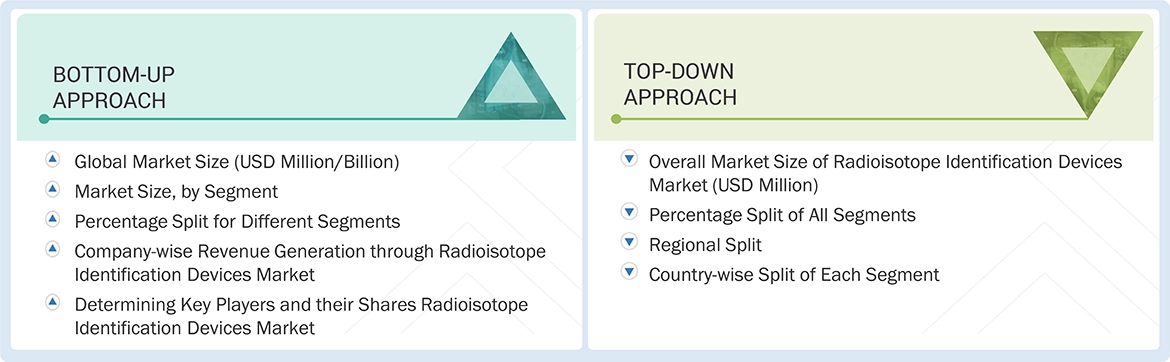
Radioisotope Identification Devices Market : Top-Down and Bottom-Up Approach
Data Triangulation
The research approach involved dividing the global radioisotope identification devices market into different participant groups and categories. Data triangulation and segmentation methods were applied to ensure the accuracy of information across all market segments. Multiple analyses were carried out to assess both the demand and supply aspects of the market. By combining top-down and bottom-up approaches, the study provided a comprehensive understanding of the radioisotope identification devices market.
Market Definition
The radioisotope identification devices (RIIDs) market refers to the global industry focused on the development, production, and deployment of portable and handheld radiation detection systems that are capable of not only detecting radiation but also accurately identifying specific radioactive isotopes using spectroscopic analysis. These devices are widely used across applications such as homeland security, border protection, emergency response, nuclear facilities, healthcare, and environmental monitoring to detect, classify, and assess radiological threats or materials. The market encompasses various technologies, including scintillation and semiconductor-based detectors, along with integrated software for real-time data analysis and isotope identification, enabling users to make informed decisions for safety, compliance, and threat mitigation.
Key Stakeholders
- RIID Manufacturers
- Component Suppliers (scintillators, semiconductor detectors, electronics)
- Original Equipment Manufacturers (OEMs)
- System Integrators & Solution Providers
- Distributors & Channel Partners
- Raw Material and Reagent Suppliers
- Regulatory Authorities
Report Objectives
- To define, describe, and forecast the global radioisotope identification devices market based on product type, application, end user, and region
- To provide detailed information regarding the major factors influencing market growth (drivers, restraints, opportunities, and challenges), along with the current trends
- To strategically analyze micromarkets with respect to their individual growth trends, future prospects, and contributions to the total market
- To analyze opportunities in the market for stakeholders and provide details of the competitive landscape for market leaders
- To forecast the revenue of the market segments for five regions: North America (US and Canada), Europe (Germany, France, UK, Italy, Spain, and Rest of Europe), Asia Pacific (China, Japan, India, South Korea, Australia, and Rest of Asia Pacific), Latin America (Brazil, Mexico, and Rest of Latin America), and the Middle East & Africa
- To profile the key players and comprehensively analyze their market shares and core competencies
- To track and analyze competitive developments in the radioisotope identification devices market, such as acquisitions, product launches, expansions, agreements, joint ventures, alliances, and collaborations
Available customizations:
Based on the available market data, MarketsandMarkets offers tailored customization to meet the specific needs of a company. The following customization options are available for the global radioisotope identification devices market:
Regional Analysis
- Detailed analysis of the Rest of Europe radioisotope identification devices market (including Russia, Belgium, the Netherlands, Switzerland, Sweden, Austria, Portugal, and other countries)
- Detailed analysis of the Rest of Asia Pacific radioisotope identification devices market (including Singapore, Philippines, Taiwan, New Zealand, and other countries)
Get the Full Radioisotope Identification Devices Market Report
Full forecast, segment splits, and company analysis for all Radioisotope Identification Devices Market.
- GCC Radioisotope Identification Devices Market
- US Radioisotope Identification Devices Market
- Canada Radioisotope Identification Devices Market
- Germany Radioisotope Identification Devices Market
- UK Radioisotope Identification Devices Market
- Italy Radioisotope Identification Devices Market
- Spain Radioisotope Identification Devices Market
- China Radioisotope Identification Devices Market
- Japan Radioisotope Identification Devices Market
- India Radioisotope Identification Devices Market
- Australia Radioisotope Identification Devices Market
- South Korea Radioisotope Identification Devices Market
- Brazil Radioisotope Identification Devices Market
- Mexico Radioisotope Identification Devices Market
- Rest Of Europe Radioisotope Identification Devices Market
- Rest Of Asia Pacific Radioisotope Identification Devices Market
- Rest Of Latin America Radioisotope Identification Devices Market
Need a Tailored Report?
Customize this report to your needs
Get 10% FREE Customization
Customize This Report
