
Germany DRaaS Market (2025-2030)

The Germany DRaaS Market was valued at $1656.2 Million in 2025 and projected to reach to $2548.3 Million by 2030, representing a compound annual growth rate of 17.0%. Germany's DRaaS market is poised for sustained growth through 2030, driven by increasing digitalization across manufacturing, finance, and public sectors.


| Market Size in | USD 26.32 MN |
| Market Forecast in | |
| CAGR | |
| Forecast Period | |
| Units Considered | Value (USD MN) |
Germany DRaaS Market Trends and Insights
- This 17.0% compound annual growth rate reflects Germany's strong digital infrastructure investments and increasing enterprise demand for resilient business continuity solutions.
- Germany's position as Europe's largest economy drives significant adoption of cloud-based disaster recovery among mid-market and enterprise organizations seeking to minimize downtime and protect critical operations. The German DRaaS market benefits from stringent data protection regulations, including GDPR compliance requirements that mandate robust recovery capabilities.
- Germany's manufacturing and financial services sectors are particularly active in deploying DRaaS solutions to ensure operational continuity.
- Between 2025 and 2030, Germany is expected to see accelerated adoption driven by rising cyber threats, increasing regulatory pressures, and the growing complexity of hybrid IT environments across German enterprises..
Key Market Statistics
- CAGR (2025-2030) 17.0% CAGR
- Market Size, 2025 ~USD 1656.2 Million
- Forecast, 2030 ~USD 2548.3 Million
- Country Germany
Germany DRaaS Market Overview
Market Valuation Growth :
Germany's DRaaS market is valued at $1,656.2 million in 2025, with strong momentum driving expansion to $2,548.3 million by 2030, representing a 17% CAGR that outpaces the global average of 16.2%.
Digital Infrastructure Leadership :
As Europe's largest economy, Germany's robust digital infrastructure and high cloud adoption rates among enterprises create a fertile environment for DRaaS solutions and business continuity investments.
Enterprise Resilience Demand :
German enterprises increasingly prioritize disaster recovery capabilities to protect critical operations, driven by regulatory compliance requirements, data protection laws, and the need for operational continuity in a competitive market.
Regional Market Dominance :
Germany represents a significant portion of the European DRaaS market, with its strong manufacturing, financial services, and technology sectors driving substantial demand for advanced recovery solutions.
Germany DRaaS Market Dynamics
- Enterprise awareness of cyber threats and business continuity risks continues to elevate DRaaS adoption rates among mid-market and large organizations.
- Regulatory frameworks including GDPR and industry-specific compliance mandates further accelerate investment in resilient disaster recovery infrastructure. The competitive landscape in Germany is intensifying as both global and regional providers expand service offerings tailored to German enterprises' specific requirements.
- Investment in hybrid and multi-cloud DRaaS solutions is expected to accelerate, reflecting the country's preference for flexible, scalable infrastructure.
- Strategic partnerships between German IT service providers and international DRaaS vendors will likely shape market dynamics through 2030..
Market Ecosystem
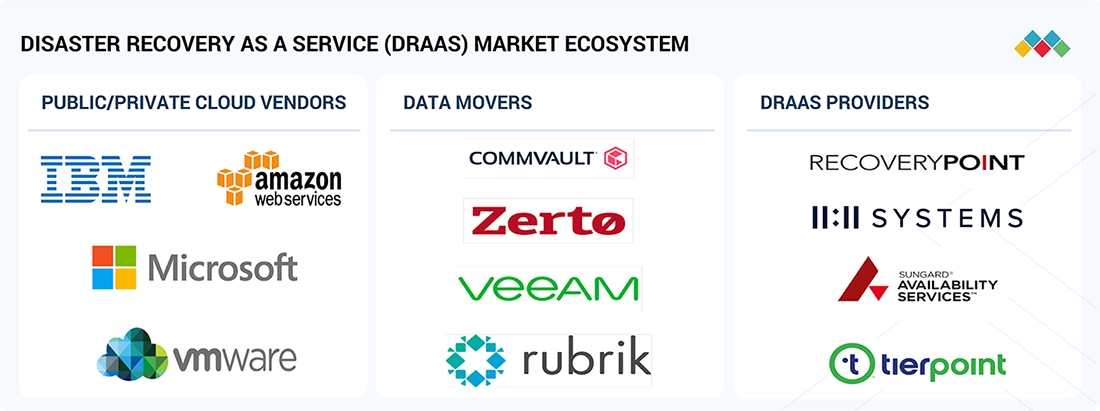
DISASTER RECOVERY AS A SERVICE (DRAAS) MARKET: COMMERCIAL USE CASES ACROSS INDUSTRIES
| COMPANY | USE CASE DESCRIPTION | BENEFITS |
|---|---|---|
 |
Allegany Insurance Group simplified its disaster recovery strategy with iland | Witnessed continuous data availability and business uptime | Gained platform control and flexibility | Predictable pricing with no hidden fees was offered | Provided seamless integration with Veeam | Innovative and comprehensive service was offered in line with company’s objectives |
 |
Computer Driven Solutions deployed Infrascale backup and disaster recovery (IBDR) to protect SME clients’ data and prepare for disasters | CDS received a hybrid cloud backup and disaster recovery service | Infrascale IBDR solution provided CDS with all the backup and disaster recovery functionality | Infrascale Dashboard provided a one-stop-shop for all CDS’ backup and recovery needs, including setting backup settings and schedules |
 |
RMS used TierPoint’s hybrid cloud & DRaaS to improve performance and reliability | Custom DRaaS solution provided RMS with guaranteed 100% uptime and failsafe business continuity protection | RMS can now grow on demand–year-over-year growth in the 30% range. When capacity reaches 80%, RMS can quickly expand by adding nodes to the cloud configuration |
 |
Safeguarding business continuity with disaster recovery from CloudHPT by bios at Waha Capital | Provided a RPO of less than 30 seconds | Provided a RTO of under 45 minutes | 24x7 monitoring of replication | 24x7 monitoring of WAN | DR for Oracle physical machines | Test on demand for compliance |
 |
MSP InfoStream ensured disaster recovery confidence with Axcient Cloud Backup | Full speed data download and upload – no throttling | 24 hours to 100% recovery | 0% of data lost after ransomware | Sleep soundly with BDR confidence| Proactive cloud backups in preparation for a hurricane disaster |
Logos and trademarks shown above are the property of their respective owners. Their use here is for informational and illustrative purposes only.
Related Ecosystem
Cloud Computing
- Software as A Service (SaaS)
- Natural Language Processing (NLP)
- Platform as A Service (PaaS)
- Machine Learning
- Supply Chain Management
- International Business Machines Corporation
- MICROSOFT CORPORATION
- Oracle Corporation
- Amazon.com, Inc.
Public Safety
- Face Recognition
- Cloud Security
- Surveillance System
- Voice Recognition
- Biometric Security and Authentication System
- Zensar Technologies Limited
- International Business Machines Corporation
- Allot Ltd.
- Cisco Systems, Inc.
- MICROSOFT CORPORATION
Software And Services
- Natural Language Processing (NLP)
- Machine Learning
- Supply Chain Management
- Predictive Analytics
- Image Sensors
- International Business Machines Corporation
- MICROSOFT CORPORATION
- Oracle Corporation
- SAP SE
- Amazon.com, Inc.
Key Takeaways
- Germany's DRaaS market will grow from $1,656.2M (2025) to $2,548.3M (2030) at a 17.0% CAGR, outpacing global growth.
- GDPR and data sovereignty regulations drive German enterprises to invest in compliant, locally-hosted DRaaS solutions.
- Manufacturing and financial services sectors in Germany lead DRaaS adoption to protect mission-critical operations.
- Germany's strong economy and digital maturity position it as a key growth market for DRaaS providers in Europe.
DRaaS Market Report Scope
| Report Metric | Details |
|---|---|
| Base Year | 2025 |
| Fastest Growing Segment | IT & ITES (Vertical) |
| Forecast Period | 2025–2030 |
| Growth Rate | CAGR of 16.2% from 2025 to 2030 |
| Largest Segment | LARGE ENTERPRISES (Organization Size) |
| Market Size Base Year (Billions) | ~USD 16.11 (2025) |
| Revenue Forecast (Billions) | ~USD 34.13 (2030) |
| Segments Covered | Solution Module, Delivery Model, Workload Protection, Organization Size, Vertical |
Germany DRaaS Market Report Segmentation
5 segment dimensions are covered across the global market.
By Solution Module
- Cyber Recovery Draas
- Dr Testing And Compliance
- Orchestration And Runbook Automation
- Replication & Failover Draas
By Delivery Model
- Assisted Draas
- Managed Draas
- Self-Service Draas
By Workload Protection
- Business Critical Enterprise Apps
- Cloud Workload
- Physical Server
- Virtualized Workload
By Organization Size
- Large Enterprises
- Smes
By Vertical
- Bfsi
- Energy & Utilities
- Government
- Healthcare
- It & Ites
- Manufacturing
- Media & Entertainment
- Other Verticals
- Retail & Ecommerce
- Telecommunications
GERMANY: DISASTER RECOVERY-AS-A-SERVICE MARKET, BY VERTICAL, 2026–2032
| Segment | 2026 | 2027 | 2028 | 2029 | 2030 | 2031 | 2032 | CAGR (%) |
|---|---|---|---|---|---|---|---|---|
| BFSI | 186 | 224.3 | 267.7 | 316.6 | 371 | 431.1 | 496.9 | 17.8 |
| ENERGY & UTILITIES | 58.9 | 69.8 | 81.8 | 95 | 109.4 | 124.9 | 141.4 | 15.7 |
| GOVERNMENT | 79.3 | 95.9 | 114.8 | 136.2 | 160 | 186.5 | 215.6 | 18.1 |
| HEALTHCARE | 91.2 | 110.5 | 132.7 | 157.7 | 185.8 | 217 | 251.5 | 18.4 |
| IT & ITES | 146.5 | 177 | 211.7 | 250.8 | 294.5 | 342.9 | 396.1 | 18 |
| MANUFACTURING | 163.8 | 197.1 | 234.9 | 277.3 | 324.5 | 376.4 | 433.2 | 17.6 |
| MEDIA & ENTERTAINMENT | 42.1 | 50 | 58.7 | 68.2 | 78.6 | 89.9 | 101.9 | 15.9 |
| OTHER VERTICALS | 56 | 65.8 | 76.3 | 87.5 | 99.1 | 110.9 | 122.9 | 14 |
| RETAIL & ECOMMERCE | 72.1 | 84.9 | 99.1 | 114.5 | 131.1 | 148.9 | 167.8 | 15.1 |
| TELECOMMUNICATIONS | 97 | 113.9 | 132.4 | 152.5 | 174 | 196.9 | 221.1 | 14.7 |
| TOTAL | 993 | 1189.2 | 1410.1 | 1656.2 | 1927.9 | 2225.4 | 2548.3 | 17 |
Target Audience
- DRaaS Solution Providers : Global and regional DRaaS vendors need Germany-specific market data to refine product offerings, identify growth segments, and develop localized sales and marketing strategies for this high-value European market.
- Enterprise IT Decision Makers : German CIOs, IT directors, and business continuity managers require market insights to benchmark their disaster recovery investments, evaluate vendor options, and justify DRaaS adoption to stakeholders.
- Managed Service Providers (MSPs) : German and European MSPs need market intelligence to expand DRaaS service portfolios, identify customer segments with highest adoption potential, and position competitive offerings in the growing market.
- Investment & Strategy Consultants : Management consultants and investment firms advising on German IT infrastructure and digital transformation require detailed market data to support client recommendations and investment decisions.
- Technology Investors & Analysts : Private equity firms, venture capital investors, and equity research analysts need Germany DRaaS market analysis to evaluate investment opportunities and assess growth potential in the European market.
Reasons to Buy this Report
- Market-Specific Sizing & Forecasts : Access precise valuation data for Germany's DRaaS market with detailed 2025-2030 projections, enabling accurate budget allocation and investment planning specific to the German market opportunity.
- Competitive Landscape Intelligence : Understand the competitive positioning of DRaaS providers operating in Germany, including market share analysis, service differentiation strategies, and regional player capabilities.
- Regulatory & Compliance Insights : Gain clarity on how German data protection regulations, GDPR compliance requirements, and industry-specific mandates drive DRaaS adoption and shape solution requirements.
- Sector-Specific Demand Analysis : Identify growth drivers across Germany's key verticals including manufacturing, financial services, healthcare, and public sector, with tailored insights for targeted market penetration.
- Strategic Market Entry Guidance : Leverage Germany-focused market intelligence to develop go-to-market strategies, partnership opportunities, and customer acquisition approaches aligned with local enterprise preferences and buying behaviors.
Frequently asked questions
What is the current size of Germany's DRaaS market in 2025?
Germany's DRaaS market is valued at $1,656.2 million in 2025, reflecting strong enterprise investment in disaster recovery capabilities.
What is the projected size of Germany's DRaaS market by 2030?
Germany's DRaaS market is forecast to reach $2,548.3 million by 2030, representing a 17.0% compound annual growth rate.
Why is Germany's DRaaS market growing faster than the global average?
Germany's DRaaS market growth is driven by strict GDPR compliance requirements, high digital maturity, and strong demand from manufacturing and financial services sectors.
Which industries in Germany are driving DRaaS adoption?
Manufacturing, financial services, and healthcare sectors in Germany are primary drivers of DRaaS adoption due to their critical operational requirements and regulatory compliance needs.
How do data sovereignty regulations impact Germany's DRaaS market?
Germany's stringent data protection laws and GDPR requirements mandate that enterprises implement robust disaster recovery solutions with data residency in compliant locations, boosting DRaaS demand.
RESEARCH METHODOLOGY
This research study involved extensive secondary sources, directories, and paid databases to identify and collect information useful for this technical, market-oriented, and commercial study of the DRaaS market. In-depth interviews were conducted with various primary respondents, including key industry participants, subject matter experts, C-level executives of key market players, and industry consultants, to obtain and verify critical qualitative and quantitative information and assess the market prospects. The following figure highlights the market research methodology in developing this report on the DRaaS market.
Secondary Research
The market size of companies offering DRaaS was based on the secondary data available through paid and unpaid sources and by analyzing the product portfolios of major companies in the ecosystem and rating the companies based on their product capabilities and business strategies. In the secondary research process, various sources were referred to for identifying and collecting information for the study. The secondary sources included annual reports, press releases, investor presentations of companies, product data sheets, white papers, journals, certified publications, articles from recognized authors, government websites, directories, and databases.
Secondary research was mainly used to obtain key information about the industry’s supply chain, the total pool of key players, market classification and segmentation according to industry trends to the bottom-most level, regional markets, and key developments from both market- and technology-oriented perspectives, all of which were further validated by primary sources.
Primary Research
In the primary research process, various primary sources from both the supply and demand sides were interviewed to obtain qualitative and quantitative information on the market. The primary sources from the supply side included various industry experts, including Chief Experience Officers (CXOs); Vice Presidents (VPs); directors from business development, marketing, and product development/innovation teams; and related key executives from DRaaS vendors, industry associations, independent consultants, and key opinion leaders.
Primary interviews were conducted to gather insights, such as market statistics, the latest trends disrupting the market, new use cases implemented, data on revenue collected from products and services, market breakups, market size estimations, market forecasts, and data triangulation. Primary research also helped in understanding various trends related to technology, service type, deployment, and region. Stakeholders from the demand side, such as Chief Information Officers (CIOs), Chief Technology Officers (CTOs), Chief Security Officers (CSOs), the installation teams of governments/end users using DRaaS, and digital initiatives project teams, were interviewed to understand the buyer’s perspective on suppliers, products, service providers, and their current use of solutions, which would affect the overall DRaaS market.
Market Size Estimation
Both top-down and bottom-up approaches were used to estimate and forecast the DRaaS market and other dependent submarkets. The bottom-up procedure was deployed to arrive at the overall market size using the revenues and offerings of the key companies in the market. With data triangulation methods and validation through primary interviews, this study determined and confirmed the exact value of the overall parent market size. The overall market size was then used in the top-down procedure to estimate the size of other individual markets via percentage splits of the market segments.
Top Down and Bottom Up Approach of the DRaaS market.
The top-down and bottom-up approaches were used to estimate and validate the size of the DRaaS market and various other dependent subsegments. The research methodology used to estimate the market size included the following:
Key players in the market were identified through secondary research, and their revenue contributions in respective countries were determined through primary and secondary research.
This entire procedure included the study of the annual and financial reports of top market players and extensive interviews for key insights from industry leaders, such as Chief Executive Officers (CEOs), VPs, directors, and marketing executives.
All percentage splits and breakups were determined using secondary sources and verified through primary sources.
Data Triangulation
After arriving at the overall market size, the market was split into several segments and subsegments—using the market size estimation processes as explained above. Where applicable, data triangulation and market breakdown procedures were employed to complete the overall market engineering process and determine each market segment's and subsegment's exact statistics. The data was triangulated by studying various factors and trends from government agencies’ demand and supply sides.
Market Definition
DRaaS refers to a cloud model that enables replicating enterprise data and applications on a third-party virtual or cloud environment to ensure business continuity during artificial or natural disasters. It is mainly facilitated by System Integrators (SIs) and Managed Service Providers (MSPs). DRaaS is based on three crucial aspects: disaster planning/management, business continuity, and backup.
Key Stakeholders
- Cloud service providers (CSPs)
- Colocation providers
- Technology service providers
- Data center managed service providers
- Government organizations
- Networking companies
- Consultants/consultancies/advisory firms
- Support and maintenance service providers
- Telecom service providers
- Information Technology (IT) infrastructure providers
- System Integrators (SIs)
- Regional associations
- Independent software vendors
- Value-added resellers and distributors
Report Objectives
- To describe and forecast the global Disaster Recovery as a Service (DRaaS) market based on service types, deployment modes, organization size, verticals, and regions
- To forecast the market size of the five major regional segments: North America, Europe, Asia Pacific (APAC), Middle East & Africa (MEA), and Latin America
- To strategically analyze the market subsegments with respect to individual growth trends, prospects, and contributions to the total market
- To provide detailed information related to the major factors influencing the growth of the market (drivers, restraints, opportunities, and challenges)
- To strategically analyze macro and micro markets with respect to growth trends, prospects, and their contributions to the overall market
- To analyze industry trends, patents & innovations, and pricing data related to the DRaaS market
- To analyze the impact of recession impact on service types, deployment modes, organization size, verticals, and regions across the globe
- To analyze the opportunities in the market for stakeholders and provide details of the competitive landscape for major players
- To profile key players in the market and comprehensively analyze their market share/ranking and core competencies
- To track and analyze competitive developments, such as mergers and acquisitions, new product developments, and partnerships and collaborations in the market
Available Customizations
With the given market data, MarketsandMarkets offers customizations per the company’s specific needs. The following customization options are available for the report:
Product Analysis
- The product matrix provides a detailed comparison of the product portfolio of each company.
Geographic Analysis
- Further breakup of the DRaaS market
Company Information
- Detailed analysis and profiling of five additional market players
Get the Full DRaaS Market Report
Full forecast, segment splits, and company analysis for all DRaaS Market.
Need a Tailored Report?
Customize this report to your needs
Get 10% FREE Customization
Customize This Report
