
Russia Recreational Boat Market (2025-2030)

The Russia Recreational Boat Market was valued at $65241 Million in 2025 and projected to reach to $82723 Million by 2030, representing a compound annual growth rate of 3.4%. Russia's recreational boat market is positioned for sustained growth through 2030, driven by rising consumer affluence and expanding leisure spending among high-income households.


| Market Size in | USD 26.32 MN |
| Market Forecast in | |
| CAGR | |
| Forecast Period | |
| Units Considered | Value (USD MN) |
Russia Recreational Boat Market Trends and Insights
- Russia's market expansion is driven by increasing disposable incomes among affluent consumers and growing interest in leisure activities on Russia's extensive waterways and coastal regions.
- The market in Russia reflects steady demand for both motorized and sailing vessels, with domestic manufacturers and international importers competing for market share. The recreational boating sector in Russia is characterized by seasonal demand patterns influenced by climate conditions across Russia's diverse geography.
- Russia's market growth is supported by infrastructure development at marinas and waterfront facilities, particularly in European Russia and along major rivers.
- Between 2025 and 2030, Russia is expected to see moderate but consistent expansion as consumer preferences shift toward premium recreational experiences and water-based tourism gains traction across Russia..
Key Market Statistics
- CAGR (2025-2030) 3.4% CAGR
- Market Size, 2025 ~USD 65241 Million
- Forecast, 2030 ~USD 82723 Million
- Country Russia
Russia Recreational Boat Market Overview
Market Valuation :
Russia's recreational boat market is valued at $65.2 billion USD in 2025, with projections reaching $82.7 billion USD by 2030, demonstrating steady growth in the leisure marine sector.
Growth Trajectory :
The Russian market exhibits a CAGR of 3.4% from 2025 to 2030, outpacing global growth rates and indicating strong domestic demand for recreational boating activities.
Wealth-Driven Expansion :
Increasing disposable incomes among affluent Russian consumers are fueling demand for premium recreational boats and luxury watercraft experiences across the nation.
Geographic Advantage :
Russia's extensive waterways, coastal regions along the Black Sea, Baltic Sea, and Far Eastern waters provide abundant opportunities for recreational boating market development.
Russia Recreational Boat Market Dynamics
- The country's vast network of rivers, lakes, and coastal areas creates significant opportunities for boat manufacturers and marine service providers.
- Increasing interest in water-based recreational activities and tourism is expected to support market expansion.
- However, market growth remains moderate compared to global averages, reflecting regional economic considerations and seasonal variations in boating activity across Russia's diverse climate zones..
Market Ecosystem
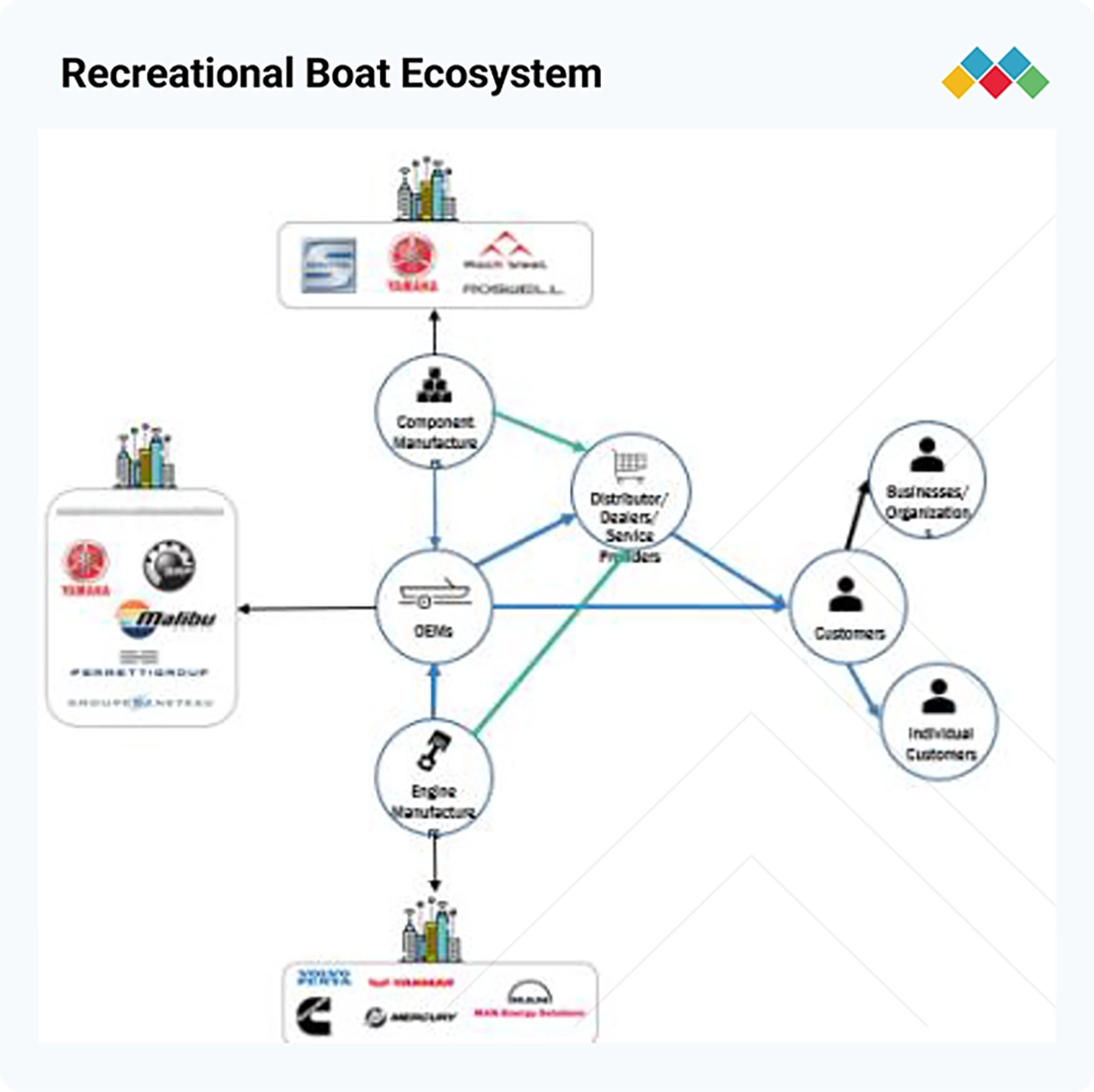
RECREATIONAL BOAT MARKET: COMMERCIAL USE CASES ACROSS INDUSTRIES
| COMPANY | USE CASE DESCRIPTION | BENEFITS |
|---|---|---|
 |
In October 2025, Brunswick introduced the Simrad AutoCaptain autonomous boating system, integrating Mercury Marine propulsion, cameras, and marine electronics to automate docking, undocking, and short-distance maneuvering. | Reduces the complexity of close-quarters maneuvering | Improves situational awareness | Helps less-experienced boaters dock with greater confidence |
 |
In September 2026, BENETEAU unveiled the Swift Trawler 43 and Gran Turismo 40 Open, expanding its motorboat portfolio with models designed for cruising and recreational use. | Broadens customer choice across cruising and leisure boating, supporting different onboard comfort, performance, and recreational requirements |
 |
In February 2025, Yamaha introduced the Helm Master EX Wireless Control System, enabling joystick control, autopilot functions, and man-overboard safety features from different positions around the vessel. | Improves maneuverability and operational convenience | Enables easier close-quarters handling | Strengthens onboard safety |
 |
In September 2025, Ferretti Group showcased its sustainable propulsion technologies, including the Riva El-Iseo fully electric powerboat and hybrid propulsion solutions developed in collaboration with Rolls-Royce Power Systems for future yachts. | Reduces propulsion-related emissions | Supports quieter and more efficient cruising | Expands sustainable luxury boating options | Strengthens the Group's position in electric and hybrid yacht technologies. |
Logos and trademarks shown above are the property of their respective owners. Their use here is for informational and illustrative purposes only.
Related Ecosystem
Automotive Advance Technologies
- Battery Electric Vehicle (BEV)
- Light Commercial Vehicles (LCVs)
- Fuel Cell Electric Vehicle (FCEV)
- Hybrid Electric Vehicle (HEV)
- Internal Combustion Engine (ICE)
- BOSCH LIMITED
- Continental ag
- Visteon Corporation
- DENSO Corporation
- ZF FRIEDRICHSHAFEN AG
Automotive Systems
- Light Commercial Vehicles (LCVs)
- Battery Electric Vehicle (BEV)
- Hybrid Electric Vehicle (HEV)
- Agricultural Tractors
- Fuel Cell Electric Vehicle (FCEV)
- BOSCH LIMITED
- DENSO Corporation
- Continental ag
- ZF FRIEDRICHSHAFEN AG
- GORKOVSKY AVTOMOBILNY ZAVOD
Key Takeaways
- Russia's recreational boat market is valued at $65.2 billion USD in 2025 and will reach $82.7 billion USD by 2030, growing at a 3.4% CAGR.
- Russia's market growth is driven by rising disposable incomes and increased consumer interest in leisure water activities across the country.
- Seasonal demand patterns in Russia are influenced by climate conditions, with peak activity during warmer months in European Russia and southern regions.
- Infrastructure development at marinas and waterfront facilities in Russia supports market expansion and enhances accessibility for recreational boating enthusiasts.
Recreational Boat Market Report Scope
| Report Metric | Details |
|---|---|
| Base Year | 2025 |
| Fastest Growing Segment | ABOVE 200 KW (Power Range) |
| Forecast Period | 2025–2030 |
| Growth Rate | CAGR of 6.4% from 2025 to 2030 |
| Largest Segment | CRUISING AND WATERSPORTS (Activity Type) |
| Market Size Base Year (Billions) | ~USD 15.96 (2025) |
| Revenue Forecast (Billions) | ~USD 21.76 (2030) |
| Segments Covered | Activity Type, Boat Type, Boat Size, Engine Type, Material Type, Power Range, Power Source |
Russia Recreational Boat Market Report Segmentation
7 segment dimensions are covered across the global market.
By Activity Type
- Cruising + Watersports
- Cruising And Watersports
- Fishing
By Boat Type
- Inflatable Boat
- Personal Watercraft
- Sailboat
- Yacht
By Boat Size
- 30–50 Ft
- <30 Ft
- > 50 Ft
By Engine Type
- Electric
- Ic
By Material Type
- Aluminum
- Fiberglass
- Steel
By Power Range
- 100 Kw–200 Kw
- Above 200 Kw
- Up To 100 Kw
By Power Source
- Engine Powered
- Human Powered
- Sail Powered
Target Audience
- Boat Manufacturers & OEMs : Manufacturers need Russia-specific market data to assess production capacity requirements, pricing strategies, and product localization opportunities in this $65B+ market segment.
- Marine Dealers & Distributors : Retailers and distributors require detailed market forecasts and consumer insights to optimize inventory management, regional expansion plans, and sales channel strategies across Russia.
- Investment & Private Equity Firms : Investors evaluating opportunities in Russia's recreational marine sector need comprehensive market sizing, growth projections, and competitive landscape analysis for due diligence and portfolio decisions.
- Tourism & Hospitality Operators : Marina operators, resort developers, and water-based tourism companies require market intelligence on recreational boating demand to justify capital investments and service expansion initiatives.
- Market Research & Consulting Professionals : Analysts and consultants need authoritative Russia market data to support client advisory work, competitive benchmarking, and strategic recommendations in the recreational boating industry.
Key Companies in the Russia Recreational Boat Market
| Company | HQ | Ownership | Strongest segments |
|---|---|---|---|
| WALBRO CORPORATION | United States | Public Company | Automotive fuel storage systems,Automotive fuel delivery modules and pumps,Small engine fuel systems, |
| PLAYCORE | United States | Private Company | Outdoor play structures and nature play,Fitness, climbing, and outdoor adult fitness,Recreational surfacing and services, |
| BRUNSWICK CORPORATION | United States | Public Company | Propulsion (outboard, sterndrive, inboard, controls, rigging, propellers),Engine P&A (parts, consumables, electrical, oils, lubricants, distribution),Navico Group (electronics, sensors, power and control systems, accessories), |
| YAMAHA MOTOR COMPANY | Japan | Public Company | Motorcycles and land mobility,Marine (outboards, boats, WaveRunners),Outdoor land vehicles (ATVs, ROHVs, golf cars, snowmobiles), |
| MALIBU BOATS | United States | Public Company | Performance sport boats (Malibu, Axis),Saltwater fishing (Pursuit, Maverick, Cobia, Pathfinder, Hewes),Cobalt sterndrive and outboard day boats, |
| FERRETTI GROUP | Italy | Public Company | Luxury composite yachts (Riva, Ferretti Yachts, Pershing, Itama, Easy Boat),Made-to-measure and semi-custom yachts (Custom Line, Wally power),Superyachts and full-custom (CRN, Wally sailing, large FSD patrol/coastal vessels), |
| POLARIS INC. | United States | Public Company | Off Road (ORVs, military and commercial ORVs),Snowmobiles,On Road (motorcycles, moto-roadsters, quadricycles), |
| MASTERCRAFT BOAT COMPANY | United States | Public Company | MasterCraft performance sport boats (ski/wake/wakesurf),Crest pontoons,Balise and other outboard/specialty boats, |
| BOMBARDIER RECREATIONAL PRODUCTS | Canada | Public Company | Off-road (ATVs and side-by-sides),Snowmobiles,Personal watercraft (PWC), |
| MARINE PRODUCTS CORPORATION | United States | Private Company | Chaparral SSi Sport Boats,Chaparral SSX Sport Boats,Chaparral Surf Series, |
| MAHINDRA & MAHINDRA | India | Public Company | Automotive (SUVs, LCVs, pickups, two wheelers, construction equipment),Farm Equipment (tractors, implements, spares, powerol),Auto Investments, |
WALBRO CORPORATION
Walbro Corporation is a United States-based public company that operates in the industrial sector. The company's founding date and employee count are not available.
PLAYCORE
Playcore is a United States-based private company founded in 1979 with 1,062 employees. The company operates in the recreation and leisure equipment industry.
BRUNSWICK CORPORATION
Brunswick Corporation is a United States-based public company founded in 1845 with 13,650 employees. The company is a diversified manufacturer operating across marine, powersports, and fitness segments.
YAMAHA MOTOR COMPANY
Yamaha Motor Company is a Japan-based public company founded in 1918 with 55,176 employees. The company manufactures motorcycles, marine engines, recreational vehicles, and related products globally.
MALIBU BOATS
Malibu Boats is a United States-based public company founded in 1982 with 2,200 employees. The company designs and manufactures premium recreational boats.
FERRETTI GROUP
Ferretti Group is an Italy-based public company founded in 1968 with 2,064 employees. The company is a luxury yacht manufacturer operating multiple prestigious boat brands.
POLARIS INC.
Polaris Inc. is a United States-based public company founded in 1945 with 14,500 employees. The company manufactures powersports vehicles, including snowmobiles, all-terrain vehicles, and motorcycles.
MASTERCRAFT BOAT COMPANY
MasterCraft Boat Company is a United States-based public company founded in 1968 with 700 employees. The company designs and manufactures premium recreational boats and towboats.
BOMBARDIER RECREATIONAL PRODUCTS
Bombardier Recreational Products is a Canada-based public company founded in 1937 with 17,000 employees. The company manufactures recreational vehicles including snowmobiles, all-terrain vehicles, and personal watercraft.
MARINE PRODUCTS CORPORATION
Marine Products Corporation is a United States-based private company founded in 1965 with 698 employees. The company manufactures recreational fiberglass boats.
MAHINDRA & MAHINDRA
Mahindra & Mahindra is an India-based public company founded in 1945 with 26,765 employees. The company is a diversified conglomerate manufacturing automobiles, tractors, and related products.
Reasons to Buy this Report
- Market Size & Valuation Data : Access precise market valuations for Russia's recreational boat sector with verified figures for 2025 ($65.2B) and 2030 forecasts ($82.7B), enabling accurate business planning and investment decisions.
- Growth Rate Intelligence : Understand Russia's 3.4% CAGR trajectory compared to global 6.4% growth, identifying market maturity levels and competitive positioning opportunities within the regional recreational boating landscape.
- Consumer Demand Insights : Gain detailed analysis of affluent Russian consumer behavior, disposable income trends, and leisure spending patterns driving recreational boat purchases and marine activity expansion.
- Geographic & Waterway Opportunities : Identify high-potential regions across Russia's extensive waterways, coastal areas, and seasonal boating destinations to target distribution, manufacturing, and service expansion strategies.
- Strategic Market Entry Planning : Develop informed go-to-market strategies for boat manufacturers, dealers, and marine service providers seeking to capitalize on Russia's growing recreational boating demand through 2030.
Frequently asked questions
What is the current size of Russia's recreational boat market?
Russia's recreational boat market is estimated at $65.2 billion USD in 2025 and is projected to grow to $82.7 billion USD by 2030.
What is the expected growth rate for Russia's recreational boat market?
Russia's recreational boat market is expected to grow at a compound annual growth rate (CAGR) of 3.4% from 2025 to 2030.
What factors are driving growth in Russia's recreational boat market?
Growth in Russia's market is driven by increasing disposable incomes, growing consumer interest in leisure activities, infrastructure development at marinas, and expanding water-based tourism.
How does seasonality affect Russia's recreational boat market?
Russia's recreational boat market experiences seasonal demand patterns influenced by climate conditions, with peak activity during warmer months, particularly in European Russia and southern coastal regions.
Who are the main competitors in Russia's recreational boat market?
Russia's recreational boat market includes both domestic manufacturers and international importers competing for market share among affluent consumers seeking premium recreational vessels.
RESEARCH METHODOLOGY
The study encompassed four primary tasks to determine the present and future scope of the recreational boat market. Initially, extensive secondary research was conducted to gather data on the market, its related sectors, and overarching industries. Subsequently, primary research involving industry experts across the supply chain corroborated and validated these findings and assumptions. The complete market size was estimated by using the bottom-up and top-down methodologies. Following this, a market breakdown and data triangulation approach were utilized to determine the size of specific segments and subsegments within the market.
Secondary Research
In the secondary research process, various sources, including company annual reports and presentations, press releases, industry association publications, publications by automobile OEMs, recreational boating publications, and reports from recreational boating associations [such as the National Marine Manufacturers Association (NMMA), European Boating Association (EBA), National Association of State Boating Law Administrators, and International Council of Marine Industry Associations (ICOMIA)], country-level boating associations, recreational boating magazines, articles, directories, technical handbooks, the World Economic Outlook, trade websites, technical articles, and databases, were used to identify and collect information for an extensive commercial study of the global recreational boat market.
Primary Research
Extensive primary research was conducted after acquiring an understanding of the recreational boat market scenarios through secondary research. Several primary interviews were conducted with market experts from both the demand (country-level government associations, trade associations, and institutes) and supply (boat manufacturers and part manufacturers) sides across four major regions, namely, North America, Europe, Asia Oceania, and RoW. 30% of the experts involved in primary interviews were from the demand side, and 70% were from the supply side of the industry. Primary data was collected through questionnaires, emails, and telephonic interviews. Several primary interviews were conducted with various departments within organizations, such as sales, operations, and administration, to provide a holistic viewpoint in the report.
After interacting with industry participants, some brief sessions were conducted with experienced independent consultants to reinforce the findings from the primaries. This, along with the in-house subject matter experts’ opinions, has led to the findings delineated in the rest of this report. The following is the breakdown of primary respondents
Breakdown of Primaries

- Note: Tiers of companies are based on engine/parts/systems/manufacturers and technology providers of the recreational boat market; revenues of companies were not considered. Tier 1 companies are engine/parts/systems/manufacturers and technology providers for the market.
- * Others include production managers, R&D, manufacturing managers, and engineers
To know about the assumptions considered for the study, download the pdf brochure
Market Size Estimation
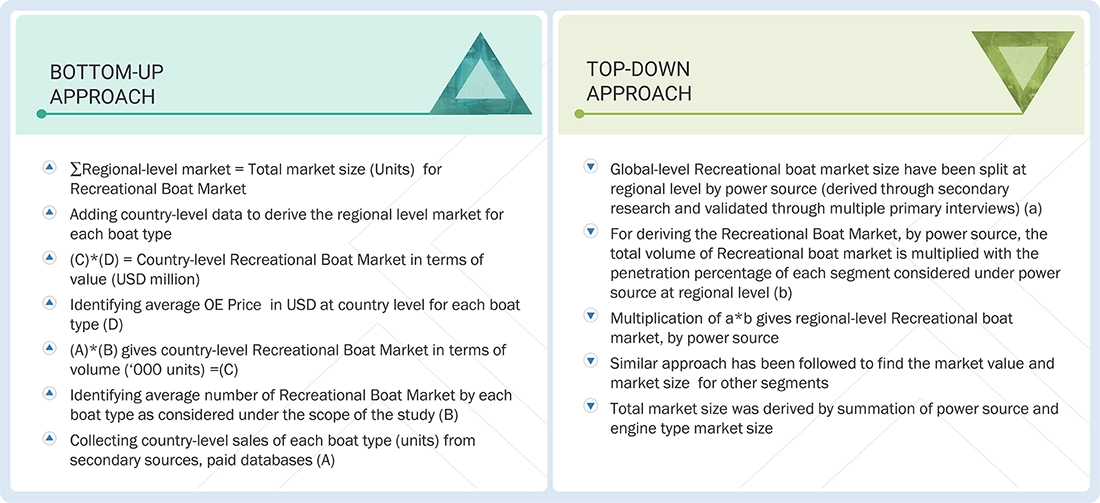
The bottom-up & top-down approaches were used to estimate and validate the total size of the recreational boat market. These methods were also used extensively to estimate the size of various subsegments, such as in the Boat Type segment. The research methodology used to estimate the market size includes the following:
- The key players in the industry and markets have been identified through extensive secondary research.
- The industry’s future supply chain and market size, in terms of volume, have been determined through primary and secondary research processes.
- All percentage shares, splits, and breakdowns have been determined using secondary sources and verified through primary sources.
Bottom-up Approach
- The bottom-up approach has been used to estimate and validate the market size of the recreational boat market. Historical unit recreational boats, by type—motorboats, yachts/cruisers, sailboats, personal watercraft (PWC), inflatable boats, pontoon/deck boats, and others—were tracked at the country level using OEM annual reports, manufacturer shipment disclosures, industry association data, boat registration records, dealer inputs, government statistics, import-export data, and industry databases. Where direct sales data was unavailable, estimates were developed using new boat registrations, historical shipment trends, import volumes, manufacturer delivery announcements, and dealer-level market information.
- Country-level unit sales, by type, were forecast through 2033 based on historical demand patterns, boat replacement cycles, growth in recreational boating participation, tourism activity, marina & boating infrastructure development, and water sports and other leisure activities. Forecasting assumptions accounted for boat lifespan, ownership trends, economic conditions, seasonal demand, and tourism expenditure. Replacement demand was assessed separately from incremental boat purchases to avoid double counting.
- Average selling prices (ASPs) were estimated for each boat type (motorboats, yachts/cruisers, sailboats, personal watercraft boats, inflatable boats, pontoon and deck boats, and cruisers), country, and relevant size or configuration class using OEM product prices, dealer quotations, public procurement data, import-export values, and available transaction information. These estimates were validated through primary interviews, considering differences in boat type. Forecast ASPs incorporated assumptions regarding price inflation, raw-material and component costs, exchange-rate movements, import duties, local manufacturing, technological upgrades, electrification, and changes in boat size and product mix.
- Finally, country-level unit sales were multiplied by the corresponding ASPs to calculate market values for country-level recreational boats, by type. The resulting volumes and values were aggregated across countries and regions to derive the global market size in terms of volume and value.
Top-down Approach
- The recreational boat market volume (units), by region, was derived from regional recreational boat sales across major engine types: gasoline, diesel, and electric/hybrid.
- The penetration of engine type was estimated at the regional level leveraging secondary sources, including OEM product portfolios, industry association statistics, boat registration data, and manufacturer disclosures, and validated through primary interviews with industry experts.
- Forecast regional penetration was based on expected changes in consumer boating preferences, boat type, tourism activity, and fuel efficiency requirements. The engine type penetration rates were multiplied by regional recreational boat volume to derive market volume (units) for gasoline, diesel, and electric/hybrid.
- The average selling price (ASP) of recreational boats (USD) was derived from secondary sources and validated through primary interviews, considering differences in engine type (Gasoline, diesel, and Electric/hybrid).
- The volume of recreational boats by engine type was multiplied by the corresponding ASP and converted into USD million to derive market value.
- Finally, regional estimates were aggregated to determine the global market by engine type (gasoline, diesel, and electric/hybrid), in terms of value (USD million) and volume (units).
- The same approach was used for hull design, boat size, material type, power range, and distribution channel.
Recreational Boat Market: Top-Down and Bottom-Up Approach
Data Triangulation
After arriving at the overall market size of recreational boats using the market size estimation processes as explained above, the market was split into several segments and subsegments. To complete the overall market engineering process and arrive at the exact statistics of each market segment and subsegment, data triangulation and market breakdown procedures were employed, wherever applicable. The data were triangulated by studying various factors and trends from both the demand and supply sides.
Market Definition
The recreational boat market refers to the design, manufacturing, sale, and use of boats intended for leisure and personal enjoyment activities such as cruising, fishing, water sports, and sailing. These boats include motorboats, sailboats, yachts, and personal watercraft, equipped with modern propulsion, navigation, and infotainment systems. The market integrates technologies such as GPS-based telematics, electric propulsion, and connected onboard systems to enhance safety, performance, and user convenience. Increasing adoption of digital monitoring, smart displays, and energy-efficient powertrains supports predictive maintenance and sustainability. Overall, the market aims to deliver high-performance, user-friendly, and environmentally responsible boating experiences while maximizing operational reliability and consumer value.
Key Stakeholders
- Recreational boat manufacturers
- Dealers and distributors
- Marine engine manufacturers
- Marine parts manufacturers
- Recreational boating associations
- Individual marine experts and consultants
- International unions
- Boat owners
- Boat maintenance and repair service providers
- Boating shows and event organizers
- Insurance companies
- Financing institutions
- Government regulatory agencies
Report Objectives
-
To segment and forecast the recreational boat market, in terms of volume (units) and value (USD million):
- By boat type (yachts/cruisers, inflatable motorboats/powerboats, personal watercraft boats, sailboats, cruisers, pontoon/deck boats, fishing boats, and others)
- By boat size (<30 feet, 30–50 feet, >50 feet)
- By engine placement (outboards and inboards)
- By engine type (ICE and electric/hybrid)
- By power range (below 100 kW, 100–200 kW, above 200 KW)
- By material type (aluminum, fiberglass, and steel)
- By hull design (planning hulls and displacement hulls)
- By distribution channel (boat dealerships, boat shows, and online sales)
- By regions (North America, Europe, Asia Oceania, and RoW)
- To provide detailed information about the major factors influencing market growth (drivers, challenges, restraints, and opportunities)
- To track and analyze competitive developments, such as product launches, deals, and other activities by key industry participants
- To strategically analyze the market with supply chain analysis, revenue analysis, and regulatory analysis in the market
- To examine the opportunities in the market for stakeholders and provide details of the competitive landscape for market leaders
Available customizations:
With the given market data, MarketsandMarkets offers customizations in line with company-specific needs.
- Recreational boat market, by engine location at the country level (for countries covered in the report)
- Recreational boat market, by yacht type, additional countries (small, medium, and large)
- Recreational boat market, by region, additional countries (up to 3)
Get the Full Recreational Boat Market Report
Full forecast, segment splits, and company analysis for all Recreational Boat Market.
- US Recreational Boat Market
- Canada Recreational Boat Market
- Mexico Recreational Boat Market
- Germany Recreational Boat Market
- France Recreational Boat Market
- Spain Recreational Boat Market
- UK Recreational Boat Market
- Italy Recreational Boat Market
- India Recreational Boat Market
- Japan Recreational Boat Market
- China Recreational Boat Market
- South Korea Recreational Boat Market
- Australia Recreational Boat Market
- New Zealand Recreational Boat Market
- Brazil Recreational Boat Market
Need a Tailored Report?
Customize this report to your needs
Get 10% FREE Customization
Customize This Report
