
Australia Refinery and Petrochemical Filtration Market (2025-2030)

The Australia Refinery and Petrochemical Filtration Market was valued at $113.8 Million in 2025 and projected to reach to $147.5 Million by 2030, representing a compound annual growth rate of 5.3%. Australia's refinery and petrochemical filtration market is positioned for steady growth through 2030, driven by aging infrastructure upgrades, increased environmental compliance pressures, and technological advancements in filtration systems.


| Market Size in | USD 26.32 MN |
| Market Forecast in | |
| CAGR | |
| Forecast Period | |
| Units Considered | Value (USD MN) |
Australia Refinery and Petrochemical Filtration Market Trends and Insights
- Australia's energy sector relies heavily on advanced filtration technologies to maintain operational efficiency and meet stringent environmental regulations across its refining and petrochemical facilities.
- The market growth in Australia is driven by increasing demand for high-performance filtration solutions that enhance product quality and reduce downtime in critical industrial processes. Australia's refinery and petrochemical filtration market benefits from the country's established industrial base and commitment to sustainable operations.
- Between 2025 and 2030, Australia is expected to see steady adoption of innovative filtration technologies, including membrane filtration and advanced particulate removal systems.
- Australia's strategic position in the Asia-Pacific region and its focus on operational excellence position the market for consistent expansion during the forecast period..
Key Market Statistics
- CAGR (2025-2030) 5.3% CAGR
- Market Size, 2025 ~USD 113.8 Million
- Forecast, 2030 ~USD 147.5 Million
- Country Australia
Australia Refinery and Petrochemical Filtration Market Overview
Market Valuation :
Australia's refinery and petrochemical filtration market is valued at USD 113.8 million in 2025, with strong growth trajectory driven by domestic energy infrastructure investments and operational modernization across refineries.
Growth Trajectory :
The market is projected to reach USD 147.5 million by 2030, representing a 5.3% CAGR. This growth outpaces global average expansion, reflecting Australia's commitment to upgrading filtration capabilities and environmental compliance standards.
Regulatory Compliance :
Australia's stringent environmental regulations and emissions standards are driving adoption of advanced filtration technologies in refineries and petrochemical facilities, ensuring operational efficiency while meeting sustainability requirements.
Energy Sector Dependency :
Australia's energy sector heavily relies on advanced filtration solutions to maintain operational efficiency, reduce downtime, and extend equipment lifespan across major refining and petrochemical processing facilities nationwide.
Australia Refinery and Petrochemical Filtration Market Dynamics
- The country's major refineries and petrochemical complexes are investing in modernization initiatives to enhance operational efficiency and reduce environmental impact, creating sustained demand for advanced filtration solutions. The market outlook remains positive as Australia strengthens its energy security and sustainability commitments.
- Domestic manufacturers and international suppliers are expanding their presence to meet growing demand for specialized filtration products tailored to Australia's unique operational and regulatory environment.
- Strategic investments in R&D and localized production capabilities will further support market expansion through the forecast period..
Market Ecosystem
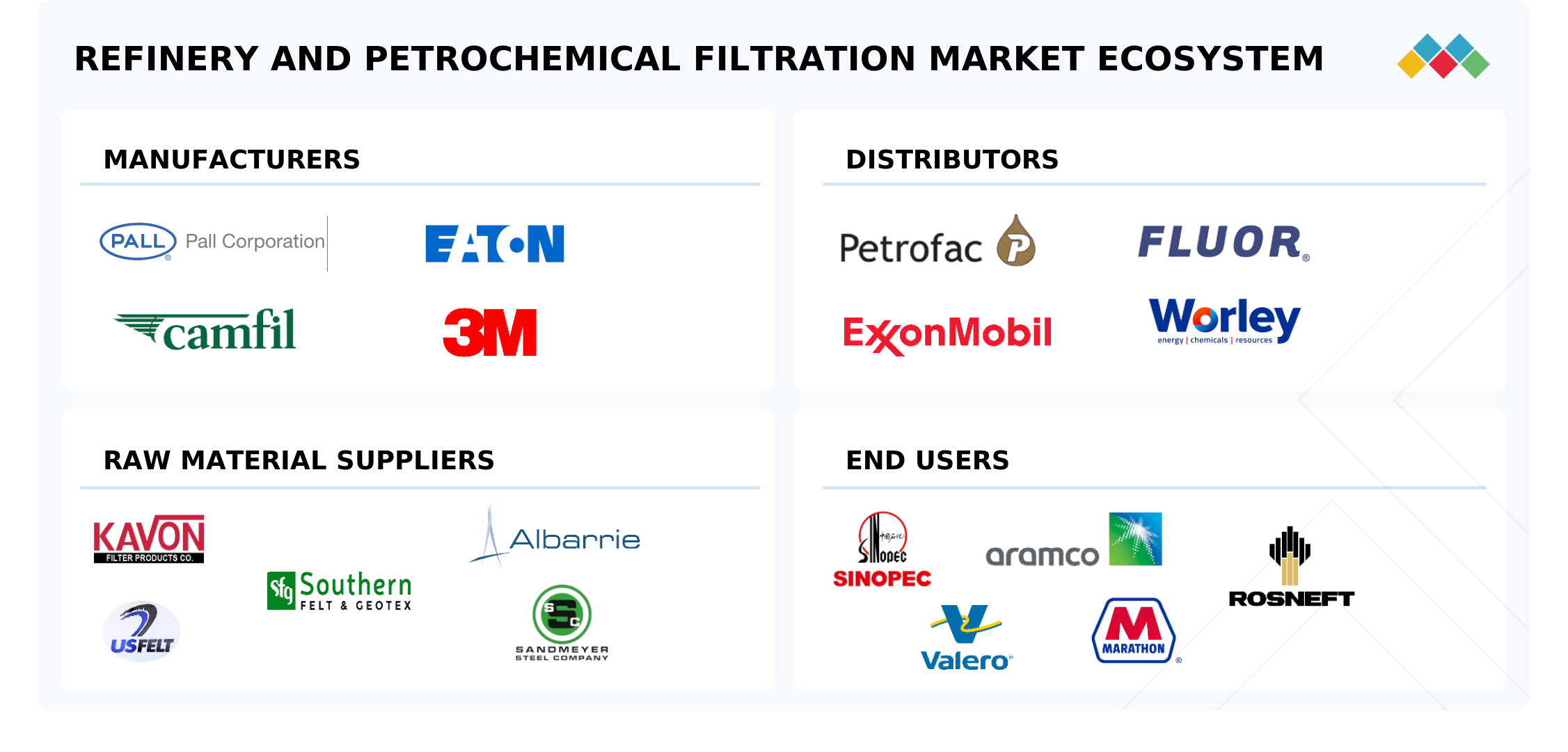
refinery and petrochemical filtration market: COMMERCIAL USE CASES ACROSS INDUSTRIES
| COMPANY | USE CASE DESCRIPTION | BENEFITS |
|---|---|---|
 |
A Texas refinery operating two coking units encountered significant issues with its hydrocracking unit’s high-temperature gas oil backwash feed filter system, especially due to increased use of opportunity crudes. The main problem was frequent unscheduled maintenance caused by persistent filter element changeouts for external cleaning, which led to safety concerns and costly maintenance. These challenges resulted in operational setbacks and high expenses, particularly after the turnaround cycle began, making filter maintenance a continuous burden. | To resolve these problems, Jonell Systems implemented a pre-filtration solution by installing a custom-engineered High-Temperature High Flow Cartridge Filter upstream of the backwash feed filter. This resulted in completely eliminating external filter element cleaning and significantly reduced filter maintenance needs. The refinery achieved savings of approximately USD 2 million per year in filter maintenance, and the reduced catalyst changeouts contributed to multi-million dollar cost reductions, ultimately exceeding USD 50 million in savings over six years. |
Logos and trademarks shown above are the property of their respective owners. Their use here is for informational and illustrative purposes only.
Related Ecosystem
Industrial Equipment
- HVAC System
- Fiberglass
- Actuators
- Cartridge Filters
- Electrostatic Precipitators
- Siemens ag
- ABB India Limited
- GRUNDFOS GROUP
- SCHNEIDER ELECTRIC SE
- Emerson Electric Co.
Key Takeaways
- Australia's refinery and petrochemical filtration market is valued at USD 113.8 million in 2025 and will reach USD 147.5 million by 2030.
- Australia is experiencing a 5.3% CAGR, reflecting steady demand for advanced filtration solutions in the energy sector.
- Australia's regulatory environment and focus on sustainability are driving adoption of high-performance filtration technologies.
- Australia's market growth is supported by ongoing investments in refinery modernization and petrochemical facility upgrades.
Refinery and Petrochemical Filtration Market Report Scope
| Report Metric | Details |
|---|---|
| Base Year | 2025 |
| Fastest Growing Segment | COALESCER FILTER (Filter Type) |
| Forecast Period | 2025-2030 |
| Growth Rate | CAGR of 5.9% from 2025 to 2030 |
| Largest Segment | REFINERIES (End User) |
| Market Size Base Year (Billions) | ~USD 5.08 (2025) |
| Revenue Forecast (Billions) | ~USD 6.76 (2030) |
| Segments Covered | Filter Type, Application, End User |
Australia Refinery and Petrochemical Filtration Market Report Segmentation
3 segment dimensions are covered across the global market.
By Filter Type
- Bag Filter
- Cartridge Filter
- Coalescer Filter
- Depth Cartridge
- Electrostatic Precipitator
- Filter Press
- High Flow Cartridge
- Liquid-Gas
- Liquid-Gas Coalescer
- Liquid-Liquid
- Liquid-Liquid Coalescer
- Other Filter Types
- Pleated Cartridge
By Application
- Liquid-Gas Separation
- Liquid-Liquid Separation
- Other Applications
By End User
- Petrochemical Industry
- Refineries
AUSTRALIA: REFINERY AND PETROCHEMICAL FILTRATION MARKET, BY END USER, 2025–2030
| Segment | 2025 | 2026 | 2027 | 2028 | 2029 | 2030 | CAGR (%) |
|---|---|---|---|---|---|---|---|
| PETROCHEMICAL INDUSTRY | 28.8 | 30.5 | 32.4 | 34.4 | 36.6 | 38.8 | 6.1 |
| REFINERIES | 85 | 89.1 | 93.5 | 98.3 | 103.3 | 108.7 | 5 |
| TOTAL | 113.8 | 119.7 | 125.9 | 132.7 | 139.9 | 147.5 | 5.3 |
Target Audience
- Refinery Operators : Australian refinery managers need market insights to optimize filtration system investments, ensure regulatory compliance, and improve operational efficiency while managing capital expenditure across aging infrastructure.
- Petrochemical Manufacturers : Petrochemical facility operators require Australia-specific market data to evaluate filtration technology upgrades, assess supplier capabilities, and plan maintenance strategies aligned with environmental standards.
- Filtration Equipment Suppliers : Domestic and international filtration manufacturers need detailed Australian market analysis to identify growth opportunities, develop localized product offerings, and establish competitive positioning in the energy sector.
- Energy Sector Investors : Investment firms and private equity groups evaluating opportunities in Australia's energy infrastructure require market-specific data to assess growth potential, identify acquisition targets, and evaluate sector dynamics.
- Government & Policy Makers : Australian energy regulators and policy officials need market intelligence to develop informed environmental standards, support industry sustainability initiatives, and guide infrastructure investment priorities.
Reasons to Buy this Report
- Market-Specific Sizing Data : Access precise valuation figures for Australia's refinery and petrochemical filtration market (USD 113.8M in 2025), enabling accurate budget allocation and investment planning tailored to the Australian market landscape.
- Localized Growth Forecasts : Obtain Australia-specific CAGR projections (5.3%) and 2030 market forecasts to benchmark performance against regional trends and identify emerging opportunities within the domestic energy sector.
- Regulatory Insights : Understand Australia's unique environmental compliance requirements and how stringent regulations are shaping filtration technology adoption, helping suppliers develop compliant product strategies for the market.
- Competitive Positioning : Gain intelligence on Australia's refinery and petrochemical facility landscape, enabling strategic market entry planning, partnership identification, and competitive differentiation within the domestic sector.
- Investment Decision Support : Make informed capital allocation decisions with comprehensive Australia-focused market analysis, supporting business expansion, facility upgrades, and technology investments in the refining and petrochemical sectors.
Frequently asked questions
What is the current size of Australia's refinery and petrochemical filtration market?
Australia's refinery and petrochemical filtration market is valued at USD 113.8 million in 2025.
What is the projected market size for Australia by 2030?
Australia's refinery and petrochemical filtration market is projected to reach USD 147.5 million by 2030.
What is the CAGR for Australia's refinery and petrochemical filtration market?
Australia's market is growing at a compound annual growth rate of 5.3% from 2025 to 2030.
What factors are driving growth in Australia's filtration market?
Australia's market growth is driven by regulatory compliance, sustainability initiatives, refinery modernization, and demand for operational efficiency in petrochemical facilities.
Which filtration technologies are gaining traction in Australia?
Advanced technologies such as membrane filtration, high-efficiency particulate removal systems, and automated filtration solutions are gaining adoption across Australia's refining and petrochemical sectors.
RESEARCH METHODOLOGY
The study involved major activities in estimating the current size of the refinery and petrochemical filtration market. Exhaustive secondary research was done to collect information on the peer and parent markets. The next step was to validate these findings, assumptions, and sizing with industry experts across the value chain through primary research. Both the top-down and bottom-up approaches were employed to estimate the complete market size. Thereafter, market breakdown and data triangulation were used to estimate the market size of the segments and subsegments.
Secondary Research
This research study on the refinery and petrochemical filtration market involved the use of extensive secondary sources, directories, and databases, such as Hoovers, Bloomberg, Businessweek, Factiva, International Energy Agency, and BP Statistical Review of World Energy, to identify and collect information useful for a technical, market-oriented, and commercial study of the refinery and petrochemical filtration market. The other secondary sources included annual reports, press releases & investor presentations of companies, white papers, certified publications, articles by recognized authors, manufacturer associations, trade directories, and databases.
Primary Research
The refinery and petrochemical filtration market comprises several stakeholders, such as refinery and petrochemical filtration manufacturers, manufacturing technology providers, and technical support providers in the supply chain. The demand side of this market is characterized by the rising demand for refinery and petrochemical filtration in liquid-liquid separation, liquid-gas separation, and other applications. The supply side is characterized by rising demand for contracts from the industrial sector and mergers & acquisitions among big players. Various primary sources from both the supply and demand sides of the market were interviewed to obtain qualitative and quantitative information. Following is the breakdown of primary respondents:
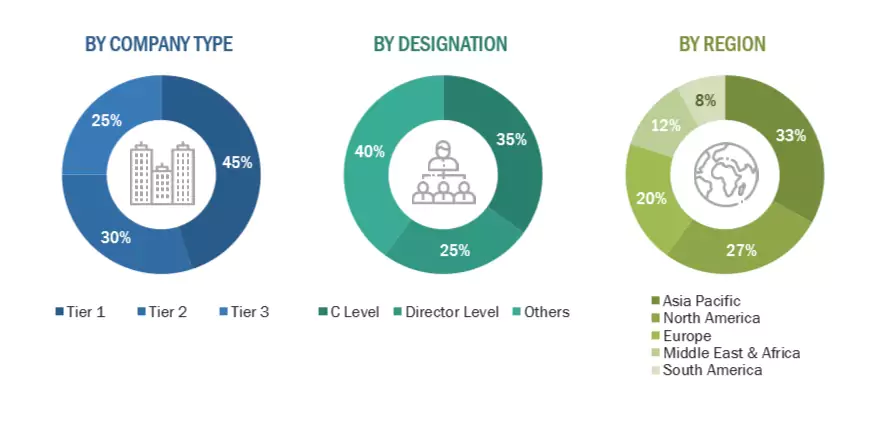
Note: “Others” include sales managers, engineers, and regional managers
The tier of the companies is defined on the basis of their total revenue as of 2024; Tier 1 = > USD 1
billion, Tier 2 = From USD 500 million to USD 1 billion, and Tier 3 = < USD 500 million.
To know about the assumptions considered for the study, download the pdf brochure
Market Size Estimation
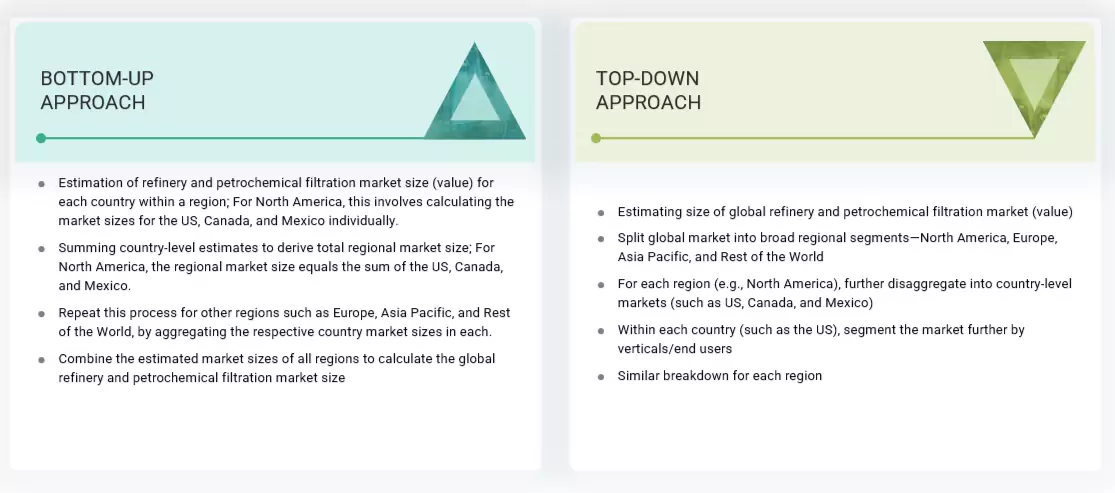
Both top-down and bottom-up approaches were used to estimate and validate the total size of the refinery and petrochemical filtration market. These methods were also used extensively to estimate the size of various subsegments in the market. The research methodology used to estimate the market size includes the following:
- The key players in the industry and market have been identified through extensive secondary research, and their market share in the respective regions has been determined through both primary and secondary research.
- The industry’s value chain and market size, in terms of value, have been determined through primary and secondary research processes.
- All percentage shares, splits, and breakdowns have been determined using secondary sources and verified through primary sources.
Refinery and Petrochemical Filtration Market : Top-Down and Bottom-Up Approach
Data Triangulation
After arriving at the overall market size from the estimation process explained above, the total market has been split into several segments and subsegments. To complete the overall market engineering process and arrive at the exact statistics for all the segments and subsegments, the data triangulation and market breakdown processes have been employed, wherever applicable. The data has been triangulated by studying various factors and trends from both the demand and supply sides. Along with this, the market has been validated using both the top-down and bottom-up approaches.
Market Definition
The refinery and petrochemical filtration refers to the specialized filtration systems used in refineries and petrochemical plants. These filtration systems remove impurities, contaminants, and particles from process streams, ensuring product quality, protecting equipment, and maintaining smooth operations. Various types of filters, such as cartridge, bag, filter press, coalescers, and electrostatic precipitators, among others, are employed for this purpose. The growth of the refinery and petrochemical filtration market can be attributed to the development of the downstream sector across major countries in North America, Europe, Asia Pacific, South America, and the Middle East & Africa.
Stakeholders
- Associations, forums, and alliances related to the refinery and petrochemical filtration market
- Consulting companies in the energy sector
- Government and research organizations
- Refinery owners
- Petrochemical plant owners
- Public and private downstream companies
- State and national regulatory authorities
- Energy management companies
- Government & research organizations
- OEMs
- Refinery and petrochemical filtration equipment manufacturers
- Support infrastructure equipment providers
- Oil and gas engineering, procurement, and construction (EPC) companies
Report Objectives
- To define, describe, and forecast the refinery and petrochemical filtration market based on filter type, end user, application, and region, in terms of value and volume
- To describe and forecast the refinery and petrochemical filtration market for various segments with respect to five main regions: North America, Europe, Asia Pacific, South America, and the Middle East & Africa, in terms of value
- To provide detailed information regarding the drivers, restraints, opportunities, and challenges influencing the growth of the market
- To provide a detailed overview of the refinery and petrochemical filtration value chain, along with industry trends, use cases, security standards, and Porter’s five forces analysis
- To strategically analyze micromarkets with respect to individual growth trends, prospects, and contributions to the total market
- To analyze opportunities in the market for various stakeholders by identifying high-growth segments in the refinery and petrochemical filtration market
- To strategically profile key players and comprehensively analyze their market position in terms of ranking and core competencies, along with detailing the competitive landscape of the market.
- To analyze growth strategies adopted by market players, such as partnerships, mergers & acquisitions, agreements, and product launches, in the refinery and petrochemical filtration market.
Available Customizations
With the given market data, MarketsandMarkets offers customizations according to the specific requirements of companies. The following customization options are available for the report:
Product Analysis
- Product Matrix, which provides a detailed comparison of the product portfolio of each company
Company Information
- Detailed analyses and profiling of additional market players
Get the Full Refinery and Petrochemical Filtration Market Report
Full forecast, segment splits, and company analysis for all Refinery and Petrochemical Filtration Market.
- China Refinery and Petrochemical Filtration Market
- India Refinery and Petrochemical Filtration Market
- Japan Refinery and Petrochemical Filtration Market
- South Korea Refinery and Petrochemical Filtration Market
- Canada Refinery and Petrochemical Filtration Market
- Mexico Refinery and Petrochemical Filtration Market
- US Refinery and Petrochemical Filtration Market
- Russia Refinery and Petrochemical Filtration Market
- Germany Refinery and Petrochemical Filtration Market
- UK Refinery and Petrochemical Filtration Market
- France Refinery and Petrochemical Filtration Market
- Italy Refinery and Petrochemical Filtration Market
- Saudi Arabia Refinery and Petrochemical Filtration Market
- UAE Refinery and Petrochemical Filtration Market
- South Africa Refinery and Petrochemical Filtration Market
- Brazil Refinery and Petrochemical Filtration Market
- Argentina Refinery and Petrochemical Filtration Market
- Rest Of Europe Refinery and Petrochemical Filtration Market
- Rest Of Asia Pacific Refinery and Petrochemical Filtration Market
- Rest Of South America Refinery and Petrochemical Filtration Market
Need a Tailored Report?
Customize this report to your needs
Get 10% FREE Customization
Customize This Report
