
South Korea Refrigerants Market (2024-2029)

The South Korea Refrigerants Market was valued at $192.9 Million in 2024 and projected to reach to $258.6 Million by 2029, representing a compound annual growth rate of 6.03%. South Korea's refrigerants market is poised for sustained expansion through 2029, driven by stringent environmental regulations promoting the adoption of eco-friendly refrigerants and the phase-out of ozone-depleting substances.


| Market Size in | USD 26.32 MN |
| Market Forecast in | |
| CAGR | |
| Forecast Period | |
| Units Considered | Value (USD MN) |
South Korea Refrigerants Market Trends and Insights
- This growth trajectory reflects South Korea's robust industrial base and increasing demand across cooling and air conditioning applications in both commercial and residential sectors.
- South Korea's strategic position in the Asia Pacific region positions it as a key market for refrigerant innovation and adoption. The South Korea refrigerants market is driven by regulatory compliance with environmental standards, particularly the phase-out of ozone-depleting substances and the transition to low-global-warming-potential alternatives.
- South Korea's manufacturing sector, including electronics and automotive industries, relies heavily on efficient refrigeration systems, supporting sustained demand.
- Between 2024 and 2029, South Korea is expected to see accelerated adoption of eco-friendly refrigerants as both regulatory pressure and corporate sustainability commitments intensify across the nation..
Key Market Statistics
- CAGR (2024-2029) 6.03% CAGR
- Market Size, 2024 ~USD 192.9 Million
- Forecast, 2029 ~USD 258.6 Million
- Country South Korea
South Korea Refrigerants Market Overview
Market Valuation :
South Korea's refrigerants market is valued at USD 192.9 million in 2024, with strong growth momentum driven by industrial expansion and rising cooling demand across commercial and residential sectors.
Growth Trajectory :
The market is projected to reach USD 258.6 million by 2029, representing a CAGR of 6.03%, outpacing many regional markets and reflecting South Korea's advanced manufacturing capabilities.
Regional Strategic Position :
South Korea's strategic location in Asia Pacific positions it as a key hub for refrigerant distribution and innovation, with strong export potential to neighboring markets and growing domestic consumption.
Sector Drivers :
Growth is fueled by increasing demand for HVAC systems in commercial buildings, residential air conditioning upgrades, and industrial cooling applications across South Korea's manufacturing sector.
South Korea Refrigerants Market Dynamics
- The country's advanced industrial infrastructure and high consumer spending on climate control solutions support consistent demand growth across both commercial and residential segments. Key growth catalysts include rising temperatures driving air conditioning adoption, government initiatives supporting energy-efficient cooling systems, and South Korea's leadership in semiconductor and electronics manufacturing requiring specialized refrigeration solutions.
- The market will likely see increased competition among suppliers offering low-GWP alternatives and innovative cooling technologies tailored to South Korea's specific regulatory environment..
Market Ecosystem
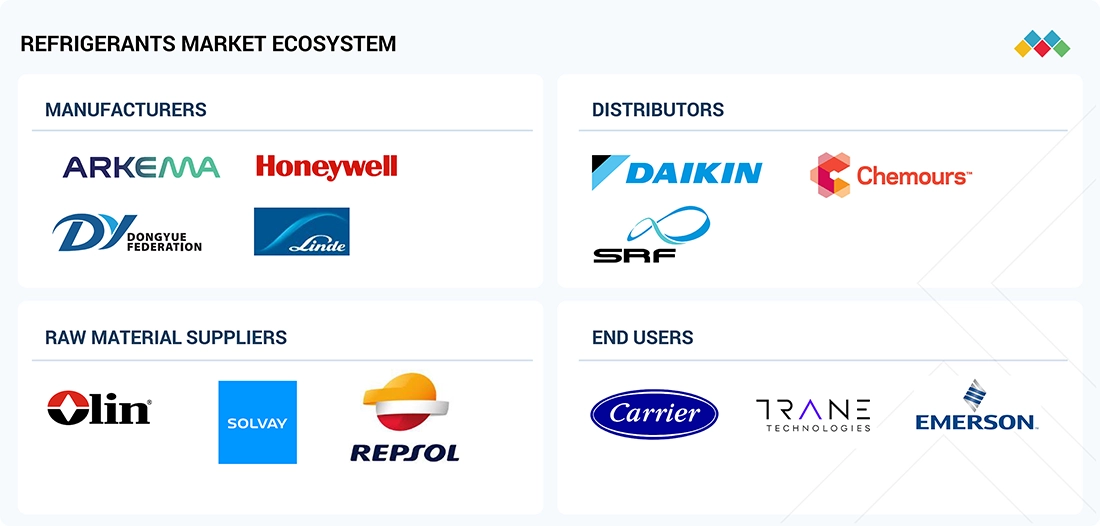
Refrigerants Market: COMMERCIAL USE CASES ACROSS INDUSTRIES
| COMPANY | USE CASE DESCRIPTION | BENEFITS |
|---|---|---|
 |
Uses natural refrigerants (CO2, ammonia, hydrocarbons) in ice-cream freezers and industrial refrigeration systems globally. | Reduces greenhouse gas emissions, improves energy efficiency, and enhances environmental sustainability. |
 |
Installs HFC-free coolers and dispensers using natural refrigerants in cold-drink equipment worldwide. | Prevents CO2 emissions, supports climate goals, and ensures regulatory compliance for sustainable cooling. |
 |
Deploys energy-efficient, HFC-free coolers and vending machines using natural refrigerants like R-290 and CO2. | Reduces direct GHG emissions, lowers energy consumption, and aligns with global sustainability initiatives. |
 |
Uses natural refrigerants in commercial refrigeration and display equipment under its sustainability program. | Minimizes global warming potential, supports eco-friendly retail operations, and lowers maintenance costs. |
 |
Implements natural refrigerant systems in store refrigeration and display cases replacing HFC-based systems. | Increases energy efficiency, lowers operational costs, and reduces overall carbon footprint. |
Logos and trademarks shown above are the property of their respective owners. Their use here is for informational and illustrative purposes only.
Related Ecosystem
Industrial Gases
- Dry Cooling Tower
- HVAC System
- Heat Exchanger
- Hybrid Cooling Tower
- Industrial Refrigeration
- Linde plc
- Air Products and Chemicals, Inc.
- MESSER GROUP GMBH
- AIR LIQUIDE
- Iwatani Corporation
Mining Minerals And Metals
- Wastewater Treatment
- Fiberglass
- Light Commercial Vehicles (LCVs)
- Nitrogen
- Acetic Acid
- LHOIST S.A
- SEVERSTAL JSC
- ArcelorMittal S.A.
- TW METALS, INC.
- Linde plc
Key Takeaways
- South Korea's refrigerants market is valued at USD 192.9 million in 2024 and is forecast to reach USD 258.6 million by 2029, representing a 6.03% CAGR.
- South Korea's industrial and manufacturing sectors drive significant demand for refrigeration solutions across electronics, automotive, and HVAC applications.
- Environmental regulations and the transition to low-GWP refrigerants are reshaping South Korea's market landscape and accelerating innovation.
- South Korea's position within Asia Pacific makes it a critical hub for refrigerant technology adoption and regional supply chain development.
Refrigerants Market Report Scope
| Report Metric | Details |
|---|---|
| Base Year | 2024 |
| Forecast Period | 2024–2029 |
| Growth Rate | CAGR of 6.5% from 2024 to 2029 |
| Market Size Base Year (Billions) | ~USD 6.98 (2024) |
| Revenue Forecast (Billions) | ~USD 9.56 (2029) |
| Segments Covered | Type, Application |
South Korea Refrigerants Market Report Segmentation
2 segment dimensions are covered across the global market.
By Type
- Ammonia
- Carbon Dioxide
- Hfc & Blends
- Hfo
- Isobutane
- Other Types
- Propane
By Application
- Air Conditioning Systems
- Chillers
- Mobile Air Conditioning
- Refrigeration Systems
- –Commercial Refrigeration
- –Domestic Refrigeration
- –Ducted, Packaged & Rooftop Acs
- –Industrial Refrigeration
- –Split Ac
- –Vrf
- –Window Ac
Target Audience
- Refrigerant Manufacturers & Suppliers : Manufacturers need South Korea-specific market data to assess production capacity requirements, identify distribution channels, and develop product portfolios aligned with local regulatory standards and customer preferences.
- HVAC & Cooling Equipment Producers : Equipment manufacturers require detailed market insights to forecast demand for cooling systems in South Korea, optimize supply chains, and align product development with the country's growing commercial and residential sectors.
- Investment & Private Equity Firms : Investors evaluating opportunities in South Korea's industrial gases and refrigerants sector need accurate market sizing, growth projections, and competitive analysis to make informed acquisition and funding decisions.
- Distribution & Logistics Companies : Distributors and logistics providers need market-specific data to plan warehouse locations, inventory levels, and supply chain networks to efficiently serve South Korea's growing refrigerants demand through 2029.
- Government & Policy Makers : Regulatory bodies and government agencies require market intelligence to develop environmental policies, monitor compliance with refrigerant phase-outs, and support the transition to sustainable cooling solutions in South Korea.
Key Companies in the South Korea Refrigerants Market
| Company | HQ | Ownership | Strongest segments |
|---|---|---|---|
| AIRGAS INC | United States | Private Company | HFC & Blends,HFO,Isobutane, |
| TRANE TECHNOLOGIES PLC | Ireland | Public Company | Air Conditioning System,Chillers,Refrigeration System, |
| CARRIER GLOBAL CORPORATION | United States | Public Company | HFC & Blends,HFO,Isobutane & Propane, |
| ARKEMA | France | Public Company | HFC & Blends,HFO,Isobutane & Propane, |
| DONGYUE GROUP LIMITED | China | Public Company | HFC & Blends,HFO,Isobutane, |
| HONEYWELL INTERNATIONAL INC. | United States | Public Company | HFC & Blends,HFO,Isobutane & Propane, |
| THE CHEMOURS COMPANY | United States | Public Company | HFC & Blends,HFO,Isobutane, |
| LINDE PLC | United Kingdom | Public Company | HFC & Blends,HFO,Isobutane, |
| SINOCHEM HONG KONG (GROUP) COMPANY LIMITED | Hong Kong | Private Company | HFC & Blends,HFO,Isobutane, |
| DAIKIN INDUSTRIES, LTD. | Japan | Public Company | HFC & Blends,HFO,Isobutane, |
| ORBIA ADVANCE CORPORATION, S.A.B. DE C.V. | Mexico | Public Company | HFC & Blends,HFO,Isobutane & Propane, |
| AGC INC. | United States | Public Company | HFC & Blends,HFO,Isobutane, |
| SRF LIMITED | India | Public Company | HFC & Blends,HFO,Isobutane, |
| GUJARAT FLUOROCHEMICALS LIMITED | India | Public Company | HFC & Blends,HFO,Isobutane, |
| NAVIN FLUORINE INTERNATIONAL LIMITED | India | Public Company | HFC & Blends,HFO,Isobutane & Propane, |
AIRGAS INC
Airgas Inc. is a private company founded in 1982 in the United States with 17,000 employees. The company operates in the industrial gases and related products sector.
TRANE TECHNOLOGIES PLC
Trane Technologies PLC is a public company incorporated in Ireland with a history dating back to 1885 and 44,000 employees. The company provides climate control and building solutions globally.
CARRIER GLOBAL CORPORATION
Carrier Global Corporation is a publicly traded U.S. company established in 2019 with 47,000 employees. The company specializes in HVAC, refrigeration, and fire and security solutions.
ARKEMA
Arkema is a French public company founded in 2003 with 20,700 employees. The company manufactures specialty chemicals and advanced materials for various industrial applications.
DONGYUE GROUP LIMITED
Dongyue Group Limited is a Chinese public company established in 1987 with 6,377 employees. The company operates in the chemical manufacturing sector.
HONEYWELL INTERNATIONAL INC.
Honeywell International Inc. is a publicly traded U.S. company with roots dating to 1885 and 101,000 employees. The company provides diversified technology and manufacturing solutions across aerospace, building technologies, and performance materials.
THE CHEMOURS COMPANY
The Chemours Company is a U.S. public company founded in 2014 with 5,700 employees. The company manufactures and sells specialty chemicals, including refrigerants and fluoroproducts.
LINDE PLC
Linde PLC is a public company incorporated in the United Kingdom with origins tracing to 1879 and 65,034 employees. The company is a leading global supplier of industrial gases and engineering services.
SINOCHEM HONG KONG (GROUP) COMPANY LIMITED
Sinochem Hong Kong (Group) Company Limited is a private company established in Hong Kong in 1989. The company operates in the chemical and petrochemical sectors.
DAIKIN INDUSTRIES, LTD.
Daikin Industries, Ltd. is a Japanese public company founded in 1924 with 104,095 employees. The company is a global leader in air conditioning, refrigeration, and chemical products.
ORBIA ADVANCE CORPORATION, S.A.B. DE C.V.
Orbia Advance Corporation, S.A.B. de C.V. is a Mexican public company established in 1953 with 22,683 employees. The company manufactures and distributes specialty chemicals, polymers, and building solutions.
AGC INC.
AGC Inc. is a U.S. public company founded in 1990 with 22,000 employees. The company operates in the specialty chemicals and materials sector.
SRF LIMITED
SRF Limited is an Indian public company founded in 1970 with 7,686 employees. The company manufactures specialty chemicals, fluorochemicals, and polymer films.
GUJARAT FLUOROCHEMICALS LIMITED
Gujarat Fluorochemicals Limited is an Indian public company established in 1987 with 3,405 employees. The company produces fluorochemicals and related specialty chemicals.
NAVIN FLUORINE INTERNATIONAL LIMITED
Navin Fluorine International Limited is an Indian public company founded in 1967 with 1,569 employees. The company manufactures fluorochemicals and specialty chemicals.
Reasons to Buy this Report
- Market-Specific Sizing Data : Access precise valuation figures for South Korea's refrigerants market (USD 192.9M in 2024) with detailed forecasts through 2029, enabling accurate budget allocation and investment planning specific to this high-growth market.
- Competitive Landscape Intelligence : Understand South Korea's unique competitive dynamics, regulatory environment, and market structure to identify opportunities for market entry, partnerships, or expansion within this strategically important Asia Pacific economy.
- Sector-Specific Growth Drivers : Gain insights into South Korea-specific demand factors including industrial cooling needs, residential HVAC adoption rates, and government environmental policies driving the 6.03% CAGR through 2029.
- Strategic Market Positioning : Leverage South Korea's role as a regional hub and manufacturing powerhouse to develop distribution strategies, supply chain optimization, and product localization plans for broader Asia Pacific penetration.
- Regulatory & Compliance Insights : Stay informed on South Korea's specific refrigerant regulations, environmental standards, and phase-out timelines to ensure product compliance and capitalize on the shift toward low-GWP alternatives.
Frequently asked questions
What is the current size of South Korea's refrigerants market?
South Korea's refrigerants market was valued at USD 192.9 million in 2024 and is expected to grow to USD 258.6 million by 2029.
What is the projected growth rate for South Korea's refrigerants market?
South Korea's refrigerants market is projected to grow at a compound annual growth rate (CAGR) of 6.03% from 2024 to 2029.
Which industries drive demand for refrigerants in South Korea?
South Korea's demand for refrigerants is driven by the electronics, automotive, HVAC, construction, and food processing industries, which rely on efficient cooling systems.
What regulatory factors influence South Korea's refrigerants market?
South Korea's refrigerants market is shaped by environmental regulations mandating the phase-out of ozone-depleting substances and the adoption of low-global-warming-potential alternatives.
How does South Korea's market compare to the broader Asia Pacific region?
South Korea represents a significant segment of the Asia Pacific refrigerants market, driven by its advanced manufacturing base and stringent environmental standards.
RESEARCH METHODOLOGY
The study involved four major activities in estimating the market size for refrigerants. Exhaustive secondary research was done to collect information on the market, the peer market, and the parent market. The next step was to validate these findings, assumptions, and sizing with industry experts across the value chain through primary research. Both top-down and bottom-up approaches were employed to estimate the complete market size. Post that, the market breakdown and data triangulation procedures were used to estimate the market size of the segments and subsegments.
Secondary Research
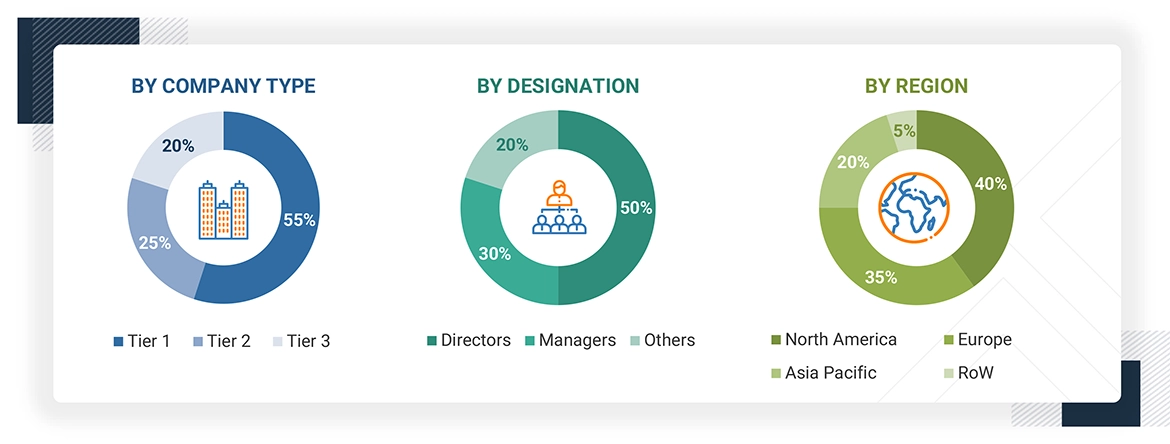
Secondary sources used in this study included annual reports, press releases, and investor presentations of companies; white papers; certified publications; articles from recognized authors; and gold standard & silver standard websites such as Factiva, ICIS, Bloomberg, and others. The findings of this study were verified through primary research by conducting extensive interviews with key officials such as CEOs, VPs, directors, and other executives. The breakdown of profiles of the primary interviewees is illustrated in the figure below:
Primary Research
The Refrigerants market comprises several stakeholders, such as raw material suppliers, end-product manufacturers, and regulatory organizations in the supply chain. The demand side of this market is characterized by the automotive, medical, construction and others. The supply side is characterized by advancements in technology and diverse application industries. Various primary sources from both the supply and demand sides of the market were interviewed to obtain qualitative and quantitative informations.
Breakdown of Primary Participants
Note: Tier 1, Tier 2, and Tier 3 companies are classified based on their market revenue in 2023 available in the public domain, product portfolios, and geographical presence.
Other designations include consultants and sales, marketing, and procurement managers.
To know about the assumptions considered for the study, download the pdf brochure
| COMPANY NAME | DESIGNATION | |
|---|---|---|
| Honeywell International Inc. | Director of Marketing | |
| The Chemours Company | Manager- Sales & Marketing | |
| The Linde Group | Sales Manager | |
| Arkema | Production Manager | |
Market Size Estimation
Both top-down and bottom-up approaches were used to estimate and validate the total size of the Refrigerants market. These methods were also used extensively to estimate the size of various subsegments in the market. The research methodology used to estimate the market size includes the following:
- The key players in the industry have been identified through extensive secondary research.
- The supply chain of the industry has been determined through primary and secondary research.
- All percentage shares, splits, and breakdowns have been determined using secondary sources and verified through primary sources.
- All possible parameters that affect the markets covered in this research study have been accounted for, viewed in extensive detail, verified through primary research, and analyzed to obtain the final quantitative and qualitative data.
Refrigerants Market: Top-Down Approach
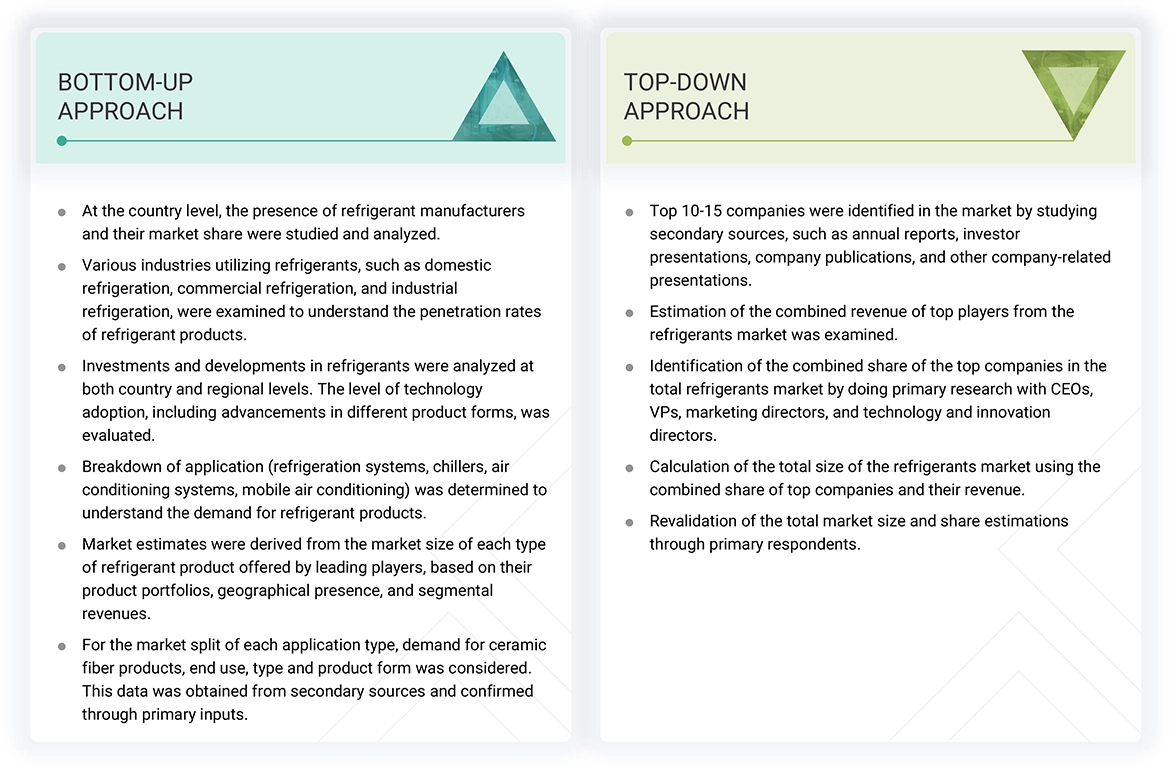
Data Triangulation
After arriving at the overall market size—using the market size estimation processes as explained above—the market was split into several segments and subsegments. To complete the overall market engineering process and arrive at the exact statistics of each market segment and subsegment, the data triangulation, and market breakdown procedures were employed, wherever applicable. The data was triangulated by studying various factors and trends from both the demand and supply sides in the refrigerants industry.
Market Definition
According to the International Institute of Refrigeration, refrigerants are cooling mediums that absorb heat at low temperatures and pressure and release heat at high temperatures and pressure. Fluorocarbons are the most widely used refrigerants in equipment, such as refrigerators and air conditioners. However, due to their high ozone depleting potential (ODP) and global warming potential (GWP), they are being replaced by greener refrigerants such as propane, isobutane, ammonia, and carbon dioxide, among others, such as water and propene.
Stakeholders
- Refrigerants Manufacturers
- Refrigerants Traders, Distributors, and Suppliers
- End-use Market Participants of Different Segments of Refrigerants
- Government and Research Organizations
- Associations and Industrial Bodies
- Research and Consulting Firms
- R&D Institutions
- Environment Support Agencies
- Investment Banks and Private Equity Firms
Report Objectives
- To define, describe, and forecast the refrigerants market in terms of value and volume
- To provide detailed information regarding the drivers, opportunities, restraints, and challenges influencing market growth
- To estimate and forecast the market size by type, application, and region
- To forecast the size of the market for five main regions: Europe, North America, Asia Pacific, South America, and the Middle East & Africa, along with their key countries
- To strategically analyze micromarkets1 with respect to their growth trends, prospects, and contribution to the overall market
- To analyze opportunities in the market for stakeholders and provide a competitive landscape for market leaders
- To analyze competitive developments, such as deals and expansions, in the market
- To analyze the impact of the recession on the market
- To strategically profile key players and comprehensively analyze their growth strategies
Get the Full Refrigerants Market Report
Full forecast, segment splits, and company analysis for all Refrigerants Market.
- China Refrigerants Market
- India Refrigerants Market
- Japan Refrigerants Market
- Indonesia Refrigerants Market
- Thailand Refrigerants Market
- Malaysia Refrigerants Market
- Australia Refrigerants Market
- Canada Refrigerants Market
- Mexico Refrigerants Market
- US Refrigerants Market
- Germany Refrigerants Market
- Russia Refrigerants Market
- Italy Refrigerants Market
- France Refrigerants Market
- UK Refrigerants Market
- Turkey Refrigerants Market
- Spain Refrigerants Market
- Saudi Arabia Refrigerants Market
- UAE Refrigerants Market
- Iran Refrigerants Market
- South Africa Refrigerants Market
- Brazil Refrigerants Market
- Argentina Refrigerants Market
- Rest Of Europe Refrigerants Market
- Rest Of Asia Pacific Refrigerants Market
Need a Tailored Report?
Customize this report to your needs
Get 10% FREE Customization
Customize This Report
