
South America Release Liners Market (2024-2029)

The South America Release Liners Market was valued at $137.5 Million in 2024 and projected to reach to $158 Million by 2029, representing a compound annual growth rate of CAGR 2.8%. South America's release liners market demonstrates moderate but stable growth potential, supported by expanding manufacturing sectors and rising demand from adhesive tape and label producers.


| Market Size in | USD 26.32 MN |
| Market Forecast in | |
| CAGR | |
| Forecast Period | |
| Units Considered | Value (USD MN) |
South America Release Liners Market Trends and Insights
- South America's release liners market is characterized by steady demand from adhesive tape, label, and composite industries, driven by expanding manufacturing sectors and increasing adoption of pressure-sensitive applications across the region.
- The market in South America reflects moderate growth compared to global trends, with regional economic conditions and industrial development patterns shaping demand trajectories through the forecast period..
Key Market Statistics
- CAGR (2024-2029) CAGR 2.8%
- Market Size, 2024 ~USD 137.5 Million
- Forecast, 2029 ~USD 158 Million
- Country South America
South America Release Liners Market Overview
Steady Growth Trajectory :
South America's release liners market is projected to grow from USD 137.5 million in 2024 to USD 158.0 million by 2029, with a CAGR of 2.8%, reflecting consistent demand across key end-use industries.
Adhesive Tape & Label Dominance :
The region's market is primarily driven by adhesive tape, label, and composite industries, which continue to expand manufacturing capabilities and increase consumption of pressure-sensitive release liners.
Manufacturing Sector Expansion :
Growing industrialization and manufacturing output across South American countries are fueling demand for release liners in packaging, labeling, and industrial applications.
Pressure-Sensitive Technology Adoption :
Increasing adoption of pressure-sensitive adhesive products in South America is driving the need for high-quality release liner solutions across multiple industrial segments.
South America Release Liners Market Dynamics
- The region's CAGR of 2.8% reflects steady industrialization and increased adoption of pressure-sensitive technologies across various applications.
- Key growth drivers include infrastructure development, growing packaging requirements, and the expansion of composite manufacturing.
- However, the market faces challenges from economic volatility and competition from alternative materials.
- Strategic investments in production capacity and innovation in liner formulations will be critical for market participants seeking to capitalize on South America's emerging opportunities..
Market Ecosystem
Related Ecosystem
Resins And Polymers
- Polycarbonate
- Acrylonitrile Butadiene Styrene (ABS)
- Epoxy Resin
- Light Commercial Vehicles (LCVs)
- Polypropylene (PP)
- Basf se
- DOW CHEMICAL COMPANY
- Solvay sa
- Saudi arabia basic industries corporation (sabic)
- DuPont de Nemours, Inc.
Labels And Tags
- Gravure Process
- Digital Printing
- Global Positioning System (GPS)
- Radio Frequency Identification (RFID)
- Smart Card & Readers
- Essentra plc
- Avery Dennison Corporation
- Ccl industries inc.
- 3M COMPANY
- Lg chem ltd.
Packaging
- Ampoules
- Gravure Process
- Rigid Packaging
- Aerosols
- Aseptic Filling and Sealing Equipment
- Amcor plc
- Essentra plc
- Berry Global Group, Inc.
- Mondi plc
- SEALED AIR CORPORATION
Key Takeaways
- South America's release liners market is valued at USD 137.5 million in 2024 and will reach USD 158.0 million by 2029.
- South America exhibits a 2.8% CAGR, indicating steady but moderate growth relative to global market expansion.
- South America's market growth is driven by rising demand in adhesive, labeling, and composite manufacturing applications.
- South America's regional economic conditions and industrial development are key factors influencing market trajectory through 2029.
Release Liners Market Report Scope
| Report Metric | Details |
|---|---|
| Base Year | 2024 |
| Fastest Growing Segment | EMULSIONS (Formulation) |
| Forecast Period | 2024-2029 |
| Growth Rate | CAGR of 4% from 2024 to 2029 |
| Largest Segment | SILICONE (Material) |
| Market Size Base Year (Billions) | ~USD 12.66 (2024) |
| Revenue Forecast (Billions) | ~USD 15.4 (2029) |
| Segments Covered | Material, Substrate, Labeling Technology, Application, Formulation |
South America Release Liners Market Report Segmentation
5 segment dimensions are covered across the global market.
By Material
- Non-Silicone
- Silicone
By Substrate
- Clay-Coated Paper
- Films
- Glassine/Calendered Kraft Paper
- Other Papers
- Polyolefin-Coated Paper
By Labeling Technology
- Glue-Applied Labeling
- In-Mold Labeling
- Other Labeling Technologies
- Pressure-Sensitive Labeling
- Sleeving
By Application
- Graphic Arts
- Hygiene
- Industrial
- Labels
- Medical
- Other Applications
- Pressure-Sensitive Tapes
By Formulation
- Emulsions
- Solvent-Based
- Solventless
Target Audience
- Release Liner Manufacturers : Manufacturers need South America-specific market data to assess regional demand, identify growth opportunities, and develop localized production and distribution strategies.
- Adhesive & Tape Producers : Companies in the adhesive and tape industry require insights into South American release liner demand to secure reliable supply chains and optimize product development for regional markets.
- Label & Packaging Companies : Label and packaging manufacturers need regional market intelligence to understand release liner availability, pricing trends, and supplier options specific to South America.
- Composite Material Suppliers : Composite manufacturers operating in South America require market data to evaluate release liner requirements, forecast demand, and plan procurement strategies for the region.
- Investment & Business Development Teams : Strategic investors and business development professionals need South America market analysis to evaluate expansion opportunities, assess market viability, and support M&A decisions in the region.
Reasons to Buy this Report
- Regional Market Sizing & Forecasts : Obtain precise market valuations for South America (USD 137.5M in 2024) with detailed 5-year forecasts to support strategic planning and investment decisions specific to the region.
- Industry-Specific Demand Analysis : Understand South America's unique demand patterns across adhesive tape, label, and composite sectors to identify high-growth opportunities and tailor product offerings accordingly.
- Competitive Landscape Intelligence : Gain insights into regional market dynamics, key players, and competitive positioning within South America to inform market entry strategies and competitive differentiation.
- Growth Driver Identification : Identify and analyze specific factors driving the 2.8% CAGR in South America, including manufacturing expansion and pressure-sensitive technology adoption, to optimize business strategies.
- Risk & Opportunity Assessment : Evaluate regional economic conditions, market challenges, and emerging opportunities specific to South America to make informed investment and expansion decisions.
Frequently asked questions
What is the current market size of release liners in South America?
The South America release liners market was valued at USD 137.5 million in 2024.
What is the projected market size for South America release liners by 2029?
South America's release liners market is forecast to reach USD 158.0 million by 2029.
What is the CAGR for South America's release liners market?
South America's release liners market is expected to grow at a CAGR of 2.8% from 2024 to 2029.
Which industries drive demand for release liners in South America?
South America's release liners demand is primarily driven by adhesive tape, label manufacturing, and composite industries.
How does South America's market growth compare to global trends?
South America's 2.8% CAGR reflects moderate growth, lower than the global market CAGR of 4%, indicating regional economic and industrial development variations.
RESEARCH METHODOLOGY
The study involved four major activities for estimating the current size of the global release liners market. Exhaustive secondary research was carried out to collect information on the market, the peer product market, and the parent product group market. The next step was to validate these findings, assumptions, and sizes with the industry experts across the value chain of release liners through primary research. Both the top-down and bottom-up approaches were employed to estimate the overall size of the release liners market. After that, market breakdown and data triangulation procedures were used to determine the size of different segments and sub-segments of the market.
Secondary Research
In the secondary research process, various secondary sources such as Hoovers, Factiva, Bloomberg BusinessWeek, and Dun & Bradstreet were referred to, to identify and collect information for this study on the release liners market. These secondary sources included annual reports, press releases & investor presentations of companies; white papers; certified publications; articles by recognized authors; regulatory bodies, trade directories, and databases.
Primary Research
The release liners market comprises several stakeholders in the supply chain, which include raw material suppliers, processors, end-product manufacturers, buyers, and regulatory organizations. Various primary sources from the supply and demand sides of the markets have been interviewed to obtain qualitative and quantitative information. The primary participants from the demand side include key opinion leaders, executives, vice presidents, and CEOs of companies in the release liners market. Primary sources from the supply side include associations and institutions involved in the release liners industry, key opinion leaders, and processing players.
Following is the breakdown of primary respondents—

Notes: Others include sales, marketing, and product managers.
Tier 1: >USD 1 Billion; Tier 2: USD 500 million–1 Billion; and Tier 3: <USD 500 million.
To know about the assumptions considered for the study, download the pdf brochure
Market Size Estimation
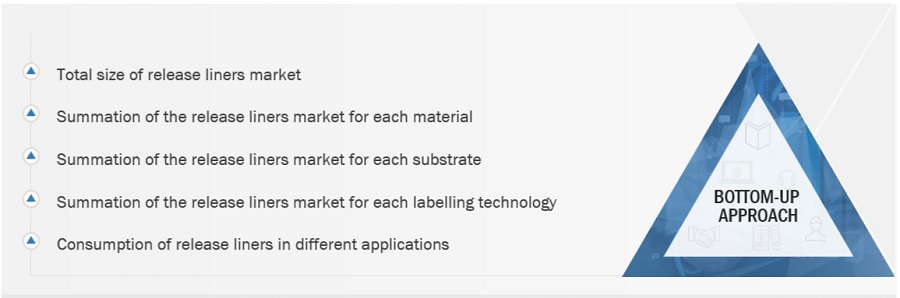
Both the top-down and bottom-up approaches were used to estimate and validate the size of the global release liners market. These approaches were also used extensively to estimate the size of various segments of the market. The research methodology used to estimate the market size included the following details:
- The key players in the industry were identified through extensive secondary research.
- The supply chain of the industry and market size, in terms of value, were determined through primary and secondary research.
- All percentage share splits and breakdowns were determined using secondary sources and verified through primary sources.
- All possible parameters that affect the markets covered in this research study were accounted for, viewed in extensive detail, verified through primary research, and analyzed to obtain the final quantitative and qualitative data.
- The research includes the study of reports, reviews, and newsletters of key industry players, along with extensive interviews with key officials, such as directors and marketing executives.
To know about the assumptions considered for the study, Request for Free Sample Report

Data Triangulation
After arriving at the overall market size from the estimation process explained above, the total market was split into several segments and sub-segments. The data triangulation and market breakdown procedures were employed, wherever applicable, to complete the overall market engineering process and arrive at the exact statistics for all the segments and sub-segments of the release liners market. The data was triangulated by studying various factors and trends from both the demand- and supply-side.
In addition, the market size was validated by using both the top-down and bottom-up approaches. Then, it was verified through primary interviews. Hence, for every data segment, there are three sources—top-down approach, bottom-up approach, and expert interviews. The data were assumed to be correct when the values arrived at from the three sources matched.
Market Definition
A release liner is a film sheet made from paper or plastic that prevents adhesives from sticking prematurely to a surface. This liner is coated on one or both sides with a release agent, like silicone, which allows it to separate easily from sticky materials such as adhesives or mastics. Release liners are crucial in various industries, including labels, tapes, medical applications, industrial coatings, and food packaging They act as a protective.barrier, ensuring that the adhesive remains effective until it is ready for use.
Release liners come in different colors and may feature printing on the back side. They are manufactured using non-migratory materials like polyacrylates, carbamates, polyolefins, fluorocarbons, and silicones, which prevent contamination of the surface they protect. The market offers a variety of substrate materials, including paper-based liners (such as Glassine/Calendered Kraft Paper, Polyolefin Coated Paper, and Clay Coated Paper) and film-based liners (like polyethylene, polypropylene, and polyester).
Key Stakeholders
- Release liners manufacturers
- Release liners traders, distributors, and suppliers
- End-use industry participants of different segments
- Government and research organizations
- Associations and industrial bodies
- Research and consulting firms
- R&D institutions
- Environment support agencies
- Investment banks and private equity firms
Report Objectives
- To define, analyze, and project the size of the release liners market in terms of value based on type, application and region.
- To project the size of the market and its segments with respect to the five main regions, namely, North America, Europe, Asia Pacific, Middle East & Africa, and South America
- To provide detailed information about the key factors, such as drivers, restraints, opportunities, and challenges, influencing the growth of the market
- To analyze the opportunities in the market for stakeholders and provide a detailed competitive landscape of the market leaders.
- To analyze the competitive developments, such as new product launches, expansions, and acquisitions, in the release liners market
- To strategically profile the key players operating in the market and comprehensively analyze their market shares and core competencies.
Available Customizations
Along with the given market data, MarketsandMarkets offers customizations as per the specific needs of the companies. The following customization options are available for the report:
Product Analysis:
- Product Matrix which gives a detailed comparison of the product portfolio of each company
Regional Analysis:
- Further breakdown of the Rest of Asia Pacific market
- Further breakdown of Rest of Europe market
Company Information:
- Detailed analysis and profiling of additional market players (up to 5)
Get the Full Release Liners Market Report
Full forecast, segment splits, and company analysis for all Release Liners Market.
- China Release Liners Market
- India Release Liners Market
- Japan Release Liners Market
- South Korea Release Liners Market
- Taiwan Release Liners Market
- Indonesia Release Liners Market
- Malaysia Release Liners Market
- Canada Release Liners Market
- Mexico Release Liners Market
- US Release Liners Market
- Germany Release Liners Market
- France Release Liners Market
- UK Release Liners Market
- Italy Release Liners Market
- Russia Release Liners Market
- Brazil Release Liners Market
- Argentina Release Liners Market
- Rest Of Europe Release Liners Market
- Rest Of Asia Pacific Release Liners Market
- GCC Countries Release Liners Market
- -Rest Of GCC Countries Release Liners Market
- Rest Of South America Release Liners Market
Need a Tailored Report?
Customize this report to your needs
Get 10% FREE Customization
Customize This Report
