
Europe RFID Market (2025-2030)

The Europe RFID Market was valued at $3643.9 Million in 2025 and projected to reach to $6879.3 Million by 2030, representing a compound annual growth rate of 7.3%. Europe's RFID market is positioned for robust growth, expanding from $3,643.9 million in 2025 to $6,879.3 million by 2030 at a 7.3% CAGR.


| Market Size in | USD 26.32 MN |
| Market Forecast in | |
| CAGR | |
| Forecast Period | |
| Units Considered | Value (USD MN) |
Europe RFID Market Trends and Insights
- This growth trajectory reflects Europe's strong adoption of RFID technology across retail, logistics, healthcare, and manufacturing sectors, driven by regulatory compliance requirements and digital transformation initiatives.
- Europe's mature infrastructure and emphasis on supply chain transparency position the region as a key driver of RFID innovation and deployment. The European RFID market benefits from stringent data protection regulations, including GDPR, which encourage organizations to implement secure identification and tracking solutions.
- Between 2025 and 2030, Europe is expected to see increased investment in IoT-enabled RFID systems and enterprise-level applications.
- Europe's competitive landscape includes both established semiconductor manufacturers and emerging technology providers focused on delivering cost-effective and interoperable RFID solutions tailored to regional market needs..
Key Market Statistics
- CAGR (2025-2030) 7.3% CAGR
- Market Size, 2025 ~USD 3643.9 Million
- Forecast, 2030 ~USD 6879.3 Million
- Geography Europe
Europe RFID Market Overview
Regulatory Compliance Driver :
Europe's stringent GDPR and product traceability regulations are accelerating RFID adoption across retail, pharmaceuticals, and food & beverage sectors, creating sustained demand for compliant tracking solutions.
Retail & Logistics Leadership :
Major European retailers and 3PL providers are investing heavily in RFID-enabled inventory management and supply chain visibility, with adoption rates significantly outpacing global averages in Western Europe.
Healthcare & Pharma Expansion :
European healthcare systems are deploying RFID for asset tracking, patient safety, and anti-counterfeiting measures, particularly in Germany, UK, and France, driving sector-specific growth.
Digital Transformation Investment :
EU digital transformation initiatives and Industry 4.0 programs are fueling RFID integration in manufacturing and smart logistics networks across Central and Northern Europe.
Europe RFID Market Dynamics
- This growth is underpinned by mandatory compliance frameworks, increasing e-commerce logistics demands, and widespread digital infrastructure investments across EU member states. Key growth catalysts include pharmaceutical track-and-trace mandates, retail omnichannel optimization, and smart manufacturing adoption.
- Western Europe leads in market maturity, while Central and Eastern European markets present emerging opportunities.
- The region's focus on sustainability and supply chain transparency will continue driving RFID technology adoption through 2030..
Market Ecosystem
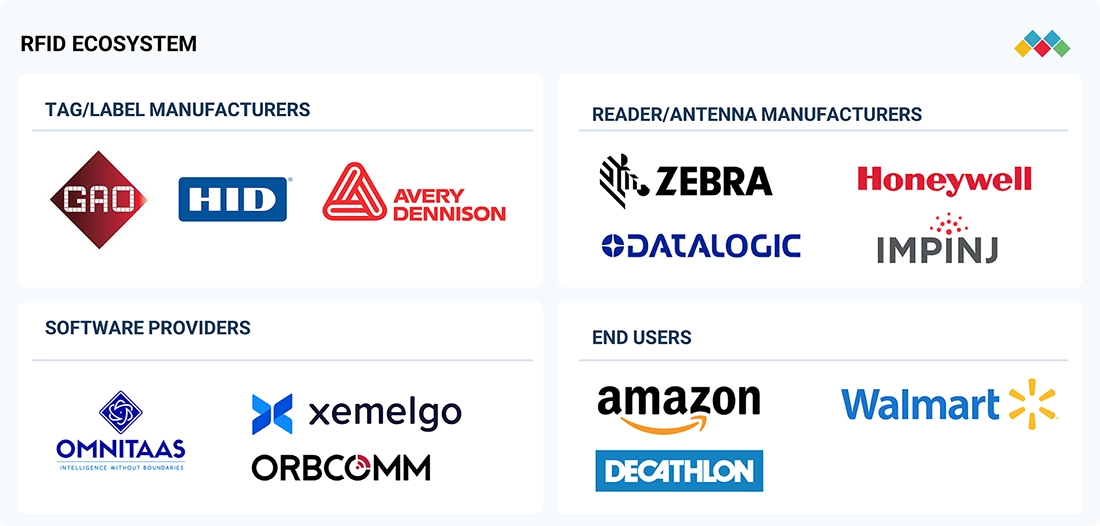
RFID MARKET SIZE, SHARE, TRENDS AND GROWTH ANALYSIS: COMMERCIAL USE CASES ACROSS INDUSTRIES
| COMPANY | USE CASE DESCRIPTION | BENEFITS |
|---|---|---|
 |
Deployment of enterprise-grade RFID readers, printers, and mobile devices for item-level inventory tracking in retail stores and distribution centers | Improved inventory accuracy | Faster cycle counts | Reduced stockouts and shrinkage |
 |
Large-scale deployment of RFID labels and inlays for supply chain visibility, apparel tagging, and logistics tracking. |
Scalable item-level traceability | Lower manual scanning effort | Enhanced supply chain transparency |
|
|
Implementation of Premise-on-Cloud AI-driven RFID platform for unified Asset and Manufacturing Intelligence & Collaboration, providing real-time Work-in-Process (WIP) and lifecycle monitoring. | Achieves 99.9% data accuracy from sensor to cloud via AI-powered phantom read filtering | Delivers a 30x reduction in stock-take time and an 18% decrease in WIP bottlenecks | Enables Industry 5.0 collaboration through mobile-first visibility and automated predictive alerts | Redefines SCM by enabling real-time "Shop-floor to Shop-floor" visibility across external partners. |
 |
Use of RAIN RFID tag chips and reader ICs for high-volume retail, logistics, and asset tracking applications | Long read range | High tag-read accuracy | Cost-efficient mass deployment |
 |
Deployment of HF and NFC-based RFID solutions for secure access control, identification, and authentication systems | Enhanced security | Reliable identity management | Reduced fraud and unauthorized access |
 |
Implementation of cloud-based RFID software for real-time work-in-progress, asset visibility, and manufacturing intelligence | Real-time operational visibility | Improved asset utilization | Data-driven decision-making |
Logos and trademarks shown above are the property of their respective owners. Their use here is for informational and illustrative purposes only.
Related Ecosystem
Key Takeaways
- Europe's RFID market is valued at $3,643.9 million in 2025 and is projected to reach $6,879.3 million by 2030, growing at a 7.3% CAGR.
- Regulatory compliance and GDPR requirements are primary drivers of RFID adoption across Europe's retail, logistics, and healthcare sectors.
- Europe's emphasis on supply chain transparency and digital transformation is accelerating investment in IoT-enabled RFID systems through 2030.
- The European RFID market is characterized by competition between established semiconductor players and innovative technology providers offering region-specific solutions.
RFID Market Report Scope
| Report Metric | Details |
|---|---|
| Base Year | 2025 |
| Fastest Growing Segment | ULTRA-HIGH (Frequency Range) |
| Forecast Period | 2025–2030 |
| Growth Rate | CAGR of 8.5% from 2025 to 2030 |
| Largest Segment | TAGS (Offering) |
| Market Size Base Year (Billions) | ~USD 14.62 (2025) |
| Revenue Forecast (Billions) | ~USD 21.99 (2030) |
| Segments Covered | Offering, Type, Frequency Range, End Use, Form Factor |
Europe RFID Market Report Segmentation
5 segment dimensions are covered across the global market.
By Offering
- Readers
- Software & Services
- Tags
By Type
- Active
- Passive
By Frequency Range
- High
- Low
- Ultra-High
By End Use
- Aerospace & Defense
- Agriculture
- Animal Tracking
- Automotive
- Data Center
- Industrial & Manufacturing
- Medical, Healthcare & Pharmaceutical
- Retail
- Sports, Events, & People Tracking
- Transportation, Logistics & Warehousing
By Form Factor
- Cards
- Key Fobs & Tokens
- Labels
- Other Form Factors
- Papers & Inlays
- Sensor-Based Tags
Target Audience
- RFID Solution Providers : Manufacturers and vendors need Europe-specific market data to develop localized product strategies, identify regulatory requirements, and prioritize regional expansion investments.
- Retail & E-Commerce Enterprises : European retailers require insights into RFID adoption benchmarks, ROI metrics, and best practices to optimize inventory management and omnichannel logistics operations.
- Logistics & Supply Chain Operators : 3PLs and logistics companies need competitive intelligence on RFID technology adoption, compliance mandates, and efficiency gains to enhance service offerings across Europe.
- Healthcare & Pharmaceutical Organizations : European healthcare systems and pharma companies need data on RFID deployment for asset tracking, anti-counterfeiting, and regulatory compliance to support digital transformation initiatives.
- Private Equity & Strategic Investors : Investment firms evaluating European RFID market opportunities require detailed market sizing, growth drivers, competitive dynamics, and sector-specific investment thesis validation.
Key Companies in the Europe RFID Market
| Company | HQ | Ownership | Strongest segments |
|---|---|---|---|
| ROCKWELL AUTOMATION INC | United States | Public Company | Intelligent Devices,Software & Control,Lifecycle Services, |
| SYNNEX CORPORATION | United States | Public Company | Endpoint solutions (PCs, peripherals, mobile, printers, supplies),Advanced solutions (data center, hybrid cloud, security, storage, networking, servers, converged/hyper-converged, hyperscale),Cloud and X-as-a-service aggregation, |
| NOVANTA, INC | United States | Public Company | Precision Medicine and Manufacturing (lasers, motion, robotics tooling, spindles),Medical Insufflators, Pumps, and Disposables,Imaging, Identification, and RFID Solutions, |
| PCTEL, INC. | United States | Private Company | Precision antennas,Industrial IoT devices,RF test and measurement, |
| ZEBRA TECHNOLOGIES CORP. | United States | Public Company | Printers & Supplies (labels, wristbands, cards, RFID tags),Mobile Computing & Accessories,Scanning, Machine Vision & Fixed Industrial, |
| HONEYWELL INTERNATIONAL INC. | United States | Public Company | Industrial Automation,Building Automation,Energy and Sustainability Solutions (UOP and related), |
| AVERY DENNISON CORPORATION | United States | Public Company | Pressure-sensitive label materials,Graphics and reflective products,Branding and information solutions (incl. RFID, Vestcom, brand embellishments), |
| DATALOGIC S.P.A. | Italy | Public Company | Fixed retail and industrial scanners,Handheld scanners (general duty and industrial),Mobile computers and wearable devices, |
| IMPINJ, INC. | United States | Public Company | Endpoint ICs,Systems products (reader ICs, readers, gateways),Software and platform, |
| ALIEN TECHNOLOGY, LLC | United States | Private Company | UHF inlays, tags, and labels,RFID chips,Readers and antennas, |
| INVENGO INFORMATION TECHNOLOGY CO., LTD. | China | Public Company | Smart railway RFID and transportation solutions,Smart public library, education, and culture RFID,Apparel retail and unmanned store solutions, |
| CHECKPOINT SYSTEMS, INC. | United States | Private Company | Merchandise Availability Solutions (EAS, Alpha, RFID visibility),Apparel Labeling Solutions,Security Labels and Tagging Solutions, |
ROCKWELL AUTOMATION INC
Rockwell Automation Inc. is a public company founded in 1903 in the United States with 26,000 employees, specializing in industrial automation and information technology solutions.
SYNNEX CORPORATION
Synnex Corporation is a public company founded in 1980 in the United States with 24,000 employees, providing IT distribution and services.
NOVANTA, INC
Novanta, Inc. is a public company founded in 1968 in the United States with 3,000 employees, specializing in photonics and motion control technologies.
PCTEL, INC.
PCTEL, Inc. is a private company founded in 1994 in the United States with 213 employees, providing wireless network testing and optimization solutions.
ZEBRA TECHNOLOGIES CORP.
Zebra Technologies Corp. is a public company founded in 1969 in the United States with 10,700 employees, specializing in barcode, RFID, and mobile computing solutions.
HONEYWELL INTERNATIONAL INC.
Honeywell International Inc. is a public company founded in 1885 in the United States with 101,000 employees, operating across aerospace, building technologies, and industrial automation sectors.
AVERY DENNISON CORPORATION
Avery Dennison Corporation is a public company founded in 1935 in the United States with 35,000 employees, specializing in labeling and packaging materials and solutions.
DATALOGIC S.P.A.
Datalogic S.p.A. is a public company founded in 1972 in Italy with 2,628 employees, specializing in automatic data capture and factory automation solutions.
IMPINJ, INC.
Impinj, Inc. is a public company founded in 2000 in the United States with 457 employees, providing RFID connectivity solutions and services.
ALIEN TECHNOLOGY, LLC
Alien Technology, LLC is a private company founded in 1994 in the United States with 241 employees, specializing in RFID inlay and tag manufacturing.
INVENGO INFORMATION TECHNOLOGY CO., LTD.
Invengo Information Technology Co., Ltd. is a public company founded in 1993 in China with 651 employees, specializing in RFID and IoT solutions.
CHECKPOINT SYSTEMS, INC.
Checkpoint Systems, Inc. is a private company founded in 1969 in the United States with 4,814 employees, providing retail security and inventory management solutions.
Countries within Europe - compare and drill down
| Country | 2025 size (native) |
|---|
Country market size visualization
Reasons to Buy this Report
- Regulatory Compliance Insights : Understand how GDPR, anti-counterfeiting directives, and EU traceability mandates are shaping RFID investment priorities across European enterprises and sectors.
- Regional Market Segmentation : Access detailed breakdowns by country and sub-region (Western, Central, Eastern Europe) to identify high-growth markets and localized adoption patterns.
- Sector-Specific Opportunity Analysis : Gain competitive intelligence on RFID deployment trends in European retail, logistics, healthcare, manufacturing, and pharma to inform go-to-market strategies.
- Competitive Landscape Mapping : Identify leading RFID solution providers, technology trends, and partnership opportunities specific to the European market through 2030.
- Investment & Expansion Planning : Leverage accurate market sizing, growth forecasts, and trend analysis to support business case development and resource allocation for European market entry or expansion.
Frequently asked questions
What is the current size of Europe's RFID market in 2025?
Europe's RFID market is valued at $3,643.9 million in 2025, with expectations to grow significantly through the forecast period.
What is the projected size of Europe's RFID market by 2030?
Europe's RFID market is forecast to reach $6,879.3 million by 2030, representing nearly 89% growth from 2025 levels.
What is the CAGR for Europe's RFID market from 2025 to 2030?
Europe's RFID market is expected to grow at a compound annual growth rate of 7.3% between 2025 and 2030.
Which industries are driving RFID adoption in Europe?
Retail, logistics, healthcare, and manufacturing sectors are the primary drivers of RFID adoption in Europe, supported by regulatory compliance and supply chain optimization needs.
How does GDPR impact Europe's RFID market growth?
GDPR and other stringent data protection regulations encourage European organizations to adopt secure RFID solutions for identification and tracking, supporting market expansion.
RESEARCH METHODOLOGY
The research study involved 4 major activities in estimating the size of the RFID market. Exhaustive secondary research has been done to collect important information about the market and peer markets. The validation of these findings, assumptions, and sizing with the help of primary research with industry experts across the value chain has been the next step. Both top-down and bottom-up approaches have been used to estimate the market size. Post which the market breakdown and data triangulation have been adopted to estimate the market sizes of segments and sub-segments.
Secondary Research
In the secondary research process, various secondary sources have been referred to for identifying and collecting information required for this study. The secondary sources include annual reports, press releases, investor presentations of companies, white papers, and articles from recognized authors. Secondary research has been mainly done to obtain key information about the market’s value chain, the pool of key market players, market segmentation according to industry trends, regional outlook, and developments from both market and technology perspectives.
In the RFID market report, the global market size has been estimated using both the top-down and bottom-up approaches, along with several other dependent submarkets. The major players in the market were identified using extensive secondary research, and their presence in the market was determined using secondary and primary research. All the percentage shares splits, and breakdowns have been determined using secondary sources and verified through primary sources.
Primary Research
Extensive primary research has been conducted after understanding the RFID market scenario through secondary research. Several primary interviews have been conducted with key opinion leaders from both demand- and supply-side vendors across 4 major regions—North America, Europe, Asia Pacific, and Rest of the World. Approximately 25% of the primary interviews have been conducted with the demand-side vendors and 75% with the supply-side vendors. Primary data has been collected mainly through telephonic interviews, which consist of 80% of the total primary interviews; questionnaires and emails have also been used to collect the data.
After successful interaction with industry experts, brief sessions were conducted with highly experienced independent consultants to reinforce the findings of our primary research. This, along with the in-house subject matter experts’ opinions, has led us to the findings as described in the report.
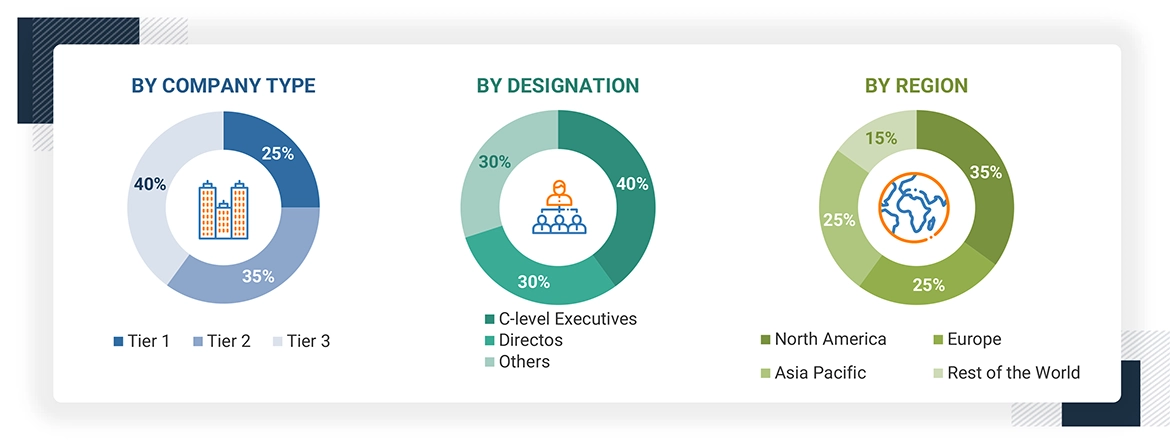
Note: “Others” includes sales, marketing, and product managers
To know about the assumptions considered for the study, download the pdf brochure
Market Size Estimation
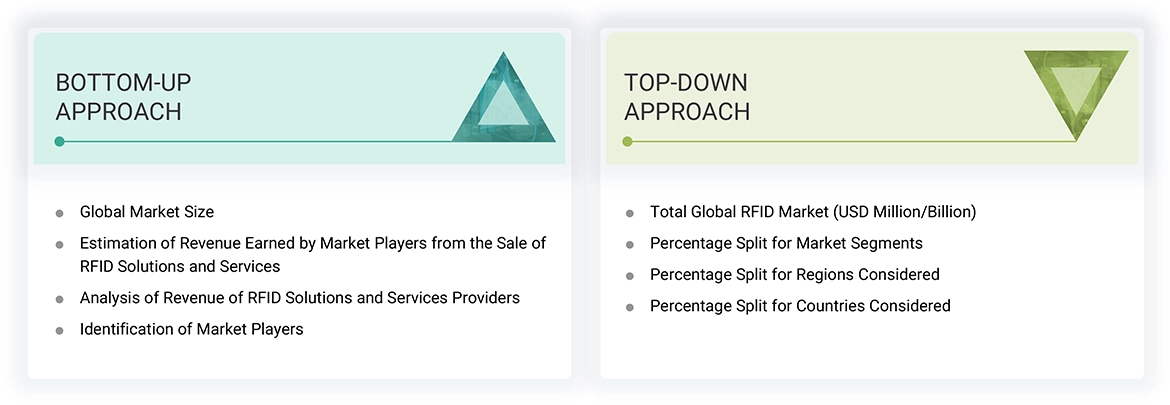
In the market engineering process, both top-down and bottom-up approaches, along with data triangulation methods, have been used to estimate and validate the size of the RFID solutions and services and other dependent submarkets. The research methodology used to estimate the market sizes includes the following:
- Identifying top-line investments and spending in the ecosystem and considering segment-level splits and major market developments
- Identifying different stakeholders in the RFID market that influence the entire market, along with participants across the supply chain
- Analyzing major manufacturers and service providers in the RFID market and studying their solutions
- Analyzing trends related to the adoption of RFID
- Tracking recent and upcoming market developments, including investments, R&D activities, product launches, expansions, collaborations, acquisitions, and partnerships, as well as forecasting the market size based on these developments and other critical parameters
- Carrying out multiple discussions with key opinion leaders to identify the adoption trends of RFID solutions and services
- Segmenting the overall market into various other market segments
- Validating the estimates at every level through discussions with key opinion leaders, such as chief executives (CXOs), directors, and operation managers, and finally with the domain experts at MarketsandMarkets
RFID Market : Top-Down and Bottom-Up Approach
Data Triangulation
After arriving at the overall market size by the market size estimation process explained in the earlier section, the overall RFID market has been divided into several segments and subsegments. To complete the overall market engineering process and arrive at the exact statistics for all segments, the data triangulation and market breakdown procedures have been used, wherever applicable. The data has been triangulated by studying various factors and trends from both the demand and supply side perspectives. Along with data triangulation and market breakdown, the market has been validated by top-down and bottom-up approaches.
Market Definition
Radio Frequency Identification (RFID) is a technology that uses electromagnetic fields to automatically identify and track tags attached to objects. The tags contain electronically stored information and are either active, powered by a battery, or passive, by the signal of the RFID reader. There are three main parts of an RFID system: a tag, a reader, and a software system for data processing. This technology allows for efficient collection and management of data, greatly reducing human effort and error. RFID technology is applied in many industries, such as retail, logistics & warehousing, healthcare, aerospace & defense, and automotive. In retail, it is used in managing the inventory, preventing theft, and optimizing the supply chain. It enhances tracking and tracing in the logistics sector. In the healthcare sector, it is applied in patient tracking, equipment management, and drug authentication. The growth in the RFID market is heavily dependent on factors like automation, real-time data visibility, and upgrading the tracking system. The key benefits associated with it include tiny size for RFID tags, maximum range of reading, IoT-based, and cloud integration. In the near future, further research and development about the technology are expected to explore new applications and strengthen RFID technology in modern industrial as well as commercial practices.
Key Stakeholders
- Raw Material Supplier
- RFID Chip Manufacturers
- Tag, Readers, and Label Manufacturers
- System Integrators
- Software Developers
- Platform Providers
- Distributors and Resellers
- Consultants and Service Providers
- Regulatory Bodies
- Research and Development Institutes
- End Users
Report Objectives
- To define, describe, and forecast the size of the RFID market, by offering, tag type, form factor, frequency, material, wafer size, application, vertical, and region, in terms of value
- To forecast the market for tag type, in terms of volume
- To forecast the size of various segments with respect to four regions, namely, North America, Asia Pacific, Europe, and Rest of the World (Middle East & Africa and South America)
- To identify and analyze key drivers, restraints, opportunities, and challenges influencing the growth of the RFID market
- To study the value chain and related industry segments of the market
- To strategically analyze the micromarkets concerning individual growth trends, prospects, and contributions to the overall market
- To assess the trends and disruptions impacting customers’ businesses’ pricing trends, patents and innovations, trade data, regulatory landscape, Porter’s five forces, case studies, key stakeholders and buying criteria, technology trends, market ecosystem, key conferences and events, and impact of AI/Gen AI related to the RFID market
- To analyze opportunities for various stakeholders by identifying the high-growth segments of the market
- To strategically profile the key players and comprehensively analyze their market position in terms of revenue, market share, and core competencies, along with detailing the competitive landscape for the market leaders
- To analyze competitive developments such as product launches, acquisitions, partnerships, collaborations, and expansions carried out by players in the RFID market
Available Customizations
With the given market data, MarketsandMarkets offers customizations according to the specific requirements of companies. The following customization options are available for the report:
Country-wise Information:
- Country-wise breakdown for North America, Europe, Asia Pacific, and Rest of the World
Company Information:
- o Detailed analysis and profiling of additional market players (up to five)
Get the Full RFID Market Report
Full forecast, segment splits, and company analysis for all RFID Market.
Need a Tailored Report?
Customize this report to your needs
Get 10% FREE Customization
Customize This Report
