
Mexico Rice Husk Ash Market (2023-2028)

The Mexico Rice Husk Ash Market was valued at $11.7 Million in 2023 and projected to reach to $13.2 Million by 2028, representing a compound annual growth rate of CAGR 2.5%. Mexico's rice husk ash market is poised for moderate but stable growth through 2028, driven by increasing sustainability initiatives in construction and packaging industries.


| Market Size in | USD 26.32 MN |
| Market Forecast in | |
| CAGR | |
| Forecast Period | |
| Units Considered | Value (USD MN) |
Mexico Rice Husk Ash Market Trends and Insights
- In Mexico, rice husk ash adoption is driven by increasing demand from the construction and packaging sectors, where the material serves as a sustainable filler and pozzolanic additive.
- Mexico's agricultural base and proximity to rice processing facilities position the country as a potential hub for rice husk ash utilization across industrial applications. The Mexican market reflects moderate but steady growth, with construction applications leading demand as Mexico continues infrastructure development and modernization initiatives.
- Mexico's rice husk ash market benefits from growing environmental awareness and regulatory pressure to adopt sustainable materials in packaging and concrete production.
- By 2028, Mexico is expected to see expanded adoption in mining operations and specialty gas applications, supported by industrial diversification and circular economy initiatives..
Key Market Statistics
- CAGR (2023-2028) CAGR 2.5%
- Market Size, 2023 ~USD 11.7 Million
- Forecast, 2028 ~USD 13.2 Million
- Country Mexico
Mexico Rice Husk Ash Market Overview
Market Valuation :
Mexico's rice husk ash market reached USD 11.7 million in 2023, with steady growth projected to USD 13.2 million by 2028, reflecting consistent demand across construction and packaging applications.
Agricultural Advantage :
Mexico's robust agricultural sector provides a reliable domestic supply of rice husks, positioning the country as a cost-effective hub for rice husk ash production and reducing import dependency.
Construction Sector Growth :
Increasing adoption of sustainable building materials in Mexico's construction industry drives demand for rice husk ash as a pozzolanic additive in concrete and cement formulations.
Packaging Innovation :
Mexican packaging manufacturers are integrating rice husk ash as an eco-friendly filler, responding to growing consumer demand for sustainable and biodegradable packaging solutions.
Mexico Rice Husk Ash Market Dynamics
- The country's agricultural foundation ensures consistent raw material availability, while infrastructure development projects continue to boost demand for pozzolanic additives in concrete applications.
- Regional proximity to North American markets presents export opportunities for Mexican producers. Government incentives for green building practices and circular economy initiatives are expected to accelerate adoption rates.
- However, growth remains tempered compared to global markets due to competition from alternative materials and limited awareness among smaller manufacturers.
- Strategic investments in processing infrastructure and industry partnerships will be critical for capturing emerging opportunities in Mexico's evolving construction landscape..
Market Ecosystem
Related Ecosystem
Speciality Chemicals
- Corrosion Inhibitors
- Polyetheretherketone (PEEK)
- Acrylonitrile Butadiene Styrene (ABS)
- Epoxy Resin
- Polycarbonate
- Basf se
- DOW CHEMICAL COMPANY
- Evonik industries ag
- Clariant ag.
- Solvay sa
Building And Construction
- HVAC System
- Acoustic Insulation
- Alkyd Resins
- Fiberglass
- Thermal Insulation
- Snc-lavalin group inc.
- Saint-gobain
- LHOIST S.A
- USG CORPORATION
- Basf se
Key Takeaways
- Mexico's rice husk ash market is valued at USD 11.7 million in 2023 and will reach USD 13.2 million by 2028 at a 2.5% CAGR.
- Construction remains the dominant end-use sector in Mexico, driven by ongoing infrastructure projects and sustainable building material adoption.
- Mexico's agricultural infrastructure and rice processing capacity provide a competitive advantage for rice husk ash production and supply chain development.
- Environmental regulations and circular economy policies in Mexico are accelerating demand for rice husk ash as a sustainable alternative to conventional materials.
Rice Husk Ash Market Report Scope
| Report Metric | Details |
|---|---|
| Base Year | 2023 |
| Fastest Growing Segment | GENETICALLY MODIFIED (Type) |
| Forecast Period | 2023-2028 |
| Growth Rate | CAGR of 4.5% from 2023 to 2028 |
| Largest Segment | GENETICALLY MODIFIED (Type) |
| Market Size Base Year (Billions) | ~USD 2.57 (2023) |
| Revenue Forecast (Billions) | ~USD 3.2 (2028) |
| Segments Covered | Application, Silica Content, Type |
Mexico Rice Husk Ash Market Report Segmentation
3 segment dimensions are covered across the global market.
By Application
- Building & Construction
- Ceramics & Refractory
- Other Applications
- Rubber
- Silica
- Steel
By Silica Content
- 80-84%
- 85-89%
- 90-94%
- More Than Or Equal To 95%
By Type
- Conventional
- Genetically Modified
Target Audience
- Construction Material Suppliers : Need Mexico-specific demand forecasts and sector trends to align inventory, pricing, and distribution strategies with local construction industry growth.
- Packaging Manufacturers : Require insights into sustainable filler adoption rates and consumer preferences in Mexico to develop eco-friendly product lines and meet market expectations.
- Agricultural Processors : Seek market validation and demand projections for rice husk ash production in Mexico to justify investments in processing infrastructure and capacity expansion.
- Investment & Private Equity Firms : Need comprehensive Mexico market data and growth forecasts to evaluate investment opportunities in rice husk ash production and distribution ventures.
- Government & Policy Makers : Require market intelligence on sustainable material adoption and economic impact to inform circular economy policies and green building incentive programs in Mexico.
Reasons to Buy this Report
- Localized Market Intelligence : Gain country-specific insights into Mexico's rice husk ash demand drivers, competitive landscape, and growth opportunities unavailable in global market reports.
- Supply Chain Optimization : Understand Mexico's agricultural supply dynamics and production capacity to optimize sourcing strategies and identify cost-effective procurement opportunities.
- Sector-Specific Strategies : Access detailed analysis of construction and packaging sector adoption patterns in Mexico to tailor product development and market entry strategies.
- Regulatory & Policy Insights : Stay informed on Mexico's sustainability regulations, green building standards, and government incentives shaping market growth and investment opportunities.
- Competitive Positioning : Identify key players, market gaps, and differentiation opportunities specific to Mexico's rice husk ash market to strengthen competitive advantage.
Frequently asked questions
What is the current market size of rice husk ash in Mexico?
Mexico's rice husk ash market was valued at USD 11.7 million in 2023 and is expected to grow to USD 13.2 million by 2028.
What is the projected growth rate for rice husk ash in Mexico?
Mexico's rice husk ash market is projected to grow at a compound annual growth rate (CAGR) of 2.5% from 2023 to 2028.
Which industries drive rice husk ash demand in Mexico?
In Mexico, the primary demand drivers are construction, packaging, mining, and specialty gas applications, with construction being the largest segment.
Why is Mexico positioned for rice husk ash market growth?
Mexico benefits from its agricultural base, rice processing infrastructure, and increasing adoption of sustainable materials driven by environmental regulations and infrastructure development.
What factors support rice husk ash adoption in Mexico?
Key factors include circular economy initiatives, environmental compliance requirements, infrastructure modernization, and the availability of rice processing byproducts across Mexico's agricultural regions.
RESEARCH METHODOLOGY
The study involved four major activities in estimating the current size of the rice husk ash market. Exhaustive secondary research was done to collect information on the market, peer markets, and parent market. The next step was to validate these findings, assumptions, and sizing with the industry experts across the Rice Husk Ash market value chain through primary research. Both top-down and bottom-up approaches were employed to estimate the complete market size. Thereafter, market breakdown and data triangulation were used to estimate the market size of segments and subsegments.
Secondary Research
Secondary sources for this research study include annual reports, press releases, and investor presentations of companies; white papers; certified publications; and articles by recognized authors; gold- and silver-standard websites; Rice Husk Ash market manufacturing companies, regulatory bodies, trade directories, and databases. The secondary research was mainly used to obtain key information about the industry’s supply chain, the total pool of key players, market classification, and segmentation according to industry trends to the bottom-most level and regional markets. It has also been used to obtain information about key developments from a market-oriented perspective.
Primary Research
The rice husk ash market comprises several stakeholders, such as such as raw material suppliers, technology support providers, rice husk ash market manufacturers, and regulatory organizations in the supply chain. Various primary sources from both the supply and demand sides of the market were interviewed to obtain qualitative and quantitative information. Primary sources from the supply side included industry experts such as Chief Executive Officers (CEOs), vice presidents, marketing directors, technology and innovation directors, and related key executives from various key companies and organizations operating in the rice husk ash market. Primary sources from the demand side included directors, marketing heads, and purchase managers from various sourcing industries. Following is the breakdown of the primary respondents:
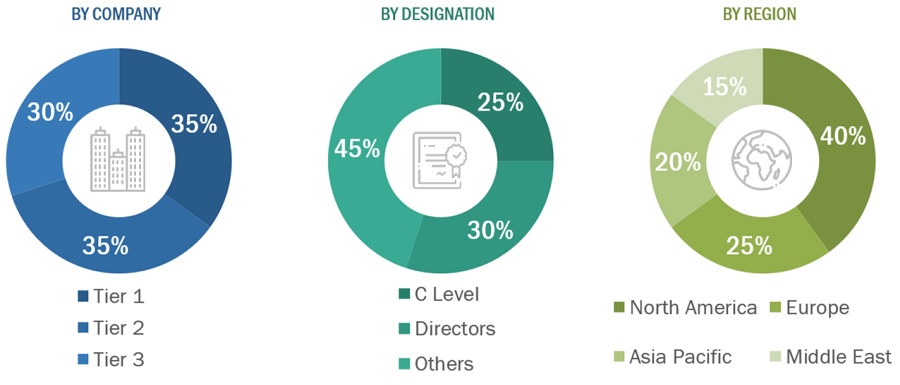
To know about the assumptions considered for the study, download the pdf brochure
Market Size Estimation
Both the top-down and bottom-up approaches have been used to estimate and validate the total size of the Rice Husk Ash market market. These approaches have also been used extensively to estimate the size of various dependent subsegments of the market. The research methodology used to estimate the market size included the following:
The following segments provide details about the overall market size estimation process employed in this study
- The key players in the market were identified through secondary research.
- The market shares in the respective regions were identified through primary and secondary research.
- The value chain and market size of the Rice Husk Ash market market, in terms of value, were determined through primary and secondary research.
- All percentage shares, splits, and breakdowns were determined using secondary sources and verified through primary sources.
- All possible parameters that affect the market covered in this research study were accounted for, viewed in extensive detail, verified through primary research, and analyzed to obtain the final quantitative and qualitative data.
- The research included the study of annual and financial reports of the top market players and interviews with industry experts, such as CEOs, VPs, directors, sales managers, and marketing executives, for key insights, both quantitative and qualitative.
Global Rice Husk Ash market Size: Bottom-Up Approach
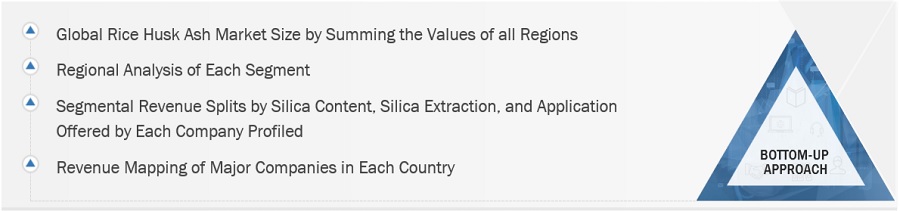
To know about the assumptions considered for the study, Request for Free Sample Report
Global Rice Husk Ash Market Size: Top-Down Approach
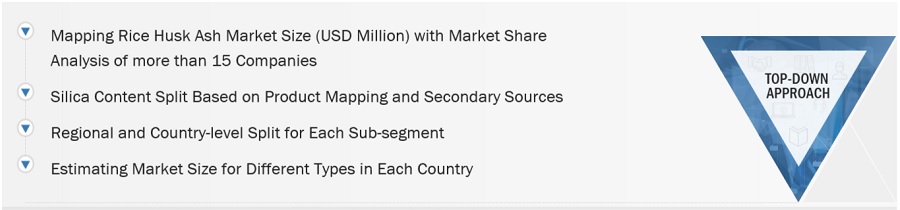
Data Triangulation
After arriving at the overall market size using the market size estimation processes as explained above, the market was split into several segments and sub-segments. To complete the overall market engineering process and arrive at the exact statistics of each market segment and subsegment, the data triangulation and market breakdown procedures were employed, wherever applicable. The data was triangulated by studying various factors and trends from both the demand and supply sides.
Market Definition
Rice husk ash (RHA) is a natural byproduct obtained from paddy rice during the rice husk processing phase. This husk is characterized by its composition, consisting of approximately 50% cellulose, 30% lignin, and 20% silica. Through a controlled thermal decomposition process, the husk is burned, transforming it into ash that predominantly comprises amorphous silica, ranging between 89-95%. During controlled thermal decomposition, the ash undergoes a transformation, turning into a highly pozzolanic material with an exceptionally large external surface relative to its weight.
Key Stakeholders
- Raw material manufacturers
- Technology support providers
- Manufacturers of Rice Husk Ash market
- Traders, distributors, and suppliers
- Regulatory Bodies and Government Agencies
- Research & Development (R&D) Institutions
- End-use Industries
- Consulting Firms, Trade Associations, and Industry Bodies
- Investment Banks and Private Equity Firms
Report Objectives
- To analyze and forecast the market size of Rice Husk Ash market in terms of value and volume
- To provide detailed information regarding the major factors (drivers, restraints, challenges, and opportunities) influencing the regional market
- To analyze and forecast the global Rice Husk Ash market on the basis of Product, Silica Content, Application, Process and Region
- To analyze the opportunities in the market for stakeholders and provide details of a competitive landscape for market leaders
- To forecast the size of various market segments based on five major regions: Asia Pacific, Europe, Middle East and Africa, South America and North America along with their respective key countries
- To track and analyze the competitive developments, such as acquisitions, partnerships, collaborations, agreements and expansions in the market
- To strategically profile the key players and comprehensively analyze their market shares and core competencies
Available Customizations
With the given market data, MarketsandMarkets offers customizations according to the client-specific needs.
The following customization options are available for the report:
- Additional country-level analysis of the rice husk ash market
- Profiling of additional market players (up to 5)
Product Analysis
- Product matrix, which gives a detailed comparison of the product portfolio of each company.
Get the Full Rice Husk Ash Market Report
Full forecast, segment splits, and company analysis for all Rice Husk Ash Market.
- China Rice Husk Ash Market
- South Korea Rice Husk Ash Market
- Japan Rice Husk Ash Market
- India Rice Husk Ash Market
- Vietnam Rice Husk Ash Market
- Thailand Rice Husk Ash Market
- Canada Rice Husk Ash Market
- US Rice Husk Ash Market
- Germany Rice Husk Ash Market
- France Rice Husk Ash Market
- UK Rice Husk Ash Market
- Italy Rice Husk Ash Market
- Spain Rice Husk Ash Market
- Russia Rice Husk Ash Market
- Saudi Arabia Rice Husk Ash Market
- UAE Rice Husk Ash Market
- Iran Rice Husk Ash Market
- Brazil Rice Husk Ash Market
- Argentina Rice Husk Ash Market
- Colombia Rice Husk Ash Market
- Rest Of Europe Rice Husk Ash Market
- Rest Of Asia Pacific Rice Husk Ash Market
- Rest Of South America Rice Husk Ash Market
Need a Tailored Report?
Customize this report to your needs
Get 10% FREE Customization
Customize This Report
