
New Zealand Lawn Mower Market (2025-2030)

The New Zealand Lawn Mower Market was valued at $430 Million in 2025 and projected to reach to $570 Million by 2030, representing a compound annual growth rate of 4.1%. New Zealand's lawn mower market is positioned for sustained growth through 2030, driven by rising residential property values and increased investment in landscape maintenance across both urban and rural areas.


| Market Size in | USD 26.32 MN |
| Market Forecast in | |
| CAGR | |
| Forecast Period | |
| Units Considered | Value (USD MN) |
New Zealand Lawn Mower Market Trends and Insights
- This steady expansion reflects New Zealand's strong residential and commercial landscaping sectors, driven by increasing property ownership and maintenance standards across both urban and rural regions.
- New Zealand's market growth is supported by rising consumer preference for efficient, environmentally conscious lawn care equipment and the adoption of advanced technologies in the landscaping industry. The New Zealand lawn mower market benefits from the country's well-developed agricultural infrastructure and growing emphasis on sustainable outdoor maintenance practices.
- Between 2025 and 2030, New Zealand is expected to see increased demand for both traditional and electric lawn mowers as environmental regulations tighten and consumer awareness of carbon footprints rises.
- New Zealand's market dynamics are shaped by local climate conditions, seasonal demand patterns, and the prevalence of residential gardens, positioning the country as a stable growth market within the Asia Pacific region..
Key Market Statistics
- CAGR (2025-2030) 4.1% CAGR
- Market Size, 2025 ~USD 430 Million
- Forecast, 2030 ~USD 570 Million
- Country New Zealand
New Zealand Lawn Mower Market Overview
Market Valuation :
New Zealand's lawn mower market is valued at USD 430 million in 2025, with projections reaching USD 570 million by 2030, demonstrating consistent growth in the residential and commercial landscaping sectors.
Steady Growth Trajectory :
The market exhibits a compound annual growth rate of 4.1%, outpacing broader economic trends and reflecting strong demand for lawn care equipment across New Zealand's diverse geographic regions.
Residential & Commercial Drivers :
Growth is fueled by increasing property ownership rates, rising maintenance standards in urban areas, and expanding commercial landscaping services throughout New Zealand's metropolitan and rural communities.
Regional Market Dynamics :
New Zealand's unique climate and landscape characteristics create distinct demand patterns, with both North and South Islands showing strong adoption of modern lawn mower technologies and sustainable equipment solutions.
New Zealand Lawn Mower Market Dynamics
- The market benefits from New Zealand's strong emphasis on property aesthetics and environmental stewardship, encouraging homeowners and commercial operators to invest in quality lawn care equipment.
- Consumer preference for fuel-efficient and eco-friendly mowers is reshaping product offerings, with manufacturers increasingly focusing on electric and hybrid technologies to meet local sustainability standards.
- Government initiatives promoting green spaces and urban beautification further support market expansion, while the growing trend of outdoor living spaces continues to elevate lawn maintenance priorities among New Zealand households and businesses..
Market Ecosystem
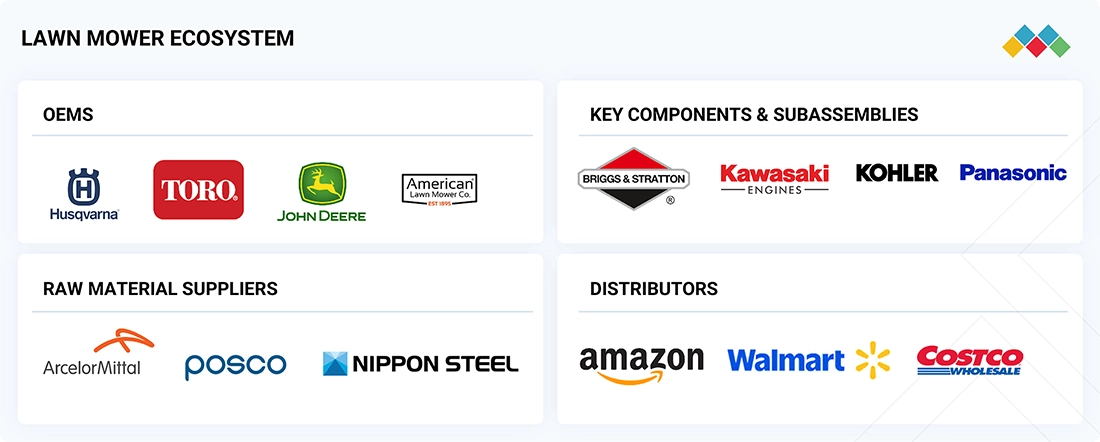
lawn mower market: COMMERCIAL USE CASES ACROSS INDUSTRIES
| COMPANY | USE CASE DESCRIPTION | BENEFITS |
|---|---|---|
 |
Deploying autonomous robotic lawn mowers equipped with GPS navigation, AI-based obstacle detection, and IoT connectivity for residential and commercial landscaping | Enhances mowing precision, reduces labor dependency, supports eco-friendly operations through battery technology, and strengthens Husqvarna’s positioning as a leader in smart outdoor solutions |
 |
Developing IoT-enabled sensors and control modules for robotic lawn mowers, enabling predictive maintenance and remote fleet monitoring | Improves mower efficiency and reliability, strengthens OEM integration, and drives innovation in connected landscaping equipment |
 |
Deploying fleets of electric and robotic mowers across corporate campuses, parks, and sports fields to optimize large-scale grounds maintenance | Reduces labor costs, lowers carbon footprint, improves operational uptime, and enhances service quality for clients |
 |
Providing replacement batteries, smart mower accessories, and servicing support for robotic and electric lawn mowers across its retail and service network | Creates strong aftermarket revenue streams, increases customer loyalty, and extends mower lifecycle through reliable maintenance support |
Logos and trademarks shown above are the property of their respective owners. Their use here is for informational and illustrative purposes only.
Related Ecosystem
Automotive Advance Technologies
- Battery Electric Vehicle (BEV)
- Light Commercial Vehicles (LCVs)
- Fuel Cell Electric Vehicle (FCEV)
- Hybrid Electric Vehicle (HEV)
- Internal Combustion Engine (ICE)
- BOSCH LIMITED
- Continental ag
- Visteon Corporation
- DENSO Corporation
- ZF FRIEDRICHSHAFEN AG
Automotive Electronics And Electrical Equipment
- Battery Electric Vehicle (BEV)
- Light Commercial Vehicles (LCVs)
- Fuel Cell Electric Vehicle (FCEV)
- Sensors
- Hybrid Electric Vehicle (HEV)
- BOSCH LIMITED
- DENSO Corporation
- Continental ag
- Panasonic Holdings Corporation
- Texas Instruments Incorporated
Automotive Systems
- Light Commercial Vehicles (LCVs)
- Battery Electric Vehicle (BEV)
- Hybrid Electric Vehicle (HEV)
- Agricultural Tractors
- Fuel Cell Electric Vehicle (FCEV)
- BOSCH LIMITED
- DENSO Corporation
- Continental ag
- ZF FRIEDRICHSHAFEN AG
- GORKOVSKY AVTOMOBILNY ZAVOD
Key Takeaways
- New Zealand's lawn mower market is valued at USD 430 million in 2025 and will reach USD 570 million by 2030, growing at a 4.1% CAGR.
- New Zealand's market is driven by strong residential property ownership and increasing demand for sustainable landscaping solutions.
- Electric and eco-friendly lawn mowers are gaining traction in New Zealand due to stricter environmental regulations and consumer sustainability preferences.
- New Zealand's seasonal climate and prevalence of residential gardens create consistent demand for lawn care equipment throughout the forecast period.
Lawn Mower Market Report Scope
| Report Metric | Details |
|---|---|
| Base Year | 2025 |
| Fastest Growing Segment | AUTONOMOUS (Autonomy) |
| Forecast Period | 2025–2030 |
| Growth Rate | CAGR of 6.1% from 2025 to 2030 |
| Largest Segment | NON-AUTONOMOUS (Autonomy) |
| Market Size Base Year (Billions) | ~USD 24 (2025) |
| Revenue Forecast (Billions) | ~USD 32.27 (2030) |
| Segments Covered | Type, Propulsion, Autonomy, Lawn Size, End User, Component |
New Zealand Lawn Mower Market Report Segmentation
6 segment dimensions are covered across the global market.
By Type
- Riding Lawn Mowers
- Robotic Lawn Mowers
- Walk-Behind Lawn Mowers
By Propulsion
- Electric
- ICE
By Autonomy
- Autonomous
- Non-Autonomous
By Lawn Size
- Large
- Medium
- Small
By End User
- Commercial
- Residential
By Component
- Batteries
- Blade Motors
- Lift Sensors
- Microcontrollers
- Tilt Sensors
- Ultrasonic Sensors
- Wheel Motors
Target Audience
- Lawn Mower Manufacturers : Manufacturers need New Zealand-specific market data to optimize product portfolios, understand local demand preferences, and develop targeted marketing strategies for this growing but distinct market segment.
- Distributors & Retailers : Distribution partners require detailed market insights to forecast inventory needs, identify growth opportunities in urban and rural New Zealand regions, and align stock with consumer purchasing patterns.
- Landscaping Service Providers : Commercial landscaping companies need market intelligence to plan equipment investments, understand competitive dynamics, and identify emerging opportunities in New Zealand's residential and commercial segments.
- Investment & Private Equity Firms : Investors evaluating opportunities in New Zealand's lawn care and landscaping sectors require comprehensive market data to assess growth potential, competitive positioning, and return on investment scenarios.
- Market Consultants & Analysts : Research professionals and business consultants need New Zealand-specific market reports to support client advisory work, competitive analysis, and strategic planning initiatives in the landscaping equipment sector.
Key Companies in the New Zealand Lawn Mower Market
| Company | HQ | Ownership | Strongest segments |
|---|---|---|---|
| THE WORX COMPANY | United States | Public Company | Data content, repair, and normalization services,Healthcare IT software modules (EMR-related, CDM, contract, RFP automation),Analytics, data integration, and warehousing, |
| THE KOBI COMPANY | United States | Private Company | Flagship core solution,Value-added modules / add-ons,Services & customization, |
| LG CORP | South Korea | Public Company | Home Appliances (refrigeration, laundry, kitchen),Home Entertainment (TVs, audio),HVAC and Energy Solutions, |
| CLAAS KGAA MBH | Germany | Private Company | Combine harvesters,Forage harvesters and forage harvesting machinery,Balers and hay tools, |
| DEERE & COMPANY | United States | Public Company | Production and Precision Agriculture,Small Agriculture and Turf,Construction and Forestry, |
| HUSQVARNA GROUP | Sweden | Public Company | Husqvarna Forest & Garden,Gardena,Husqvarna Construction, |
| STANLEY BLACK & DECKER, INC. | United States | Public Company | Professional corded and cordless power tools and equipment,Hand tools, storage, and layout instruments,Outdoor power equipment (electric and gas-powered), |
| KUBOTA CORPORATION | Japan | Public Company | Agricultural machinery (tractors, rice equipment, implements, post-harvest),Construction machinery (mini excavators, loaders, compact track and skid steer loaders),Engines and industrial machinery, generators, |
| THE TORO COMPANY | Canada | Public Company | Professional turf and grounds equipment,Residential and light commercial lawn equipment,Irrigation and water management, |
| HONDA MOTOR CO., LTD. | Japan | Public Company | Automobile Business,Motorcycle Business,Financial Services Business, |
| YAMABIKO CORPORATION | Japan | Public Company | Outdoor Power Equipment (handheld forestry and landscape tools),Agricultural Machinery (sprayers, pest-control, harvesters, drainage),General Industrial Machinery and Other (generators, welders, lighting, washers, logistics, prototypes), |
| ROBERT BOSCH GMBH | Germany | Private Company | Mobility (powertrain, chassis, electronics, aftermarket, steering),Industrial Technology (drive, control, process and packaging),Consumer Goods (power tools, appliances, garden, measuring), |
| IROBOT CORPORATION | United States | Private Company | Roomba robot vacuums,Roomba vacuum + mop combos,Standalone robot mops, |
THE WORX COMPANY
The Worx Company is a United States-based public company with 9 employees.
THE KOBI COMPANY
The Kobi Company is a private company founded in 2015 and based in the United States.
LG CORP
LG Corp is a South Korean public company founded in 1947.
CLAAS KGAA MBH
Claas KGAA mbH is a German private company founded in 1913 with 11,654 employees.
DEERE & COMPANY
Deere & Company is a United States-based public company founded in 1837 with 73,100 employees.
HUSQVARNA GROUP
Husqvarna Group is a Swedish public company founded in 1689 with 11,655 employees.
STANLEY BLACK & DECKER, INC.
Stanley Black & Decker, Inc. is a United States-based public company founded in 1843 with 43,500 employees.
KUBOTA CORPORATION
Kubota Corporation is a Japanese public company founded in 1890 with 52,503 employees.
THE TORO COMPANY
The Toro Company is a Canadian public company founded in 1961 with 7,900 employees.
HONDA MOTOR CO., LTD.
Honda Motor Co., Ltd. is a Japanese public company founded in 1946 with 195,109 employees.
YAMABIKO CORPORATION
Yamabiko Corporation is a Japanese public company founded in 2008 with 2,945 employees.
ROBERT BOSCH GMBH
Robert Bosch GmbH is a German private company founded in 1886 with 412,774 employees.
IROBOT CORPORATION
iRobot Corporation is a United States-based private company founded in 1990 with 541 employees.
Reasons to Buy this Report
- Market-Specific Sizing Data : Access precise valuation figures for New Zealand's lawn mower market with detailed 2025-2030 projections, enabling accurate financial forecasting and investment decisions tailored to this specific geographic market.
- Regional Growth Drivers Analysis : Understand the unique factors propelling New Zealand's 4.1% CAGR, including property ownership trends, maintenance standards evolution, and regional landscaping preferences that differ from global markets.
- Competitive Landscape Intelligence : Gain insights into New Zealand-specific market dynamics, local competitor positioning, and consumer preferences for lawn mower types, brands, and technologies within this distinct market segment.
- Strategic Market Entry Planning : Develop informed go-to-market strategies for New Zealand with data on residential versus commercial demand distribution, pricing sensitivity, and distribution channel preferences specific to the region.
- Investment & Expansion Guidance : Make confident capital allocation decisions for New Zealand operations with comprehensive market forecasts, growth trajectory analysis, and identification of high-potential customer segments and geographic zones.
Frequently asked questions
What is the current size of the lawn mower market in New Zealand?
New Zealand's lawn mower market is valued at USD 430 million in 2025 and is expected to grow to USD 570 million by 2030.
What is the projected growth rate for New Zealand's lawn mower market?
New Zealand's lawn mower market is projected to grow at a compound annual growth rate (CAGR) of 4.1% between 2025 and 2030.
What factors are driving growth in New Zealand's lawn mower market?
Growth in New Zealand's lawn mower market is driven by increasing residential property ownership, rising demand for sustainable landscaping equipment, and adoption of advanced lawn care technologies.
Are electric lawn mowers popular in New Zealand?
Yes, electric and eco-friendly lawn mowers are gaining significant traction in New Zealand due to environmental regulations and growing consumer preference for sustainable products.
How does New Zealand's climate influence the lawn mower market?
New Zealand's temperate climate and seasonal weather patterns create consistent year-round demand for lawn maintenance equipment, supporting stable market growth.
RESEARCH METHODOLOGY
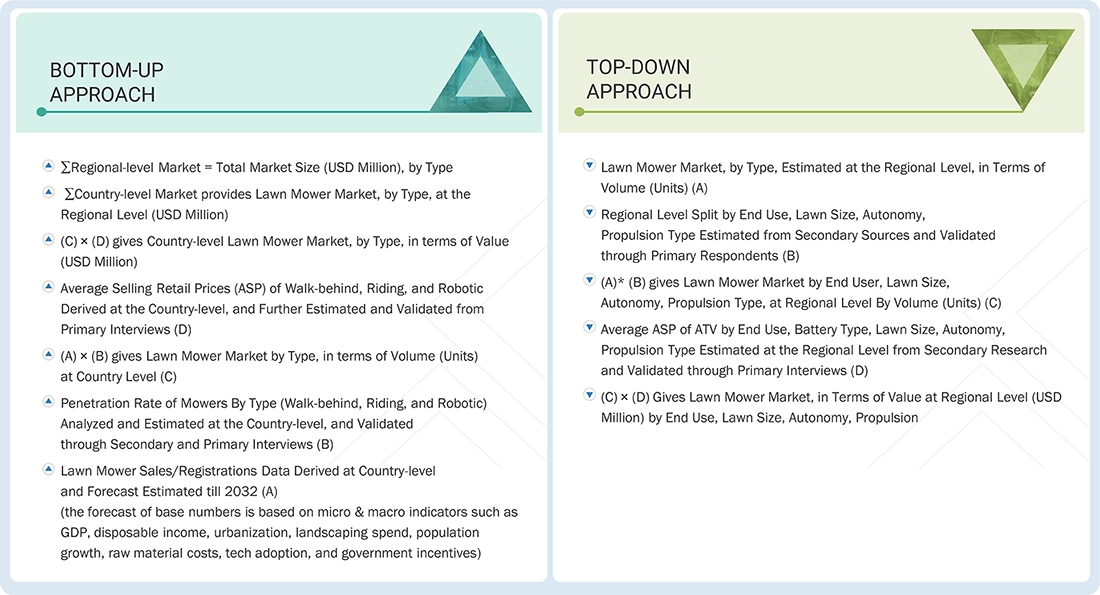
The study involved four major activities in estimating the current size of the lawn mower market. Exhaustive secondary research was conducted to collect information on the market, the peer market, and the parent market. The next step was to validate these findings and assumptions and size them with industry experts across value chains through primary research. The bottom-up and top-down approaches were employed to estimate the complete market size. Thereafter, market breakdown and data triangulation processes were used to estimate the market size of segments and subsegments.
Secondary Research
The lawn mower market is directly dependent on mower production. Lawn mower sales/registration volume was derived through secondary sources such as industry organizations, corporate filings (such as annual reports, investor presentations, and financial statements), trade, paid repository, and relevant associations such as COMAGARDEN, Agricultural Engineers Association (AEA), European Garden Machinery Federation (EGMF), and OPEI. Historical sales/registrations data was collected and analyzed, and the industry trend was considered to arrive at the forecast, which was further validated by primary research.
Primary Research
In the primary research process, various primary sources from both the supply and demand sides were interviewed to obtain qualitative and quantitative information on the market. The primary sources from the supply side included various industry experts, such as CXOs, vice presidents, directors from business development, marketing, and product development/innovation teams, and related key executives from various key companies. Various system integrators, industry associations, independent consultants/industry veterans, and key opinion leaders were also interviewed.
Primary interviews were conducted to gather insights such as lawn mower sales/registrations and market forecasts, future technology trends, and upcoming technologies in the industry. Using the information gathered from secondary research and model mapping, data triangulation of all these points was carried out. Stakeholders from the demand and supply sides were interviewed to understand their views on the aforementioned points.
Primary interviews were conducted with market experts from both the demand (lawn mower manufacturers) and supply (component manufacturers) sides across four major regions, North America, Europe, Asia Oceania, and the Rest of the World. Approximately 45% and 55% of primary interviews were conducted with the end user and the OEM and tier-1 supplier, respectively. Primary data was collected through questionnaires, emails, and telephonic interviews. In the canvassing of primaries, various departments within organizations, such as sales, marketing, operations, R&D, and aftermarket, were covered to provide a holistic viewpoint in the report.
After interacting with industry experts, brief sessions were conducted with highly experienced independent consultants to reinforce the findings from the primaries. This, along with the in-house subject matter expert opinions, led to the findings as described in the remainder of this report.
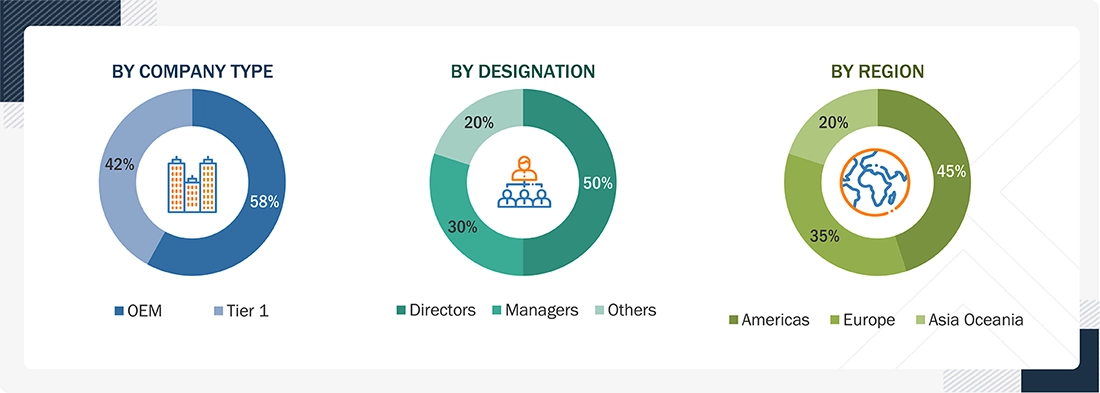
Note 1: Others include sales managers, marketing managers, and product managers.
Note 2: Tier 1 companies’ revenues are more than USD 10 billion; tier 2 companies’ revenues range between USD 1 and 10 billion; and tier 3 companies’ revenues range between USD 500 million and USD 1 billion.
Source: Industry Experts
To know about the assumptions considered for the study, download the pdf brochure
Market Size Estimation
A detailed market estimation approach was followed to estimate and validate the value of the lawn mower market and other dependent submarkets, as mentioned below:
- Key players in the lawn mower market were identified through secondary research, and their global market shares were determined through primary and secondary research.
- The research methodology included a study of annual and quarterly financial reports and regulatory filings of major market players (public), as well as interviews with industry experts for detailed market insights.
- All industry-level penetration rates, percentage shares, splits, and breakdowns for the lawn mower market were determined using secondary sources and verified through primary sources.
- All key macro indicators affecting the revenue growth of the market segments and subsegments were accounted for, viewed in extensive detail, verified through primary research, and analyzed to get the validated and verified quantitative and qualitative data.
- The gathered market data was consolidated and added with detailed inputs, analyzed, and presented in this report.
- Qualitative aspects such as market drivers, restraints, opportunities, and challenges were taken into consideration while calculating and forecasting the market size.
Lawn Mower Market : Top-Down and Bottom-Up Approach
Data Triangulation
After arriving at the overall market size using the market size estimation processes as explained above, the market was split into several segments and subsegments. To complete the overall market engineering process and arrive at the exact statistics of each market segment and subsegment, data triangulation and market breakdown procedures were employed, wherever applicable. The data was triangulated by studying various factors and trends from both the demand and supply sides.
Stakeholders
- Global lawn mower manufacturers & component suppliers
- Battery technology providers
- Electrical and electronic component suppliers
- Equipment rental companies
- Government & municipalities
- Government & regulatory bodies
- Landscaping & gardening service companies
- Lawn mower component suppliers
- Legal and regulatory authorities
- Market research firms and consultancies
- Outdoor Power Equipment Institute (OPEI)
- Regulatory & standards bodies
- Research & development (R&D) centers
- Retailers & channel partners
- Robotics & AI firms
- Software providers & simulation specialists
- Sports facilities & golf courses - subscription/remote monitoring service providers
- Third-party maintenance/ professional landscaping providers
Report Objectives
- To define, describe, and forecast the lawn mower market with respect to individual growth trends and prospects, and determine the contribution of each segment to the total market
-
To forecast the lawn mower market size by volume (units) and value (USD million) based on
- By type (riding, walk-behind, robotic)
- By lawn size (small, medium, and large)
- By end user (residential and commercial)
- By propulsion type (electric and ICE)
- By autonomy (autonomous and non-autonomous)
- By robotic lawn mower market, by hardware (sensors [ultrasonic, lift, tilt], motors (blade, wheel), microcontrollers, and batteries)
- By region [Asia Pacific (China, India, Japan, South Korea, Australia, and New Zealand), Europe (Germany, France, UK, Italy, Sweden, Russia, Spain, and Rest of Europe), and the Americas (US, Canada, Mexico, and Brazil)]
- To analyze the market qualitatively by Distribution Channel (online and retail)
- To provide detailed information regarding the major factors influencing the growth of the market (drivers, restraints, opportunities, and challenges)
- To strategically analyze the market with macroeconomic outlook, trends/disruptions impacting buyers, case studies, patent analysis, supply chain analysis, market ecosystem, regulatory analysis, impact of AI/Gen AI on lawn mower market, brand comparison, company valuation, investment & funding scenario, and technology trend, trade analysis, average selling price analysis
- To understand the competition in the lawn mower market and position the players as stars, emerging leaders, pervasive players, and participants according to their product portfolio and business strategies
- To analyze the market share of leading players in the lawn mower market and evaluate the competitive leadership mapping
- To strategically analyze the key player strategies/right to win, and company revenue
- To analyze the opportunities in the market for stakeholders and provide details of the competitive landscape for market leaders
- To provide an analysis of recent developments, alliances, joint ventures, mergers & acquisitions, product launches, and other activities carried out by key industry participants in the lawn mower market
Available Customizations
With the given market data, MarketsandMarkets offers customizations in accordance with the company’s specific needs.
Robotic lawn mower market, by type, at the country level
Lawn mower market, by end market, at the country level
Company information
- Profiling of additional market players (up to three)
Get the Full Lawn Mower Market Report
Full forecast, segment splits, and company analysis for all Lawn Mower Market.
- China Lawn Mower Market
- India Lawn Mower Market
- Japan Lawn Mower Market
- South Korea Lawn Mower Market
- Australia Lawn Mower Market
- Germany Lawn Mower Market
- France Lawn Mower Market
- UK Lawn Mower Market
- Italy Lawn Mower Market
- Sweden Lawn Mower Market
- Russia Lawn Mower Market
- Spain Lawn Mower Market
- Canada Lawn Mower Market
- Mexico Lawn Mower Market
- Brazil Lawn Mower Market
- US Lawn Mower Market
- Rest Of Europe Lawn Mower Market
Need a Tailored Report?
Customize this report to your needs
Get 10% FREE Customization
Customize This Report
