
Italy Rodenticides Market (2024-2029)

The Italy Rodenticides Market was valued at $62.2 Million in 2024 and projected to reach to $78.3 Million by 2029, representing a compound annual growth rate of 4.7%. Italy's rodenticides market is positioned for moderate but consistent growth through 2029, driven by the country's significant agricultural sector and ongoing need for effective crop protection.


| Market Size in | USD 26.32 MN |
| Market Forecast in | |
| CAGR | |
| Forecast Period | |
| Units Considered | Value (USD MN) |
Italy Rodenticides Market Trends and Insights
- Italy's agricultural sector relies on rodent control solutions to protect crops and stored grain from pest damage, driving steady demand across the country's farming regions.
- The market in Italy reflects broader European trends in integrated pest management and regulatory compliance with EU pesticide directives. Growth in Italy's rodenticides market is supported by increasing awareness of crop protection needs and modernization of agricultural practices.
- Italy's position as a major producer of cereals, rice, and stored commodities creates consistent demand for effective rodent management solutions.
- Between 2024 and 2029, Italy is expected to see incremental adoption of both conventional and advanced rodenticide formulations, though market expansion remains moderate compared to global growth rates..
Key Market Statistics
- CAGR (2024-2029) 4.7% CAGR
- Market Size, 2024 ~USD 62.2 Million
- Forecast, 2029 ~USD 78.3 Million
- Country Italy
Italy Rodenticides Market Overview
Market Valuation :
Italy's rodenticides market reached USD 62.2 million in 2024, with projections to expand to USD 78.3 million by 2029, representing a steady 4.7% CAGR driven by agricultural pest management needs.
Agricultural Dependency :
Italy's farming regions depend heavily on rodent control solutions to protect crops and stored grain from pest damage, particularly in cereal production and wine-growing areas vulnerable to rodent infestations.
Growth Trajectory :
The Italian market grows at 4.7% CAGR, slightly below the global average of 5.9%, reflecting mature agricultural practices and established pest management protocols in the country's farming sector.
European Market Alignment :
Italy's rodenticides market reflects broader European regulatory standards and sustainability trends, with increasing emphasis on integrated pest management and environmentally responsible rodent control solutions.
Italy Rodenticides Market Dynamics
- The market benefits from Italy's diverse farming landscape, including grain storage facilities, vineyards, and vegetable production areas where rodent control remains essential.
- Regulatory compliance with EU pesticide directives and growing adoption of sustainable pest management practices will shape product innovation and market dynamics. Future growth will be supported by technological advancements in rodenticide formulations, increased awareness of food safety standards, and the integration of digital monitoring systems in agricultural operations.
- However, growth rates remain moderate compared to global markets due to mature farming practices and established supplier relationships.
- Investment in eco-friendly and targeted rodent control solutions will be critical for market players seeking competitive advantage in Italy's evolving agricultural landscape..
Market Ecosystem
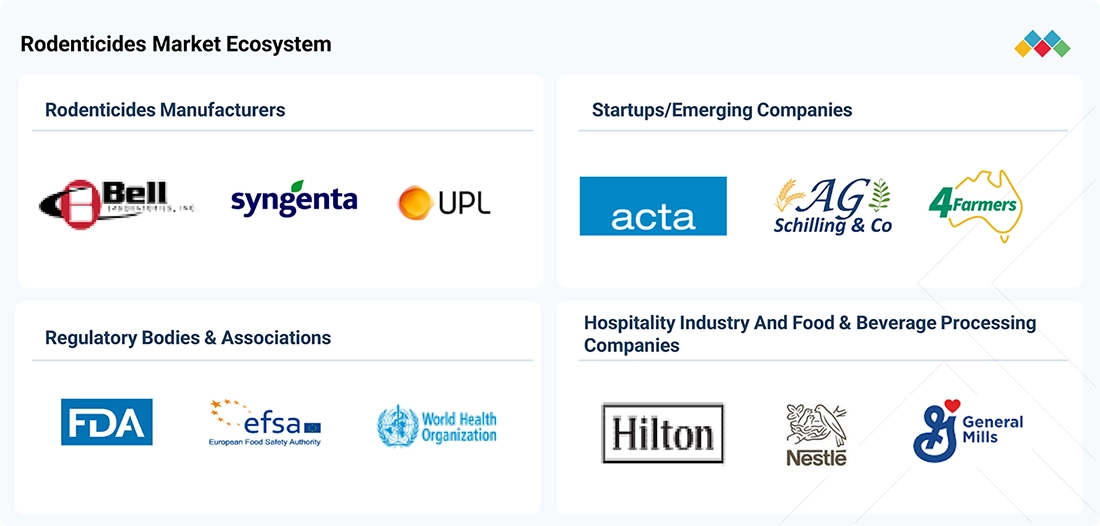
RODENTICIDES MARKET: COMMERCIAL USE CASES ACROSS INDUSTRIES
| COMPANY | USE CASE DESCRIPTION | BENEFITS |
|---|---|---|
 |
Commercial & industrial pest control, warehouses, food-processing facilities, urban buildings, using zinc-phosphide or bromethalin based baits. | Rapid rodent elimination; effective against resistant populations; integrated pest-management reduces reliance on repeated chemical use. |
 |
Agricultural storage and crop-protection, rodent control in grain stores and farm storage facilities via zinc-phosphide non-anticoagulant baits. | Immediate action, minimal residue, suitable for food-grain storage, minimizing crop losses. |
 |
Humane pest-control approach, fertility-control baits (non-coagulant) for long-term rodent population management in residential, commercial and urban areas. | Reduces future infestations rather than just kill-on-contact; lower risks to non-target species and pets; eco-friendly solution. |
 |
Rodent control in emerging-market agriculture and storage sectors, non-anticoagulant formulations suitable for crops (e.g. grains, sugarcane) and post-harvest protection. | Affordable and accessible for large-scale farming; supports food security by protecting harvests; tailored solutions for emerging markets. |
Logos and trademarks shown above are the property of their respective owners. Their use here is for informational and illustrative purposes only.
Related Ecosystem
Key Takeaways
- Italy's rodenticides market is valued at USD 62.2 million in 2024 and will reach USD 78.3 million by 2029.
- Italy's market grows at a 4.7% CAGR, reflecting steady but moderate expansion in agricultural pest control demand.
- Italy's cereal and rice production drives consistent rodent control requirements across the country's farming sector.
- Italy's market is shaped by EU pesticide regulations and the shift toward integrated pest management practices.
Rodenticides Market Report Scope
| Report Metric | Details |
|---|---|
| Base Year | 2024 |
| Fastest Growing Segment | SOFTWARE & SERVICES (Type) |
| Forecast Period | 2024-2029 |
| Growth Rate | CAGR of 5.9% from 2024 to 2029 |
| Largest Segment | RESIDENTIAL (Application) |
| Market Size Base Year (Billions) | ~USD 5.78 (2024) |
| Revenue Forecast (Billions) | ~USD 7.7 (2029) |
| Segments Covered | Type, Mode Of Application, End Use, Rodent Type, Urban Center, Anticoagulant, Application |
Italy Rodenticides Market Report Segmentation
7 segment dimensions are covered across the global market.
By Type
- Anticoagulants
- Biological
- Brodifacoum
- Bromadiolone
- Bromethalin
- Chemical
- Chlorophacinone
- Cholecalciferol
- Commercial
- Coumatetralyl
- Difenacoum
- Difethialone
- Diphacinone
- Fgar
- First-Generation Anticoagulants
- Flocoumafone
- Fungicides & Bactericides
- Herbicides
- Insecticides
- Mechanical
- Non-Anticoagulants
- Other Types
- Residential
- Second-Generation Anticoagulants
- Sgar
- Software & Services
- Strychnine
- Warfarin
- Zinc Phosphide
By Mode Of Application
- Pellets
- Powder
- Spray
By End Use
- Agricultural Fields
- Urban Centers
- Warehouses
By Rodent Type
- Chipmunks
- Hamsters
- Mice
- Other Rodent Types
- Other Rodents
- Rats
By Urban Center
- Commercial
- Residential
By Anticoagulant
- First-Generation Anticoagulant Rodenticides
- First-Generation Anticoagulants Rodenticides
- Second-Generation Anticoagulant Rodenticides
- Second-Generation Anticoagulants Rodenticides
By Application
- Commercial
- Industrial
- Livestock
- Other Applications
- Residential
Target Audience
- Agricultural Chemical Manufacturers : Rodenticide producers and agrochemical companies need Italy-specific market data to develop localized product portfolios, optimize pricing strategies, and identify growth opportunities in Italian farming regions.
- Crop Protection Distributors : Agricultural input distributors and retailers operating in Italy require detailed market insights to forecast demand, manage inventory, and align product offerings with regional pest management practices and regulatory requirements.
- Farm Management Consultants : Agricultural advisors and pest management specialists serving Italian farmers need market intelligence to recommend appropriate rodent control solutions and justify investment in integrated pest management programs.
- Investment & Business Development : Private equity firms, venture capital investors, and corporate development teams evaluating opportunities in Italian agriculture need market sizing and growth projections to assess investment viability and returns.
- Government & Policy Makers : Italian agricultural ministries and regulatory bodies require market data to inform pesticide policies, sustainability initiatives, and food safety standards affecting the rodenticides sector and farming practices.
Reasons to Buy this Report
- Precise Market Sizing : Access validated market data specific to Italy with exact valuations (USD 62.2M in 2024) and forecasts through 2029, enabling accurate budget allocation and investment planning for Italian agricultural operations.
- Regional Growth Intelligence : Understand Italy's 4.7% CAGR trajectory compared to global 5.9% benchmarks, identifying growth opportunities and market maturity levels specific to Italian farming regions and agricultural sectors.
- Regulatory & Compliance Insights : Gain clarity on EU pesticide directives and Italian-specific regulations affecting rodenticide products, formulations, and distribution channels critical for market entry and product development strategies.
- Competitive Positioning : Benchmark your products and strategies against Italy's established market dynamics, supplier relationships, and customer preferences to identify differentiation opportunities in crop protection and grain storage solutions.
- Strategic Market Entry : Leverage Italy-specific insights on agricultural segments (cereals, vineyards, vegetables), distribution networks, and sustainability trends to develop targeted go-to-market strategies for Italian agribusiness stakeholders.
Frequently asked questions
What is the current size of Italy's rodenticides market?
Italy's rodenticides market was valued at USD 62.2 million in 2024 according to verified market data.
What is the projected market size for Italy's rodenticides by 2029?
Italy's rodenticides market is forecast to reach USD 78.3 million by 2029, representing growth from the 2024 baseline.
What is the growth rate of Italy's rodenticides market?
Italy's rodenticides market is expected to grow at a CAGR of 4.7% between 2024 and 2029.
What drives demand for rodenticides in Italy?
Italy's agricultural production of cereals, rice, and stored commodities, combined with EU pest management regulations, drives consistent rodenticide demand.
How does Italy's rodenticides market compare to global growth?
Italy's 4.7% CAGR is lower than the global rodenticides market CAGR of 5.9%, indicating more moderate regional expansion.
RESEARCH METHODOLOGY
This study involved four major activities in estimating the current size of the rodenticides market. Exhaustive secondary research was conducted to collect information on the market, peer market, and parent market. The next step involved validating these findings, assumptions, and sizing with industry experts across the value chain through primary research. Both top-down and bottom-up approaches were employed to estimate the complete market size. After that, market breakdown and data triangulation were used to estimate the market size of segments and subsegments.
Secondary Research
This research study involved the extensive use of secondary sources—directories and databases such as Bloomberg Businessweek and Factiva—to identify and collect information useful for a technical, market-oriented, and commercial study of the rodenticides market.
In the secondary research process, various sources such as annual reports, press releases & investor presentations of companies, white papers, certified publications, articles from recognized authors, gold & silver standard websites, directories, and databases were referred to to identify and collect information. Secondary research was mainly used to obtain key information about the industry’s supply chain, the total pool of key players, and market classification and segmentation as per the industry trends to the bottom-most level, regional markets, and key developments from both market- and technology-oriented perspectives.
Primary Research
Extensive primary research was conducted after obtaining information regarding the rodenticides market scenario through secondary research. Several primary interviews were conducted with market experts from both the demand and supply sides across major countries of North America, Europe, Asia Pacific, the Middle East & Africa, and South America. Primary data was collected through questionnaires, emails, and telephonic interviews. The primary sources from the supply side included various industry experts, such as Chief X Officers (CXOs); Vice Presidents (VPs); Directors from business development, marketing, research, and development teams; related key executives from distributors; and key opinion leaders. Primary interviews were conducted to gather insights such as market statistics, data on revenue collected from the products and services, market breakdowns, market size estimations, market forecasting, and data triangulation. Primary research also helped in understanding the various trends related to type, mode of application, end use, rodent type, and region.
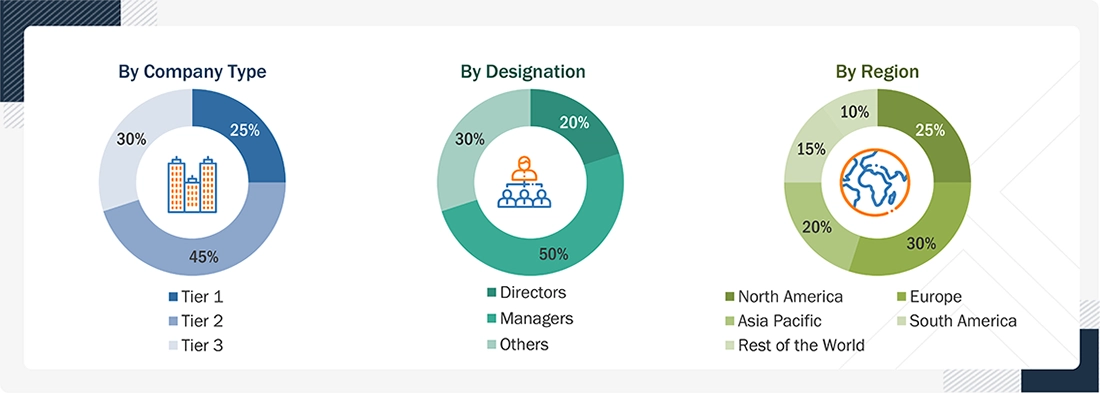
Note: Rest of the World includes the Middle East & Africa.
To know about the assumptions considered for the study, download the pdf brochure
Market Size Estimation
Both the top-down and bottom-up approaches were used to estimate and validate the total size of the rodenticides market. These approaches were also used extensively to estimate the size of various dependent submarkets. The research methodology used to estimate the market size includes the following:
- Key players were identified through extensive secondary research.
- The industry’s value chain and market size were determined through primary and secondary research.
- All percentage share splits and breakdowns were determined using secondary sources and verified through primary sources.
- All the possible parameters that affect the markets covered in this research study were accounted for, viewed in extensive detail, verified through primary research, and analyzed to obtain the final quantitative and qualitative data.
Rodenticides Market: Top-Down and Bottom-Up Approach
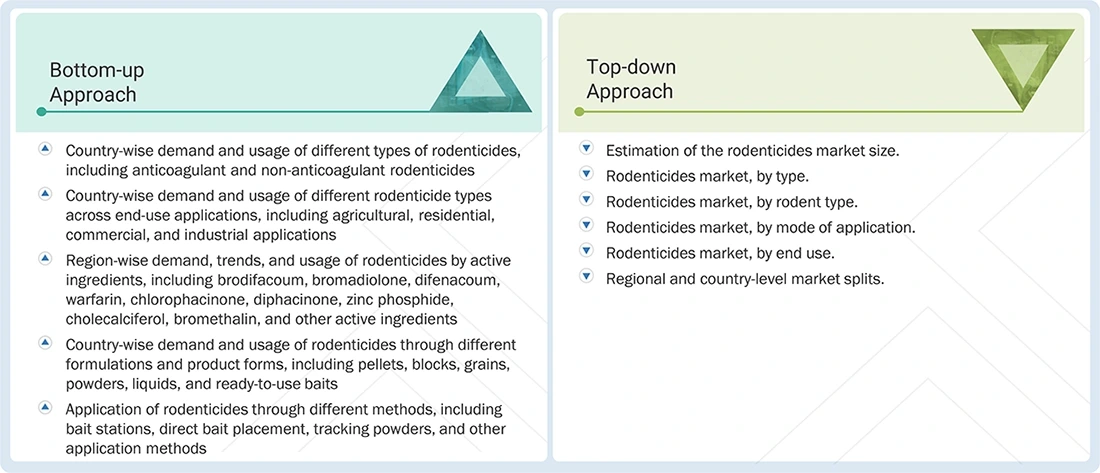
Data Triangulation
After arriving at the overall market size from the estimation process explained above, the total market was split into several segments and subsegments. To estimate the overall rodenticides market and arrive at the exact statistics for all segments and subsegments, the data triangulation and market breakdown procedures were employed, wherever applicable. The data were triangulated by studying various factors and trends from the demand and supply sides. Along with this, the market size was validated using both the top-down and bottom-up approaches.
Market Definition
According to the National Pesticide Information Center (US), ‘Rodenticides are pesticides that kill mice and rats.’ Even though rodents play an important role in nature, they are increasingly required to be controlled, as they damage crops, transmit diseases, and in some cases, cause ecological damage. Rodenticides are formulated as baits, which are designed to attract rodents.
Key Stakeholders
- Rodenticide manufacturers and suppliers
- Traders, distributors, and retailers of pest control products
- Farmers, warehouse owners, and logistics providers
- Government and private research organizations
- Public hygiene organizations, government regulatory institutions, and food safety agencies
- Pest control companies and users of pest control services
-
Associations and industry bodies:
- Food and Agriculture Organization (FAO)
- European Food Safety Authority (EFSA)
- British Pest Control Association
- National Pest Management Association (NPMA)
- National Pest Technicians Association
- Confederation of Europe Pest Management Association (CEPA)
- Organization for Economic Co-operation and Development (OECD)
- Venture capitalists and investors
Report Objectives
Market Intelligence
- To determine and project the size of the rodenticides market with respect to type, mode of application, end use, rodent type, and region
- To identify the attractive opportunities in the market by determining the largest and fastest-growing segments
- To provide detailed information about the key factors influencing the market growth (drivers, restraints, opportunities, and industry-specific challenges)
- To provide the regulatory framework and market entry process related to the market
- To analyze the micro markets with respect to individual growth trends, prospects, and their contribution to the total market
Competitive Intelligence
- To identify and profile the key players in the rodenticides market
-
To provide a comparative analysis of market leaders based on the following:
- Product offerings
- Business strategies
- Strengths and weaknesses
- Key financials
- To understand the competitive landscape and identify the major growth strategies adopted by players
- To provide insights on key product innovations and investments in the rodenticides market
Available customizations:
With the given market data, MarketsandMarkets offers customizations according to company-specific scientific needs.
The following customization options are available for the report:
Geographic Analysis
With the given market data, MarketsandMarkets offers customizations according to company-specific scientific needs.
- Further breakdown of the Rest of Europe into Greece and Ukraine
- Further breakdown of the Rest of Asia Pacific into New Zealand and Vietnam
- Further breakdown of the Rest of South America into Argentina, Paraguay, and Peru
Product Analysis
- Product Matrix, which gives a detailed comparison of the product portfolio of each company.
Company Information
- Detailed analyses and profiling of additional market players (up to five)
Get the Full Rodenticides Market Report
Full forecast, segment splits, and company analysis for all Rodenticides Market.
- US Rodenticides Market
- Canada Rodenticides Market
- Mexico Rodenticides Market
- Germany Rodenticides Market
- France Rodenticides Market
- UK Rodenticides Market
- Spain Rodenticides Market
- Russia Rodenticides Market
- Poland Rodenticides Market
- Netherlands Rodenticides Market
- China Rodenticides Market
- India Rodenticides Market
- Japan Rodenticides Market
- Australia Rodenticides Market
- Thailand Rodenticides Market
- Indonesia Rodenticides Market
- Brazil Rodenticides Market
- Chile Rodenticides Market
- South Africa Rodenticides Market
- Kenya Rodenticides Market
- Tanzania Rodenticides Market
- UAE Rodenticides Market
- Rest Of Europe Rodenticides Market
- Rest Of Asia Pacific Rodenticides Market
- Other In Row Rodenticides Market
- Ecuador Rodenticides Market
- Rest Of South America Rodenticides Market
Need a Tailored Report?
Customize this report to your needs
Get 10% FREE Customization
Customize This Report
