
South Korea Satellite Communication (SATCOM) Equipment Market (2026-2031)

The South Korea Satellite Communication (SATCOM) Equipment Market was valued at $392.5 Million in 2026 and projected to reach to $790.8 Million by 2031, representing a compound annual growth rate of 12.4%. South Korea's SATCOM equipment market is positioned for accelerated growth through 2031, supported by government space agency investments, military modernization budgets, and the country's technological leadership in electronics and aerospace.


| Market Size in | USD 26.32 MN |
| Market Forecast in | |
| CAGR | |
| Forecast Period | |
| Units Considered | Value (USD MN) |
South Korea Satellite Communication (SATCOM) Equipment Market Trends and Insights
- This represents a compound annual growth rate (CAGR) of 12.4%, outpacing global averages and reflecting South Korea's strategic investments in space infrastructure and defense modernization.
- South Korea's advanced technological capabilities and government initiatives to strengthen domestic satellite capabilities are driving demand across military, commercial, and civilian applications. The market growth in South Korea is underpinned by increasing geopolitical tensions in the region, rising demand for secure communications, and South Korea's commitment to developing indigenous satellite systems.
- South Korea's aerospace and defense sector continues to prioritize SATCOM equipment as critical infrastructure for national security and economic resilience.
- Between 2026 and 2031, South Korea is expected to see accelerated adoption of next-generation satellite terminals, ground stations, and integrated communication systems across government and private sector entities..
Key Market Statistics
- CAGR (2026-2031) 12.4% CAGR
- Market Size, 2026 ~USD 392.5 Million
- Forecast, 2031 ~USD 790.8 Million
- Country South Korea
South Korea Satellite Communication (SATCOM) Equipment Market Overview
Outpacing Global Growth :
South Korea's SATCOM equipment market grows at 12.4% CAGR, exceeding the global rate of 11.6%, driven by government space initiatives and defense modernization programs.
Strategic Defense Investments :
South Korea's advanced technological capabilities and military modernization priorities are fueling demand for satellite communication systems to enhance national security and operational capabilities.
Rapid Market Expansion :
Market valuation is projected to double from USD 392.5 million in 2026 to USD 790.8 million by 2031, reflecting accelerating adoption across defense and commercial sectors.
Space Infrastructure Development :
South Korea's commitment to indigenous space programs and satellite constellation development creates sustained demand for domestically-sourced and integrated SATCOM equipment solutions.
South Korea Satellite Communication (SATCOM) Equipment Market Dynamics
- The market benefits from South Korea's strategic focus on reducing dependency on foreign satellite systems while developing indigenous capabilities for national defense and commercial applications.
- Increasing demand for secure communications, disaster management systems, and broadband connectivity in remote areas will drive equipment procurement across both public and private sectors.
- The competitive landscape will intensify as domestic manufacturers expand production capacity and international players establish stronger regional presence to capture South Korea's high-value defense contracts and emerging commercial opportunities..
Market Ecosystem
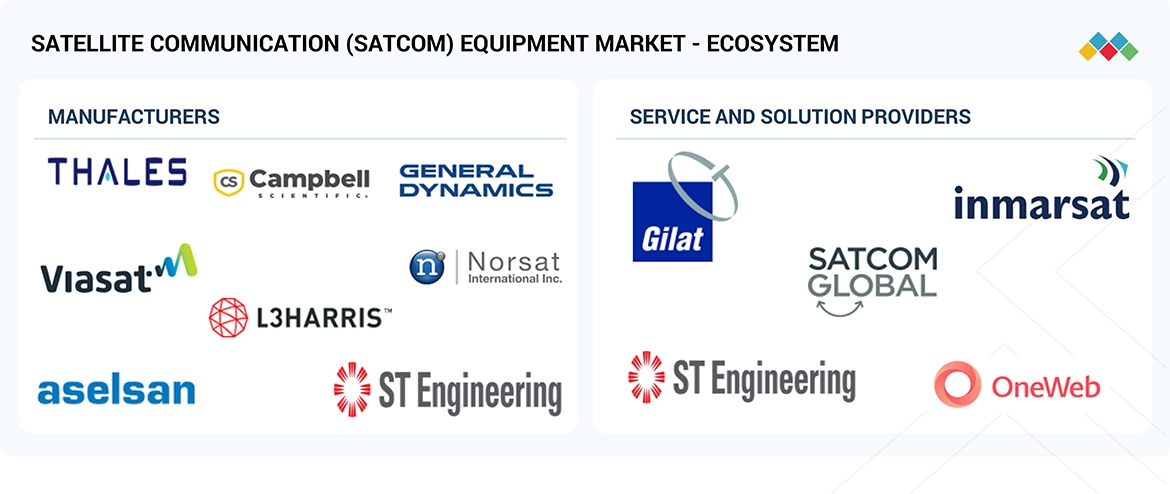
SATELLITE COMMUNICATION (SATCOM) EQUIPMENT MARKET SIZE & GROWTH: COMMERCIAL USE CASES ACROSS INDUSTRIES
| COMPANY | USE CASE DESCRIPTION | BENEFITS |
|---|---|---|
 |
Hughes Network’s JUPITER system is used to support high-throughput broadband delivery in remote and underserved regions where traditional terrestrial networks have limited reach. It uses advanced satellite modems, gateway infrastructure, optimized modulation, and bandwidth management to improve broadband performance across large coverage areas. | Supports efficient use of satellite bandwidth, improves network scalability, increases data throughput, and enables reliable broadband connectivity in areas with limited ground infrastructure. |
 |
Iridium Certus terminals are used for global mobility connectivity across maritime, aviation, and land transport applications. These platforms often operate outside terrestrial network coverage and need continuous communication for safety, operational coordination and data exchange. | Provides global L-band connectivity, supports voice and data communication, offers low-latency service compared with traditional GEO systems, and enables stable communication in remote and polar regions. |
 |
L3Harris maritime SATCOM terminals are used for naval and commercial vessel communication at sea. These terminals support vessels that operate under constant movement, harsh weather conditions, and limited terrestrial network availability. | Enables stable satellite links under dynamic sea conditions, supports multiple frequency bands, including X, Ka, Ku and C-band, improves compatibility with military and commercial satellite networks, and supports continuous naval and maritime operations. |
Logos and trademarks shown above are the property of their respective owners. Their use here is for informational and illustrative purposes only.
Related Ecosystem
Cns Systems
- C-Band
- Ka-Band
- Antennas
- Unmanned Ground Vehicles (UGV)
- Rotary Wing Aircraft
- L3Harris Technologies, Inc.
- Thales group
- HONEYWELL INTERNATIONAL INC.
- Northrop Grumman Corporation
- LOCKHEED MARTIN CORPORATION
Space
- C-Band
- Small Satellite
- Antennas
- Ka-Band
- Microsatellite
- L3Harris Technologies, Inc.
- AIRBUS
- Thales group
- Northrop Grumman Corporation
- LOCKHEED MARTIN CORPORATION
Key Takeaways
- South Korea's SATCOM equipment market is valued at USD 392.5 million in 2026 and will nearly double to USD 790.8 million by 2031, driven by 12.4% CAGR.
- South Korea's market growth outpaces the global SATCOM equipment market CAGR of 11.6%, reflecting regional strategic priorities and defense investments.
- South Korea's geopolitical position and commitment to indigenous satellite capabilities are accelerating demand for advanced SATCOM terminals and ground station infrastructure.
- South Korea's aerospace and defense sector is increasingly integrating SATCOM solutions for secure military communications and civilian space applications through 2031.
Satellite Communication (SATCOM) Equipment Market Report Scope
| Report Metric | Details |
|---|---|
| Base Year | 2026 |
| Fastest Growing Segment | UNMANNED AERIAL VEHICLE (Airborne Platform) |
| Forecast Period | 2026–2031 |
| Growth Rate | CAGR of 11.6% from 2026 to 2031 |
| Largest Segment | PRODUCT (Solution) |
| Market Size Base Year (Billions) | ~USD 29.05 (2026) |
| Revenue Forecast (Billions) | ~USD 50.29 (2031) |
| Segments Covered | Frequency, Connectivity, Vertical, Commercial Vertical, Government & Defense Vertical, Solution, Product, Antenna, Service, Type, Platform, Portable Platform, Land Mobile Platform, Land Fixed Platform, Maritime Platform, Airborne Platform, Technology, Terminal |
South Korea Satellite Communication (SATCOM) Equipment Market Report Segmentation
18 segment dimensions are covered across the global market.
By Frequency
- C-Band
- Ka-Band
- Ku-Band
- L & S-Band
- Multi-Band
- Q/V-Band
- Vhf/Uhf-Band
- X-Band
By Connectivity
- Leo
- Meo/Geo
By Vertical
- Commercial
- Government & Defense
By Commercial Vertical
- Aviation
- Business & Enterprise
- Energy & Power
- Marine
- Media & Entertainment
- Mining & Construction
- Retail & Consumer
- Scientific Research & Development
- Telecommunication & Cellular Backhaul
- Transportation & Logistics
By Government & Defense Vertical
- Homeland Security & Emergency Management
- Military
By Solution
- Product
- Service
By Product
- Antenna
- Converters
- Gyro Stabilization
- Modem & Router
- Power Amplifiers
- Radio
- Radome
- Transceiver
By Antenna
- Mimo (Multiple Input Multiple Output)
- Phased Array
By Service
- Engineering & Integration
- Installation
- Logistics & Maintenance
By Type
- Satcom-On-The-Move
- Satcom-On-The-Pause
- Zsatcom-On-The-Move
By Platform
- Airborne
- Land Fixed
- Land Mobile
- Maritime
- Portable
By Portable Platform
- Deployable/Flyaway
- Handheld
- Manpack
By Land Mobile Platform
- Commercial Vehicle
- Emergency Vehicle
- Military Vehicle
- Train
- Unmanned Ground Vehicle
By Land Fixed Platform
- Command & Control Center
- Direct To Home (Dth)/Satellite Tv
- Earth Station/Ground Station
- Enterprise System
By Maritime Platform
- Commercial Ship
- Military Ship
- Submarine
- Unmanned Maritime Vehicle
By Airborne Platform
- Business Jets
- Commercial Aircraft
- Military Aircraft
- Unmanned Aerial Vehicle
By Technology
- Legacy
- Next-Generation
By Terminal
- Lte-Based
- Non-Lte-Based
Target Audience
- Defense Contractors & Integrators : South Korean and international defense companies need market intelligence to bid on military SATCOM contracts, understand procurement requirements, and develop localized solutions for government agencies.
- Satellite Equipment Manufacturers : Equipment suppliers require detailed South Korea market data to assess demand for terminals, antennas, modems, and ground stations, and to plan manufacturing and distribution strategies.
- Government & Space Agencies : South Korean government bodies and space agencies use market analysis to inform budget allocation, technology roadmaps, and strategic decisions on indigenous satellite communication capabilities.
- Investment & Private Equity Firms : Investors evaluating opportunities in South Korea's aerospace and defense sectors need market projections and growth drivers to assess portfolio companies and identify acquisition targets.
- Telecommunications & Service Providers : Telecom operators and satellite service providers require market insights to plan SATCOM service offerings, infrastructure investments, and competitive positioning in South Korea's growing connectivity market.
Key Companies in the South Korea Satellite Communication (SATCOM) Equipment Market
| Company | HQ | Ownership | Strongest segments |
|---|---|---|---|
| CRANE CO | United States | Public Company | Aerospace & Advanced Technologies,Process Flow Technologies, |
| ALTEN | France | Public Company | Engineering & R&D Services,IT & Digital Services,Life Sciences & Health Engineering, |
| AVANTI COMMUNICATIONS GROUP PLC | United Kingdom | Private Company | Wholesale satellite capacity & spectrum (government, military, carrier),Enterprise and bespoke connectivity solutions,Consumer and SME broadband packages, |
| SES S.A. | Canada | Public Company | Waste Management,Energy Infrastructure, |
| PCTEL, INC. | United States | Private Company | Precision antennas,Industrial IoT devices,RF test and measurement solutions, |
| MERCURY SYSTEMS, INC. | United States | Public Company | Embedded processing boards and integrated subsystems,RF/microwave components and multi-function assemblies,Electronic warfare DRFM and radar environment simulation, |
| THALES | France | Public Company | Defence systems & C4ISR (air, land, naval, joint),Digital identity, cyber & secure IoT,Aerospace avionics & in-flight systems, |
| VIASAT, INC. | United States | Public Company | Fixed and mobile broadband services (incl. residential, enterprise, IFC),Defense and government communications & ISR services,Terminals, modems, antennas, and space systems hardware, |
| GENERAL DYNAMICS CORPORATION | United States | Public Company | Aerospace (business jets and services),Marine Systems (submarines and surface combatants),Combat Systems (land combat vehicles and munitions), |
| RTX | United States | Public Company | Collins Aerospace (avionics, interiors, mission systems, aftermarket),Pratt & Whitney (commercial and military engines, APUs, MRO),Raytheon (sensors, effectors, C2, space and cyber solutions), |
| L3HARRIS TECHNOLOGIES, INC. | United States | Public Company | Space & Mission Systems (SMS),Communications & Spectrum Dominance (CSD),Missile Solutions (MSL), |
| ECHOSTAR CORPORATION | United States | Public Company | Pay-TV (DISH, Sling, Freestream and related services),Broadband & Satellite Services (Hughes, Hughesnet, enterprise and government),Wireless (Boost Mobile, Gen Mobile and devices), |
| HONEYWELL INTERNATIONAL INC. | United States | Public Company | Industrial Automation (control, sensing, smart energy, safety, and software),Building Automation (BMS software, controls, security, and services),Energy and Sustainability Solutions / UOP (process technology, catalysts, equipment, software), |
| GILAT SATELLITE NETWORKS | Israel | Public Company | Satellite Networks (platforms, VSATs, modems, antennas),Integrated Solutions (defense, mobility, broadcast),Network Infrastructure and Services (managed networks, construction, O&M), |
| IRIDIUM COMMUNICATIONS INC. | United States | Public Company | Service revenue – government and defense (voice, data, PTT, gateway services),Service revenue – commercial voice and data (postpaid, prepaid, PTT, maritime, aviation),Service revenue – IoT, tracking, time and location, hosted payload/data services, |
| ASELSAN A.S. | Turkey | Public Company | Military communication & C4ISR systems,Radar and electronic warfare systems,Avionics, navigation, and guidance systems, |
| INTELLIAN TECHNOLOGIES, INC. | South Korea | Public Company | NX and compact maritime VSAT,Mil-spec VSAT and government terminals,XEO and multi-orbit VSAT, |
| ST ENGINEERING | Singapore | Public Company | Defence & Public Security (air, land, sea, C4ISR, homeland security),Commercial Aerospace (MRO, P2F, nacelles, aerostructures, leasing),Urban Solutions & Satcom (smart mobility, smart city, energy, digital platforms), |
| SPACEX | United States | Public Company | Connectivity (Starlink broadband and related services),Space (Falcon 9, Falcon Heavy, Starship, Dragon launch and mission services),AI Platform (Grok, X, enterprise AI solutions, compute infrastructure), |
| ELBIT SYSTEMS LTD. | Israel | Public Company | Aerospace (airborne platforms, UAS, avionics, training and simulators),C4I and Cyber (C4ISR systems, radios, data links, cyber intelligence),ISTAR & EW (electro-optics, EW, SIGINT, radar, naval combat systems), |
CRANE CO
Crane Co. is a United States-based public company founded in 1855 with 7,100 employees. The company operates as an established industrial manufacturer with a long history spanning nearly 170 years.
ALTEN
ALTEN is a French public company founded in 1988 with 56,376 employees. It is one of Europe's largest engineering and technology consulting firms.
AVANTI COMMUNICATIONS GROUP PLC
Avanti Communications Group PLC is a United Kingdom-based private company founded in 2002 with 239 employees, operating in the communications sector.
SES S.A.
SES S.A. is a Canadian public company founded in 2007 with 1,937 employees, providing satellite and communications services.
PCTEL, INC.
PCTEL, Inc. is a United States-based private company founded in 1994 with 213 employees, operating in the wireless communications testing sector.
MERCURY SYSTEMS, INC.
Mercury Systems, Inc. is a United States-based public company founded in 1981 with 2,117 employees, providing secure processing solutions for defense and aerospace applications.
THALES
Thales is a French public company founded in 1893 with 82,111 employees, operating as a global leader in aerospace, defense, and security technologies.
VIASAT, INC.
ViaSat, Inc. is a United States-based public company founded in 1986 with 7,000 employees, providing satellite communications and networking solutions.
GENERAL DYNAMICS CORPORATION
General Dynamics Corporation is a United States-based public company founded in 1899 with 117,000 employees, operating as a major defense and aerospace contractor.
RTX
RTX is a United States-based public company founded in 1934 with 180,000 employees, serving as a leading aerospace and defense technology provider.
L3HARRIS TECHNOLOGIES, INC.
L3Harris Technologies, Inc. is a United States-based public company founded in 1895 with 45,000 employees, specializing in defense, space, and security solutions.
ECHOSTAR CORPORATION
EchoStar Corporation is a United States-based public company founded in 1980 with 12,100 employees, operating in satellite communications and digital television services.
HONEYWELL INTERNATIONAL INC.
Honeywell International Inc. is a United States-based public company founded in 1885 with 101,000 employees, operating as a diversified technology and manufacturing conglomerate.
GILAT SATELLITE NETWORKS
Gilat Satellite Networks is an Israel-based public company founded in 1987 with 1,159 employees, providing satellite-based broadband and communications solutions.
IRIDIUM COMMUNICATIONS INC.
Iridium Communications Inc. is a United States-based public company with 975 employees, operating a global satellite communications network.
ASELSAN A.S.
ASELSAN A.S. is a Turkey-based public company founded in 1975 with 16,243 employees, specializing in defense electronics and systems.
INTELLIAN TECHNOLOGIES, INC.
Intellian Technologies, Inc. is a South Korea-based public company founded in 2004 with 502 employees, manufacturing satellite communication systems.
ST ENGINEERING
ST Engineering is a Singapore-based public company founded in 1967 with 27,000 employees, providing aerospace, defense, and engineering solutions.
SPACEX
SpaceX is a United States-based private company founded in 2002 with 22,000 employees, specializing in space launch services and rocket development.
ELBIT SYSTEMS LTD.
Elbit Systems Ltd. is an Israel-based public company founded in 1966 with 20,000 employees, operating as a major defense electronics and systems provider.
Reasons to Buy this Report
- Market-Specific Growth Projections : Access precise South Korea market sizing (USD 392.5M in 2026, USD 790.8M in 2031) with 12.4% CAGR to inform investment decisions and competitive positioning in this high-growth market.
- Defense Sector Opportunity Analysis : Understand South Korea's military modernization drivers, procurement cycles, and strategic satellite communication requirements to identify contract opportunities and partnership potential.
- Competitive Landscape Intelligence : Gain insights into domestic and international competitors operating in South Korea's SATCOM market, including market share distribution and strategic positioning within the region.
- Government Policy & Investment Tracking : Monitor South Korea's space agency initiatives, defense budgets, and indigenous satellite program developments that directly influence SATCOM equipment demand and market dynamics.
- Technology & Localization Trends : Identify opportunities in South Korea's push for domestic SATCOM manufacturing, technology transfer partnerships, and integration with advanced Korean electronics and aerospace capabilities.
Frequently asked questions
What is the current size of South Korea's SATCOM equipment market?
South Korea's SATCOM equipment market is valued at USD 392.5 million in 2026 and is projected to grow to USD 790.8 million by 2031.
What is the CAGR for South Korea's SATCOM equipment market?
South Korea's SATCOM equipment market is growing at a compound annual growth rate (CAGR) of 12.4% from 2026 to 2031.
How does South Korea's SATCOM market growth compare to global trends?
South Korea's SATCOM equipment market CAGR of 12.4% exceeds the global market CAGR of 11.6%, indicating stronger regional demand and investment momentum.
What factors are driving growth in South Korea's SATCOM equipment market?
South Korea's market growth is driven by geopolitical security concerns, government investments in indigenous satellite systems, defense modernization, and increasing demand for secure communications infrastructure.
Which sectors are primary consumers of SATCOM equipment in South Korea?
South Korea's primary SATCOM equipment consumers include the military and defense sector, government agencies, commercial telecommunications providers, and emerging civilian space applications.
RESEARCH METHODOLOGY
The study involved four major activities in estimating the current size of the satellite communication (SATCOM) equipment market. Exhaustive secondary research was done to collect information on the market, its adjacent markets, and its parent market. The next step was to validate these findings, assumptions, and sizing with industry experts across the value chain through primary research. Demand-side analysis was conducted to estimate the overall market size. After that, market breakdown and data triangulation procedures were employed to estimate the sizes of various segments and subsegments within the market.
Secondary Research
During the secondary research process, various sources were consulted to identify and collect information for this study. The secondary sources included government sources, such as SIPRI; corporate filings, including annual reports, press releases, and investor presentations from companies; white papers, journals, and certified publications; and articles from recognized authors, directories, and databases.
Primary Research
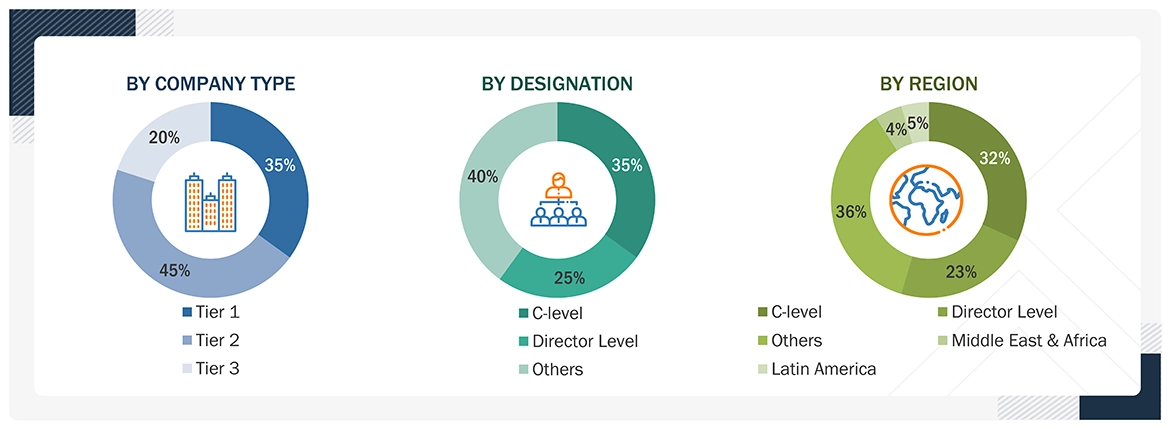
Extensive primary research was conducted after acquiring information regarding the SATCOM equipment market scenario through secondary research. Several primary interviews were conducted with market experts from the demand and supply sides across major countries of North America, Europe, Asia Pacific, the Middle East & Africa, and Latin America. Primary data was collected through questionnaires, emails, and telephonic interviews.
To know about the assumptions considered for the study, download the pdf brochure
Market Size Estimation
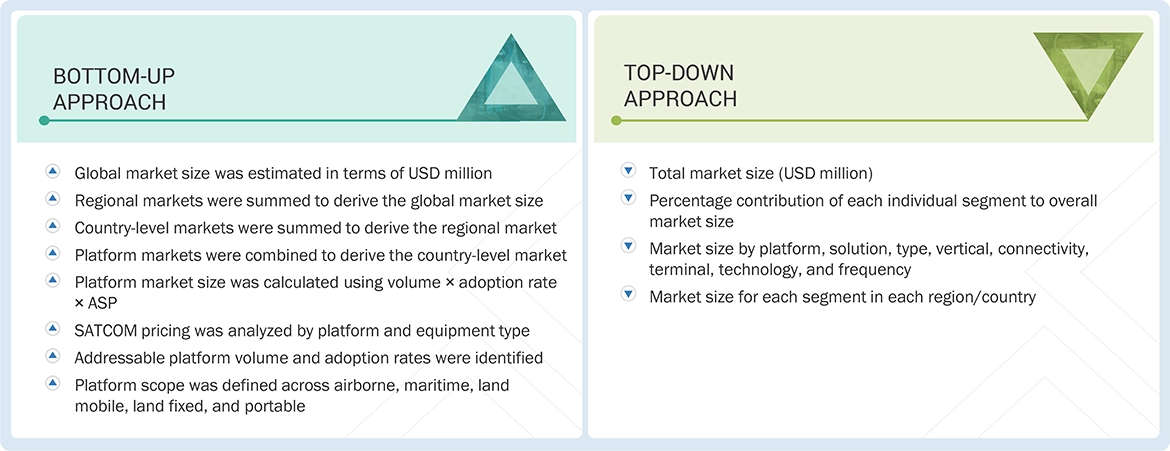
The top-down and bottom-up approaches were used to estimate and validate the size of the SATCOM equipment market. The research methodology used to estimate the size of the market included the following details:
- Key players in the SATCOM equipment market were identified through secondary research, and their market shares were determined through a combination of primary and secondary research. This included a study of the annual and financial reports of the top market players, as well as extensive interviews with leaders, including directors, engineers, marketing executives, and other key stakeholders of leading companies operating in the market.
- All percentage shares, splits, and breakdowns were determined using secondary sources and verified through primary sources.
- All possible parameters that affect the markets covered in this research study were accounted for, viewed in extensive detail, verified through primary research, and analyzed to obtain the final quantitative and qualitative data on the SATCOM equipment market. This data was consolidated, enhanced with detailed inputs, analyzed by MarketsandMarkets, and presented in this report.
Satellite Communication (SATCOM) Equipment Market : Top-Down and Bottom-Up Approach
Data Triangulation
After determining the overall market size, the total market was divided into several segments and subsegments. The data triangulation and market breakdown procedures explained below were implemented, wherever applicable, to complete the overall market engineering process and arrive at the estimated market numbers for the market segments and subsegments. The data was triangulated by studying various factors and trends from the demand and supply sides. Additionally, the market size was validated using top-down and bottom-up approaches.
Market Definition
The SATCOM equipment market comprises the design, manufacturing, integration, sale, installation, and lifecycle support of satellite communication equipment and related ground-segment solutions used to transmit, receive, process, and manage satellite-based communications. It includes antennas, terminals, modems, gateways, routers, RF equipment, network control and management systems, and associated services such as engineering & integration, installation, logistics, and maintenance across fixed, portable, mobile, maritime, airborne, enterprise, government, and defense applications.
Key Stakeholders
- Equipment Manufacturers
- Satellite Operators and Service Providers
- Network Integrators and System Integrators
- Telecom Operators and Connectivity Providers
- Government and Defense Organizations
- Aviation, Maritime, and Land Mobility Operators
- Technology and Component Suppliers (Chips, RF, Semiconductors)
- Installation, Maintenance, and Service Providers
- Distributors and Channel Partners
- Regulatory Bodies and Spectrum Authorities
- Research Institutions and Industry Associations
Report Objectives
- To define, describe, segment, and forecast the size of the SATCOM equipment market based on solution (product and service), vertical, connectivity, frequency, platform, terminal, technology, type, and region
- To forecast the size of market segments based on five regions: North America, Europe, Asia Pacific, the Middle East & Africa, and Latin America
- To identify and analyze key drivers, restraints, opportunities, and challenges influencing the growth of the market
- To identify industry trends, market trends, and technology trends prevailing in the market
- To analyze micro markets with respect to individual technological trends, prospects, and their contribution to the overall market
- To strategically profile key market players and comprehensively analyze their market ranking and core competencies
- To provide a detailed competitive landscape of the market and analyze competitive growth strategies, such as product developments, contracts, partnerships, agreements, and collaborations adopted by key players in the market
- To identify the detailed financial position of key players, as well as their key products, unique selling points, and key developments
Customization Options
MarketsandMarkets offers the following customizations for this market report:
- Additional country-level analysis of the SATCOM equipment market
- Profiling of other market players (up to 5)
Product Analysis
- Product matrix, which provides a detailed comparison of the product portfolio of each company in the SATCOM equipment market
Get the Full Satellite Communication (SATCOM) Equipment Market Report
Full forecast, segment splits, and company analysis for all Satellite Communication (SATCOM) Equipment Market.
- Canada Satellite Communication (SATCOM) Equipment Market
- US Satellite Communication (SATCOM) Equipment Market
- France Satellite Communication (SATCOM) Equipment Market
- Germany Satellite Communication (SATCOM) Equipment Market
- UK Satellite Communication (SATCOM) Equipment Market
- Italy Satellite Communication (SATCOM) Equipment Market
- Spain Satellite Communication (SATCOM) Equipment Market
- Russia Satellite Communication (SATCOM) Equipment Market
- China Satellite Communication (SATCOM) Equipment Market
- Japan Satellite Communication (SATCOM) Equipment Market
- Australia Satellite Communication (SATCOM) Equipment Market
- India Satellite Communication (SATCOM) Equipment Market
- Saudi Arabia Satellite Communication (SATCOM) Equipment Market
- UAE Satellite Communication (SATCOM) Equipment Market
- Israel Satellite Communication (SATCOM) Equipment Market
- Turkey Satellite Communication (SATCOM) Equipment Market
- Brazil Satellite Communication (SATCOM) Equipment Market
- Mexico Satellite Communication (SATCOM) Equipment Market
- Argentina Satellite Communication (SATCOM) Equipment Market
- Rest Of Europe Satellite Communication (SATCOM) Equipment Market
- Rest Of Asia Pacific Satellite Communication (SATCOM) Equipment Market
- Africa Satellite Communication (SATCOM) Equipment Market
Need a Tailored Report?
Customize this report to your needs
Get 10% FREE Customization
Customize This Report
