
Australia Satellite Data Services Market (2023-2028)

The Australia Satellite Data Services Market was valued at $249.7 Million in 2023 and projected to reach to $600 Million by 2028, representing a compound annual growth rate of 19.2%. Australia's satellite data services market is poised for accelerated expansion, driven by increasing defence spending, technological advancement, and growing adoption across agricultural and environmental sectors.


| Market Size in | USD 26.32 MN |
| Market Forecast in | |
| CAGR | |
| Forecast Period | |
| Units Considered | Value (USD MN) |
Australia Satellite Data Services Market Trends and Insights
- This expansion reflects Australia's increasing reliance on satellite-derived intelligence for defence, agriculture, and environmental monitoring applications.
- Australia's geographic position and advanced technological infrastructure position the nation as a key hub for satellite data analytics in the Asia-Pacific region. The 19.2% compound annual growth rate underscores strong demand drivers across Australia's public and private sectors.
- Australia's investment in space capabilities, coupled with growing adoption of Earth observation data for climate resilience and resource management, fuels market acceleration through 2028.
- Government initiatives and partnerships with international space agencies further strengthen Australia's satellite data services ecosystem..
Key Market Statistics
- CAGR (2023-2028) 19.2% CAGR
- Market Size, 2023 ~USD 249.7 Million
- Forecast, 2028 ~USD 600 Million
- Country Australia
Australia Satellite Data Services Market Overview
Market Valuation & Growth :
Australia's satellite data services market reached USD 249.7 million in 2023, with a robust CAGR of 19.2% projected through 2028, significantly outpacing the global growth rate of 17.5%.
Strategic Geographic Advantage :
Australia's unique geographic position in the Indo-Pacific region positions it as a critical hub for satellite data collection, enabling enhanced surveillance and monitoring capabilities across vast oceanic and terrestrial areas.
Defence & Security Applications :
Growing government investment in defence intelligence and national security initiatives is driving demand for advanced satellite data services, supporting Australia's strategic autonomy in regional monitoring and threat assessment.
Agricultural & Environmental Use Cases :
Australia's expansive agricultural sector and environmental monitoring needs are leveraging satellite data for precision farming, drought management, and climate resilience, creating sustained commercial demand.
Australia Satellite Data Services Market Dynamics
- The market's 19.2% CAGR reflects strong government backing and private sector investment in space-derived intelligence capabilities.
- By 2028, the market is forecast to reach USD 600 million, representing a 140% increase from 2023 levels. Key growth catalysts include Australia's commitment to space sovereignty, partnerships with international space agencies, and the emergence of domestic satellite operators.
- Rising demand for real-time geospatial intelligence, climate monitoring, and disaster management solutions will further accelerate market penetration.
- Investment in local infrastructure and skilled workforce development will strengthen Australia's position as a regional leader in satellite data services..
Market Ecosystem
Related Ecosystem
Key Takeaways
- Australia's satellite data services market will grow from USD 249.7M (2023) to USD 600M (2028) at a 19.2% CAGR.
- Australia's defence and national security priorities drive significant demand for advanced satellite intelligence capabilities.
- Australia's agricultural and environmental sectors increasingly leverage satellite data for precision farming and climate monitoring.
- Australia's strategic location and space infrastructure investments position it as a regional leader in satellite data analytics.
Satellite Data Services Market Report Scope
| Report Metric | Details |
|---|---|
| Base Year | 2023 |
| Fastest Growing Segment | DATA ANALYTICS (Service) |
| Forecast Period | 2023-2028 |
| Growth Rate | CAGR of 17.5% from 2023 to 2028 |
| Largest Segment | DATA ANALYTICS (Service) |
| Market Size Base Year (Billions) | ~USD 9.33 (2023) |
| Revenue Forecast (Billions) | ~USD 20.9 (2028) |
| Segments Covered | Vertical, End Use, Service |
Australia Satellite Data Services Market Report Segmentation
3 segment dimensions are covered across the global market.
By Vertical
- Academic & Research
- Agriculture
- Defense & Security
- Energy & Power
- Engineering & Infrastructure
- Environment & Weather
- Forestry
- Insurance
- Maritime
- Other Verticals
- Transportation & Logistic
- Transportation & Logistics
By End Use
- Commercial
- Government & Military
- Service Providers
By Service
- Data Analytics
- Image Data
AUSTRALIA: SATELLITE DATA SERVICES MARKET, BY VERTICAL, 2023–2028
| Segment | 2023 | 2024 | 2025 | 2026 | 2027 | 2028 | CAGR (%) |
|---|---|---|---|---|---|---|---|
| ACADEMIC & RESEARCH | 4.9 | 5.7 | 6.6 | 7.6 | 8.8 | 10.2 | 15.9 |
| AGRICULTURE | 45.2 | 54.2 | 65 | 77.8 | 93.2 | 111.5 | 19.8 |
| DEFENSE & SECURITY | 57.6 | 68.8 | 82.3 | 98.3 | 117.3 | 140 | 19.4 |
| ENERGY & POWER | 30 | 35.9 | 42.9 | 51.2 | 61.1 | 72.9 | 19.4 |
| ENGINEERING & INFRASTRUCTURE | 30 | 35.8 | 42.7 | 51 | 60.7 | 72.4 | 19.3 |
| ENVIRONMENT & WEATHER | 20 | 23.8 | 28.3 | 33.7 | 40.1 | 47.7 | 19 |
| FORESTRY | 12.4 | 14.8 | 17.5 | 20.8 | 24.7 | 29.3 | 18.7 |
| INSURANCE | 7.5 | 8.9 | 10.5 | 12.5 | 14.9 | 17.6 | 18.8 |
| MARITIME | 25 | 29.8 | 35.6 | 42.5 | 50.6 | 60.3 | 19.3 |
| OTHER VERTICALS | 7.3 | 8.4 | 9.7 | 11.2 | 12.9 | 14.8 | 15.3 |
| TRANSPORTATION & LOGISTICS | 9.9 | 11.8 | 14 | 16.6 | 19.7 | 23.3 | 18.6 |
| TOTAL | 249.7 | 297.9 | 355.2 | 423.3 | 504.1 | 600 | 19.2 |
Target Audience
- Defence & Government Agencies : Australian defence and security organisations require market intelligence to evaluate satellite data service providers, assess capability gaps, and align procurement strategies with national security priorities.
- Agricultural Technology Companies : AgTech firms operating in Australia need market data to understand satellite-derived precision farming adoption rates, competitive offerings, and revenue opportunities in the expanding agricultural segment.
- Space & Satellite Operators : Domestic and international satellite operators require Australia-specific market analysis to assess demand drivers, identify customer segments, and develop localised service offerings for the growing market.
- Environmental & Climate Monitoring Organisations : Environmental agencies and climate research institutions need market insights to understand satellite data service availability, pricing models, and capabilities for monitoring Australia's unique environmental challenges.
- Investment & Private Equity Firms : Investors evaluating opportunities in Australia's aerospace and defence sector require comprehensive market data, growth forecasts, and competitive analysis to identify high-potential investment targets.
Reasons to Buy this Report
- Market Size & Growth Validation : Obtain precise market valuation data for Australia's satellite data services sector with verified CAGR of 19.2%, enabling accurate financial forecasting and investment decision-making through 2028.
- Competitive Landscape Intelligence : Understand Australia-specific market dynamics, key players, and competitive positioning to identify partnership opportunities and market entry strategies tailored to the local ecosystem.
- Sector-Specific Application Insights : Access detailed analysis of defence, agricultural, and environmental applications driving demand in Australia, enabling targeted product development and go-to-market strategies for each vertical.
- Government & Policy Context : Gain insights into Australian government initiatives, defence spending trends, and regulatory frameworks shaping the satellite data services market and influencing future growth trajectories.
- Regional Strategic Positioning : Leverage Australia's Indo-Pacific geographic advantage and emerging space sovereignty agenda to identify expansion opportunities and strategic partnerships in the fastest-growing regional market.
Frequently asked questions
What is the current size of Australia's satellite data services market?
Australia's satellite data services market was valued at USD 249.7 million in 2023 and is projected to reach USD 600 million by 2028.
What is the growth rate for Australia's satellite data services market?
Australia's satellite data services market is expected to grow at a compound annual growth rate (CAGR) of 19.2% from 2023 to 2028.
Which sectors drive demand for satellite data services in Australia?
Australia's defence, agriculture, environmental monitoring, and resource management sectors are primary drivers of satellite data services demand.
Why is Australia a key market for satellite data services?
Australia's geographic position, advanced technological infrastructure, government space investments, and strategic defence priorities make it a critical hub for satellite data analytics in Asia-Pacific.
What applications of satellite data are growing fastest in Australia?
Australia is experiencing rapid growth in Earth observation applications including precision agriculture, climate monitoring, disaster management, and national security intelligence.
RESEARCH METHODOLOGY
The study involved four major activities in estimating the current size of the Satellite Data Services Market. Exhaustive secondary research was done to collect information on the Satellite Data Services market, its adjacent markets, and its parent market. The next step was to validate these findings, assumptions, and sizing with industry experts across the value chain through primary research. Demand-side analyses were carried out to estimate the overall size of the market. After that, market breakdown and data triangulation procedures were used to estimate the sizes of different segments and subsegments of the Satellite Data Services market.
Secondary Research
The market ranking of satellite data services companies was determined using secondary data made available through paid and unpaid sources and by analyzing the product portfolios of major companies. These companies perform on the basis of the performance and quality of their products. These data points were further validated by primary sources.
Secondary sources referred to for this research study included financial statements of companies offering satellite data services and information from various trade, business, and professional associations. The secondary data was collected and analyzed to arrive at the overall size of the satellite data services market, which was validated by primary respondents.
Primary Research
Extensive primary research was conducted after acquiring information regarding the satellite data services market scenario through secondary research. Several primary interviews were conducted with market experts from both the demand and supply sides across major countries of North America, Europe, Asia Pacific, the Middle East and ROW which includes Africa, and Latin America. Primary data was collected through questionnaires, emails, and telephonic interviews.
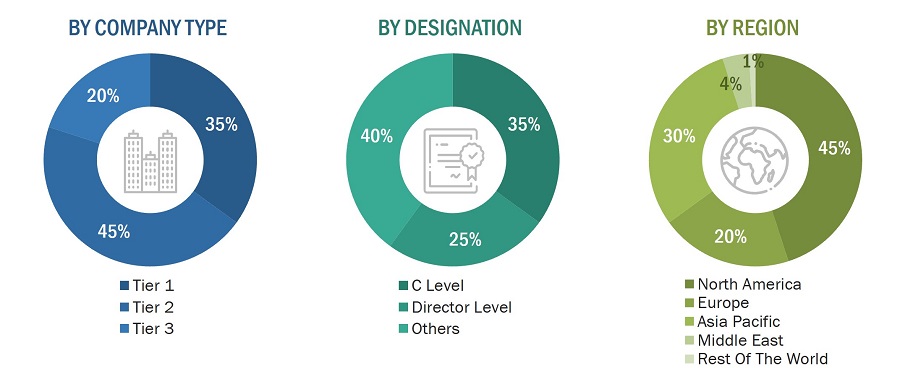
To know about the assumptions considered for the study, download the pdf brochure
Market Size Estimation
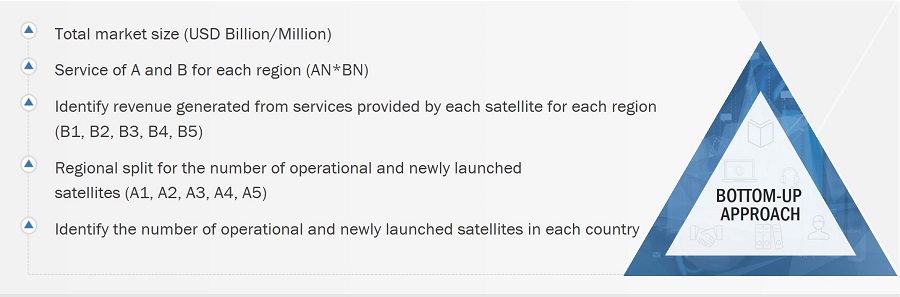
The market sizing of the market was undertaken from the demand side. The market was upsized at a regional level based on procurements and launches planned by the country. Such procurements provide information on each application demand aspects of satellite data services. For each application, all possible end users in the satellite data services market were identified.
Note: An analysis of technological, military funding, year-on-year launches, and operational costs was carried out to arrive at the CAGR and understand the market dynamics of all countries in the report. The market share for all vertical, end-use, service, deployment and region was based on the recent and upcoming launches of satellite data services in every country from 2023 to 2028.
Satellite Data ServicesMarket Size: Bottom-up Approach
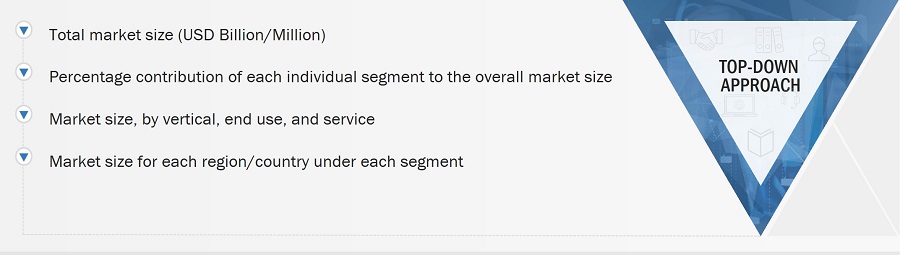
Satellite Data Services Market Size: Top-Down Approach
Data Triangulation
After arriving at the overall size of the market, the total market was split into several segments and subsegments. The data triangulation and market breakdown procedures explained below were implemented wherever applicable, to complete the overall market engineering process and arrive at the exact statistics for various market segments and subsegments. The data was triangulated by studying various factors and trends from both, the demand and supply sides. Along with this, the market size was validated using both, the top-down and bottom-up approaches.
Country-wise deliveries of vehicles in different platforms from 2023 to 2028 were considered for base data. Data was taken from the OEM manufacturers and various governing bodies of each country.
The following figure indicates the market breakdown structure and the data triangulation procedure implemented in the market engineering process used to develop this report.
Market Definition
Satellite data services refer to the acquisition, processing, and delivery of critical information such as imagery, measurements, and signals collected by satellites orbiting Earth. These services cater to various industries and applications, offering valuable insights for agriculture, environmental monitoring, defense, infrastructure management, disaster response, navigation, and telecommunications. Key features of satellite data services include global coverage, real-time or near-real-time data acquisition, and the ability to monitor large areas consistently.
Market Stakeholders
- Remote Sensing Service Providers
- Ministries of Defense
- Scientific Research Centers
- Satellite Imagery Service Providers
- Satellite Data Analytics Solution Providers
- Satellite Operators
Report Objectives
- To define, describe, and forecast the size of the satellite data services market based on vertical, end-use, service, deployment, and region from 2023 to 2028.
- To forecast the size of various segments of the market with respect to major regions, namely, North America, Europe, Asia Pacific, Middle East and the Rest of the World (RoW), which comprises Latin America and Africa
- To identify and analyze key drivers, restraints, opportunities, and challenges influencing the growth of the satellite data services market across the globe.
- To strategically analyze micromarkets1 with respect to individual growth trends, prospects, and their contribution to the satellite data services market.
- To analyze opportunities for stakeholders in the market by identifying key market trends
- To analyze competitive developments such as contracts, acquisitions and expansions, agreements, joint ventures and partnerships, new product launches, and Research & Development (R&D) activities in the satellite data services market.
- To provide a detailed competitive landscape of the -market, in addition to an analysis of business and corporate strategies adopted by leading market players.
- To strategically profile key market players and comprehensively analyze their core competencies2.
Available Customizations
MarketsandMarkets offers the following customizations for this market report:
- Additional country-level analysis of the Satellite Data Services Market
- Profiling of other market players (up to 5)
Product Analysis
- Product matrix, which provides a detailed comparison of the product portfolio of each company in the Satellite Data Services Market.
Get the Full Satellite Data Services Market Report
Full forecast, segment splits, and company analysis for all Satellite Data Services Market.
- Canada Satellite Data Services Market
- US Satellite Data Services Market
- UK Satellite Data Services Market
- Germany Satellite Data Services Market
- France Satellite Data Services Market
- Spain Satellite Data Services Market
- Netherlands Satellite Data Services Market
- Russia Satellite Data Services Market
- China Satellite Data Services Market
- Japan Satellite Data Services Market
- India Satellite Data Services Market
- South Korea Satellite Data Services Market
- Singapore Satellite Data Services Market
- Saudi Arabia Satellite Data Services Market
- UAE Satellite Data Services Market
- Rest Of Europe Satellite Data Services Market
- Brazil Satellite Data Services Market
- Mexico Satellite Data Services Market
Need a Tailored Report?
Customize this report to your needs
Get 10% FREE Customization
Customize This Report
