
Global Semiconductor Intellectual Property (IP) Market (2024-2030)

The Global Semiconductor Intellectual Property (IP) Market was valued at $7.45 Million in 2024 and projected to reach to $11.2 Million by 2030, representing a compound annual growth rate of 8.5%.
Global Semiconductor Intellectual Property (IP) Market Trends and Insights
- Global demand for semiconductor IP is driven by accelerating adoption of advanced chip design methodologies, increased complexity in semiconductor manufacturing, and the proliferation of AI, IoT, and edge computing applications across Global markets.
- The Global market reflects strong investment in design automation tools, processor cores, and memory IP solutions as semiconductor companies worldwide seek to reduce time-to-market and development costs. Global semiconductor IP licensing and development continues to be a critical enabler for chipmakers, fabless companies, and system-on-chip (SoC) designers operating across all major regions.
- The Global expansion through 2030 is underpinned by rising demand for customized IP blocks, growing collaboration between Global design houses and IP vendors, and the strategic importance of intellectual property in maintaining competitive advantage.
- Global market participants are increasingly investing in next-generation IP portfolios to support emerging technologies including 5G, automotive electrification, and quantum computing..
Key Market Statistics
- CAGR (2024-2030) : 8.5% CAGR
- Market Size, 2024 : ~USD 7.45
- Forecast, 2030 : ~USD 11.2
- Region : Global
Global Semiconductor Intellectual Property (IP) Market Overview
Market Valuation & Growth Trajectory :
The Global Semiconductor IP Market reached $7.45 billion in 2024 and is projected to grow to $11.2 billion by 2030, demonstrating robust expansion at an 8.5% CAGR across all major regions and segments.
AI & Advanced Computing Demand :
Global semiconductor IP adoption is accelerating due to surging demand for AI chips, advanced processors, and edge computing solutions, driving innovation in IP licensing and design methodologies worldwide.
Manufacturing Complexity & Design Innovation :
Increased complexity in global semiconductor manufacturing processes, coupled with the shift toward advanced nodes, is fueling demand for specialized IP cores and design tools across international markets.
Regional Market Diversification :
Growth is distributed across multiple global regions including Asia Pacific, Europe, and North America, with China, Taiwan, and Japan emerging as significant contributors to overall market expansion.
Global Semiconductor Intellectual Property (IP) Market Dynamics
The Global Semiconductor IP Market is positioned for sustained growth through 2030, driven by the proliferation of AI applications, IoT devices, and the continuous evolution of chip design complexity. International semiconductor manufacturers are increasingly investing in IP licensing to accelerate time-to-market and reduce development costs, creating opportunities across all major geographies. The market's 8.5% CAGR reflects strong demand from both established semiconductor hubs and emerging markets seeking advanced design capabilities. Strategic partnerships between IP vendors and foundries globally are expected to further accelerate adoption and market penetration across diverse applications and regions.
Related Ecosystem
Semiconductor Materials And Components
- Sensors
- Gallium Nitride (GaN)
- Digital Signal Processor (DSP)
- Natural Language Processing (NLP)
- Silicon Carbide
- Texas Instruments Incorporated
- Samsung
- APPLIED MATERIALS, INC.
- Stmicroelectronics
-
Lenovo
Key Takeaways
- Global Semiconductor IP Market reached $7.45 billion in 2024 and is forecast to grow to $11.2 billion by 2030 at an 8.5% CAGR.
- Global demand is accelerated by AI, IoT, and edge computing adoption, requiring advanced IP solutions across Global semiconductor design ecosystems.
- Global market growth is supported by increasing complexity in chip design and the strategic need for faster time-to-market in Global competition.
- Global IP vendors are expanding portfolios to address emerging technologies including 5G, automotive, and quantum computing applications worldwide.
Global Semiconductor Intellectual Property (IP) Market Report Scope
| Report Metric | Details |
|---|---|
| Base Year | 2024 |
| Forecast Period | 2024–2036 |
| Growth Rate | CAGR of 8.5% from 2024 to 2036 |
| Market Size Base Year | 7.45 (2024) |
| Revenue Forecast | 11.2 (2036) |
| Segments Covered | Design Ip, Processor Ip, Vertical, Ip Source, Ip Core |
Global Semiconductor Intellectual Property (IP) Market Report Segmentation
5 segment dimensions are covered across the global market.
By Design Ip
- Interface Ip
- Memory Ip
- Other Ips
- Processor Ip
By Processor Ip
- Digital Signal Processor (Dsp)
- Microprocessor Unit (Mpu)
By Vertical
- Automotive
- Commercial
- Consumer Electronics
- Industrial
- Other Verticals
- Telecommunication & Data Center
- Telecommunications & Data Center
By Ip Source
- Licensing
- Royalty
By Ip Core
- Hard Ip Core
- Soft Ip Core
Target Audience
- Semiconductor IP Vendors : Global IP vendors need comprehensive market data to identify growth opportunities, assess competitive positioning, and develop expansion strategies across international markets.
- Chip Design Companies : Design firms require global market insights to optimize IP licensing decisions, evaluate vendor partnerships, and understand regional demand patterns for semiconductor IP solutions.
- Semiconductor Manufacturers & Foundries : Foundries and manufacturers need global market forecasts to plan IP investments, assess technology roadmaps, and align production capabilities with worldwide demand trends.
- Investment & Private Equity Firms : Investors require detailed global market analysis to evaluate acquisition targets, assess growth potential in semiconductor IP, and identify emerging opportunities across regions.
- Technology Consultants & Analysts : Consultants need comprehensive global market data to advise clients on semiconductor IP strategy, competitive positioning, and market entry decisions across international markets.
Key Companies in the Global Semiconductor Intellectual Property (IP) Market
| Company | HQ | rev. share | Strongest segments |
|---|
Countries within Global - compare and drill down
| Country | 2025 size (native) |
|---|---|
| Canada | USD 11.2 Million |
| China | USD 2224.5 Million |
| France | USD 472.9 Million |
| Germany | USD 769.3 Million |
| Japan | USD 884.7 Million |
| Mexico | USD 224.3 Million |
| Rest Of Asia Pacific | USD 525.8 Million |
| Rest Of Europe | USD 576.4 Million |
| South Korea | USD 475.2 Million |
| Taiwan | USD 945.4 Million |
| UK | USD 534 Million |
| US | USD 11.2 Million |
Country market size visualization
Reasons to Buy this Report
- Comprehensive Global Market Sizing : Access detailed market valuation data for the global semiconductor IP sector, with accurate 2024 baseline ($7.45B) and 2030 forecasts ($11.2B) to support strategic planning and investment decisions.
- Regional Performance Insights : Understand market dynamics across all major global regions including Asia Pacific, Europe, and North America, enabling targeted go-to-market strategies and regional expansion planning.
- Growth Driver Analysis : Identify key catalysts fueling the 8.5% CAGR globally, including AI adoption, manufacturing complexity, and IoT proliferation, to align product development with market demand.
- Competitive Landscape Intelligence : Benchmark your position against global market trends and understand how semiconductor IP demand is evolving across different geographies and customer segments worldwide.
- Strategic Investment Guidance : Make informed decisions on IP portfolio expansion, licensing partnerships, and geographic market entry based on comprehensive global market forecasts and growth projections.
Frequently asked questions
What is the Global Semiconductor IP Market size in 2024?
The Global Semiconductor IP Market was valued at $7.45 billion in 2024.
What is the projected Global Semiconductor IP Market size by 2030?
The Global Semiconductor IP Market is projected to reach $11.2 billion by 2030.
What is the CAGR of the Global Semiconductor IP Market?
The Global Semiconductor IP Market is expected to grow at a compound annual growth rate (CAGR) of 8.5% from 2024 to 2030.
What are the primary drivers of Global Semiconductor IP Market growth?
Global market growth is driven by increased adoption of AI and IoT technologies, rising chip design complexity, demand for faster time-to-market, and investment in advanced design automation tools across Global semiconductor companies.
Which technologies are fueling demand in the Global Semiconductor IP Market?
Global demand is fueled by emerging technologies including artificial intelligence, 5G communications, automotive electrification, edge computing, and quantum computing applications worldwide.
RESEARCH METHODOLOGY
The research process for this technical, market-oriented, and commercial study of the semiconductor IP market included systematic gathering, recording, and analysis of data about companies operating in the market. It involved the extensive use of secondary sources, directories, and databases (Factiva, Oanda) to identify and collect relevant information. In-depth interviews were conducted with various primary respondents, including experts from core and related industries and preferred manufacturers, to obtain and verify critical qualitative and quantitative information as well as to assess the growth prospects of the market. Key players in the semiconductor IP market were identified through secondary research, and their market rankings were determined through primary and secondary research. This included studying annual reports of top players and interviewing key industry experts, such as CEOs, directors, and marketing executives.
Secondary Research
In the secondary research process, various secondary sources were referred to for identifying and collecting information relevant to this study. Secondary sources included annual reports, press releases, and investor presentations of companies; white papers, certified publications, and articles from recognized authors; directories; and databases. Secondary research was mainly conducted to obtain key information about the supply of the industry; a total pool of key players; segmentation of the market according to industry trends, geographic markets, and key developments from market- and technology-oriented perspectives.
Primary Research
In the primary research process, primary sources from the supply and demand sides were interviewed to obtain qualitative and quantitative information for this report. Primary sources from the supply side included CEOs, vice presidents, marketing directors, technology and innovation directors, subject-matter experts, consultants, and related key executives from major companies and organizations operating in the semiconductor IP market.
After the complete market engineering process (market statistics calculations, market breakdown, market size estimations, market forecasting, and data triangulation), extensive primary research was conducted to gather information and verify and validate the critical market numbers.
Several primary interviews were conducted with experts from the demand and supply sides across four major regions—North America, Europe, Asia Pacific, and Rest of the World (RoW). Approximately 25% of the primary interviews were conducted with the demand side and 75% with the supply side. This primary data was collected through questionnaires, emails, and telephonic interviews
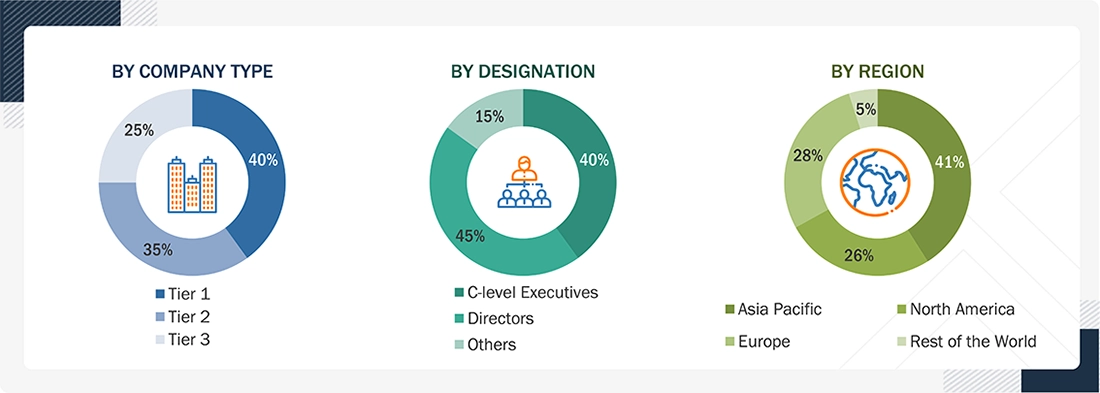
Note: Tier 1 companies include market players with revenues above USD 500 million; tier 2 companies earn revenues between USD 100 million and USD 500 million; and tier 3 companies earn revenues up to USD 100 million. Other designations include sales, marketing, and product managers.
To know about the assumptions considered for the study, download the pdf brochure
Market Size Estimation
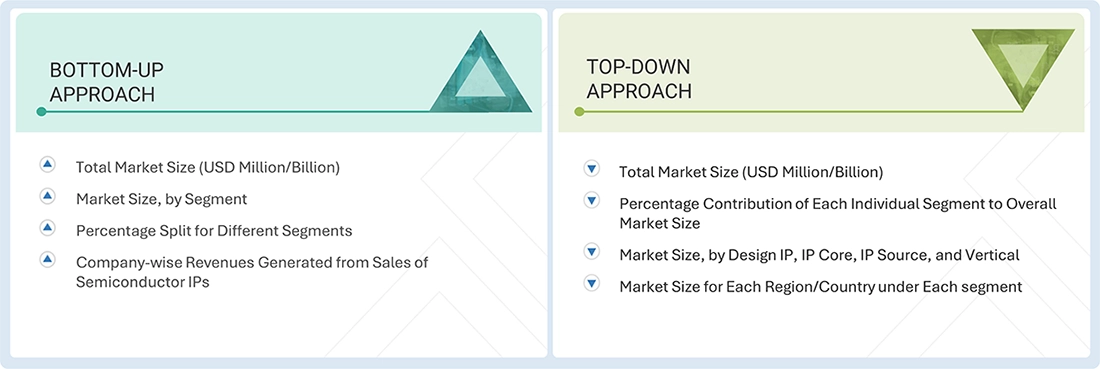
In the complete market estimation process, the top-down and bottom-up approaches were used, along with several data triangulation methods, to estimate and forecast the size of the market and its segments and subsegments listed in the report. Extensive qualitative and quantitative analyses were carried out on the complete market engineering process to list the key information/insights pertaining to the semiconductor IP market.
Key players in the semiconductor IP market were identified through secondary research, and their rankings in the respective regions were determined through primary and secondary research. This entire procedure involved the study of the annual and financial reports of top players and interviews with industry experts, such as chief executive officers, vice presidents, directors, and marketing executives, for quantitative and qualitative insights. All percentage shares, splits, and breakdowns were determined using secondary sources and verified through primary sources. All parameters that affect the markets covered in this research study were accounted for, viewed in extensive detail, verified through primary research, and analyzed to obtain the final quantitative and qualitative data. This data was consolidated and enhanced with detailed inputs and analysis from MarketsandMarkets and presented in this report.
BOTTOM-UP APPROACH
- Identifying the stakeholders in the semiconductor intellectual property (IP) market influencing the entire market, along with the related component players
- Analyzing major providers of semiconductor IPs, studying their portfolios, and understanding different types of product offerings
- Analyzing trends pertaining to the use of different types of semiconductor IP solutions for different applications
- Tracking the ongoing and upcoming developments in the market, such as investments made, R&D activities, product launches, collaborations, and partnerships, and forecasting the market based on these developments and other critical parameters
- Carrying out multiple discussions with key opinion leaders to understand the different types of semiconductor IP solutions and recent trends in the market, thereby analyzing the breakup of the scope of work carried out by major companies
- Arriving at the market estimates by analyzing and totaling the revenues generated by companies from each type of solution
- Categorizing the overall market into various segments
- Verifying and cross-checking the estimated values at every level through discussions with key opinion leaders such as CXOs, directors, and operations managers, and finally with the domain experts in MarketsandMarkets
- Studying various paid and unpaid sources of information, such as annual reports, press releases, white papers, and databases
TOP-DOWN APPROACH
- Focusing initially on top-line investments and expenditures being made in the semiconductor IP ecosystem
- Calculating the market size by considering the revenues generated by players through the sales of semiconductor IP solutions
- Segmenting the market based on R&D activities and developments in key areas
- Segmenting the market based on mapping the usage of semiconductor IP solutions in different applications
- Collecting information related to the revenues generated by players by offering key types of semiconductor IP solutions
- Conducting multiple on-field discussions with key opinion leaders across major companies involved in the development of semiconductor IP solutions
- Estimating the geographic split using secondary sources based on various factors, such as the number of players in a specific country and region, the role of major players in the market for the development of innovative products, adoption and penetration rates in a particular country for various end-use applications, and others
INFOGRAPHIC DEPICTING BOTTOM-UP AND TOP-DOWN APPROACHES
Data Triangulation
After arriving at the overall market size from the market size estimation process explained above, the total market was split into several segments and subsegments. To complete the overall market engineering process and arrive at the exact statistics for all segments and subsegments, the market breakdown and data triangulation procedures were employed, wherever applicable. The data was triangulated by studying various factors and trends from both the demand and supply sides. Along with this, the market size was validated using both the top-down and bottom-up approaches.
Market Definition
The semiconductor intellectual property (IP) market refers to the global ecosystem of reusable and licensable semiconductor design assets that are integrated into integrated circuits (ICs), System-on-Chip (SoC) designs, ASICs, FPGAs, chiplets, and advanced semiconductor devices. These IP blocks include processor architectures, interface protocols, memory subsystems, analog and mixed-signal functions, security engines, and verification IP that are licensed to semiconductor companies for integration into chip designs. The market includes revenues generated through licensing, royalties, subscriptions, maintenance, and IP customization services associated with reusable semiconductor design blocks.
Key Stakeholders
- IP Suppliers
- IP Core Developers
- Integrated Device Manufacturers (IDMs)
- Fabless Semiconductor Companies
- System Companies & Custom Silicon Developers
- Third-party IP Developers
- IP Licensors (licensing vendors)
- Open-source IP Vendors
- IP Aggregators
- Electronic Design Automation (EDA) Vendors
- Non-pure-play (IDM) Foundry Vendors
- Fabrication Players
- Raw Material Vendors
- Semiconductor IP Solution Providers
- System Integrators
- Original Equipment Manufacturers (OEMs)/Device Manufacturers
- Technology Standard Organizations, Forums, Alliances, and Associations
- Governments, Financial Institutions, and Investment Communities
- Research Organizations
- Analysts and Strategic Business Planners
- Venture Capitalists, Private Equity Firms, and Startups
Report Objectives
- To define, describe, and forecast the semiconductor IP market size, in terms of value by design IP, IP core, IP source, IP consumer type, architecture type, vertical, and region
- To describe and forecast the market size across four key regions, namely, North America, Europe, Asia Pacific, and the Rest of the World (RoW), along with their respective country-level market size, in terms of value
- To provide detailed information regarding the drivers, restraints, opportunities, and challenges in the market
- To strategically analyze the micromarkets concerning the individual growth trends, prospects, and their contribution to the market
- To map competitive intelligence based on company profiles, key player strategies, and key developments
- To analyze trends/disruptions impacting customer business, interconnected markets and cross-sector opportunities, strategic moves by tier-1/2/3 players, pricing analysis, patents analysis, trade analysis (export and import scenario), Porter's five forces analysis, macroeconomic indicators, case studies, investment and funding scenario, decision-making process, buyer stakeholders and buying evaluation criteria, adoption barriers and internal challenges, unmet needs from various industries, technology analysis, technology roadmap, ecosystem analysis, regional regulations and compliance, impact of 2025 US tariff, and key conferences and events related to the semiconductor IP market.
- To benchmark the market players using the proprietary company evaluation matrix framework, which analyzes them on various parameters within the broad categories of market ranking/share and product portfolio
- To analyze competitive developments such as contracts, acquisitions, product launches & developments, collaborations, and partnerships, along with research & development (R&D), in the semiconductor IP market
Available customizations:
With the given market data, MarketsandMarkets offers customizations according to the company’s specific needs. The following customization options are available for the report:
COMPANY INFORMATION
- Detailed analysis and profiling of additional market players (up to 7)
Get the Full Semiconductor Intellectual Property (IP) Market Report
Full forecast, segment splits, and company analysis for all Semiconductor Intellectual Property (IP) Market.
- US Semiconductor Intellectual Property (IP) Market
- Canada Semiconductor Intellectual Property (IP) Market
- Mexico Semiconductor Intellectual Property (IP) Market
- Germany Semiconductor Intellectual Property (IP) Market
- UK Semiconductor Intellectual Property (IP) Market
- France Semiconductor Intellectual Property (IP) Market
- Rest Of Europe Semiconductor Intellectual Property (IP) Market
- China Semiconductor Intellectual Property (IP) Market
- Japan Semiconductor Intellectual Property (IP) Market
- South Korea Semiconductor Intellectual Property (IP) Market
- Taiwan Semiconductor Intellectual Property (IP) Market
- Rest Of Asia Pacific Semiconductor Intellectual Property (IP) Market
Need a Tailored Report?
Customize this report to your needs
Get 10% FREE Customization
Customize This Report