
South Korea Semiconductor IP Market (2026-2031)

The South Korea Semiconductor IP Market was valued at $667.7 Million in 2026 and projected to reach to $1195.8 Million by 2031, representing a compound annual growth rate of 10.2%. South Korea's semiconductor IP market is poised for sustained growth through 2031, driven by the country's position as a global semiconductor manufacturing and design powerhouse.


| Market Size in | USD 26.32 MN |
| Market Forecast in | |
| CAGR | |
| Forecast Period | |
| Units Considered | Value (USD MN) |
South Korea Semiconductor IP Market Trends and Insights
- South Korea's advanced semiconductor manufacturing ecosystem and strong design capabilities drive demand for intellectual property solutions across logic, memory, and analog IP categories.
- South Korea's strategic investments in next-generation chip design and foundry services reinforce the country's role as a key hub for semiconductor IP innovation and adoption. The growth trajectory in South Korea reflects the nation's commitment to semiconductor self-sufficiency and technological leadership in the global market.
- South Korea's major chipmakers and fabless design companies increasingly rely on specialized IP licensing to accelerate time-to-market and reduce development costs.
- South Korea's expanding 5G, AI, and automotive semiconductor initiatives create sustained demand for differentiated IP portfolios, positioning the market for robust expansion through 2031..
Key Market Statistics
- CAGR (2026-2031) 10.2% CAGR
- Market Size, 2026 ~USD 667.7 Million
- Forecast, 2031 ~USD 1195.8 Million
- Country South Korea
South Korea Semiconductor IP Market Overview
Market Valuation Growth :
South Korea's semiconductor IP market is valued at $667.7 million in 2026, with strong projected growth to $1,195.8 million by 2031, representing a robust 10.2% CAGR aligned with global expansion trends.
Advanced Manufacturing Ecosystem :
South Korea's world-class semiconductor fabrication infrastructure, anchored by major foundries and chipmakers, creates substantial demand for specialized IP solutions across logic, memory, and analog categories.
Design Capability Leadership :
The country's strong semiconductor design capabilities and innovation-driven companies drive continuous investment in intellectual property to maintain competitive advantages in global markets.
Strategic IP Diversification :
South Korean semiconductor firms increasingly diversify IP portfolios across multiple technology nodes and application domains, including AI, 5G, and automotive semiconductors.
South Korea Semiconductor IP Market Dynamics
- The market benefits from continuous technological advancement, increasing complexity of chip designs, and rising demand for differentiated IP solutions from local and international semiconductor companies.
- South Korea's strategic focus on next-generation technologies, including advanced packaging, AI accelerators, and high-bandwidth memory, will fuel IP licensing and development activities.
- The competitive landscape will intensify as companies seek to optimize design cycles and reduce time-to-market, further accelerating IP adoption across the semiconductor value chain..
Market Ecosystem
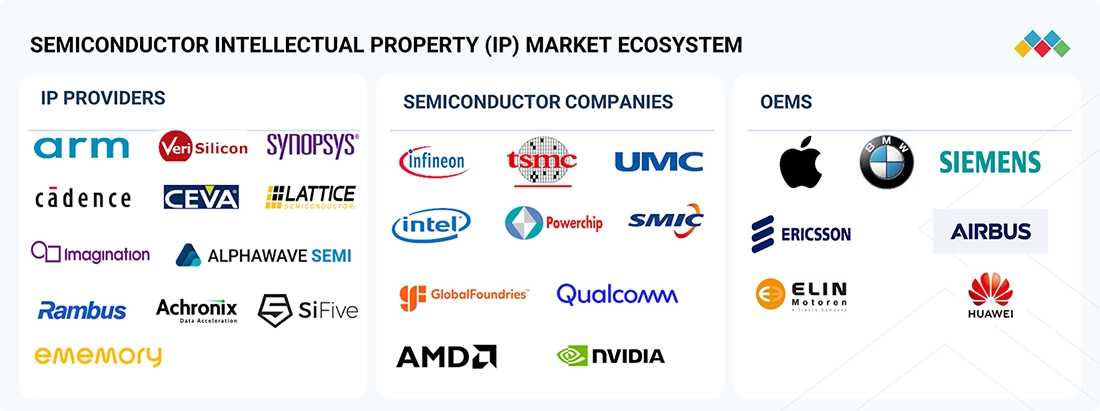
SEMICONDUCTOR INTELLECTUAL PROPERTY (IP) MARKET: COMMERCIAL USE CASES ACROSS INDUSTRIES
| COMPANY | USE CASE DESCRIPTION | BENEFITS |
|---|---|---|
 |
Siemens Digital Industries Software entered into an OEM agreement with Alphawave Semi to expand access to advanced high-speed connectivity and memory interface IP solutions for semiconductor developers. The collaboration integrates Alphawave Semi’s portfolio of interface IP, including technologies supporting PCIe, CXL, Ethernet, HBM, and UCIe, into Siemens’ semiconductor design ecosystem, enabling customers to streamline development of AI, high-performance computing (HPC), data center, and networking applications through a unified design environment. | The partnership broadened access to proven high-speed interface IP, reduced design complexity, and accelerated semiconductor development cycles. It also enabled faster integration of next-generation connectivity standards, lowered development risks, and improved time-to-market for AI, HPC, networking, and data center semiconductor solutions. |
 |
GlobalFoundries acquired MIPS to integrate processor IP capabilities, including RISC-V-based architectures and AI-focused compute technologies, into its semiconductor ecosystem. The acquisition expands GlobalFoundries’ offerings beyond manufacturing services by providing customers with access to customizable processor IP and design solutions, enabling the development of advanced semiconductor products for AI, automotive, industrial, data center, and intelligent edge applications. | The acquisition strengthened GlobalFoundries’ end-to-end semiconductor value proposition by combining manufacturing expertise with processor IP capabilities. It enabled customers to accelerate product development, simplify integration processes, reduce commercialization challenges, and support the deployment of next-generation semiconductor solutions across multiple high-growth markets. |
 |
Synopsys collaborated with TSMC to deliver a comprehensive portfolio of silicon-proven foundation and interface IP optimized for TSMC’s advanced process technologies. The portfolio supports key standards and technologies, including HBM4, UCIe, PCIe 7.0, Ethernet, DDR, and advanced memory interfaces, enabling semiconductor companies to develop next-generation AI accelerators, high-performance computing (HPC) platforms, and multi-die semiconductor solutions with greater design efficiency. | The collaboration enabled semiconductor developers to accelerate the deployment of advanced-node and multi-die architectures while reducing implementation and integration risks. Access to silicon-proven IP improved design productivity, shortened development timelines, and facilitated faster adoption of emerging connectivity and memory standards across AI, automotive, and HPC applications. |
Logos and trademarks shown above are the property of their respective owners. Their use here is for informational and illustrative purposes only.
Related Ecosystem
Semiconductor Materials And Components
- Sensors
- Gallium Nitride (GaN)
- Digital Signal Processor (DSP)
- Natural Language Processing (NLP)
- Silicon Carbide
- Texas Instruments Incorporated
- Samsung
- APPLIED MATERIALS, INC.
- Stmicroelectronics
- Lenovo
Key Takeaways
- South Korea's semiconductor IP market is valued at $667.7 million in 2026 and is forecast to reach $1,195.8 million by 2031, representing a 10.2% CAGR.
- South Korea's advanced manufacturing and design ecosystem positions the country as a major consumer of semiconductor IP across multiple technology nodes and applications.
- South Korea's investments in 5G, AI, and automotive semiconductors are primary growth drivers for IP licensing and customization demand.
- South Korea's competitive landscape includes both global IP vendors and domestic players leveraging the country's strong semiconductor supply chain.
Semiconductor IP Market Report Scope
| Report Metric | Details |
|---|---|
| Base Year | 2026 |
| Fastest Growing Segment | NPU IP (Compute Ip Type) |
| Forecast Period | 2026–2031 |
| Growth Rate | CAGR of 10.2% from 2026 to 2031 |
| Largest Segment | COMPUTE IP (Design Ip) |
| Market Size Base Year (Billions) | ~USD 10.41 (2026) |
| Revenue Forecast (Billions) | ~USD 16.91 (2031) |
| Segments Covered | Design Ip, Compute Ip Type, Architecture Type, Ip Source, Vertical, Ip Core 2022–2025, Ip Consumer Type, Interface Ip Type, Ip Core |
South Korea Semiconductor IP Market Report Segmentation
9 segment dimensions are covered across the global market.
By Design Ip
- Analog And Mixed Signal Ip
- Analog And Mixed-Signal Ip
- Compute Ip
- Foundation & Physical Library Ip
- Interface Ip
- Memory Ip
- Other Design Ips
- Other Ips
- Processor Ip
- Security Ip
By Compute Ip Type
- Cpu Ip
- Dsp Ip
- Gpu Ip
- Mcu Ip
- Npu Ip
- Other Compute Ip Types
By Architecture Type
- Arm Architecture
- Other Proprietary Architecture Types
- Other Proprietary Architectures
- Risc-V Architecture
- X86 Architecture
By Ip Source
- Licensing
- Royalty
By Vertical
- Automotive
- Commercial
- Consumer Electronics
- Data Center
- Industrial
- Other Verticals
- Telecommunication & Data Center
- Telecommunications
- Telecommunications & Data Center
By Ip Core 2022–2025
- Hard Ip Core
- Soft Ip Core
By Ip Consumer Type
- Fabless Semiconductor Companies
- Integrated Device Manufacturers
- Other Ip Consumer Type
- Other Ip Consumer Types
- System Companies & Custom Silicon Developers
By Interface Ip Type
- Cxl Ip
- Die-To-Die/Ucie Ip
- High-Speed Connectivity Ip
- Memory Interface Ip
- Mipi Ip
- Other Interface Ip Types
- Pcie Ip
- Usb Ip
By Ip Core
- Hard Ip Core
- Soft Ip Core
Target Audience
- Semiconductor IP Vendors : IP licensing companies and design tool providers need South Korea-specific market data to identify growth opportunities, assess competitive positioning, and develop localized go-to-market strategies for Korean semiconductor firms.
- Korean Semiconductor Manufacturers : Domestic chipmakers and foundries require market intelligence to benchmark IP spending, evaluate licensing strategies, and make informed decisions about in-house IP development versus external licensing.
- Investment & Private Equity Firms : Investors evaluating opportunities in South Korea's semiconductor sector need detailed market forecasts and growth drivers to assess valuations, identify acquisition targets, and structure investment theses.
- Technology Strategy Consultants : Management consulting firms advising semiconductor clients in South Korea require granular market data to support strategic recommendations on IP strategy, technology roadmaps, and competitive positioning.
- Corporate Development Teams : M&A and business development professionals in semiconductor companies need South Korea market insights to identify partnership opportunities, evaluate acquisition targets, and assess market expansion feasibility.
Key Companies in the South Korea Semiconductor IP Market
| Company | HQ | Ownership | Strongest segments |
|---|---|---|---|
| APPLIED MATERIALS, INC | United States | Public Company | Deposition and CMP Systems,Etch and Rapid Thermal Processing,Metrology, Inspection, and Process Control, |
| ATMEL CORPORATION | United States | Private Company | Microcontroller,Nonvolatile Memory,Automotive, |
| INTEL CORPORATION | United States | Public Company | Client Computing Group (CCG),Data Center and AI (DCAI),Intel Foundry, |
| ENSILICA | United Kingdom | Public Company | Custom RF and mmWave ASICs,Mixed-signal ASICs (non-RF),Digital ASICs and SoCs, |
| NTT DATA CORPORATION | Japan | Private Company | Application development and management,Cloud, infrastructure, and data centers,Consulting and industry solutions, |
| ALTRAN | France | Private Company | Engineering & R&D Services,Organization & IT Systems Consulting,Digital & Connectivity Projects within Capgemini, |
| LG CHEM LTD. | South Korea | Public Company | Ethylene-based synthetic resins (PE, EVA, POE, UNIQABLE),Styrene-based resins (ABS, ASA, PS, EPS, SAN),Polycarbonate and engineering plastics (LUMID/LUXY, LUPOY, etc.), |
| UNITED MICROELECTRONICS CORP | Taiwan | Public Company | Communications ICs,Consumer Electronics ICs,Computing & Peripheral ICs, |
| ARM LIMITED | United Kingdom | Public Company | CPU IP (licensing and royalties),GPU and NPU accelerators,System IP (interconnects, system components), |
| SYNOPSYS, INC. | United States | Public Company | Digital and Custom IC Design,Verification (simulation, emulation, FPGA-based prototyping, debug),Design IP (logic libraries, embedded memories, processor, security, automotive, SoC infrastructure, datapath), |
| CADENCE DESIGN SYSTEMS, INC. | United States | Public Company | Digital and custom IC design & verification (Innovus, Virtuoso, Xcelium, Jasper, Verisium),Hardware emulation, prototyping, and enterprise platforms (Palladium, Protium, Millennium),System Design and Analysis (Allegro X, OrCAD X, Sigrity X, Clarity, Celsius, Fidelity, AIR, Integrity 3D-IC, Optimality, Reality), |
| RAMBUS | United States | Public Company | DDR5 memory interface chips (RCD, DB, PMIC, SPD hubs, sensors, client clocks),DDR4 memory interface chips,Interface IP (high-speed memory and chip-to-chip controller IP), |
| IMAGINATION TECHNOLOGIES | United Kingdom | Private Company | PowerVR graphics, ray tracing, video and vision IP,MIPS processor cores for mobile, wearables, and IoT,Ensigma wireless IP and connectivity/broadcast solutions, |
| CEVA, INC. | United States | Public Company | Cellular baseband and RAN DSP IP (PentaG-RAN, PentaG2, Ceva-XC20/21/23, Ceva-BX2),Connectivity IP (Ceva-Waves Bluetooth, Wi-Fi, UWB, Links, DragonFly NB-IoT),AI and vision NPUs (Ceva-NeuPro-M, NeuPro-Nano, NeuPro Studio), |
| EMEMORY TECHNOLOGY INC. | Taiwan | Public Company | PUF-based security IP (NeoPUF, PUFrt, PUFcc, PUFhsm, PUFPQC),Embedded OTP / MTP / logic NVM (NeoBit, NeoFuse, NeoEE, NeoMTP, EcoBit),Embedded Flash / NVM (NeoFlash, PUF Flash, embedded NAND/NOR), |
| VERISILICON | China | Public Company | One-Stop Chip Customization Services,Semiconductor IP Licensing Services,Others (software platforms and services), |
| LATTICE SEMICONDUCTOR | United States | Public Company | Small FPGA platforms (Lattice Nexus, Nexus 2, iCE, MachXO),Mid-range FPGA platform (Lattice Avant family including Avant-G/E/X),Specialized FPGAs (CrossLink, CrossLinkPlus, SCP, video connectivity ASSPs), |
| ARTERIS, INC. | United States | Public Company | Non-coherent NoC IP (FlexGen, FlexNoC, FlexWay),Cache-coherent NoC and last-level cache (Ncore, CodaCache),SoC integration automation software (Magillem Connectivity & Registers, CSRCompiler), |
APPLIED MATERIALS, INC
Applied Materials, Inc. is a United States-based public company founded in 1967 that employs 36,500 people. The company operates as a major provider of manufacturing equipment and services for the semiconductor industry.
ATMEL CORPORATION
Atmel Corporation is a United States-based private company founded in 1984 with 4,700 employees. The company specializes in the design and manufacture of microcontrollers and semiconductor products.
INTEL CORPORATION
Intel Corporation is a United States-based public company founded in 1968 with 85,100 employees. The company is a leading designer and manufacturer of semiconductor processors and computing technologies.
ENSILICA
Ensilica is a United Kingdom-based public company founded in 2001 with 179 employees. The company provides semiconductor design and engineering services.
NTT DATA CORPORATION
NTT Data Corporation is a Japan-based private company founded in 1988 with 197,777 employees. The company is a major provider of information technology and business solutions services.
ALTRAN
Altran is a France-based private company founded in 1970 with 50,124 employees. The company provides engineering and technology consulting services across multiple industries.
LG CHEM LTD.
LG Chem Ltd. is a South Korea-based public company founded in 1947 with 14,019 employees. The company manufactures chemicals, advanced materials, and battery products.
UNITED MICROELECTRONICS CORP
United Microelectronics Corp is a Taiwan-based public company founded in 1980 with 20,000 employees. The company is a leading semiconductor foundry providing manufacturing services.
ARM LIMITED
ARM Limited is a United Kingdom-based public company founded in 1990 with 9,584 employees. The company designs and licenses semiconductor processor architecture and intellectual property.
SYNOPSYS, INC.
Synopsys, Inc. is a United States-based public company founded in 1986 with 28,000 employees. The company provides software and semiconductor design tools and services.
CADENCE DESIGN SYSTEMS, INC.
Cadence Design Systems, Inc. is a United States-based public company founded in 1987 with 13,800 employees. The company develops electronic design automation software and semiconductor solutions.
RAMBUS
Rambus is a United States-based public company founded in 1990 with 791 employees. The company develops and licenses semiconductor memory and interface technologies.
IMAGINATION TECHNOLOGIES
Imagination Technologies is a United Kingdom-based private company founded in 1994 with 1,273 employees. The company designs graphics processing and semiconductor intellectual property.
CEVA, INC.
CEVA, Inc. is a United States-based public company founded in 1999 with 400 employees. The company provides semiconductor intellectual property and digital signal processing solutions.
EMEMORY TECHNOLOGY INC.
eMemory Technology Inc. is a Taiwan-based public company founded in 2000 with 342 employees. The company specializes in semiconductor memory technology and intellectual property licensing.
VERISILICON
VeriSilicon is a China-based public company founded in 2001 with 2,057 employees. The company provides semiconductor design services and intellectual property solutions.
LATTICE SEMICONDUCTOR
Lattice Semiconductor is a United States-based public company founded in 1983 with 1,174 employees. The company designs and manufactures programmable logic semiconductors and related products.
ARTERIS, INC.
Arteris, Inc. is a United States-based public company founded in 2003 with 353 employees. The company develops semiconductor interconnect intellectual property and design solutions.
Reasons to Buy this Report
- Localized Market Intelligence : Gain deep insights specific to South Korea's semiconductor IP landscape, including country-specific growth drivers, regulatory environment, and competitive dynamics that differ from broader regional or global analyses.
- Strategic Investment Planning : Leverage accurate market sizing and forecasts (2026-2031) to inform capital allocation decisions, partnership strategies, and market entry plans tailored to South Korea's semiconductor ecosystem.
- Competitive Positioning : Understand South Korea's unique IP demand patterns across logic, memory, and analog segments to identify market gaps, differentiation opportunities, and competitive advantages in this high-value market.
- Technology Trend Alignment : Access insights on how South Korean semiconductor companies are adopting IP solutions for emerging technologies like AI, 5G, and advanced packaging to align your offerings with market priorities.
- Risk Mitigation : Make informed decisions backed by comprehensive South Korea-specific data, reducing uncertainty in market assessments and enabling more accurate revenue projections and business case development.
Frequently asked questions
What is the current size of South Korea's semiconductor IP market?
South Korea's semiconductor IP market is estimated at $667.7 million in 2026 and is projected to grow to $1,195.8 million by 2031.
What is the expected growth rate for South Korea's semiconductor IP market?
South Korea's semiconductor IP market is expected to grow at a compound annual growth rate (CAGR) of 10.2% from 2026 to 2031.
Which sectors are driving demand for semiconductor IP in South Korea?
South Korea's demand for semiconductor IP is primarily driven by 5G infrastructure, artificial intelligence applications, automotive semiconductors, and advanced memory and logic chip development.
Who are the key players in South Korea's semiconductor IP market?
South Korea's semiconductor IP market includes global IP vendors such as Arm, Synopsys, and Cadence, alongside domestic players leveraging South Korea's strong semiconductor manufacturing base.
How does South Korea's semiconductor IP market compare to the broader Asia Pacific region?
South Korea represents a significant portion of the Asia Pacific semiconductor IP market, driven by the country's world-leading semiconductor manufacturers and design capabilities.
RESEARCH METHODOLOGY
The research process for this technical, market-oriented, and commercial study of the semiconductor IP market included systematic gathering, recording, and analysis of data about companies operating in the market. It involved the extensive use of secondary sources, directories, and databases (Factiva, Oanda) to identify and collect relevant information. In-depth interviews were conducted with various primary respondents, including experts from core and related industries and preferred manufacturers, to obtain and verify critical qualitative and quantitative information as well as to assess the growth prospects of the market. Key players in the semiconductor IP market were identified through secondary research, and their market rankings were determined through primary and secondary research. This included studying annual reports of top players and interviewing key industry experts, such as CEOs, directors, and marketing executives.
Secondary Research
In the secondary research process, various secondary sources were referred to for identifying and collecting information relevant to this study. Secondary sources included annual reports, press releases, and investor presentations of companies; white papers, certified publications, and articles from recognized authors; directories; and databases. Secondary research was mainly conducted to obtain key information about the supply of the industry; a total pool of key players; segmentation of the market according to industry trends, geographic markets, and key developments from market- and technology-oriented perspectives.
Primary Research
In the primary research process, primary sources from the supply and demand sides were interviewed to obtain qualitative and quantitative information for this report. Primary sources from the supply side included CEOs, vice presidents, marketing directors, technology and innovation directors, subject-matter experts, consultants, and related key executives from major companies and organizations operating in the semiconductor IP market.
After the complete market engineering process (market statistics calculations, market breakdown, market size estimations, market forecasting, and data triangulation), extensive primary research was conducted to gather information and verify and validate the critical market numbers.
Several primary interviews were conducted with experts from the demand and supply sides across four major regions—North America, Europe, Asia Pacific, and Rest of the World (RoW). Approximately 25% of the primary interviews were conducted with the demand side and 75% with the supply side. This primary data was collected through questionnaires, emails, and telephonic interviews
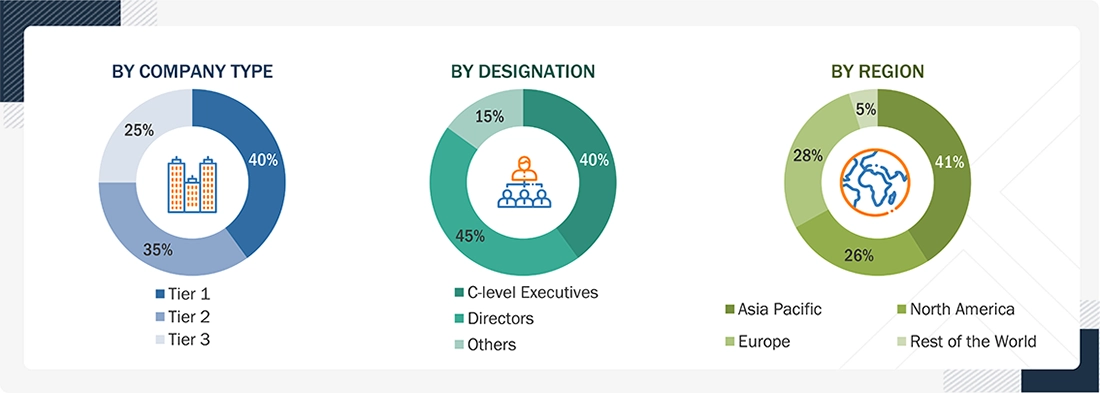
Note: Tier 1 companies include market players with revenues above USD 500 million; tier 2 companies earn revenues between USD 100 million and USD 500 million; and tier 3 companies earn revenues up to USD 100 million. Other designations include sales, marketing, and product managers.
To know about the assumptions considered for the study, download the pdf brochure
Market Size Estimation
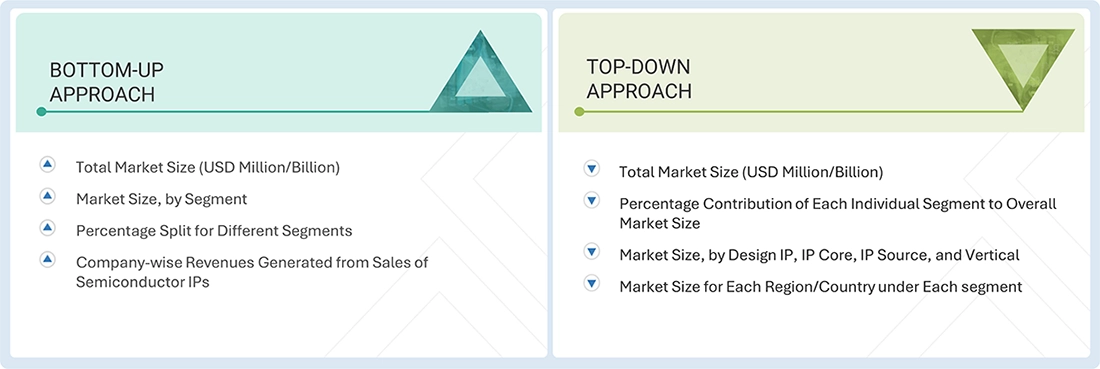
In the complete market estimation process, the top-down and bottom-up approaches were used, along with several data triangulation methods, to estimate and forecast the size of the market and its segments and subsegments listed in the report. Extensive qualitative and quantitative analyses were carried out on the complete market engineering process to list the key information/insights pertaining to the semiconductor IP market.
Key players in the semiconductor IP market were identified through secondary research, and their rankings in the respective regions were determined through primary and secondary research. This entire procedure involved the study of the annual and financial reports of top players and interviews with industry experts, such as chief executive officers, vice presidents, directors, and marketing executives, for quantitative and qualitative insights. All percentage shares, splits, and breakdowns were determined using secondary sources and verified through primary sources. All parameters that affect the markets covered in this research study were accounted for, viewed in extensive detail, verified through primary research, and analyzed to obtain the final quantitative and qualitative data. This data was consolidated and enhanced with detailed inputs and analysis from MarketsandMarkets and presented in this report.
BOTTOM-UP APPROACH
- Identifying the stakeholders in the semiconductor intellectual property (IP) market influencing the entire market, along with the related component players
- Analyzing major providers of semiconductor IPs, studying their portfolios, and understanding different types of product offerings
- Analyzing trends pertaining to the use of different types of semiconductor IP solutions for different applications
- Tracking the ongoing and upcoming developments in the market, such as investments made, R&D activities, product launches, collaborations, and partnerships, and forecasting the market based on these developments and other critical parameters
- Carrying out multiple discussions with key opinion leaders to understand the different types of semiconductor IP solutions and recent trends in the market, thereby analyzing the breakup of the scope of work carried out by major companies
- Arriving at the market estimates by analyzing and totaling the revenues generated by companies from each type of solution
- Categorizing the overall market into various segments
- Verifying and cross-checking the estimated values at every level through discussions with key opinion leaders such as CXOs, directors, and operations managers, and finally with the domain experts in MarketsandMarkets
- Studying various paid and unpaid sources of information, such as annual reports, press releases, white papers, and databases
TOP-DOWN APPROACH
- Focusing initially on top-line investments and expenditures being made in the semiconductor IP ecosystem
- Calculating the market size by considering the revenues generated by players through the sales of semiconductor IP solutions
- Segmenting the market based on R&D activities and developments in key areas
- Segmenting the market based on mapping the usage of semiconductor IP solutions in different applications
- Collecting information related to the revenues generated by players by offering key types of semiconductor IP solutions
- Conducting multiple on-field discussions with key opinion leaders across major companies involved in the development of semiconductor IP solutions
- Estimating the geographic split using secondary sources based on various factors, such as the number of players in a specific country and region, the role of major players in the market for the development of innovative products, adoption and penetration rates in a particular country for various end-use applications, and others
INFOGRAPHIC DEPICTING BOTTOM-UP AND TOP-DOWN APPROACHES
Data Triangulation
After arriving at the overall market size from the market size estimation process explained above, the total market was split into several segments and subsegments. To complete the overall market engineering process and arrive at the exact statistics for all segments and subsegments, the market breakdown and data triangulation procedures were employed, wherever applicable. The data was triangulated by studying various factors and trends from both the demand and supply sides. Along with this, the market size was validated using both the top-down and bottom-up approaches.
Market Definition
The semiconductor intellectual property (IP) market refers to the global ecosystem of reusable and licensable semiconductor design assets that are integrated into integrated circuits (ICs), System-on-Chip (SoC) designs, ASICs, FPGAs, chiplets, and advanced semiconductor devices. These IP blocks include processor architectures, interface protocols, memory subsystems, analog and mixed-signal functions, security engines, and verification IP that are licensed to semiconductor companies for integration into chip designs. The market includes revenues generated through licensing, royalties, subscriptions, maintenance, and IP customization services associated with reusable semiconductor design blocks.
Key Stakeholders
- IP Suppliers
- IP Core Developers
- Integrated Device Manufacturers (IDMs)
- Fabless Semiconductor Companies
- System Companies & Custom Silicon Developers
- Third-party IP Developers
- IP Licensors (licensing vendors)
- Open-source IP Vendors
- IP Aggregators
- Electronic Design Automation (EDA) Vendors
- Non-pure-play (IDM) Foundry Vendors
- Fabrication Players
- Raw Material Vendors
- Semiconductor IP Solution Providers
- System Integrators
- Original Equipment Manufacturers (OEMs)/Device Manufacturers
- Technology Standard Organizations, Forums, Alliances, and Associations
- Governments, Financial Institutions, and Investment Communities
- Research Organizations
- Analysts and Strategic Business Planners
- Venture Capitalists, Private Equity Firms, and Startups
Report Objectives
- To define, describe, and forecast the semiconductor IP market size, in terms of value by design IP, IP core, IP source, IP consumer type, architecture type, vertical, and region
- To describe and forecast the market size across four key regions, namely, North America, Europe, Asia Pacific, and the Rest of the World (RoW), along with their respective country-level market size, in terms of value
- To provide detailed information regarding the drivers, restraints, opportunities, and challenges in the market
- To strategically analyze the micromarkets concerning the individual growth trends, prospects, and their contribution to the market
- To map competitive intelligence based on company profiles, key player strategies, and key developments
- To analyze trends/disruptions impacting customer business, interconnected markets and cross-sector opportunities, strategic moves by tier-1/2/3 players, pricing analysis, patents analysis, trade analysis (export and import scenario), Porter's five forces analysis, macroeconomic indicators, case studies, investment and funding scenario, decision-making process, buyer stakeholders and buying evaluation criteria, adoption barriers and internal challenges, unmet needs from various industries, technology analysis, technology roadmap, ecosystem analysis, regional regulations and compliance, impact of 2025 US tariff, and key conferences and events related to the semiconductor IP market.
- To benchmark the market players using the proprietary company evaluation matrix framework, which analyzes them on various parameters within the broad categories of market ranking/share and product portfolio
- To analyze competitive developments such as contracts, acquisitions, product launches & developments, collaborations, and partnerships, along with research & development (R&D), in the semiconductor IP market
Available customizations:
With the given market data, MarketsandMarkets offers customizations according to the company’s specific needs. The following customization options are available for the report:
COMPANY INFORMATION
- Detailed analysis and profiling of additional market players (up to 7)
Get the Full Semiconductor IP Market Report
Full forecast, segment splits, and company analysis for all Semiconductor IP Market.
- Netherlands Semiconductor IP Market
- US Semiconductor IP Market
- Canada Semiconductor IP Market
- Mexico Semiconductor IP Market
- Germany Semiconductor IP Market
- UK Semiconductor IP Market
- France Semiconductor IP Market
- China Semiconductor IP Market
- Japan Semiconductor IP Market
- Taiwan Semiconductor IP Market
- India Semiconductor IP Market
Need a Tailored Report?
Customize this report to your needs
Get 10% FREE Customization
Customize This Report
