
France IoT Sensors Market (2024-2029)

The France IoT Sensors Market was valued at $530.7 Million in 2024 and projected to reach to $1816.9 Million by 2029, representing a compound annual growth rate of 27.9%. France's IoT Sensors Market is poised for substantial growth through 2029, driven by government-backed digital transformation programs and industrial modernization investments.


| Market Size in | USD 26.32 MN |
| Market Forecast in | |
| CAGR | |
| Forecast Period | |
| Units Considered | Value (USD MN) |
France IoT Sensors Market Trends and Insights
- This represents a compound annual growth rate (CAGR) of 27.9%, significantly driven by France's digital transformation initiatives and industrial modernization efforts.
- France is positioning itself as a key European hub for IoT adoption across manufacturing, smart cities, and connected infrastructure sectors. The French market benefits from strong government support for Industry 4.0 initiatives and substantial investments in smart city infrastructure across major urban centers.
- France's established semiconductor and electronics ecosystem provides a competitive advantage for IoT sensor development and deployment.
- Between 2024 and 2029, France is expected to see accelerated adoption of advanced sensor technologies in automotive, healthcare, and environmental monitoring applications. France's strategic location within the European Union and its commitment to digital sovereignty further enhance market opportunities.
- The country's focus on sustainable IoT solutions and edge computing capabilities positions France as an innovation leader in the broader European IoT sensors landscape..
Key Market Statistics
- CAGR (2024-2029) 27.9% CAGR
- Market Size, 2024 ~USD 530.7 Million
- Forecast, 2029 ~USD 1816.9 Million
- Country France
France IoT Sensors Market Overview
Market Valuation Growth :
France's IoT Sensors Market is valued at USD 530.7 million in 2024, with projections to reach USD 1,816.9 million by 2029, demonstrating exceptional market expansion potential.
Strong CAGR Performance :
The French market is growing at a CAGR of 27.9%, outpacing many European counterparts and reflecting accelerated digital transformation across manufacturing and industrial sectors.
Digital Transformation Driver :
France's commitment to Industry 4.0 and digital modernization initiatives is propelling IoT sensor adoption across automotive, aerospace, and smart city applications.
European Hub Positioning :
France is establishing itself as a strategic European center for IoT innovation, attracting investments and fostering ecosystem development in sensor technology and connected solutions.
France IoT Sensors Market Dynamics
- The country's strong manufacturing base, particularly in automotive and aerospace sectors, is accelerating IoT sensor deployment for predictive maintenance, quality control, and operational efficiency.
- French enterprises are increasingly adopting connected sensor solutions to enhance competitiveness and meet Industry 4.0 standards. The market expansion is further supported by France's commitment to smart city initiatives, renewable energy monitoring, and environmental sustainability goals.
- With a CAGR of 27.9%, the sector presents significant opportunities for technology providers, system integrators, and IoT solution developers targeting the French and broader European markets.
- Strategic partnerships and localized innovation hubs will be critical for capturing market share..
Market Ecosystem
Related Ecosystem
Sensors And Control
- Sensors
- Temperature Sensors
- Image Sensors
- Pressure Sensors
- Flow Sensors
- BAUMER ELECTRIC AG
- HONEYWELL INTERNATIONAL INC.
- Stmicroelectronics
- Lenovo
- Texas Instruments Incorporated
Smart Home
- Sensors
- Pressure Sensors
- Temperature Sensors
- Actuators
- Face Recognition
- HONEYWELL INTERNATIONAL INC.
- SCHNEIDER ELECTRIC SE
- Siemens ag
- Samsung
- Godrej Industries Limited
Aviation
- Narrow Body Aircraft
- Wide Body Aircraft
- Military Helicopters
- Special Mission Aircraft
- Fighter Aircraft
- HONEYWELL INTERNATIONAL INC.
- COLLINS AEROSPACE
- Thales group
- Safran group
- HEICO Corporation
Key Takeaways
- France's IoT Sensors Market will grow from USD 530.7M (2024) to USD 1,816.9M (2029) at a 27.9% CAGR.
- France is leveraging Industry 4.0 and smart city initiatives to drive IoT sensor adoption across multiple sectors.
- France's semiconductor expertise and digital sovereignty focus create competitive advantages in sensor innovation.
- France is expected to lead European IoT sensor deployment in automotive, healthcare, and environmental monitoring by 2029.
IoT Sensors Market Report Scope
| Report Metric | Details |
|---|---|
| Base Year | 2024 |
| Fastest Growing Segment | CONSUMER IOT (Vertical) |
| Forecast Period | 2024-2029 |
| Growth Rate | CAGR of 34.4% from 2024 to 2029 |
| Largest Segment | WIRELESS (Network Technology) |
| Market Size Base Year (Billions) | ~USD 15.99 (2024) |
| Revenue Forecast (Billions) | ~USD 70.1 (2029) |
| Segments Covered | Sensor Type, Vertical, Network Technology, Type, End Use Applications, Retail Applications, Healthcare Applications, Smart Agriculture Applications |
France IoT Sensors Market Report Segmentation
8 segment dimensions are covered across the global market.
By Sensor Type
- Accelerometers
- Acoustic Sensors
- Co2 Sensors
- Flow Sensors
- Gyroscopes
- Humidity Sensors
- Image Sensors
- Inertial Sensors
- Magnetometers
- Motion Sensors
- Occupancy Sensors
- Other Sensor Types
- Other Sensors
- Pressure Sensors
- Proximity Sensors
- Temperature Sensors
- Touch Sensors
By Vertical
- Commercial IoT
- Consumer IoT
- Industrial IoT
By Network Technology
- Wired
- Wireless
By Type
- 6Lowpan
- Bluetooth
- Dali
- Dect-Ule
- Enocean
- Ethernet
- Knx
- Lonworks
- Modbus
- Nfc
- Profibus
- Rfid
- Thread
- Whart
- Wi-Fi
- Z-Wave
- Zigbee
By End Use Applications
- Aerospace & Defense
- Corporate Offices
- Energy
- Entertainment
- Financial Institutes
- Healthcare
- Industrial Automation
- Logistics, Supply Chain, And Transportation
- Retail
- Smart Agriculture
- Smart Cities
By Retail Applications
- Advertising And Marketing
- Digital Signage
- Digital Signages
- Energy Optimization
- Intelligent Payment Solutions
- Real-Time/ Streaming Analytics
- Resource Management
- Safety & Security
- Smart Shelves And Smart Doors
- Smart Vending Machines
By Healthcare Applications
- Clinical Operations And Workflow Management
- Connected Imaging
- Inpatient Monitoring
- Medication Management
- Other Healthcare Applications
- Telemedicine
By Smart Agriculture Applications
- Fish Farming
- Livestock Monitoring
- Other Smart Agriculture Applications
- Precision Farming
- Smart Greenhouses
Target Audience
- IoT Sensor Manufacturers : Manufacturers need France-specific market data to optimize product development, pricing strategies, and distribution channels aligned with local industrial requirements and growth opportunities.
- System Integrators & Solution Providers : Integration firms require detailed France market insights to identify customer segments, assess competitive positioning, and develop localized IoT solutions for manufacturing and smart city applications.
- Investment & Private Equity Firms : Investors need comprehensive France market analysis to evaluate portfolio opportunities, assess growth potential, and make informed decisions on IoT technology investments in the region.
- Corporate Strategy & Business Development : Enterprise decision-makers need France market intelligence to guide expansion strategies, partnership development, and resource allocation for IoT initiatives and digital transformation programs.
- Government & Policy Organizations : Policy makers and government agencies require market data to inform digital transformation initiatives, industrial policy development, and strategic planning for IoT ecosystem growth in France.
Reasons to Buy this Report
- Market Size & Growth Validation : Access precise valuation data for France's IoT Sensors Market with verified CAGR of 27.9%, enabling accurate financial forecasting and investment decision-making for the 2024-2029 period.
- Competitive Positioning Intelligence : Understand France's market dynamics relative to global trends (34.4% global CAGR) to identify competitive advantages and market entry strategies specific to the French ecosystem.
- Sector-Specific Growth Drivers : Gain insights into France's unique digital transformation initiatives, Industry 4.0 adoption, and industrial modernization efforts driving IoT sensor demand across key verticals.
- Strategic Investment Guidance : Leverage detailed France market analysis to identify high-potential segments, regional partnerships, and expansion opportunities within manufacturing, automotive, and smart city sectors.
- Risk Mitigation & Planning : Develop informed go-to-market strategies for France with comprehensive market intelligence, regulatory insights, and competitive landscape analysis to minimize market entry risks.
Frequently asked questions
What is the current size of France's IoT Sensors Market?
France's IoT Sensors Market was valued at USD 530.7 million in 2024 and is projected to grow to USD 1,816.9 million by 2029.
What is the expected growth rate for France's IoT Sensors Market?
France's IoT Sensors Market is expected to grow at a compound annual growth rate (CAGR) of 27.9% from 2024 to 2029.
Which sectors are driving IoT sensor adoption in France?
Key sectors driving France's IoT sensor adoption include manufacturing (Industry 4.0), smart cities, automotive, healthcare, and environmental monitoring applications.
What government initiatives support IoT growth in France?
France supports IoT growth through Industry 4.0 initiatives, smart city infrastructure investments, and digital sovereignty programs that encourage sensor technology development.
How does France's market compare to the broader European IoT Sensors Market?
France's 27.9% CAGR positions it as a strong growth market within Europe, driven by its semiconductor expertise and commitment to digital transformation initiatives.
RESEARCH METHODOLOGY
The study involved four major activities in estimating the size of the IoT sensors market. Exhaustive secondary research has been done to collect information on the market, peer market, and parent market. Validation of these findings, assumptions, and sizing with industry experts across the value chain through primary research has been the next step. Both top-down and bottom-up approaches have been employed to estimate the global market size. After that, market breakdown and data triangulation have been used to estimate the market sizes of segments and subsegments.
Secondary Research
Secondary sources that were referred to for this research study include corporate filings (such as annual reports, investor presentations, and financial statements); trade, business, and professional associations; white papers; certified publications; articles from recognized authors; directories; and databases. Secondary data was collected and analyzed to arrive at the overall market size, further validated by primary research.
Primary Research
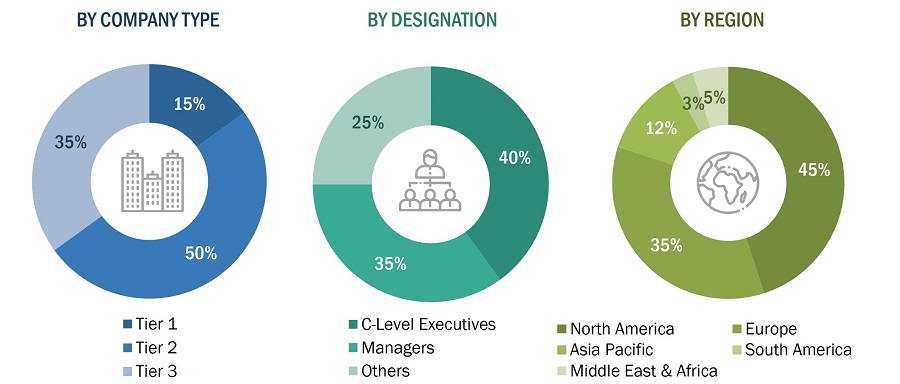
Extensive primary research was conducted after understanding and analyzing the IoT sensors market size scenario through the secondary research process. Several primary interviews were conducted with key opinion leaders from both the demand- and supply-side vendors across four major regions—North America, Asia Pacific, Europe, and RoW (including the Middle East & Africa and South America).
After interacting with industry experts, brief sessions were conducted with highly experienced independent consultants to reinforce the findings from our primary. This, along with the in-house subject matter experts’ opinions, has led us to the findings as described in the remainder of this report.
To know about the assumptions considered for the study, download the pdf brochure
IoT Sensors Market Size Estimation
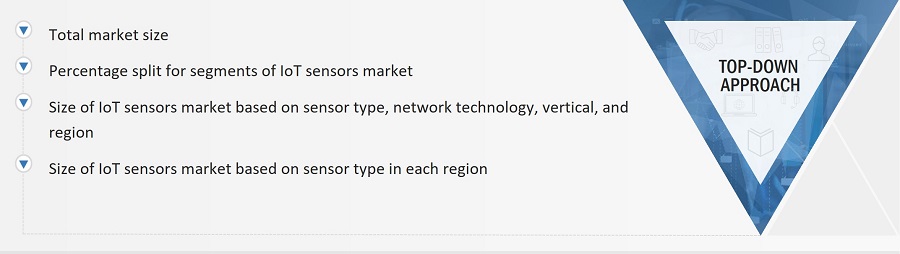
In the complete market engineering process, both top-down and bottom-up approaches have been used, along with several data triangulation methods to perform market estimation and forecasting for the overall market segments and subsegments listed in this report. Extensive qualitative and quantitative analyses have been performed on the complete market engineering process to list key information/insights. The research methodology used to estimate the market size includes the following:
- Key players in major applications and markets have been identified through extensive secondary research.
- The industry’s supply chain and market size, in terms of value, have been determined through primary and secondary research processes.
- All percentage shares, splits, and breakdowns have been determined using secondary sources and verified through primary sources.
After arriving at the overall market size from the market size estimation process explained above, the total market has been split into several segments and subsegments. To complete the overall market engineering process and arrive at the exact statistics for all segments and subsegments, the market breakdown and data triangulation procedures have been employed, wherever applicable. The data has been triangulated by studying various factors and trends from both demand-and supply-side. Along with this, the market has been validated using both top-down and bottom-up approaches.
IoT sensors Market Top-down Approach
Data Triangulation
After arriving at the overall market size through the process explained earlier, the total market was split into several segments. The market breakdown and data triangulation procedures were employed, wherever applicable, to complete the overall market engineering process and arrive at the exact statistics for all the segments and subsegments. The data was triangulated by studying various factors and trends from both the demand and supply sides. The market was validated using both the top-down and bottom-up approaches.
Market Definition
IoT sensors refer to sensors used in smart applications, which require uninterrupted connectivity to carry out real-time data analytics. They require common connecting platforms for collecting and analyzing data. IoT sensors are based on the computing concept that considers every physical object to be connected to the Internet to communicate with each other. Sensors are the most important component in the IoT ecosystem. They gather required data from their surroundings and communicate it to the concerned operators. Image, temperature, pressure, ultrasonic, light, and position sensors, accelerometers, and gyroscopes are the key sensors in the IoT ecosystem.
Key Stakeholders
- Semiconductor Companies
- Embedded System Companies
- Consumer Electronics Manufacturers
- Sensor Manufacturers
- Technology Providers
- Original Equipment Manufacturers (OEMs)
- Universities and Research Organizations
- Internet Identity Management, Privacy, and Security Companies
- Machine-to-Machine (M2M), IoT, and Telecommunication Companies
- Government Bodies
Report Objectives
- To describe and forecast the size of the Internet of Things (IoT) sensors market in terms of value, based sensor type, network technology, vertical, and region
- To forecast the market size, in terms of value, for various segments in four key regions, namely, North America, Europe, Asia Pacific (APAC), and the Rest of the World (RoW)
- To forecast the size of the IoT sensors market size in terms of volume
- To provide detailed information regarding the key factors such as drivers, restraints, opportunities, and challenges influencing the growth of the IoT sensors market
- To analyze micromarkets1 with respect to individual growth trends, prospects, and contribution to the total market
-
To analyze the opportunities in the market for various stakeholders by identifying the
high-growth segments of the IoT sensors market size - To profile the key players and comprehensively analyze their market ranking and core competencies2, along with a detailed competitive landscape for the market leaders.
- To map the competitive intelligence based on the company profiles, key player strategies, and game-changing developments, such as product launches and developments, partnerships, collaborations, and acquisitions undertaken in the market.
Available customizations:
MarketsandMarkets offers the following customizations for this market report:
- Further breakdown of the market in different regions to the country-level
- Detailed analysis and profiling of additional market players (up to 5)
Get the Full IoT Sensors Market Report
Full forecast, segment splits, and company analysis for all IoT Sensors Market.
- Canada IoT Sensors Market
- Mexico IoT Sensors Market
- US IoT Sensors Market
- Germany IoT Sensors Market
- Italy IoT Sensors Market
- Rest Of Europe IoT Sensors Market
- Spain IoT Sensors Market
- UK IoT Sensors Market
- Australia IoT Sensors Market
- China IoT Sensors Market
- India IoT Sensors Market
- Japan IoT Sensors Market
- Rest Of Asia Pacific IoT Sensors Market
- South Korea IoT Sensors Market
Need a Tailored Report?
Customize this report to your needs
Get 10% FREE Customization
Customize This Report
