
Rest Of Asia Pacific Small Modular Reactor Market (2024-2029)

The Rest Of Asia Pacific Small Modular Reactor Market was valued at $106.1 Million in 2024 and projected to reach to $113.1 Million by 2029, representing a compound annual growth rate of 1.1%. Rest Of Asia Pacific's small modular reactor market is positioned for gradual expansion as regional governments recognize SMRs' potential for distributed power generation and industrial heat applications.


| Market Size in | USD 26.32 MN |
| Market Forecast in | |
| CAGR | |
| Forecast Period | |
| Units Considered | Value (USD MN) |
Rest Of Asia Pacific Small Modular Reactor Market Trends and Insights
- Rest Of Asia Pacific represents a developing segment within the broader Asia Pacific energy landscape, where SMR adoption remains nascent compared to traditional nuclear and renewable energy sources.
- The region's growth trajectory reflects emerging interest in decentralized power generation and energy security initiatives across smaller economies and island nations. Rest Of Asia Pacific's modest CAGR of 1.1% indicates a cautious but steady market expansion driven by regulatory frameworks, technological maturation, and increasing energy demand.
- Throughout the 2024-2029 forecast period, Rest Of Asia Pacific is expected to benefit from regional cooperation on nuclear technology and growing recognition of SMRs as viable solutions for remote and off-grid applications.
- However, Rest Of Asia Pacific faces challenges including limited domestic manufacturing capacity, high capital requirements, and competing renewable energy investments that may constrain faster market penetration..
Key Market Statistics
- CAGR (2024-2029) 1.1% CAGR
- Market Size, 2024 ~USD 106.1 Million
- Forecast, 2029 ~USD 113.1 Million
- Country Rest Of Asia Pacific
Rest Of Asia Pacific Small Modular Reactor Market Overview
Modest Growth Trajectory :
Rest Of Asia Pacific's SMR market is expanding at 1.1% CAGR from 2024 to 2029, reflecting slower adoption compared to the global 3% growth rate, indicating emerging market dynamics and infrastructure development challenges.
Valuation Growth :
Market size is projected to increase from USD 106.1 million in 2024 to USD 113.1 million by 2029, representing a USD 7 million absolute gain driven by pilot projects and regulatory framework development.
Nascent SMR Adoption :
Rest Of Asia Pacific remains in early stages of SMR deployment, with limited commercial projects compared to traditional nuclear and renewable energy infrastructure, creating significant growth potential as energy demands increase.
Regional Energy Transition :
The region is gradually exploring SMRs as a decarbonization solution to meet rising electricity demand while addressing grid modernization and energy security concerns in developing economies.
Rest Of Asia Pacific Small Modular Reactor Market Dynamics
- The 1.1% CAGR reflects the region's cautious approach to nuclear technology adoption, driven by regulatory development, capital constraints, and competing renewable energy investments.
- However, increasing energy demand, climate commitments, and technological maturation are expected to accelerate interest in coming years. Key growth drivers include infrastructure modernization in developing nations, remote area electrification needs, and industrial decarbonization initiatives.
- Strategic partnerships with established nuclear vendors and international financing mechanisms will be critical to overcoming adoption barriers.
- By 2029, Rest Of Asia Pacific is expected to transition from pilot phase to early commercial deployment, positioning the region as an emerging market for SMR technology providers and energy investors..
Market Ecosystem
Related Ecosystem
Decarbonization
- Battery Electric Vehicle (BEV)
- Energy Management Systems
- Fuel Cell
- Fuel Cell Electric Vehicle (FCEV)
- Geographical Information System (GIS)
- TotalEnergies SE
- Siemens ag
- Mitsui & Co., Ltd.
- General Electric Company
- Thyssenkrupp ag
Power Infrastructure
- Geographical Information System (GIS)
- Cogeneration
- Battery Electric Vehicle (BEV)
- Cellular Network
- Fuel Cell
- ABB India Limited
- Siemens ag
- SCHNEIDER ELECTRIC SE
- General Electric Company
- Eaton Corporation plc
Key Takeaways
- Rest Of Asia Pacific's SMR market is valued at USD 106.1 million in 2024 and will reach USD 113.1 million by 2029, growing at 1.1% CAGR.
- Rest Of Asia Pacific exhibits slower growth compared to global averages, reflecting early-stage market maturity and regulatory development.
- Rest Of Asia Pacific's SMR adoption is driven by energy security needs, decentralized power requirements, and emerging nuclear technology frameworks.
- Rest Of Asia Pacific faces barriers including capital intensity, limited local supply chains, and competition from renewable energy alternatives.
Small Modular Reactor Market Report Scope
| Report Metric | Details |
|---|---|
| Base Year | 2024 |
| Fastest Growing Segment | POWER GENERATION (Application) |
| Forecast Period | 2024-2029 |
| Growth Rate | CAGR of 3% from 2024 to 2029 |
| Largest Segment | MULTI-MODULE POWER PLANTS (Deployment) |
| Market Size Base Year (Billions) | ~USD 5.98 (2024) |
| Revenue Forecast (Billions) | ~USD 6.93 (2029) |
| Segments Covered | Power Rating, Coolant, Type, Deployment, Connectivity, Application |
Rest Of Asia Pacific Small Modular Reactor Market Report Segmentation
6 segment dimensions are covered across the global market.
By Power Rating
- 101-200 Mw
- 201-300 Mw
- Up To 100 Mw
By Coolant
- Gases
- Heavy Liquid Metals
- Molten Salts
- Water
By Type
- Boiling Water Reactors
- Fast Neutron Reactors
- Heavy Water Reactors
- High-Temperature Reactor
- High-Temperature Reactors
- Light Water Reactors
- Molten Salt Reactors
- Pressurized Water Reactors
By Deployment
- Multi-Module Power Plants
- Single-Module Power Plants
By Connectivity
- Grid-Connected
- Off-Grid
By Application
- Desalination
- Hydrogen Production
- Industrial
- Power Generation
- Process Heat
Target Audience
- Nuclear Technology Vendors : SMR manufacturers and technology providers need Rest Of Asia Pacific-specific market data to assess regional demand, identify pilot project opportunities, and develop localized commercialization strategies.
- Energy & Utility Companies : Regional power generators and utility operators require detailed market insights to evaluate SMR integration into their portfolios, assess competitive positioning, and plan long-term energy transition investments.
- Investment & Financial Institutions : Private equity, venture capital, and infrastructure investors need Rest Of Asia Pacific SMR market forecasts to evaluate project financing opportunities, assess risk-return profiles, and identify portfolio diversification options.
- Government & Policy Makers : Regional energy ministries and regulatory bodies use market analysis to inform nuclear policy development, infrastructure planning, and climate commitments while understanding SMR's role in energy security.
- Consulting & Strategic Advisors : Management consultants and strategic advisors serving energy clients require Rest Of Asia Pacific-specific data to support market assessments, feasibility studies, and go-to-market strategy development.
Reasons to Buy this Report
- Regional Market Differentiation : Gain specific insights into Rest Of Asia Pacific's unique SMR dynamics, separate from broader Asia Pacific trends, enabling targeted market entry and investment strategies for this emerging segment.
- Growth Opportunity Identification : Understand the 1.1% CAGR trajectory and USD 7 million market expansion potential through 2029, identifying early-mover advantages in a nascent but developing SMR market with limited competition.
- Regulatory & Infrastructure Landscape : Access detailed analysis of Rest Of Asia Pacific's regulatory frameworks, pilot projects, and infrastructure readiness, critical for navigating market entry and partnership development in developing economies.
- Competitive Positioning : Benchmark your SMR technology, services, or investments against regional adoption rates and identify gaps in the market where Rest Of Asia Pacific lags behind global leaders, revealing strategic opportunities.
- Investment Decision Support : Make informed capital allocation decisions with granular forecasts specific to Rest Of Asia Pacific, supporting business case development for SMR projects, partnerships, and market expansion initiatives.
Frequently asked questions
What is the market size of Rest Of Asia Pacific's small modular reactor sector in 2024?
Rest Of Asia Pacific's small modular reactor market is valued at USD 106.1 million in 2024.
What is the projected market size for Rest Of Asia Pacific SMRs by 2029?
Rest Of Asia Pacific's SMR market is forecast to reach USD 113.1 million by 2029.
What is the CAGR for Rest Of Asia Pacific's small modular reactor market?
Rest Of Asia Pacific's SMR market is expected to grow at a compound annual growth rate of 1.1% from 2024 to 2029.
Why is Rest Of Asia Pacific's SMR growth rate lower than the global average?
Rest Of Asia Pacific exhibits slower growth due to early regulatory frameworks, limited manufacturing infrastructure, high capital requirements, and competition from renewable energy investments.
What are the primary drivers of SMR adoption in Rest Of Asia Pacific?
Rest Of Asia Pacific's SMR adoption is driven by energy security concerns, demand for decentralized power in remote areas, technological maturation, and regional nuclear cooperation initiatives.
RESEARCH METHODOLOGY
The study involved major activities in estimating the current size of the small modular reactor market. Exhaustive secondary research was done to collect information on the peer and parent markets. The next step was to validate these findings, assumptions, and sizing with industry experts across the value chain through primary research. Both top-down and bottom-up approaches were employed to estimate the total market size. Thereafter, market breakdown and data triangulation were used to estimate the market size of the segments and subsegments.
Secondary Research
Secondary sources referred to for this research study include annual reports, press releases, and investor presentations of companies; white papers; certified publications; articles by recognized authors; and databases of various companies and associations. Secondary research was mainly used to obtain key information about the industry’s supply chain, the total pool of key players, market classification, and segmentation according to industry trends to the bottom-most level, regional markets, and key developments from both, market- and technology-oriented perspectives.
Primary Research
In the primary research process, various primary sources from the supply and demand sides were interviewed to obtain qualitative and quantitative information for this report. Primary sources from the supply side include industry experts such as chief executive officers (CEOs), vice presidents (VPs), marketing directors, and related key executives from various companies and organizations operating in the small modular reactors market.
In the complete market engineering process, the top-down and bottom-up approaches, along with several data triangulation methods, were extensively used to perform the market size estimations and forecasts for all segments and subsegments listed in this report. Extensive qualitative and quantitative analyses were conducted to complete the market engineering process and list key information/insights throughout the report. Following is the breakdown of primary respondents:
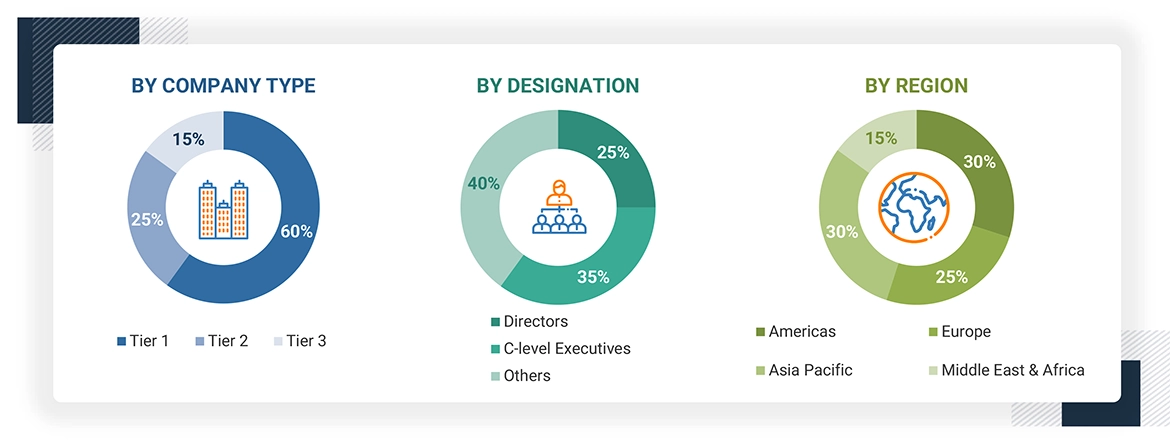
Note: Other designations include sales managers, engineers, and regional managers.
The tier of the companies is defined based on their total revenue; as of 2023: Tier 1 = > USD 1 billion, Tier
2 = From USD 500 million to USD 1 billion, and Tier 3 = < USD 500 million.
To know about the assumptions considered for the study, download the pdf brochure
Market Size Estimation
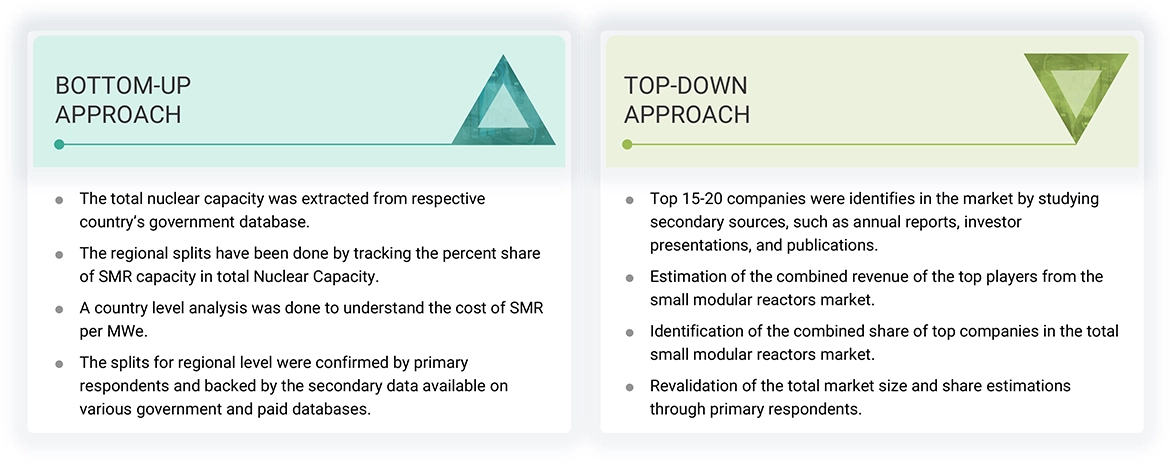
Both top-down and bottom-up approaches were used to estimate and validate the size of the small modular reactors market. These methods were also used extensively to estimate the size of various subsegments in the market. The research methodology used to estimate the market size includes the following:
Small Modular Reactor Market : Top-Down and Bottom-Up Approach
Data Triangulation
After arriving at the overall market size from the estimation process explained below, the total market was split into several segments and subsegments. The data triangulation and market breakdown procedures were employed, wherever applicable, to complete the overall market engineering process and arrive at the exact statistics for all segments and subsegments. The data was triangulated by studying various factors and trends from both the demand and supply sides. The market size was validated using the top-down and bottom-up approaches.
Market Definition
According to the World Nuclear Association, “Small modular reactors (SMRs) are defined as nuclear reactors generally 300 MWe equivalent or less, designed with modular technology using module factory fabrication, pursuing economies of series production and short construction times.” SMRs vary in terms of size and thermal output. These reactors can be used for various applications, such as power generation, process heating, desalination, and industrial uses. Their designs may employ light water as a coolant or other coolants, such as gases, liquid metals, or molten salts. Small modular reactors offer multiple benefits, such as small physical footprints, reduced capital investments compared with traditional nuclear power plants, the ability to be sited in locations not possible for larger nuclear plants, and provisions for incremental power additions.
The small modular reactors market size is defined as the sum revenue generated by global companies' manufacturing small modular reactors.
Stakeholders
- Consulting companies in energy & power sector
- Government and research organizations
- Investment banks
- Nuclear power plant operators
- Power and energy associations
- Small modular reactor support service providers
- Manufacturers of small modular reactors
- Small modular reactor component manufacturers and fuel fabricators
- Power generation companies
- Heavy industries
Report Objectives
- To describe, segment, and forecast the small modular reactors market based on type, coolant, connectivity, deployment, location, power rating, and application, in terms of value
- To describe and forecast the market for four key regions: Americas, Europe, Asia Pacific, and Middle East & Africa, along with their country-level market sizes, in terms of value
- To forecast the small modular reactors market by type and region, in terms of volume
- To strategically analyze micromarkets1 with respect to individual growth trends, future expansions, and their contribution to the overall small modular reactors market.
- To provide detailed information regarding key drivers, restraints, opportunities, and challenges influencing the growth of the market
- To provide the supply chain analysis, trends/disruptions impacting customers’ businesses, ecosystem analysis, regulatory landscape, pricing analysis, patent analysis, case study analysis, technology analysis, key conferences and events, trade analysis, Porter’s Five Forces analysis, and key stakeholders and buying criteria sections in the small modular reactors market
- To analyze opportunities for stakeholders in the small modular reactors market and draw a competitive landscape
- To benchmark market players using the company evaluation quadrant, which analyzes market players on broad categories of business and product strategies adopted by them
- To compare key market players with respect to product specifications and applications
- To strategically profile key players and comprehensively analyze their market rankings and core competencies2
- To analyze competitive developments such as contracts and agreements, investments and expansions, mergers and acquisitions, partnerships, joint ventures, and collaborations in the small modular reactors market
- To study the impact of AI/Gen AI on the market under study, along with the global macroeconomic outlook
Available Customizations
With the given market data, MarketsandMarkets offers customizations according to the specific requirements of companies. The following customization options are available for the report:
Product Analysis
- Product Matrix, which provides a detailed comparison of the product portfolio of each company
Company Information
- Detailed analyses and profiling of additional market players
Get the Full Small Modular Reactor Market Report
Full forecast, segment splits, and company analysis for all Small Modular Reactor Market.
- China Small Modular Reactor Market
- Japan Small Modular Reactor Market
- India Small Modular Reactor Market
- South Korea Small Modular Reactor Market
- US Small Modular Reactor Market
- Canada Small Modular Reactor Market
- Argentina Small Modular Reactor Market
- France Small Modular Reactor Market
- UK Small Modular Reactor Market
- Russia Small Modular Reactor Market
- South Africa Small Modular Reactor Market
- Rest Of Europe Small Modular Reactor Market
- GCC Countries Small Modular Reactor Market
Need a Tailored Report?
Customize this report to your needs
Get 10% FREE Customization
Customize This Report
