
UAE Smart Buildings Market (2021-2026)

The UAE Smart Buildings Market was valued at $1924 Million in 2021 and projected to reach to $3383 Million by 2026, representing a compound annual growth rate of 12.0%. The UAE smart buildings market is poised for sustained growth through 2026, driven by increasing investments in smart city infrastructure, rising energy costs, and regulatory mandates for building efficiency.


| Market Size in | USD 26.32 MN |
| Market Forecast in | |
| CAGR | |
| Forecast Period | |
| Units Considered | Value (USD MN) |
UAE Smart Buildings Market Trends and Insights
- This expansion reflects UAE's strategic positioning as a regional technology hub and its commitment to digital transformation across commercial and residential infrastructure.
- The UAE smart buildings market is driven by increasing government initiatives, rising urbanization, and growing demand for energy-efficient solutions across Dubai, Abu Dhabi, and other emirates. UAE's smart buildings sector benefits from substantial investments in IoT, artificial intelligence, and building automation technologies.
- The UAE smart buildings market growth is supported by favorable regulatory frameworks and the nation's Vision 2021 and Vision 2030 development agendas.
- Between 2021 and 2026, the UAE smart buildings market is expected to capture increasing adoption rates among enterprises seeking operational efficiency, cost reduction, and enhanced occupant experiences through integrated smart building solutions..
Key Market Statistics
- CAGR (2021-2026) 12.0% CAGR
- Market Size, 2021 ~USD 1924 Million
- Forecast, 2026 ~USD 3383 Million
- Country UAE
UAE Smart Buildings Market Overview
Rapid Market Expansion :
UAE's smart buildings market is experiencing robust growth with a 12% CAGR, significantly outpacing the global average of 10.9%, driven by aggressive digital infrastructure investments and government modernization initiatives.
Strategic Regional Hub :
As the Middle East's leading technology and innovation center, UAE is leveraging smart building solutions to enhance operational efficiency across Dubai and Abu Dhabi's expanding commercial and residential sectors.
Government-Backed Initiatives :
UAE's commitment to digital transformation through Vision 2021 and emirate-specific smart city projects is accelerating adoption of IoT, automation, and energy management systems in building infrastructure.
Sustainability Focus :
Growing emphasis on sustainable development and energy efficiency standards is propelling demand for smart HVAC, lighting, and resource management solutions across UAE's premium real estate developments.
UAE Smart Buildings Market Dynamics
- Major developments in Dubai and Abu Dhabi, coupled with the expansion of commercial real estate, are creating substantial opportunities for integrated building management systems and IoT solutions.
- The market's 12% CAGR reflects strong demand from both public sector modernization projects and private developers seeking competitive differentiation through smart technologies.
- Government support for digital transformation and sustainability goals will continue to fuel market expansion, positioning UAE as a regional leader in smart building adoption and innovation..
Market Ecosystem
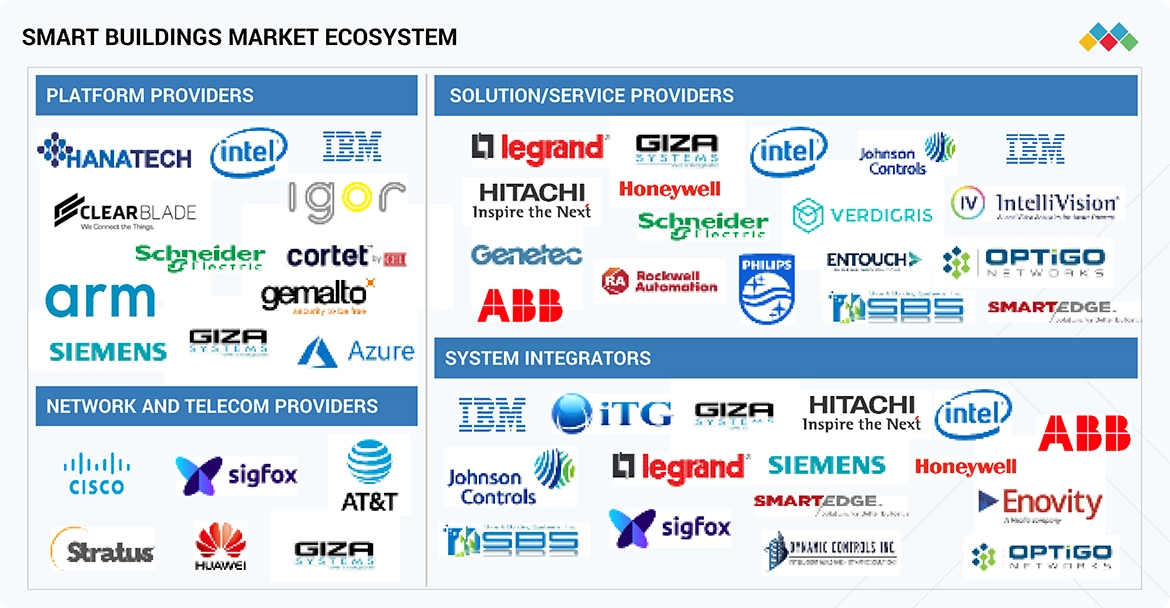
SMART BUILDINGS MARKET: COMMERCIAL USE CASES ACROSS INDUSTRIES
| COMPANY | USE CASE DESCRIPTION | BENEFITS |
|---|---|---|
 |
Siemens assists in managing large commercial spaces by integrating heating, ventilation, air conditioning, lighting, and security systems into a single system, which can then be used to monitor operations on a day-to-day basis. | Lower energy consumption | Improved building security | Centralized facility management |
 |
The software used by the property manager is provided by Honeywell and helps in monitoring the spaces and improving the quality of air. The sensor network helps in regulating the temperature according to the number of people in that area. | Healthier indoor environment | Reduced energy waste | Better use of office space |
 |
Johnson Controls helps in the creation of smart facilities through its provision of platforms that make use of data in predicting maintenance. This means that problems will be fixed in advance in order to prevent breakdowns. | Reduced equipment downtime | Lower maintenance costs | Improved operational efficiency |
Logos and trademarks shown above are the property of their respective owners. Their use here is for informational and illustrative purposes only.
Related Ecosystem
Digitalization And Iot
- Sensors
- Remote Monitoring
- Supply Chain Management
- Passenger Information System (PIS)
- Platform as A Service (PaaS)
- International Business Machines Corporation
- Cisco Systems, Inc.
- MICROSOFT CORPORATION
- Oracle Corporation
- HUAWEI TECHNOLOGIES CO LTD
Key Takeaways
- UAE smart buildings market is projected to grow from $1,924M (2021) to $3,383M (2026) at a 12.0% CAGR
- UAE's strategic focus on digital transformation and Vision 2030 initiatives accelerates smart building adoption
- Energy efficiency and operational cost reduction drive enterprise investment in UAE smart buildings solutions
- UAE's position as a regional technology leader attracts major smart building vendors and solution providers
Smart Buildings Market Report Scope
| Report Metric | Details |
|---|---|
| Base Year | 2021 |
| Fastest Growing Segment | SUPPORT AND MAINTENANCE (Type) |
| Forecast Period | 2021–2026 |
| Growth Rate | CAGR of 10.9% from 2021 to 2026 |
| Largest Segment | SOLUTIONS (Component) |
| Market Size Base Year (Billions) | ~USD 72.49 (2021) |
| Revenue Forecast (Billions) | ~USD 121.6 (2026) |
| Segments Covered | Component, Type, Building Type |
UAE Smart Buildings Market Report Segmentation
3 segment dimensions are covered across the global market.
By Component
- Services
- Solutions
By Type
- Access Control System
- Building Infrastructure Management
- Capital Project Management
- Consulting
- Elevators And Escalators Management System
- Energy Management
- Environment And Energy Management
- Facility Management
- Hvac Control System
- Implementation
- Iwms
- Lighting Management System
- Network Management
- Operations And Services Management
- Parking Management System
- Real Estate Management
- Safety And Security Management
- Safety System
- Smart Water Management System
- Support And Maintenance
- Video Surveillance System
- Wired Technology
- Wireless Technology
By Building Type
- Commercial
- Industrial
- Residential
Target Audience
- Smart Building Technology Vendors : Vendors of IoT platforms, building automation systems, and energy management solutions need UAE-specific market data to identify customer segments, competitive positioning, and expansion opportunities in the high-growth Emirates market.
- Real Estate Developers & Property Managers : UAE-based developers and property management companies require market insights to understand smart building adoption trends, technology ROI, and customer expectations to remain competitive in Dubai and Abu Dhabi's premium segments.
- System Integrators & Consultants : Integration firms and consulting companies need detailed UAE market analysis to advise clients on smart building investments, technology selection, and implementation strategies aligned with local regulations and market dynamics.
- Government & Municipal Authorities : UAE government agencies and municipal bodies planning smart city infrastructure require market forecasts and technology trends to guide procurement policies, sustainability initiatives, and digital transformation roadmaps.
- Investment & Private Equity Firms : Investors evaluating opportunities in UAE's smart buildings sector need comprehensive market sizing, growth projections, and competitive analysis to assess portfolio companies and identify acquisition or funding targets.
Key Companies in the UAE Smart Buildings Market
| Company | HQ | Ownership | Strongest segments |
|---|---|---|---|
| BELDEN INC | United States | Public Company | Industrial Ethernet switches and industrial networking,Structured cabling for enterprise and smart buildings,Fiber and copper cables for industrial and broadcast, |
| TELENET GROUP | Belgium | Private Company | Residential broadband and fixed-line connectivity,Pay TV and video (HD, pay TV, VOD, set-top boxes),Mobile services and handsets (BASE and FMC mobile), |
| SNC-LAVALIN GROUP INC. | Canada | Public Company | Consultancy, Strategy & Advisory,Engineering & Design Services,Project & Program Management / Delivery, |
| FOXCONN INDUSTRIAL INTERNET CO LTD | China | Public Company | Servers and Storage Hardware,Networking Equipment,Cloud Computing Infrastructure Platforms, |
| DHC SOFTWARE CO., LTD. | China | Public Company | Healthcare and internet medical solutions,Financial services software and platforms,Government, smart city, and public security solutions, |
| LENOVO | China | Public Company | Small form factor / desktop signage controllers,Embedded / dedicated media players and thin clients,Tablets, smart devices, and interactive kiosks, |
| ZENSAR TECHNOLOGIES LTD | India | Public Company | |
| TATA COMMUNICATIONS LTD | India | Public Company | Network and Connectivity Services (voice, data transmission, internet, undersea bandwidth),Managed Services and Colocation (hosting, data center colocation, network management),Cloud and AI Platforms (IZO, IZO+, Vayu Cloud, AI Studio, ThreadSpan, TC), |
| IBM | United States | Public Company | Software (Hybrid Cloud & AI Platforms),Consulting (Strategy, Technology, Intelligent Operations),Infrastructure (Servers, Storage, Hybrid Cloud Infrastructure Services), |
| SIEMENS | Germany | Public Company | Digital Industries (automation, PLM, simulation),Smart Infrastructure (electrification, buildings, grid),Mobility (rail systems, automation, services), |
| JOHNSON CONTROLS | Ireland | Public Company | HVAC and refrigeration equipment,Controls and building management systems,Fire detection and suppression, |
| INTEL | United States | Public Company | Client Computing Group (CCG),Data Center and AI (DCAI),Intel Foundry, |
| PTC | United States | Public Company | PLM and ALM (Windchill, Arena, Codebeamer, FlexPLM),CAD and product development (Creo, Onshape, Mathcad),Industrial IoT and connectivity (ThingWorx, Kepware, Kepware Edge, KEPServerEX), |
| ABB | Switzerland | Public Company | Electrification (switchgear, breakers, distribution, UPS, building solutions),Motion (drives, motors, generators, traction converters),Automation (process, hybrid, factory automation, software, services), |
BELDEN INC
Belden Inc. is a publicly traded American company founded in 1902 that employs approximately 8,000 people. The company operates as a manufacturer and supplier of signal transmission products and solutions.
TELENET GROUP
Telenet Group is a private Belgian telecommunications company founded in 1994 with 3,467 employees, providing broadband, television, and telephony services.
SNC-LAVALIN GROUP INC.
SNC-Lavalin Group Inc. is a publicly traded Canadian engineering and construction company founded in 1911 with approximately 40,246 employees, serving diverse sectors including infrastructure and energy.
FOXCONN INDUSTRIAL INTERNET CO LTD
Foxconn Industrial Internet Co Ltd is a publicly traded Chinese company founded in 2015 with over 217,000 employees, specializing in industrial internet and smart manufacturing solutions.
DHC SOFTWARE CO., LTD.
DHC Software Co., Ltd. is a publicly traded Chinese software company founded in 2001 with approximately 10,757 employees, providing enterprise software and IT solutions.
LENOVO
Lenovo is a Chinese technology company founded in 1984 and operates as a publicly traded enterprise specializing in personal computers, servers, and related technology products.
ZENSAR TECHNOLOGIES LTD
Zensar Technologies Ltd is a publicly traded Indian IT services and consulting company founded in 1963 with approximately 10,066 employees.
TATA COMMUNICATIONS LTD
Tata Communications Ltd is a publicly traded Indian telecommunications company founded in 1986 with approximately 6,046 employees, providing global communication and IT services.
IBM
IBM is a publicly traded American technology and consulting company founded in 1911 with approximately 264,300 employees, providing hardware, software, and IT services globally.
SIEMENS
Insufficient data available for company description.
JOHNSON CONTROLS
Siemens is a publicly traded German multinational conglomerate founded in 1847 with approximately 310,312 employees, operating across electrification, automation, and digitalization sectors.
INTEL
Huawei is a private Chinese technology company founded in 1987 with approximately 207,000 employees, operating in telecommunications, networking, and consumer electronics.
PTC
Intel is a publicly traded American semiconductor company founded in 1968 with approximately 85,100 employees, designing and manufacturing microprocessors and computing technologies.
ABB
PTC is a publicly traded American software company founded in 1985 with approximately 7,000 employees, providing product lifecycle management and industrial IoT solutions.
Reasons to Buy this Report
- Market-Specific Growth Data : Access precise UAE market sizing ($1,924M in 2021, $3,383M by 2026) and 12% CAGR projections to benchmark investments and identify growth opportunities specific to the Emirates market.
- Competitive Landscape Intelligence : Understand UAE's unique market dynamics, key players, and regional competitive positioning to develop targeted go-to-market strategies for smart building solutions in Dubai, Abu Dhabi, and other emirates.
- Government Policy Insights : Gain clarity on UAE's digital transformation mandates, sustainability regulations, and smart city initiatives driving procurement decisions and investment priorities across public and private sectors.
- Sector-Specific Opportunities : Identify high-growth segments within UAE's commercial real estate, hospitality, and residential markets where smart building adoption is accelerating and ROI potential is highest.
- Strategic Investment Planning : Make informed decisions on market entry, partnerships, and resource allocation in UAE by understanding demand drivers, technology adoption rates, and emerging customer requirements.
Frequently asked questions
What is the current size of the UAE smart buildings market?
The UAE smart buildings market was valued at $1,924 million in 2021 and is forecasted to reach $3,383 million by 2026.
What is the expected growth rate for UAE smart buildings market?
The UAE smart buildings market is expected to grow at a compound annual growth rate (CAGR) of 12.0% from 2021 to 2026.
What factors are driving growth in the UAE smart buildings market?
Key drivers include government digital transformation initiatives, Vision 2030 development agenda, rising urbanization, energy efficiency demands, and increasing IoT and AI adoption across commercial and residential sectors in UAE.
Which emirates are leading the UAE smart buildings market adoption?
Dubai and Abu Dhabi are the primary drivers of UAE smart buildings market growth, supported by substantial infrastructure investments and technology-forward policies.
What technologies are shaping the UAE smart buildings market?
IoT sensors, artificial intelligence, building automation systems, cloud computing, and integrated energy management solutions are the primary technologies transforming the UAE smart buildings market.
RESEARCH METHODOLOGY
The study involved four major activities in estimating the current size of the Smart Buildings market. Exhaustive secondary research was done to collect information on the lending industry. The next step was to validate these findings, assumptions, and sizing with industry experts across the value chain using primary research. Both top-down and bottom-up approaches were employed to estimate the total market size. After that, the market breakup and data triangulation procedures were used to estimate the market size of the segments and sub segments of the market.
Secondary Research
In the secondary research process, various secondary sources were referred to obtain key information about industry insights, the market’s monetary chain, the overall pool of key players, market classification and segmentation, and key developments in the market. These secondary sources included annual reports, press releases, and investor presentations of companies, white papers, certified publications, and articles from recognized associations and government publishing sources.
Primary Research
Primary sources were mainly industry experts from core and related industries, preferred system developers, service providers, System Integrators (SIs), resellers, partners, and organizations related to the various segments of the industry’s value chain. The primary sources from the supply side included industry experts, such as Chief Executive Officers (CEOs), Chief Technology Officers (CTOs), Chief Operating Officers (COOs), Vice Presidents (VPs), marketing directors, technology and innovation directors, and related key executives from various key companies and organizations operating in the Smart Buildings market. The primary sources from the demand side included Smart Buildings end users, network administrators/consultants/specialists, Chief Information Officers (CIOs) and subject-matter experts from enterprises and government associations.
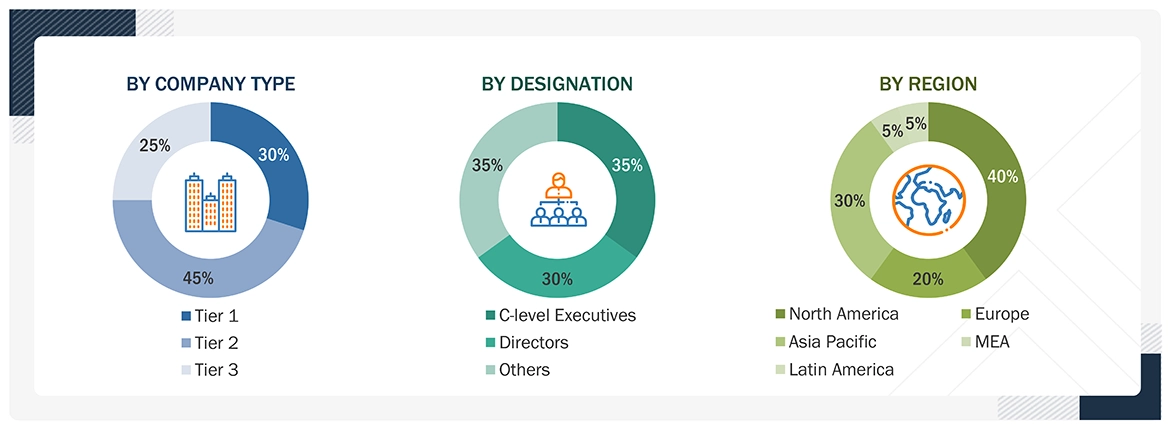
To know about the assumptions considered for the study, download the pdf brochure
Market Size Estimation
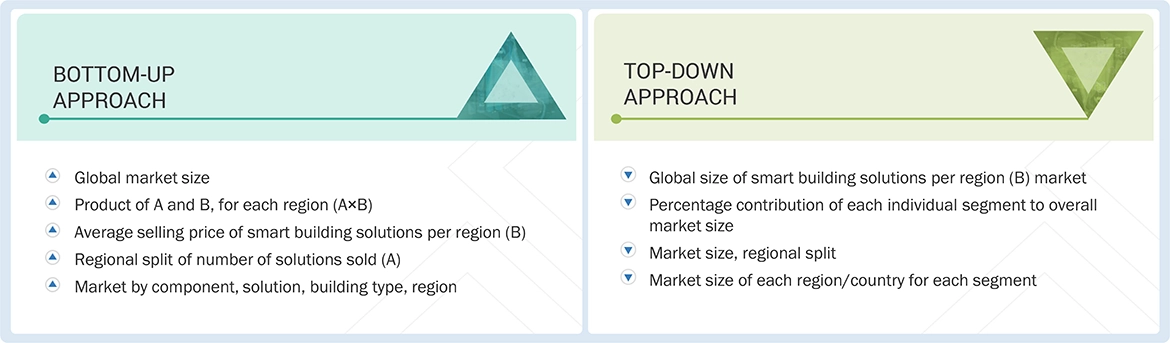
The top-down and bottom-up approaches were used to estimate and validate the size of the global Smart Buildings market and various other dependent submarkets in the overall market. An exhaustive list of all the vendors offering solutions and services in the market was prepared while using the top-down approach. The market share for all the vendors in the market was estimated through annual reports, press releases, funding, investor presentations, paid databases, and primary interviews. Each vendor was evaluated based on its offering (solutions and services). The aggregate of all companies’ revenues was extrapolated to reach the overall market size.
In the bottom-up approach, the key companies offering Smart Buildings solutions and services were identified. After confirming these companies through primary interviews with industry experts, their total revenue was estimated through annual reports, Securities and Exchange Commission (SEC) filings, and paid databases. The revenue of these companies from Business Units (BUs) that offer Smart Buildings was identified through similar sources. Then through primaries, the data on revenue generated through specific Smart Buildings components was collected.
Further, each subsegment was studied and analyzed for its global market size and regional penetration. The markets were triangulated through both primary and secondary research. The primary procedure included extensive interviews for key insights from the industry leaders, such as Chief Executive Officers (CEOs), Vice Presidents (VPs), directors, and managers.
Smart Buildings Market : Top-Down and Bottom-Up Approach
Data Triangulation
After arriving at the overall market size using the market size estimation processes as explained above, the market was split into several segments and subsegments. The data triangulation and market breakup procedures were employed, wherever applicable, to complete the overall market engineering process and arrive at the exact statistics of each market segment and subsegment. The data was triangulated by studying various factors and trends from both the demand and supply sides.
Report Objectives
- To describe and forecast the size of the Smart Buildings market by Component (solution, and services), building types, and regions, and analyze various macro and microeconomic factors that affect the market growth during the forecast period.
- To describe and forecast the size of the market segments with respect to five main regions: North America, Europe, Asia Pacific (APAC), Middle East and Africa (MEA), and the Latin America.
- To provide detailed information regarding drivers, restraints, opportunities, and challenges influencing the growth of the market.
- To analyze the impact of COVID-19 on the market.
- To analyze each submarket with respect to individual growth trends, prospects, and contributions to the total market.
- To analyze opportunities in the market for stakeholders by identifying the high-growth segments of the Smart Buildings market.
- To profile key market players, including top vendors and startups, provide comparative analysis based on business overviews, regional presence, product offerings, business strategies, and key financials, and provide a detailed competitive landscape of the market.
- To analyze competitive developments, such as Mergers and Acquisitions (M&A); new product launches and product enhancements; agreements, partnerships, and collaborations; expansions; and Research and Development (R&D) activities in the market.
Intelligent Building Market & Its impact on Smart Buildings Market:
Intelligent Building Market and Smart Buildings Market are closely related as they both refer to the use of technology to improve the efficiency and functionality of buildings. The terms are often used interchangeably, although some experts may draw distinctions between them.
Intelligent Building typically refers to the integration of various building systems, such as HVAC, lighting, security, and energy management, into a single, centralized control system that can be managed and monitored in real-time. This centralized system can leverage advanced analytics and automation to optimize building performance, reduce energy consumption, and improve occupant comfort and safety.
Smart Buildings, on the other hand, is a broader term that encompasses the use of various technologies, such as IoT sensors, data analytics, and machine learning, to optimize building performance and enhance the occupant experience. Smart Buildings can include Intelligent Building systems, but they can also include other technologies such as smart parking, indoor navigation, and mobile apps for building occupants.
The Intelligent Building market is poised to have a significant impact on the Smart Buildings market, as it represents a key component of the overall Smart Buildings ecosystem. Intelligent Buildings, which refer to the integration of various building systems into a single, centralized control system, can help to optimize building performance, reduce energy consumption, and improve occupant comfort and safety. This, in turn, can drive the adoption of Smart Buildings technologies, which are designed to enhance the overall functionality and efficiency of buildings.
Futuristic growth use-cases of Intelligent Building Market:
- Energy Management: Intelligent Building systems can help to optimize energy consumption by integrating various building systems, such as lighting, HVAC, and energy storage, into a single, centralized control system. This can help to reduce energy waste and lower energy costs.
- Predictive Maintenance: By leveraging advanced analytics and machine learning algorithms, Intelligent Building systems can predict when building equipment is likely to fail and schedule maintenance proactively. This can help to reduce downtime and extend the lifespan of building equipment.
- Occupant Comfort and Safety: Intelligent Building systems can monitor and adjust building conditions, such as temperature, lighting, and air quality, to ensure optimal comfort for occupants. They can also monitor building security and safety systems to detect potential threats and alert building managers in real-time.
- Space Optimization: Intelligent Building systems can monitor space usage and occupancy patterns to optimize space utilization and improve the overall efficiency of buildings. This can help to reduce costs associated with unused or underutilized space.
- Integration with Smart City Infrastructure: Intelligent Building systems can be integrated with smart city infrastructure, such as public transportation and energy grids, to optimize building operations and reduce energy consumption. This can help to create a more sustainable and connected urban environment.
Overall, the Intelligent Building Market is expected to play a key role in the development of smart cities and the transition to a more sustainable and efficient built environment.
Some of the top companies in Intelligent Building Market are Siemens AG, Honeywell International, Schneider Electric SE, Johnson Controls International plc, United Technologies Corporation, Cisco Systems, IBM Corporation, ABB, Legrand SA, Carrier Corporation.
New business opportunities in Intelligent Building Market:
- Integrated Building Management Systems (IBMS): IBMS is a system that integrates all building automation systems into one centralized platform, providing a holistic view of the building's performance. The IBMS market is expected to grow due to the increasing demand for energy-efficient and sustainable buildings.
- Smart Lighting Systems: Smart lighting systems use sensors and controls to adjust lighting levels based on occupancy and natural light availability. The market for smart lighting systems is expected to grow due to the increasing demand for energy-efficient and cost-effective lighting solutions.
- Energy Management Systems: Energy management systems are used to monitor, control, and optimize energy consumption in buildings. The market for energy management systems is expected to grow due to the increasing demand for energy-efficient buildings and the need to reduce carbon emissions.
- Building Analytics: Building analytics uses data analytics to optimize building performance and reduce energy consumption. The market for building analytics is expected to grow due to the increasing demand for energy-efficient buildings and the need to reduce operational costs.
- Internet of Things (IoT) in Building Automation: IoT is being integrated into building automation systems, allowing for remote monitoring and control of building systems. The market for IoT in building automation is expected to grow due to the increasing demand for smart buildings and the need for real-time monitoring and control of building systems.
- Building Information Modeling (BIM): BIM is a digital representation of a building that allows for improved collaboration and communication between building stakeholders. The market for BIM is expected to grow due to the increasing demand for sustainable and energy-efficient buildings.
Overall, the Intelligent Building Market presents a range of new business opportunities, including integrated building management systems, smart lighting systems, energy management systems, building analytics, IoT in building automation, and building information modeling.
Available Customizations
Along with the market data, MarketsandMarkets offers customizations as per the company’s specific needs. The following customization options are available for the report:
Product Analysis
- Product Matrix which gives a detailed comparison of the product portfolio of each company
Company Information
- Detailed analysis and profiling of additional market players (up to 5)
Get the Full Smart Buildings Market Report
Full forecast, segment splits, and company analysis for all Smart Buildings Market.
- United States Smart Buildings Market
- Canada Smart Buildings Market
- United Kingdom Smart Buildings Market
- Germany Smart Buildings Market
- China Smart Buildings Market
- Brazil Smart Buildings Market
- US Smart Buildings Market
- Rest Of Europe Smart Buildings Market
- UK Smart Buildings Market
- Australia Smart Buildings Market
- Japan Smart Buildings Market
- Rest Of Apac Smart Buildings Market
- Mexico Smart Buildings Market
- Rest Of Latin America Smart Buildings Market
- Ksa Smart Buildings Market
- Rest Of Mea Smart Buildings Market
Need a Tailored Report?
Customize this report to your needs
Get 10% FREE Customization
Customize This Report
