
Australia Smart Grid Market (2024-2029)

The Australia Smart Grid Market was valued at $462 Million in 2024 and projected to reach to $810.9 Million by 2029, representing a compound annual growth rate of 11.9%. Australia's smart grid market is positioned for sustained growth as the country accelerates its energy transition and modernizes aging infrastructure.


| Market Size in | USD 26.32 MN |
| Market Forecast in | |
| CAGR | |
| Forecast Period | |
| Units Considered | Value (USD MN) |
Australia Smart Grid Market Trends and Insights
- Australia is leveraging advanced grid technologies to modernize its energy infrastructure, driven by increasing renewable energy integration and the need for grid stability.
- The country's commitment to decarbonization and energy efficiency initiatives is accelerating smart grid adoption across utilities and distribution networks. In Australia, smart grid investments are concentrated on demand-side management, grid automation, and real-time monitoring systems to support the nation's transition toward renewable energy sources.
- Australia's regulatory environment and government incentives are fostering innovation in grid modernization, with utilities deploying IoT sensors, advanced metering infrastructure (AMI), and distribution automation solutions.
- By 2029, Australia is expected to solidify its position as a regional leader in smart grid technology deployment, supported by rising electricity demand and aging infrastructure replacement cycles..
Key Market Statistics
- CAGR (2024-2029) 11.9% CAGR
- Market Size, 2024 ~USD 462 Million
- Forecast, 2029 ~USD 810.9 Million
- Country Australia
Australia Smart Grid Market Overview
Market Valuation & Growth :
Australia's smart grid market is valued at $462.0 million in 2024 and is projected to reach $810.9 million by 2029, demonstrating an 11.9% CAGR. This growth trajectory reflects strong investment in grid modernization across the country.
Renewable Energy Integration :
Australia's commitment to renewable energy adoption is a primary driver of smart grid deployment. The technology enables efficient management of distributed solar and wind resources, supporting the country's transition to clean energy targets.
Grid Stability & Resilience :
Smart grid technologies are critical for maintaining grid stability as Australia integrates variable renewable sources. Advanced monitoring and control systems help prevent outages and optimize energy distribution across the National Electricity Market.
Digital Infrastructure Investment :
Australian utilities and government bodies are investing heavily in digital grid infrastructure, including IoT sensors, AI-powered analytics, and real-time monitoring systems to enhance operational efficiency and consumer engagement.
Australia Smart Grid Market Dynamics
- Government policies supporting renewable energy targets and grid decarbonization are creating favorable conditions for smart grid adoption among utilities and energy providers.
- The integration of distributed energy resources, battery storage systems, and demand-side management technologies will drive market expansion through 2029. Key opportunities exist in regional grid upgrades, particularly in states with high renewable penetration.
- Investment in cybersecurity solutions, advanced metering infrastructure (AMI), and grid automation will be essential as Australia builds a more resilient and responsive energy system.
- Collaboration between government, utilities, and technology providers will accelerate innovation and deployment across the market..
Market Ecosystem
Related Ecosystem
Power Infrastructure
- Geographical Information System (GIS)
- Cogeneration
- Battery Electric Vehicle (BEV)
- Cellular Network
- Fuel Cell
- ABB India Limited
- Siemens ag
- SCHNEIDER ELECTRIC SE
- General Electric Company
- Eaton Corporation plc
Smart Energy And Digital Solutions
- Cellular Network
- Analytics Software
- Geographical Information System (GIS)
- Meter Data Management (MDM)
- Smart Meters
- Siemens ag
- SCHNEIDER ELECTRIC SE
- ABB India Limited
- General Electric Company
- Eaton Corporation plc
Smart Grid
- Meter Data Management (MDM)
- Sensors
- Workforce Management
- Cellular Network
- Customer Analytics
- SCHNEIDER ELECTRIC SE
- Siemens ag
- ABB India Limited
- Eaton Corporation plc
- General Electric Company
Key Takeaways
- Australia's smart grid market will grow from $462.0M (2024) to $810.9M (2029) at 11.9% CAGR
- Australia is prioritizing renewable energy integration and grid stability through smart grid modernization
- Australia's utilities are deploying advanced metering infrastructure, IoT sensors, and distribution automation solutions
- Australia's regulatory support and decarbonization targets are key drivers of smart grid technology adoption
Smart Grid Market Report Scope
| Report Metric | Details |
|---|---|
| Base Year | 2024 |
| Fastest Growing Segment | CONSUMPTION (End-Use Application) |
| Forecast Period | 2024-2029 |
| Growth Rate | CAGR of 16.9% from 2024 to 2029 |
| Largest Segment | DISTRIBUTION (End-Use Application) |
| Market Size Base Year (Billions) | ~USD 73.79 (2024) |
| Revenue Forecast (Billions) | ~USD 161.1 (2029) |
| Segments Covered | Offering, Type, End-Use Application, Communication Technology |
Australia Smart Grid Market Report Segmentation
4 segment dimensions are covered across the global market.
By Offering
- Advanced Metering Infrastructure Systems
- Billing And Customer Information Systems
- Grid Asset Management Systems
- Hardware
- Service
- Services
- Smart Grid Distribution Management Systems
- Smart Grid Network Management Systems
- Smart Grid Security Systems
- Software
- Substation Automation Systems
By Type
- Advanced Metering Infrastructure
- Advanced Metering Infrastructure Systems
- Billing And Customer Information System
- Billing And Customer Information Systems
- Consulting
- Deployment & Integration
- Grid Asset Management
- Grid Asset Management Systems
- Programmable Logic Controllers
- Sensors
- Smart Grid Distribution Management
- Smart Grid Distribution Management Systems
- Smart Grid Network Management
- Smart Grid Network Management Systems
- Smart Grid Security
- Smart Grid Security Systems
- Smart Meters
- Substation Automation
- Substation Automation Systems
- Support & Maintenance
By End-Use Application
- Consumption
- Distribution
- Generation
- Transmission
By Communication Technology
- Wireless
- Wireline
- Wireline/Wired
Target Audience
- Utility Companies & Energy Providers : Australian utilities need market data to plan grid modernization investments, evaluate technology vendors, and align capital expenditure with market growth trends and regulatory requirements.
- Smart Grid Technology Vendors : Equipment manufacturers and software providers require Australia-specific market insights to develop localized solutions, identify customer segments, and establish market entry or expansion strategies.
- Government & Regulatory Bodies : Australian energy regulators and policymakers use market research to inform infrastructure planning, set renewable energy targets, and develop incentive programs for smart grid deployment.
- Investment & Private Equity Firms : Investors evaluating opportunities in Australia's energy sector need comprehensive market data to assess growth potential, identify acquisition targets, and make informed funding decisions.
- Consulting & Engineering Firms : Professional services firms advising on grid modernization projects require detailed market analysis to support client strategy development and validate project feasibility in the Australian context.
Reasons to Buy this Report
- Market Size & Growth Validation : Obtain precise market valuation data for Australia ($462M in 2024) and verified forecasts through 2029, enabling accurate business planning and investment decisions specific to the Australian market.
- Competitive Landscape Intelligence : Understand key players, market share distribution, and competitive strategies within Australia's smart grid sector to identify partnership opportunities and competitive positioning.
- Regional Opportunity Mapping : Identify high-growth segments and geographic hotspots across Australian states, including areas with highest renewable penetration and infrastructure investment priorities.
- Regulatory & Policy Insights : Access detailed analysis of Australian government policies, renewable energy targets, and regulatory frameworks driving smart grid adoption and technology requirements.
- Technology Adoption Trends : Gain insights into which smart grid technologies (AMI, grid automation, energy storage integration) are gaining traction in Australia and their implementation timelines.
Frequently asked questions
What is the current size of Australia's smart grid market?
Australia's smart grid market was valued at $462.0 million in 2024 and is projected to reach $810.9 million by 2029.
What is the growth rate of Australia's smart grid market?
Australia's smart grid market is growing at a compound annual growth rate (CAGR) of 11.9% from 2024 to 2029.
What are the main drivers of smart grid adoption in Australia?
Australia's smart grid adoption is driven by renewable energy integration, decarbonization targets, aging infrastructure replacement, and government regulatory incentives.
Which technologies are being deployed in Australia's smart grid market?
Australia is deploying advanced metering infrastructure (AMI), IoT sensors, distribution automation, demand-side management systems, and real-time grid monitoring solutions.
How does Australia's smart grid market compare to the Asia Pacific region?
Australia is a key market within Asia Pacific, with its 11.9% CAGR reflecting strong regional demand for grid modernization and renewable energy integration.
RESEARCH METHODOLOGY
The study involved major activities in estimating the current size of the Smart Grid market. Exhaustive secondary research was done to collect information on the peer and parent markets. The next step was to validate these findings, assumptions, and sizing with industry experts across the value chain through primary research. Both top-down and bottom-up approaches were employed to estimate the complete market size. Thereafter, market breakdown and data triangulation were used to estimate the market size of the segments and subsegments.
Secondary Research
This research study on the Smart Grid market involved the use of extensive secondary sources, directories, and databases, such as the International Organization for Standardization (ISO), the International Electrotechnical Commission (IEC), the American National Standards Institute (ANSI), the Geography Markup Language (GML) to identify and collect information useful for a technical, market-oriented, and commercial study of the global Smart Grid market. The other secondary sources included annual reports, press releases & investor presentations of companies, white papers, certified publications, articles by recognized authors, manufacturer associations, trade directories, and databases.
Primary Research
The Smart Grid market comprises several stakeholders such as smart grid manufacturers, manufacturers of subcomponents of smart grid, manufacturing technology providers, and technology support providers in the supply chain. The increased use of energy sources worldwide, especially in industrial and commercial projects, is driving up demand for smart grid. Smart grid technology attracts customers from the public and private sectors owing to its several benefits providing numerous opportunities for building smart infrastructure. Utility providers, solution providers, electronic device manufacturers, and system integrators are developing cost-effective and reliable solutions in the emerging smart grid market.
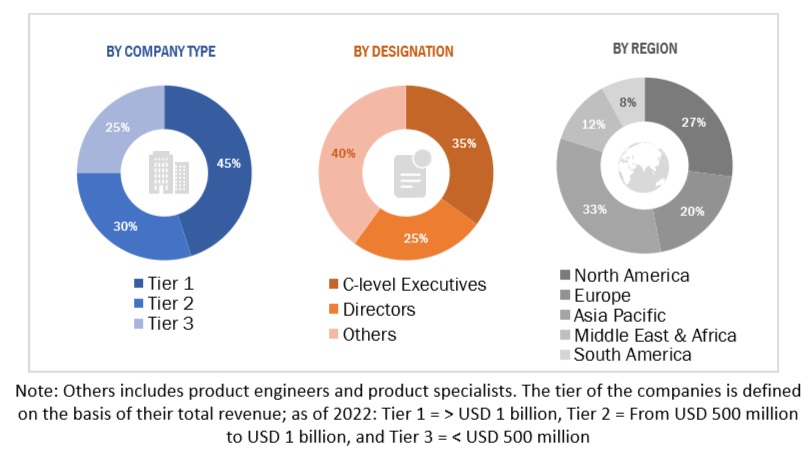
To know about the assumptions considered for the study, download the pdf brochure
Market Size Estimation
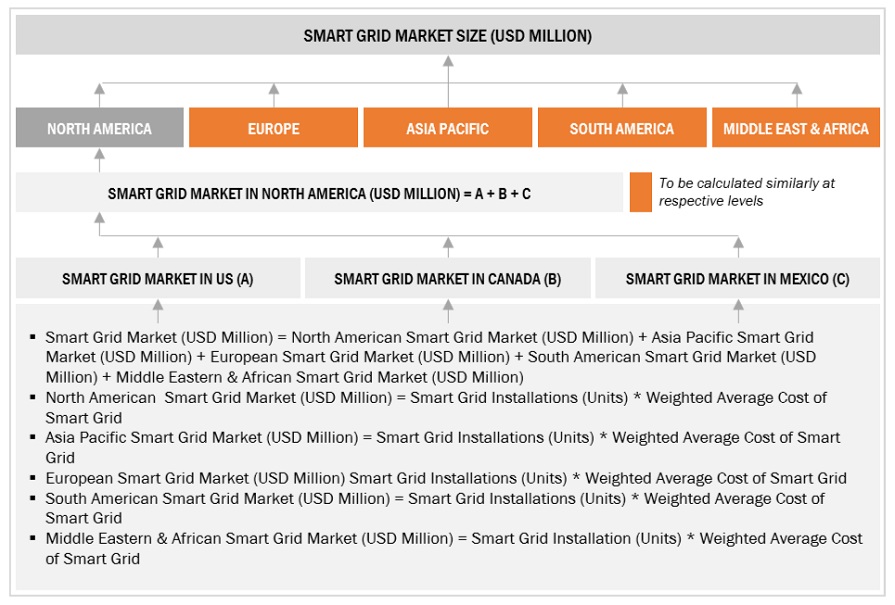
Both top-down and bottom-up approaches were used to estimate and validate the total size of the smart grid market. These methods were also used extensively to estimate the size of various subsegments in the market. The research methodology used to estimate the market size includes the following:
- The key players in the industry and market have been identified through extensive secondary research, and their market share in the respective regions have been determined through both primary and secondary research.
- The industry’s value chain and market size, in terms of value, have been determined through primary and secondary research processes.
- All percentage shares, splits, and breakdowns have been determined using secondary sources and verified through primary sources.
Global Smart Grid Market Size: Top-down Approach
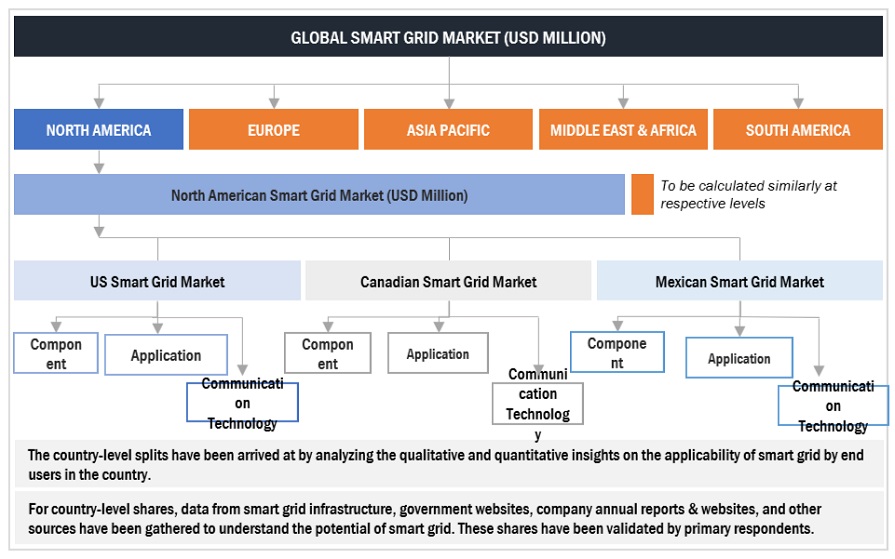
To know about the assumptions considered for the study, Request for Free Sample Report
Global Smart Grid Market Size: Bottom-Up Approach
Data Triangulation
After arriving at the overall market size from the estimation process explained above, the total market has been split into several segments and subsegments. To complete the overall market engineering process and arrive at the exact statistics for all the segments and subsegments, the data triangulation and market breakdown processes have been employed, wherever applicable. The data has been triangulated by studying various factors and trends from both the demand- and supply sides. Along with this, the market has been validated using both the top-down and bottom-up approaches.
Market Definition
A smart grid is an electricity network enhanced with digital technology to enable advanced monitoring, automation, control, and management of energy transmission, distribution, power generation, and network supply. This technology facilitates the evolution from traditional energy distribution to an intelligent electricity grid, allowing two-way communication between utility providers and their customers. Smart grid systems employ digital communication technologies, information systems, and automation to monitor energy flow and adjust to changes in energy demand and supply. By integrating smart metering systems, it enables real-time monitoring of power consumption, offering both consumers and suppliers real-time data on energy use. Consequently, the smart grid enhances system efficiency and reduces operational costs.
Key Stakeholders
- Energy utilities
- Power service providers
- Solution vendors
- Original equipment manufacturers (OEMs)
- Government agencies
- Managed service providers (MSPs)
- System integrators
- Consultancy firms/advisory firms
- Investors and venture capitalists
- Independent software vendors
- Value-added resellers (VARs) and distributors
- Governments and urban planning agencies
Objectives of the Study
- To define, describe, segment, and forecast the smart grid market, in terms of component, application, communication technology, and region.
- To forecast the market size for five key regions: North America, South America, Europe, Asia Pacific, and Middle East & Africa, along with their key countries
- To provide detailed information about the key drivers, restraints, opportunities, and challenges influencing the growth of the market
- To strategically analyze the subsegments with respect to individual growth trends, prospects, and contributions of each segment to the overall market size
- To analyze market opportunities for stakeholders and the competitive landscape of the market
- To strategically profile the key players and comprehensively analyze their market shares and core competencies
- To analyze competitive developments, such as deals and agreements in the market
Available Customizations:
With the given market data, MarketsandMarkets offers customizations as per the client’s specific needs. The following customization options are available for this report:
Geographic Analysis
- Further breakdown of region or country-specific analysis
Company Information
- Detailed analyses and profiling of additional market players (up to 5)
Get the Full Smart Grid Market Report
Full forecast, segment splits, and company analysis for all Smart Grid Market.
- US Smart Grid Market
- Canada Smart Grid Market
- Mexico Smart Grid Market
- Germany Smart Grid Market
- UK Smart Grid Market
- France Smart Grid Market
- Italy Smart Grid Market
- Russia Smart Grid Market
- Spain Smart Grid Market
- China Smart Grid Market
- Japan Smart Grid Market
- South Korea Smart Grid Market
- India Smart Grid Market
- Saudi Arabia Smart Grid Market
- UAE Smart Grid Market
- Qatar Smart Grid Market
- South Africa Smart Grid Market
- Iran Smart Grid Market
- Brazil Smart Grid Market
- Argentina Smart Grid Market
- Colombia Smart Grid Market
- Rest Of Europe Smart Grid Market
- Rest Of Asia Pacific Smart Grid Market
- GCC Smart Grid Market
- Rest Of GCC Smart Grid Market
- Rest Of South America Smart Grid Market
Need a Tailored Report?
Customize this report to your needs
Get 10% FREE Customization
Customize This Report
