
Italy Software Defined Radio (SDR) Market (2026-2031)

The Italy Software Defined Radio (SDR) Market was valued at $446.4 Million in 2026 and projected to reach to $691.8 Million by 2031, representing a compound annual growth rate of 6.5%. Italy's Software Defined Radio market is positioned for sustained growth through 2031, driven by increasing defence modernization budgets and NATO alignment initiatives.


| Market Size in | USD 26.32 MN |
| Market Forecast in | |
| CAGR | |
| Forecast Period | |
| Units Considered | Value (USD MN) |
Italy Software Defined Radio (SDR) Market Trends and Insights
- Valued at USD 446.4 million in 2026, Italy's SDR market demonstrates robust growth potential, with projections indicating an expansion to USD 691.8 million by 2031.
- This represents a compound annual growth rate (CAGR) of 6.5%, reflecting Italy's strategic importance in defence modernization and military communications infrastructure across the continent. The Italian SDR market is driven by increasing defence spending, modernization of military communication systems, and Italy's participation in NATO initiatives.
- Italy's aerospace and defence industry continues to invest in next-generation radio technologies to enhance interoperability and operational efficiency.
- Between 2026 and 2031, Italy is expected to see sustained demand from both government defence agencies and private sector contractors supporting military procurement programs. Italy's geographic position in the Mediterranean and its role as a key European defence hub underscore the strategic relevance of SDR adoption.
- The market growth trajectory reflects Italy's commitment to upgrading legacy communication systems with flexible, software-based solutions that meet contemporary security and performance standards..
Key Market Statistics
- CAGR (2026-2031) 6.5% CAGR
- Market Size, 2026 ~USD 446.4 Million
- Forecast, 2031 ~USD 691.8 Million
- Country Italy
Italy Software Defined Radio (SDR) Market Overview
Market Valuation Growth :
Italy's SDR market is valued at USD 446.4 million in 2026 and is projected to reach USD 691.8 million by 2031, demonstrating strong expansion within the European aerospace and defence sector.
Consistent CAGR Performance :
Italy's SDR market exhibits a steady compound annual growth rate of 6.5% from 2026 to 2031, slightly below the global average of 6.6%, reflecting stable domestic demand and regional defence investments.
Strategic Defence Positioning :
Italy's SDR market serves as a critical component of the nation's aerospace and defence infrastructure, supporting modernization initiatives and NATO interoperability requirements across military communications systems.
European Market Significance :
As a key player in the European SDR landscape, Italy's market growth is driven by increased defence spending, technological advancement in radio communications, and regional security cooperation frameworks.
Italy Software Defined Radio (SDR) Market Dynamics
- The Italian aerospace and defence sector continues to prioritize advanced communication technologies, with SDR systems becoming essential for military interoperability and operational flexibility.
- Government investments in next-generation defence capabilities and domestic industrial partnerships are expected to accelerate market expansion. The forecast period will see Italy leveraging SDR technology to enhance tactical communications, surveillance systems, and integrated defence networks.
- Regional security concerns and collaborative European defence projects will further stimulate demand for sophisticated radio solutions.
- Italian defence contractors and technology providers are well-positioned to capture growth opportunities through innovation and strategic partnerships within the broader European and NATO defence ecosystem..
Market Ecosystem
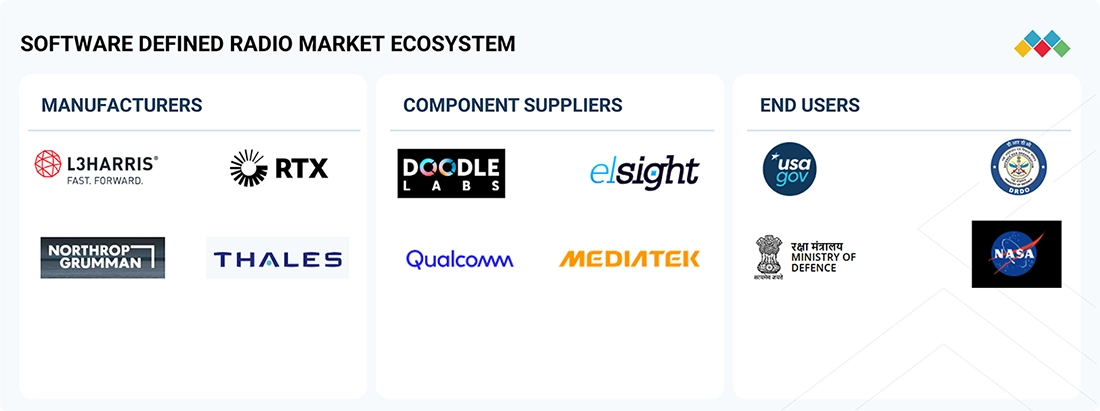
SOFTWARE DEFINED RADIO MARKET SIZE, SHARE GROWTH FORECAST: COMMERCIAL USE CASES ACROSS INDUSTRIES
| COMPANY | USE CASE DESCRIPTION | BENEFITS |
|---|---|---|
 |
Motorola Solutions’ APX NEXT radios and ASTRO 25 platform support police, fire, and emergency-response communications. The radios combine P25 mission-critical voice with LTE-based applications, broadband connectivity, and remote fleet management. | Improves communication reliability and interoperability among public-safety agencies; broadband fallback helps maintain connectivity beyond P25 coverage, while remote programming and software updates reduce radio downtime and simplify fleet management. |
 |
L3Harris supplies AN/PRC-158 and AN/PRC-163 software-defined radios to the US Army under the HMS program. These multichannel radios support resilient waveforms, multiple encryption levels, cross-banding, and connectivity between tactical ground and airborne networks. | Enables secure and resilient communications in contested electronic-warfare environments; software-defined waveforms and cross-banding improve interoperability across units and coalition forces, while allowing capabilities to be upgraded without replacing the complete radio hardware. |
 |
Thales is supplying more than 6,000 SquadNet and SYNAPS software-defined radios to the Irish Defense Forces. The radios will support secure communications across military branches and carry coalition waveforms, including the ESSOR broadband waveform. | Establishes a common tactical communication network across personnel, vehicles, and command units; it improves information sharing with allied forces, supports broadband voice and data exchange, and enables future waveform upgrades as operational requirements evolve. |
Logos and trademarks shown above are the property of their respective owners. Their use here is for informational and illustrative purposes only.
Related Ecosystem
Key Takeaways
- Italy's SDR market is valued at USD 446.4 million in 2026 and is projected to grow to USD 691.8 million by 2031, representing a 6.5% CAGR.
- Italy's defence modernization initiatives and NATO commitments are primary drivers of SDR adoption across military communication systems.
- Italy's aerospace and defence sector is increasingly transitioning from legacy radio systems to flexible, software-defined solutions for enhanced interoperability.
- Italy's strategic Mediterranean location and role as a European defence hub position the country as a key market for advanced SDR technologies through 2031.
Software Defined Radio (SDR) Market Report Scope
| Report Metric | Details |
|---|---|
| Base Year | 2026 |
| Fastest Growing Segment | AUTONOMOUS MARITIME SYSTEMS (Application) |
| Forecast Period | 2026-2031 |
| Growth Rate | CAGR of 6.6% from 2026 to 2031 |
| Largest Segment | HF/VHF/UHF (Frequency Band) |
| Market Size Base Year (Billions) | ~USD 23.53 (2026) |
| Revenue Forecast (Billions) | ~USD 32.38 (2031) |
| Segments Covered | Technology, General-Purpose Sdr Systems, Tactical & Mission-Critical Sdr, Broadband & High-Bandwidth Sdr, Uav & Autonomous Systems Sdr, Cognitive & Ai-Enabled Sdr, Application, Defense Land Systems, Public Safety & Government Systems, Transportation & Smart Mobility, Industrial & Critical Infrastructure, Unmanned Aerial Systems, Commercial Drones, Enterprise & Industrial Drones, Military Drones, Government & Law Enforcement Drones, Naval Platforms, Commercial Maritime, Autonomous Maritime Systems, Frequency Band |
Italy Software Defined Radio (SDR) Market Report Segmentation
20 segment dimensions are covered across the global market.
By Technology
- Broadband & High-Bandwidth Sdr
- Cognitive & AI-Enabled Sdr
- General-Purpose Sdr Systems
- Tactical & Mission-Critical Sdr
- Uav & Autonomous Systems Sdr
By General-Purpose Sdr Systems
- Embedded Sdr Systems
- Fixed Sdr Systems
- Portable & Mobile Sdr Systems
By Tactical & Mission-Critical Sdr
- Anti-Jam & Secure Sdr Systems
- Manet & Mesh Networking Sdr
- Tactical Communication Sdr
By Broadband & High-Bandwidth Sdr
- Isr & High-Speed Data Link Sdr
- Satcom Sdr Systems
- Wideband Sdr Systems
By Uav & Autonomous Systems Sdr
- Unmanned Aerial Vehicles
- Unmanned Aerial Vehicles (Uavs)
- Unmanned Ground Vehicles
- Unmanned Ground Vehicles (Ugvs)
- Unmanned Maritime Vehicles
- Unmanned Maritime Vehicles (Umvs)
By Cognitive & Ai-Enabled Sdr
- AI/ML-Enabled Sdr
- Cognitive Radio Sdr
- Dynamic Spectrum Access Sdr
By Application
- Autonomous Maritime Systems
- Business & General Aviation
- Commercial Aircraft
- Commercial Maritime
- Defense Land Systems
- Industrial & Critical Infrastructure
- Military Aircraft
- Naval Platforms
- Public Safety & Government Systems
- Satellites & Ground Stations
- Transportation & Smart Mobility
- Unmanned Aerial Systems
By Defense Land Systems
- Military Vehicle Communication
- Soldier Radios & Manet Systems
- Tactical Battlefield Communication
By Public Safety & Government Systems
- Disaster Response
- Emergency Services
- Police Communication
By Transportation & Smart Mobility
- Connected & Autonomous Mobility Infrastructure
- Intelligent Transportation Systems
- Railway Communication
By Industrial & Critical Infrastructure
- Mining Communication
- Oil & Gas Operations
- Utility Grid Communication
By Unmanned Aerial Systems
- Commercial Drones
- Enterprise & Industrial Drones
- Government & Law Enforcement Drones
- Military Drones
By Commercial Drones
- Agriculture Drones
- Delivery Drones
- Media & Photography Drones
By Enterprise & Industrial Drones
- Mining & Construction
- Oil & Gas Inspection
- Telecom Infrastructure Monitoring
By Military Drones
- Group 1
- Group 2
- Group 3
- Group 4
- Group 5
- Loitering Munitions
- Swarm Uavs
By Government & Law Enforcement Drones
- Border Surveillance
- Disaster Management
- Law Enforcement
By Naval Platforms
- Isr Communication Systems
- Naval Tactical Communication
By Commercial Maritime
- Commercial Shipping
- Offshore Platforms
- Port Communication Infrastructure
By Autonomous Maritime Systems
- Autonomous Underwater Systems
- Remote Maritime Monitoring
- Unmanned Surface Vehicles
By Frequency Band
- C, X, Ku & Ka Band
- Hf/Vhf/Uhf
- L & S Band
- Multi-Band & Wideband Sdr Systems
Target Audience
- Italian Defence Contractors : Domestic aerospace and defence companies need Italy-specific market data to assess growth opportunities, benchmark competitive positioning, and develop strategic expansion plans within their home market.
- International SDR Manufacturers : Global SDR technology providers require detailed Italy market analysis to evaluate market entry strategies, localization requirements, and partnership opportunities with Italian defence stakeholders.
- Government & Military Procurement : Italian Ministry of Defence and military procurement officials need market intelligence to inform defence budgeting, technology roadmaps, and acquisition strategies for next-generation communication systems.
- Investment & Private Equity Firms : Investors targeting the Italian aerospace and defence sector require comprehensive SDR market data to identify acquisition targets, assess portfolio companies, and evaluate growth potential in defence technology.
- Technology Consultants & Integrators : Systems integrators and defence technology consultants need Italy-focused market insights to advise clients on SDR adoption, technology selection, and implementation strategies aligned with Italian defence requirements.
Reasons to Buy this Report
- Italy-Specific Market Sizing : Access precise valuation data for Italy's SDR market with detailed 2026-2031 projections, enabling accurate budget allocation and investment decisions tailored to the Italian aerospace and defence sector.
- Competitive Landscape Intelligence : Understand Italy's unique competitive dynamics, local defence contractors, and regional market players to identify partnership opportunities and competitive positioning within the Italian and broader European markets.
- Strategic Defence Insights : Gain insights into Italy's defence modernization priorities, NATO integration requirements, and government spending patterns that directly influence SDR technology adoption and procurement decisions.
- Growth Opportunity Identification : Identify high-potential segments within Italy's SDR market, including military communications, tactical systems, and integrated defence networks, to prioritize product development and market entry strategies.
- Regional Market Context : Understand Italy's position within the European SDR ecosystem, including cross-border defence collaborations, EU regulations, and regional security initiatives that shape market dynamics and expansion opportunities.
Frequently asked questions
What is the current market size of Software Defined Radio in Italy?
Italy's SDR market was valued at USD 446.4 million in 2026 and is expected to reach USD 691.8 million by 2031.
What is the projected growth rate for Italy's SDR market?
Italy's SDR market is projected to grow at a compound annual growth rate (CAGR) of 6.5% from 2026 to 2031.
What are the main drivers of SDR adoption in Italy?
Italy's SDR market growth is driven by defence modernization initiatives, NATO participation, military communication system upgrades, and the need for enhanced interoperability in aerospace and defence operations.
Which sectors in Italy are investing most in SDR technology?
Italy's government defence agencies, military branches, and private aerospace and defence contractors are the primary investors in SDR technology for communication system modernization.
How does Italy's SDR market compare to other European markets?
Italy represents a significant segment of the European SDR market, with its 6.5% CAGR reflecting strong defence spending and strategic importance within NATO and European defence initiatives.
RESEARCH METHODOLOGY
The study used four main activities to estimate the current size of the software defined radio (SDR) market. First, detailed secondary research was conducted to collect information on SDR products, suppliers, applications, frequency bands, contracts, military communication programs, public-safety networks, and commercial wireless systems. The collected findings and assumptions were then checked through primary interviews with industry experts across the value chain. Demand-side analysis was used to estimate SDR spending by application and region. Finally, market breakdown and data triangulation were used to calculate the size of each segment and subsegment.
Secondary Research
Secondary research included information from government procurement portals, defense ministries, spectrum and communication authorities, company annual reports, regulatory filings, investor presentations, product documents, press releases, technical papers, journals, and recognized industry databases. Sources such as SIPRI were used to review relevant military transfers and procurement activity, while ITU publications were used to understand radio frequency allocation and spectrum regulations. Company filings and official product information were used to study SDR portfolios, revenues, contracts, technologies, applications and geographical presence as well.
Primary Research
Primary research was conducted after completing the secondary research. Interviews were carried out with SDR manufacturers, component suppliers, software and waveform developers, system integrators, distributors, defense communication specialists, public-safety users, telecom experts, and other industry participants. The interviews covered major countries across North America, Europe, Asia Pacific, the Middle East, and the Rest of the World. Primary information was collected through questionnaires, emails, and telephone interviews and was used to check market assumptions, pricing, demand patterns, segment shares, and growth estimates.
Breakdown of Primary Interviews
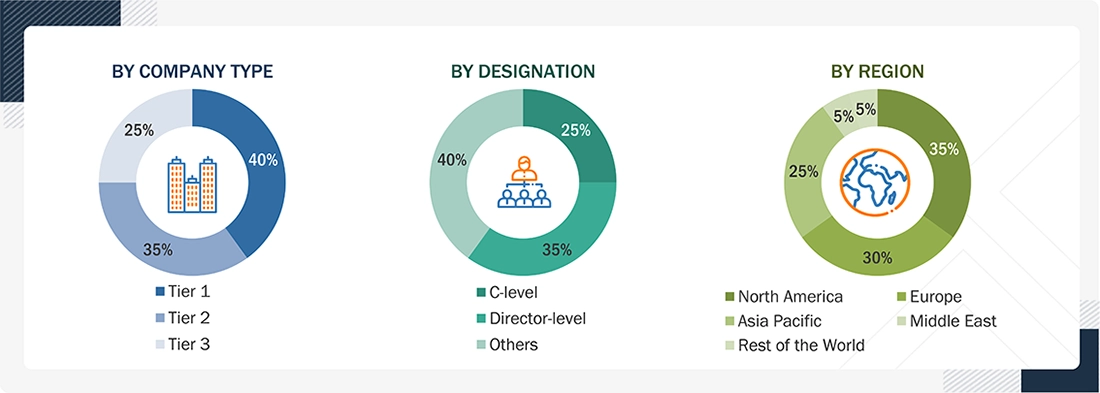
To know about the assumptions considered for the study, download the pdf brochure
Market Size Estimation
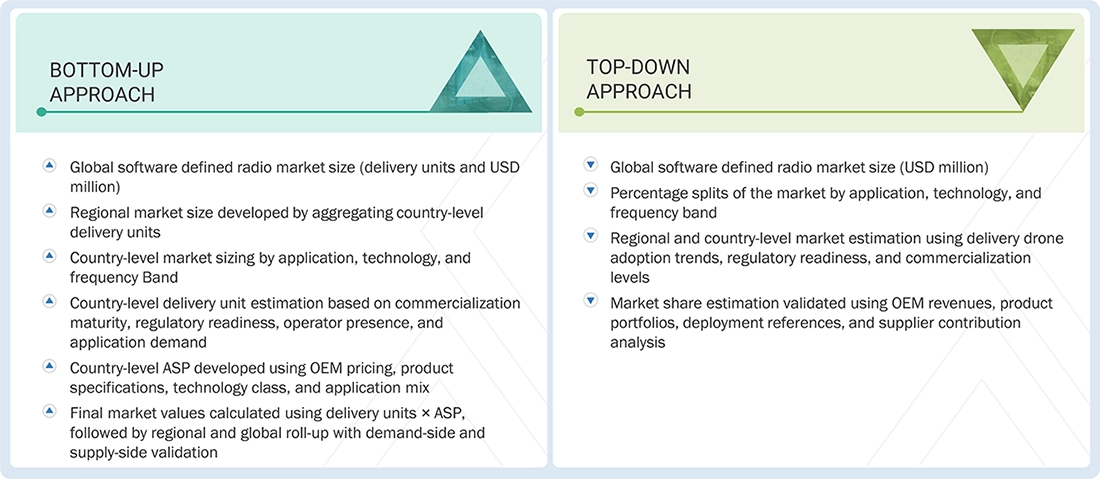
The top-down and bottom-up approaches were used to estimate and validate the size of the SDR market. The research methodology used to estimate the size of the market included the following details:
- Key SDR companies were identified through secondary research. Their market shares were estimated using company revenues, SDR product portfolios, contract activity, customer base, and application presence. Annual reports, financial filings, product documents, and interviews with company executives, engineers, sales professionals, distributors, and other industry participants were used for the analysis.
- Market shares, segment splits, regional shares, and growth rates were first estimated using secondary sources and then verified through primary interviews. The analysis covered SDR technology types, applications, frequency bands, regions, pricing, shipment volumes, and adoption levels.
- Demand from military communication, public safety, aviation, maritime, space, industrial, telecom, and autonomous-system applications was considered. Frequency allocation rules, waveform compatibility, system integration, cybersecurity, and software-upgrade requirements were also reviewed because they influence SDR adoption.
- The collected information was compared and combined through data triangulation. The final market values were calculated using company-level revenues, product-level pricing, shipment volumes, application demand, regional procurement patterns, and expert validation.
Software Defined Radio Market : Top-Down and Bottom-Up Approach
Data Triangulation
After determining the overall market size, the total market was divided into several segments and subsegments. The data triangulation and market breakdown procedures explained below were implemented, wherever applicable, to complete the overall market engineering process and arrive at the estimated market numbers for the market segments and subsegments. The data was triangulated by studying various factors and trends from the demand and supply sides. Additionally, the market size was validated using top-down and bottom-up approaches.
Market Definition
Software-defined radio (SDR) is a radio communication system where components that have been traditionally implemented by hardware, such as mixers, filters, amplifiers, modulators/demodulators, and detectors, are instead implemented by means of software to perform signal processing tasks. SDR can implement all these hardware functionalities using software so that the same hardware is used for multiple radio modes, resulting in an extremely flexible radio that can be quickly reconfigured to handle different signaling techniques.
Key Stakeholders
- Semiconductor & RF Component Suppliers
- SDR Platform Manufacturers (OEMs)
- Waveform & SDR Software Providers
- System Integrators & Solution Providers
- Network & Communication Service Providers
- Government, Regulatory & Standards Organizations
- Testing & Certification Organizations
- Research Institutions
Report Objectives
- To define, describe, segment, and forecast the size of the SDR market based on application, technology, and frequency band
- To forecast the size of market segments across five regions: North America, Europe, Asia Pacific, the Middle East, and the Rest of the World (RoW)
- To identify and analyze key drivers, restraints, opportunities, and challenges influencing the growth of the market
- To identify industry trends, market trends, and technology trends in the market
- To analyze micro markets with respect to individual technology trends, growth prospects, and their contribution to the overall market
- To strategically profile key market players and analyze their market position and core capabilities
- To provide a detailed competitive landscape of the market and analyze competitive strategies such as product launches, partnerships, agreements, and collaborations adopted by key players
- To assess the financial position of key players along with their key products, unique offerings, and recent developments
Available customizations:
MarketsandMarkets offers the following customizations for this market report:
- Additional country-level analysis of the SDR market
- Profiling of other market players (up to five)
Product Analysis
-
Product matrix, which provides a detailed comparison of the product portfolio of each company in the SDR market
Get the Full Software Defined Radio (SDR) Market Report
Full forecast, segment splits, and company analysis for all Software Defined Radio (SDR) Market.
- Canada Software Defined Radio (SDR) Market
- US Software Defined Radio (SDR) Market
- UK Software Defined Radio (SDR) Market
- Germany Software Defined Radio (SDR) Market
- France Software Defined Radio (SDR) Market
- Spain Software Defined Radio (SDR) Market
- Rest Of Europe Software Defined Radio (SDR) Market
Need a Tailored Report?
Customize this report to your needs
Get 10% FREE Customization
Customize This Report
