
Italy Solar Panel Recycling Market (2025-2030)

The Italy Solar Panel Recycling Market was valued at $21.4 Million in 2025 and projected to reach to $51.4 Million by 2030, representing a compound annual growth rate of 19.2%. Italy's solar panel recycling market is positioned for substantial growth as the country's extensive solar infrastructure reaches end-of-life cycles.


| Market Size in | USD 26.32 MN |
| Market Forecast in | |
| CAGR | |
| Forecast Period | |
| Units Considered | Value (USD MN) |
Italy Solar Panel Recycling Market Trends and Insights
- This expansion reflects Italy's commitment to circular economy principles and increasing volumes of end-of-life solar panels requiring sustainable disposal and material recovery.
- Italy's strong renewable energy adoption has created a growing feedstock of decommissioned panels, driving demand for specialized recycling infrastructure and technologies. The Italian market benefits from stringent EU environmental regulations and Italy's leadership in green energy transitions.
- Between 2025 and 2030, Italy is expected to see accelerated investment in recycling facilities and recovery processes for valuable materials such as silicon, glass, and metals.
- Italy's position within the European Union positions it as a key hub for solar panel recycling innovation, supporting both domestic sustainability goals and regional circular economy initiatives..
Key Market Statistics
- CAGR (2025-2030) 19.2% CAGR
- Market Size, 2025 ~USD 21.4 Million
- Forecast, 2030 ~USD 51.4 Million
- Country Italy
Italy Solar Panel Recycling Market Overview
Market Valuation Growth :
Italy's solar panel recycling market is valued at USD 21.4 million in 2025, with a projected CAGR of 19.2%, reaching USD 51.4 million by 2030, demonstrating strong market expansion driven by regulatory compliance and circular economy initiatives.
Renewable Energy Foundation :
Italy's high solar energy adoption rate has created a substantial pipeline of end-of-life solar panels, establishing a robust feedstock for recycling operations and driving demand for sustainable material recovery solutions across the country.
Circular Economy Alignment :
Italian policy frameworks increasingly mandate sustainable disposal and material recovery from solar installations, aligning with EU directives on waste management and circular economy principles, creating compliance-driven market opportunities.
Material Recovery Potential :
Growing volumes of decommissioned solar panels in Italy present significant opportunities for recovering valuable materials including silicon, glass, aluminum, and copper, supporting both environmental sustainability and resource efficiency goals.
Italy Solar Panel Recycling Market Dynamics
- The convergence of regulatory mandates, EU circular economy directives, and increasing environmental awareness is driving investment in recycling infrastructure and technology adoption across the Italian market.
- Domestic recycling facilities are expanding capacity to handle growing volumes of decommissioned panels. The forecast period through 2030 will see accelerated market development as Italy strengthens its commitment to sustainable waste management and material recovery.
- Rising costs of raw materials and supply chain vulnerabilities are incentivizing manufacturers to source recycled materials from domestic recycling operations.
- Strategic partnerships between solar installers, waste management companies, and recycling facilities will further consolidate market growth and establish Italy as a regional recycling hub..
Market Ecosystem
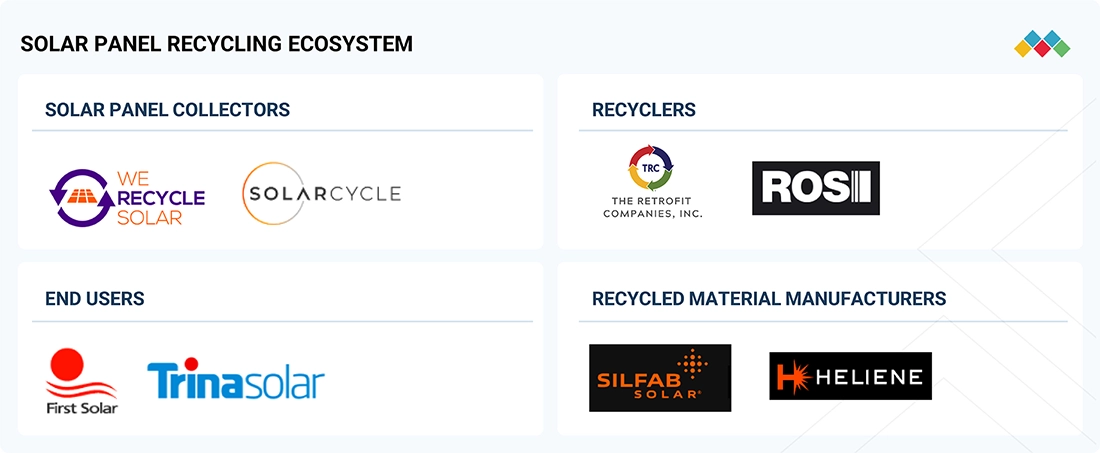
Solar Panel Recycling Market: COMMERCIAL USE CASES ACROSS INDUSTRIES
| COMPANY | USE CASE DESCRIPTION | BENEFITS |
|---|---|---|
 |
Manufactures thin-film CdTe solar modules specifically designed to simplify recycling at the end of their operational life, ensuring efficient recovery of valuable components. | Modules are designed for recyclability to reduce environmental impact, facilitate responsible disposal, and help companies meet sustainability standards and regulatory compliance requirements. |
 |
Specializes in the recycling of photovoltaic modules, extracting valuable materials such as silicon, silver, and aluminum while minimizing waste and promoting material reuse. | Supports the circular economy, recovers high-value materials efficiently, reduces the demand for virgin raw materials, and contributes to environmentally responsible solar panel management. |
 |
Provides comprehensive recycling services for end-of-life solar panels across industrial, commercial, and utility-scale installations, focusing on efficient material extraction and disposal. | Reduces landfill waste, recovers valuable metals and silicon, supports sustainable energy practices, and strengthens the adoption of environmentally responsible recycling operations. |
 |
Specializes in the environmentally safe recycling and disposal of solar panels, ensuring proper handling, material recovery, and compliance with industry recycling standards. | Provides eco-friendly disposal solutions, promotes sustainable solar waste management, recovers reusable materials, and partners with industry leaders to advance solar recycling initiatives. |
Logos and trademarks shown above are the property of their respective owners. Their use here is for informational and illustrative purposes only.
Related Ecosystem
Equipment Machine And Tooling
- Wastewater Treatment
- Air Cooled Heat Exchangers
- Diaphragm Pumps
- Fiberglass
- HVAC System
- Alfa Laval Corporate AB
- Veolia
- Johnson Controls International plc
- Daikin Industries,Ltd.
- Parker-Hannifin Corporation
Green Bio Chemicals
- Animal-Based Sealants
- Bacterial Fermentation
- Corrosion Inhibitors
- Hydrogen Peroxide
- Nitrile Butadiene Rubber (NBR)
- Basf se
- Evonik industries ag
- Solvay sa
- AZELIS HOLDINGS SA
- CARGILL, INCORPORATED
Energy Storage
- Energy Harvesting
- HVAC System
- Applicant Tracking System
- Battery Electric Vehicle (BEV)
- Carboxymethyl Cellulose (CMC)
- MOMENTIVE PERFORMANCE MATERIALS INC.
- Panasonic Holdings Corporation
- ABB India Limited
- Lg corp
- FDK Corporation
Key Takeaways
- Italy's solar panel recycling market is valued at USD 21.4 million in 2025 and is forecast to reach USD 51.4 million by 2030, representing a 19.2% CAGR.
- Italy's high solar energy penetration generates substantial volumes of end-of-life panels, creating a reliable feedstock for recycling operations.
- EU environmental directives and Italy's circular economy commitments are driving regulatory support for recycling infrastructure development across Italy.
- Italy is positioned as a regional leader in solar panel recycling innovation, attracting investment in advanced material recovery technologies and sustainable processing methods.
Solar Panel Recycling Market Report Scope
| Report Metric | Details |
|---|---|
| Base Year | 2025 |
| Fastest Growing Segment | POLYCRYSTALLINE (Type) |
| Forecast Period | 2025–2030 |
| Growth Rate | CAGR of 19.5% from 2025 to 2030 |
| Largest Segment | HYBRID (Process) |
| Market Size Base Year (Billions) | ~USD 0.46 (2025) |
| Revenue Forecast (Billions) | ~USD 1.12 (2030) |
| Segments Covered | Type, Shelf Life, Process, Material |
Italy Solar Panel Recycling Market Report Segmentation
4 segment dimensions are covered across the global market.
By Type
- Monocrystalline
- Other Types
- Polycrystalline
By Shelf Life
- Early Loss
- Normal Loss
By Process
- Hybrid
- Mechanical
By Material
- Glass
- Metal
- Other Materials
- Plastic
- Silicon
Target Audience
- Solar Panel Manufacturers : Italian and European solar manufacturers need Italy-specific recycling market data to develop extended producer responsibility strategies, source recycled materials, and ensure compliance with Italian and EU waste management regulations.
- Waste Management & Recycling Companies : Recycling operators in Italy require detailed market forecasts and growth projections to justify capital investments in recycling infrastructure, technology upgrades, and capacity expansion to meet growing demand for solar panel processing.
- Renewable Energy Installers : Italian solar installation companies need market insights to develop sustainable end-of-life management programs, establish recycling partnerships, and communicate environmental credentials to customers and regulatory bodies.
- Policy Makers & Regulators : Italian government agencies and environmental regulators require market data to inform circular economy policies, waste management standards, and incentive programs for sustainable solar panel recycling infrastructure development.
- Investment & Private Equity Firms : Investors targeting Italy's green economy need comprehensive market analysis to evaluate recycling company valuations, identify acquisition targets, and assess return potential in the expanding Italian solar recycling sector.
Key Companies in the Italy Solar Panel Recycling Market
| Company | HQ | Ownership | Strongest segments |
|---|---|---|---|
| FIRST SOLAR | United States | Public Company | Utility-scale modules,Utility-scale EPC / systems,O&M and services, |
| THE RETROFIT COMPANIES, INC. | United States | Private Company | Lighting and controls retrofits,Hazardous waste and lamp recycling,E-waste and asset disposition services, |
| VEOLIA | France | Public Company | Water and Wastewater Services,Waste Management and Hazardous Waste,Energy and Building Services, |
FIRST SOLAR
First Solar is a publicly traded United States-based solar energy company founded in 1999, specializing in photovoltaic technology and renewable energy solutions.
THE RETROFIT COMPANIES, INC.
The Retrofit Companies, Inc. is a privately held United States company founded in 1992 that provides retrofit and building improvement services.
VEOLIA
Veolia is a publicly traded French multinational company founded in 1853 with 203,100 employees, providing environmental services including waste management, water treatment, and energy recovery.
Reasons to Buy this Report
- Italy-Specific Market Sizing : Access precise market valuation data for Italy's solar panel recycling sector with detailed 2025-2030 forecasts, enabling accurate investment planning and resource allocation decisions tailored to the Italian market landscape.
- Regulatory Compliance Insights : Understand Italy's evolving regulatory framework and EU compliance requirements for solar panel recycling, helping businesses align operations with mandatory waste management standards and circular economy directives specific to the Italian market.
- Growth Opportunity Identification : Identify high-potential segments within Italy's recycling market driven by the country's renewable energy adoption rates, enabling strategic positioning in emerging opportunities for material recovery and sustainable disposal solutions.
- Competitive Landscape Analysis : Gain insights into Italy's recycling infrastructure, key market players, and competitive dynamics to inform market entry strategies, partnership opportunities, and competitive differentiation in the Italian solar recycling sector.
- Investment Decision Support : Leverage Italy-focused market intelligence to support investment decisions, feasibility studies, and business case development for recycling facilities, technology deployment, and supply chain initiatives in the Italian market.
Frequently asked questions
What is the current size of Italy's solar panel recycling market?
Italy's solar panel recycling market is valued at USD 21.4 million in 2025 and is expected to grow to USD 51.4 million by 2030.
What is the projected growth rate for Italy's solar panel recycling market?
Italy's solar panel recycling market is projected to grow at a compound annual growth rate (CAGR) of 19.2% from 2025 to 2030.
What factors are driving growth in Italy's solar panel recycling market?
Growth in Italy's solar panel recycling market is driven by increasing volumes of decommissioned solar panels, EU environmental regulations, circular economy initiatives, and demand for material recovery technologies.
Which materials are recovered from solar panel recycling in Italy?
Italy's solar panel recycling operations recover valuable materials including silicon, glass, aluminum frames, copper wiring, and other metals for reuse in manufacturing.
How does Italy's regulatory environment support solar panel recycling?
Italy benefits from stringent EU environmental directives and national circular economy policies that mandate sustainable disposal and material recovery from end-of-life solar panels.
RESEARCH METHODOLOGY
The study involved four major activities in estimating the market size of the solar panel recycling market. Exhaustive secondary research was done to collect information on the market, the peer market, and the parent market. The next step was to validate these findings, assumptions, and sizing with industry experts across the value chain through primary research. Both, the top-down and bottom-up approaches were employed to estimate the complete market size. Thereafter, the market breakdown and data triangulation procedures were used to estimate the market size of segments and subsegments.
Secondary Research
In the secondary research process, various secondary sources have been referred to for identifying and collecting information for this study. These secondary sources include annual reports, press releases, investor presentations of companies, white papers, certified publications, trade directories, certified publications, articles from recognized authors, gold standard and silver standard websites, and databases.
Secondary research has been used to obtain key information about the value chain of the industry, monetary chain of the market, the total pool of key solar panel recycling, market classification, and segmentation according to industry trends to the bottom-most level and regional markets. It was also used to obtain information about the key developments from a market-oriented perspective.
Primary Research
The solar panel recycling market comprises several stakeholders in the value chain, which include raw material suppliers, manufacturers, and end users. Various primary sources from the supply and demand sides of the solar panel recycling market have been interviewed to obtain qualitative and quantitative information. The primary interviewees from the demand side include key opinion leaders in end-use sectors. The primary sources from the supply side include manufacturers, associations, and institutions involved in the solar panel recycling industry.
Interviews were conducted with experts to gather insights such as market statistics, data on revenue collected from products and services, market breakdowns, market size estimations, market forecasting, and data triangulation. Primary research also helped in understanding the various trends related to type, shelf life, process, material, and region. Stakeholders from the demand side, such as CIOs, CTOs, and CSOs, were interviewed to understand buyers’ perspectives on suppliers, products, component providers, and their current usage of solar panel recycling and the future outlook of their business, which will affect the overall market.
The breakdown of profiles of the interviews with experts is illustrated in the figure below:
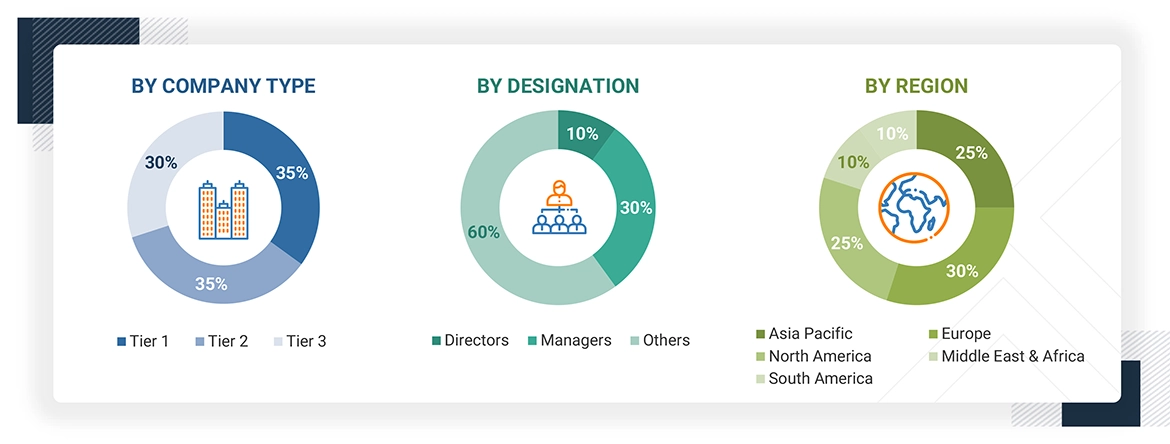
Note: Tier 1, Tier 2, and Tier 3 companies are classified based on their market revenue in 2024, available in the public domain, product portfolios, and geographical presence.
Other designations include sales representatives, production heads, and technicians.
To know about the assumptions considered for the study, download the pdf brochure
Market Size Estimation
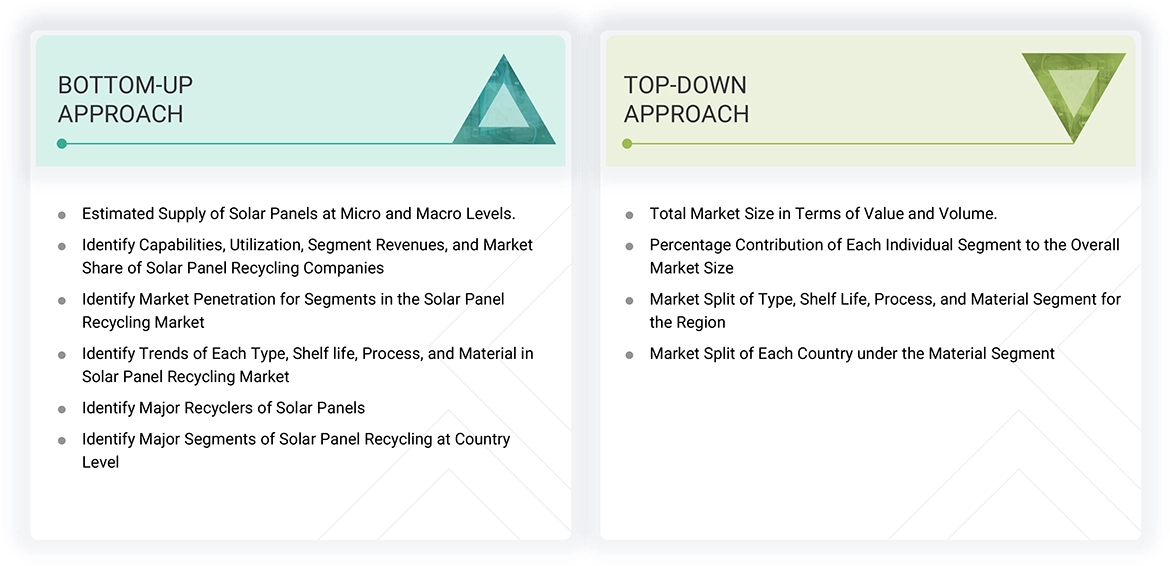
The top-down approach was used to estimate and validate the size of various submarkets for solar panel recycling for each region. The research methodology used to estimate the market size included the following steps:
- The key players in the industry have been identified through extensive secondary research.
- The supply chain of the industry has been determined through primary and secondary research.
- All percentage shares, splits, and breakdowns based on type, shelf life, process, material, and region were determined using secondary sources and verified through primary sources.
- All possible parameters that affect the markets covered in this research study were accounted for, viewed in extensive detail, verified through primary research, and analyzed to get the final quantitative and qualitative data. This data was consolidated and added with detailed inputs and analysis and presented in this report.
Data Triangulation
After arriving at the total market size from the estimation process above, the overall market has been split into several segments and subsegments. To complete the overall market engineering process and arrive at the exact statistics for all segments and subsegments, the data triangulation and market breakdown procedures have been employed, wherever applicable. The data has been triangulated by studying various factors and trends from both, the demand and supply sides. Along with this, the market size has been validated by using both, the top-down and bottom-up approaches and interviews with experts. Hence, for every data segment, there have been three sources—top-down approach, bottom-up approach, and interviews with experts. The data was assumed correct when the values arrived at from the three sources matched.
Market Definition
The solar panel recycling is an industry focused on recovering valuable materials from end-of-life or damaged photovoltaic (PV) panels. The continuous growth of solar power installations worldwide has led to a rising number of panels needing recycling, reaching the end of their 25–30-year lifespan. The industry uses specific methods to separate and repurpose silicon, glass, aluminum, copper, and silver elements found in panels. Recycling solar panels reduces landfill waste while decreasing raw material consumption and promotes circular economic systems. The implementation of solar waste management regulations by authorities combined with environmental organizations has led to increased market activity. Advances in mechanical, thermal, and chemical recycling technologies are enhancing material recovery rates and making recycling more affordable.
Stakeholders
- Solar Panel Recycling Manufacturers
- Solar Panel Recycling Traders, Distributors, and Suppliers
- Raw Type Suppliers
- Government and Private Research Organizations
- Associations and Industrial Bodies
- R&D Institutions
- Environmental Support Agencies
Report Objectives
- To define, describe, and forecast the size of the solar panel recycling market, in terms of value and volume
- To provide detailed information regarding the major factors (drivers, opportunities, restraints, and challenges) influencing the growth of the market
- To estimate and forecast the market size based on type, shelf life, process, material, and region
- To forecast the size of the market with respect to major regions, namely, North America, Europe, Asia Pacific, Middle East & Africa, and South America along with their key countries
- To strategically analyze micromarkets with respect to individual growth trends, prospects, and their contribution to the overall market
- To analyze opportunities in the market for stakeholders and provide a competitive landscape for market leaders
- To track and analyze recent developments, such as product developments, expansions, partnerships, joint ventures, and collaborations in the market
- To strategically profile key market players and comprehensively analyze their core competencies
Get the Full Solar Panel Recycling Market Report
Full forecast, segment splits, and company analysis for all Solar Panel Recycling Market.
- China Solar Panel Recycling Market
- Japan Solar Panel Recycling Market
- South Korea Solar Panel Recycling Market
- India Solar Panel Recycling Market
- Australia Solar Panel Recycling Market
- Canada Solar Panel Recycling Market
- Mexico Solar Panel Recycling Market
- US Solar Panel Recycling Market
- Germany Solar Panel Recycling Market
- France Solar Panel Recycling Market
- UK Solar Panel Recycling Market
- Spain Solar Panel Recycling Market
- Russia Solar Panel Recycling Market
- South Africa Solar Panel Recycling Market
- Brazil Solar Panel Recycling Market
- Argentina Solar Panel Recycling Market
- Rest Of Europe Solar Panel Recycling Market
- Rest Of Asia Pacific Solar Panel Recycling Market
- GCC Countries Solar Panel Recycling Market
- – Rest Of GCC Solar Panel Recycling Market
- Rest Of South America Solar Panel Recycling Market
Need a Tailored Report?
Customize this report to your needs
Get 10% FREE Customization
Customize This Report
