
China Synchronous Condenser Market (2025-2030)

The China Synchronous Condenser Market was valued at $23 Million in 2025 and projected to reach to $27.1 Million by 2030, representing a compound annual growth rate of 3.4%. China's synchronous condenser market is poised for steady growth driven by the nation's commitment to grid modernization and renewable energy integration.


| Market Size in | USD 26.32 MN |
| Market Forecast in | |
| CAGR | |
| Forecast Period | |
| Units Considered | Value (USD MN) |
China Synchronous Condenser Market Trends and Insights
- China's rapid grid modernization and renewable energy integration initiatives are driving demand for synchronous condensers, which provide critical voltage support and reactive power compensation across the nation's expanding transmission networks.
- The market in China reflects the country's strategic focus on grid stability amid increasing renewable capacity deployment. China's synchronous condenser adoption is accelerating as the nation transitions toward higher renewable penetration targets.
- Between 2025 and 2030, China is expected to strengthen its synchronous condenser infrastructure to support distributed solar and wind farms, particularly in western and central regions.
- China's investment in ultra-high-voltage (UHV) transmission corridors and smart grid technologies continues to create sustained demand for synchronous condensers as essential grid-stabilizing equipment..
Key Market Statistics
- CAGR (2025-2030) 3.4% CAGR
- Market Size, 2025 ~USD 23 Million
- Forecast, 2030 ~USD 27.1 Million
- Country China
China Synchronous Condenser Market Overview
Grid Modernization Drive :
China's aggressive grid modernization initiatives are accelerating synchronous condenser adoption to enhance voltage stability and reactive power support across its vast transmission network.
Renewable Energy Integration :
Rapid expansion of wind and solar capacity requires synchronous condensers for grid stabilization, making them essential infrastructure for China's clean energy transition targets.
Market Valuation Growth :
China's synchronous condenser market is valued at $23.0 million in 2025, with projected growth to $27.1 million by 2030, representing a steady 3.4% CAGR.
Regional Leadership Position :
As the world's largest electricity consumer and renewable energy producer, China represents a critical market for synchronous condenser manufacturers and grid technology providers.
China Synchronous Condenser Market Dynamics
- The country's massive investments in ultra-high voltage transmission lines and distributed renewable capacity necessitate advanced reactive power compensation solutions.
- State Grid Corporation of China and China Southern Power Grid are prioritizing synchronous condenser installations to maintain grid stability amid increasing variable renewable generation. The 3.4% CAGR through 2030 reflects China's strategic focus on grid resilience and carbon neutrality goals.
- Domestic manufacturers are expanding production capabilities while international players seek partnerships with Chinese utilities.
- Regulatory support for grid infrastructure upgrades and the transition away from coal-fired generation will continue to create sustained demand for synchronous condenser technology across China's interconnected power systems..
Market Ecosystem
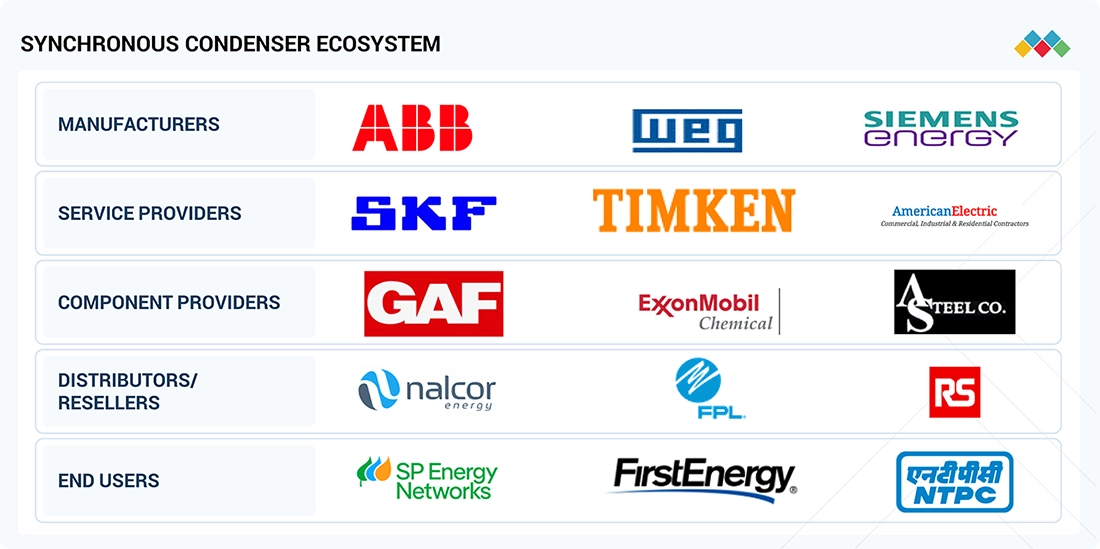
SYNCHRONOUS CONDENSER MARKET: COMMERCIAL USE CASES ACROSS INDUSTRIES
| COMPANY | USE CASE DESCRIPTION | BENEFITS |
|---|---|---|
 |
SP Energy Networks has deployed synchronous condensers across its transmission network to address declining system inertia and fault levels caused by the rapid growth of wind and solar generation, particularly in Scotland | These assets are integrated with advanced digital monitoring and grid analytics to provide dynamic voltage control, reactive power support, and short-circuit strength in weak grid conditions | Improved grid stability and voltage regulation in renewable-dominated regions | Restored system inertia lost due to the retirement of conventional thermal plants | Enabled higher renewable penetration while maintaining compliance with UK grid code requirements |
 |
FirstEnergy utilities are evaluating and deploying synchronous condensers to strengthen transmission networks affected by coal and nuclear plant retirements | The condensers support voltage stability, dynamic reactive power compensation, and short-circuit capacity in areas with high renewable integration and long transmission distances | Improved grid stability and voltage regulation in renewable-dominated regions | Restored system inertia lost due to the retirement of conventional thermal plants | Enabled higher renewable penetration while maintaining compliance with UK grid code requirements |
 |
NTPC is deploying synchronous condensers at strategic substations to support India’s rapidly expanding renewable energy capacity, particularly solar and wind. These systems provide inertia, voltage control, and grid-strengthening services, especially in regions transitioning away from conventional generation | Improved grid stability and fault-ride-through capability in renewable-heavy corridors | Enabled smoother integration of large-scale solar and wind projects | Reduced curtailment risk and supported India’s national decarbonization and energy transition goals |
Logos and trademarks shown above are the property of their respective owners. Their use here is for informational and illustrative purposes only.
Related Ecosystem
Power Infrastructure
- Geographical Information System (GIS)
- Cogeneration
- Battery Electric Vehicle (BEV)
- Cellular Network
- Fuel Cell
- Siemens ag
- ABB India Limited
- SCHNEIDER ELECTRIC SE
- General Electric Company
- Eaton Corporation plc
Key Takeaways
- China's synchronous condenser market reaches $23.0 million in 2025 with projected growth to $27.1 million by 2030.
- China's 3.4% CAGR reflects steady demand driven by renewable energy integration and grid modernization initiatives.
- China's UHV transmission expansion and western renewable corridors are primary growth catalysts for synchronous condenser deployment.
- China's focus on grid stability and voltage support positions synchronous condensers as critical infrastructure in the energy transition.
Synchronous Condenser Market Report Scope
| Report Metric | Details |
|---|---|
| Base Year | 2025 |
| Fastest Growing Segment | STATIC FREQUENCY CONVERTER (Starting Method) |
| Forecast Period | 2025–2030 |
| Growth Rate | CAGR of 3.3% from 2025 to 2030 |
| Largest Segment | STATIC FREQUENCY CONVERTER (Starting Method) |
| Market Size Base Year (Billions) | ~USD 0.71 (2025) |
| Revenue Forecast (Billions) | ~USD 0.84 (2030) |
| Segments Covered | Type, Reactive Power Rating, Cooling Technology, Starting Method |
China Synchronous Condenser Market Report Segmentation
4 segment dimensions are covered across the global market.
By Type
- New Synchronous Condensers
- Refurbished Synchronous Condensers
By Reactive Power Rating
- 101–200 Mvar
- Above 200 Mvar
- Up To 100 Mvar
By Cooling Technology
- Air-Cooled Synchronous Condensers
- Hydrogen-Cooled Synchronous Condensers
- Water-Cooled Synchronous Condensers
By Starting Method
- Other Starting Methods
- Pony Motor
- Static Frequency Converter
CHINA: SYNCHRONOUS CONDENSER MARKET, BY END USER, 2025–2030
| Segment | 2025 | 2026 | 2027 | 2028 | 2029 | 2030 | CAGR (%) |
|---|---|---|---|---|---|---|---|
| ELECTRICAL UTILITIES | 18.7 | 19.3 | 20 | 20.7 | 21.5 | 22.2 | 3.5 |
| INDUSTRIAL SECTOR | 4.3 | 4.4 | 4.5 | 4.6 | 4.7 | 4.9 | 2.8 |
| TOTAL | 23 | 23.7 | 24.5 | 25.3 | 26.2 | 27.1 | 3.4 |
Target Audience
- Power Equipment Manufacturers : Synchronous condenser and electrical equipment producers need China market data to assess production capacity requirements, supply chain positioning, and partnership opportunities with major Chinese utilities.
- Grid Operators & Utilities : State Grid Corporation, China Southern Power Grid, and regional utilities require market intelligence to optimize reactive power compensation investments and synchronize procurement with grid modernization timelines.
- Investment & Financial Firms : Private equity, infrastructure funds, and energy investors need China-specific market forecasts to evaluate synchronous condenser technology investments and utility infrastructure opportunities.
- Technology & Engineering Consultants : Grid planning consultants and engineering firms advising Chinese utilities need detailed market data to support feasibility studies, technology recommendations, and capital expenditure justifications.
- Policy & Regulatory Bodies : Government agencies and grid regulators developing renewable energy integration standards and grid stability requirements need market data to inform infrastructure mandates and technology specifications.
Key Companies in the China Synchronous Condenser Market
| Company | HQ | Ownership | Strongest segments |
|---|---|---|---|
| TOTAL SA | France | Public Company | Upstream oil and gas (incl. LNG, biogas),Refining, petrochemicals, and trading,Retail marketing (fuels, lubricants, services), |
| PETROBRAS | Brazil | Public Company | Exploration & Production (crude oil, NGL, gas),Refining, Transportation & Marketing,Gas & Low Carbon Energies, |
| SHELL PLC | United Kingdom | Public Company | Integrated Gas (LNG and GTL),Upstream (oil, gas, NGLs),Marketing (mobility, lubricants, commercial fuels), |
| ABB | Switzerland | Public Company | Electrification,Motion,Automation, |
| SIEMENS ENERGY | Germany | Public Company | Gas Services (gas and steam turbines, generators, central/distributed power services),Grid Technologies (HVDC, transformers, substations, switchgear, digital grid, storage),Siemens Gamesa (onshore and offshore wind turbines, O&M), |
| GE VERNOVA | United States | Public Company | Power (Gas, Nuclear, Hydro, Steam),Wind (Onshore & Offshore),Electrification (Grid, Power Conversion, Software, Solar & Storage), |
| WEG | Brazil | Public Company | Electric motors, reducers, and gearmotors,Drives, frequency converters, starters, and industrial automation,Transformers, substations, and power systems, |
| EATON | Ireland | Public Company | Electrical Americas,Electrical Global,Aerospace, |
| ANDRITZ | Austria | Public Company | Pulp & Paper,Hydropower,Metals, |
| ANSALDO ENERGIA | Italy | Private Company | Gas and steam turbines, generators, and core equipment,EPC, turnkey power plants, and project services,Maintenance, upgrades, and digital / predictive services, |
| VOITH GMBH & CO. KGAA | Germany | Private Company | Voith Hydro (turbines, generators, hydro services),Voith Paper (papermaking machinery, components, services),Voith Turbo (drives, couplings, braking systems, mobility), |
| BHARAT HEAVY ELECTRICALS LIMITED | India | Public Company | Coal & lignite power plant equipment and EPC,Gas, nuclear, and hydro power equipment,Transmission, transformers, and grid equipment, |
| DOOSAN ŠKODA POWER | Czech Republic | Public Company | Utility and IPP steam turbines (incl. combined cycle),Industrial, CHP, biomass, and waste-to-energy turbines,Services, LTSA, retrofit, and modernization, |
| SHANGHAI ELECTRIC | China | Public Company | Coal-fired and gas power generation equipment and auxiliaries,Nuclear power equipment,Wind, photovoltaic, hydrogen, and energy storage systems, |
| BAKER HUGHES COMPANY | United States | Public Company | Drilling, completions, and well services,Subsea, flexible pipe, and surface pressure control,Artificial lift, chemicals, and production optimization, |
| WOLONG ELECTRIC GROUP | China | Public Company | Low voltage motors,High voltage motors and generators,Drive control and automation solutions, |
TOTAL SA
TOTAL SA is a French multinational energy company founded in 1924 that operates as a public company. With 94,847 employees, it is a major player in the global oil, gas, and renewable energy sectors.
PETROBRAS
PETROBRAS is a Brazilian state-controlled oil and gas company established in 1953. Operating as a public company with 43,199 employees, it is one of the largest energy producers in Latin America.
SHELL PLC
SHELL PLC is a British-Dutch multinational energy company founded in 1897 that operates as a public company. With 84,000 employees, it is a leading global producer of oil, natural gas, and renewable energy.
ABB
ABB is a Swiss multinational technology company founded in 1883 that operates as a public company. With 111,900 employees, it specializes in robotics, power, and automation solutions across multiple industries.
SIEMENS ENERGY
SIEMENS ENERGY is a German public company founded in 1866 that focuses on power generation, transmission, and distribution technologies. With 98,995 employees, it is a leading provider of energy solutions globally.
GE VERNOVA
GE VERNOVA is an American energy technology company established in 2023 that operates as a public company. With 78,000 employees, it provides renewable energy and grid solutions.
WEG
WEG is a Brazilian industrial equipment manufacturer founded in 1961 that operates as a public company. With 49,258 employees, it specializes in electric motors, generators, and automation solutions.
EATON
EATON is an Irish multinational power management company founded in 1911 that operates as a public company. With 97,303 employees, it provides electrical, hydraulic, and mechanical power solutions.
ANDRITZ
ANDRITZ is an Austrian industrial engineering company founded in 1852 that operates as a public company. With 30,487 employees, it specializes in plants, equipment, and services for hydropower, thermal power, and other industries.
ANSALDO ENERGIA
ANSALDO ENERGIA is an Italian energy equipment manufacturer founded in 1853 that operates as a private company. With 3,244 employees, it specializes in power generation and energy conversion technologies.
VOITH GMBH & CO. KGAA
VOITH GMBH & CO. KGAA is a German industrial company founded in 1867 that operates as a private company. With 23,224 employees, it provides drive solutions and services for various industrial applications.
BHARAT HEAVY ELECTRICALS LIMITED
BHARAT HEAVY ELECTRICALS LIMITED is an Indian public sector enterprise founded in 1964 that operates as a public company. With 62,445 employees, it is a major manufacturer of power generation equipment and thermal power plants.
DOOSAN ŠKODA POWER
DOOSAN ŠKODA POWER is a Czech power equipment manufacturer founded in 1869 that operates as a public company. With 1,067 employees, it specializes in boilers and power generation equipment.
SHANGHAI ELECTRIC
SHANGHAI ELECTRIC is a Chinese multinational industrial company founded in 1902 that operates as a public company. With 43,074 employees, it manufactures power generation equipment, motors, and industrial machinery.
BAKER HUGHES COMPANY
BAKER HUGHES COMPANY is an American oilfield services and equipment company founded in 2016 that operates as a public company. With 53,000 employees, it provides solutions for oil, gas, and renewable energy sectors.
WOLONG ELECTRIC GROUP
WOLONG ELECTRIC GROUP is a Chinese electric motor and drive manufacturer founded in 1984 that operates as a public company. With 14,094 employees, it produces motors and electrical equipment for industrial applications.
Reasons to Buy this Report
- China-Specific Market Sizing : Access precise valuation data for China's synchronous condenser market with verified 2025 baseline ($23M) and 2030 forecast ($27.1M), enabling accurate investment and expansion planning.
- Regulatory & Policy Insights : Understand China's grid modernization mandates and renewable energy integration policies driving synchronous condenser demand, including State Grid priorities and provincial implementation strategies.
- Competitive Landscape Analysis : Identify domestic and international competitors operating in China's market, including partnerships with State Grid Corporation and China Southern Power Grid, plus emerging local manufacturers.
- Growth Driver Identification : Quantify the impact of China's ultra-high voltage transmission expansion, wind/solar capacity additions, and coal phase-out on synchronous condenser procurement volumes and specifications.
- Strategic Market Entry Planning : Develop China-focused go-to-market strategies with localized demand forecasts, utility procurement timelines, and regional deployment patterns across eastern, central, and western grid zones.
Frequently asked questions
What is the current market size of synchronous condensers in China?
China's synchronous condenser market is valued at $23.0 million in 2025 and is expected to reach $27.1 million by 2030.
What is the growth rate of China's synchronous condenser market?
China's synchronous condenser market is growing at a compound annual growth rate (CAGR) of 3.4% from 2025 to 2030.
What factors are driving growth in China's synchronous condenser market?
China's synchronous condenser market is driven by renewable energy integration, grid modernization, UHV transmission expansion, and the need for voltage support and reactive power compensation.
How does China's synchronous condenser market compare to global trends?
China's 3.4% CAGR slightly exceeds the global average of 3.3%, reflecting China's accelerated grid modernization and renewable energy deployment relative to other regions.
Which regions in China are seeing the highest synchronous condenser demand?
Western and central China are experiencing the highest demand for synchronous condensers due to large-scale renewable energy projects and UHV transmission corridor development.
RESEARCH METHODOLOGY
The study involved major activities in estimating the current size of the synchronous condenser market. Exhaustive secondary research was done to collect information on the peer and parent markets. The next step was to validate these findings, assumptions, and sizing with industry experts across the value chain through primary research. Both top-down and bottom-up approaches were employed to estimate the complete market size. Thereafter, market breakdown and data triangulation were used to estimate the market size of the segments and subsegments.
Secondary Research
This research study on the synchronous condenser market involved the use of extensive secondary sources, directories, and databases, such as D&B Hoovers, Bloomberg, Businessweek, Factiva, International Energy Agency, and BP Statistical Review of World Energy, to identify and collect valuable information for a technical, market-oriented, and commercial study of the global synchronous condenser market. The other secondary sources included annual reports, press releases, and investor presentations of companies, white papers, certified publications, articles by recognized authors, manufacturer associations, trade directories, and databases.
Primary Research
The synchronous condenser market comprises stakeholders such as synchronous condenser manufacturers, technology providers, and support providers in the supply chain. On the demand side, the market is driven by the growing adoption of synchronous condensers across sectors, including renewable energy and industrial applications, due to their high energy efficiency, ability to provide reactive power support, and superior grid stability compared to conventional systems. Rising infrastructure development and urbanization in emerging economies further fuel demand for advanced drive solutions. On the supply side, manufacturers are seeing increasing opportunities through contracts with utility and industrial distribution networks, as well as through strategic initiatives such as mergers, acquisitions, and partnerships among major players to expand their market presence and technological capabilities. Various primary sources from both the supply and demand sides of the market were interviewed to obtain qualitative and quantitative information. The following is the breakdown of primary respondents:
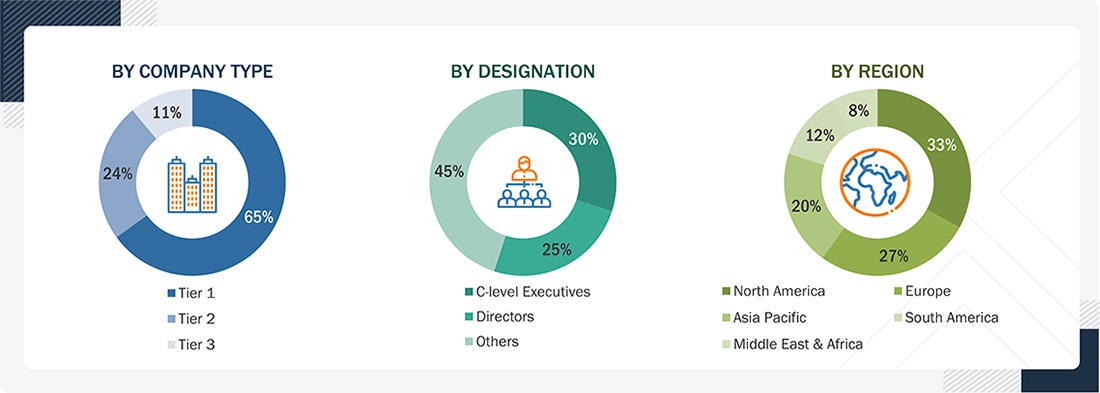
Note: Others include sales managers, engineers, and regional managers.
The tiers of the companies are defined based on their total revenue as of 2024: Tier 1: >USD 1 billion, Tier 2: USD 500 million–1 billion, and Tier 3: <USD 500 million.
To know about the assumptions considered for the study, download the pdf brochure
Market Size Estimation
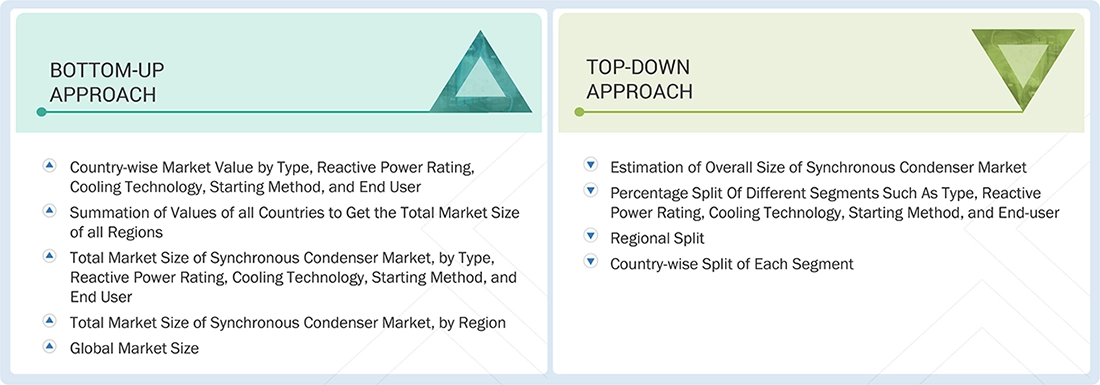
Both top-down and bottom-up approaches were employed to estimate and validate the size of the synchronous condenser market and its dependent submarkets. The key players in the market were identified through secondary research, and their market share in the respective regions was determined through a combination of primary and secondary research. The research methodology involves analyzing the annual and financial reports of top market players and conducting interviews with industry experts, including chief executive officers, vice presidents, directors, sales managers, and marketing executives, to gather key quantitative and qualitative insights related to the synchronous condenser market.
Synchronous Condenser Market Size: Bottom-up Approach and Top-down Approach
Data Triangulation
After determining the overall market size through the estimation process explained above, the total market has been divided into several segments and subsegments. To complete the overall market engineering process and obtain the exact statistics for all segments and subsegments, data triangulation and market breakdown processes have been employed, where applicable. The data has been triangulated by studying various factors and trends from both the demand and supply sides. Additionally, the market has been validated using both top-down and bottom-up approaches.
Market Definition
A synchronous condenser is a direct current (DC)-excited synchronous machine whose shaft is not attached to any driven equipment or prime mover. It is a synchronous motor with an exciter system, which enables the motor to absorb excessive reactive power during overexcited or lagging conditions to maintain and stabilize the voltage as per the transmission system’s requirements. Synchronous generators and motors can be modified and used as synchronous condensers. The modified synchronous generators and motors operate on a permanent or temporary synchronous condenser basis. Existing power plant generators, such as gas, hydro, and steam turbine generators, can temporarily operate as synchronous generators with the necessary modifications. Old and decommissioned generators can also be refurbished to be used as synchronous condensers, apart from newly built synchronous condensers.
Key Stakeholders
- Government and research organizations
- Institutional investors and investment banks
- Investors/shareholders
- Environmental research institutes
- Consulting companies in the energy & power sector
- Raw material and component manufacturers
- Synchronous condenser manufacturers, dealers, and suppliers
- Synchronous motor manufacturers, dealers, and suppliers
- Synchronous generator manufacturers, dealers, and suppliers
- Power grid infrastructure companies
- Power plant project developers
- Renewable energy companies
- Manufacturers’ associations
- Process and power industry associations
- Refinery operators
- Manufacturing sector
- Energy efficiency consultant
Report Objectives
- To describe and forecast the synchronous condenser market, by cooling technology, starting method, reactive power rating, end user, and type, in terms of value
- To provide detailed information regarding the major drivers, restraints, opportunities, and industry-specific challenges influencing the growth of the synchronous condenser market
- To analyze market opportunities for stakeholders and provide a detailed competitive landscape for market leaders
- To strategically analyze micromarkets with regard to individual growth trends, prospects, and contributions to the total market
- To strategically profile the key players and comprehensively analyze their market shares and core competencies
- To provide a detailed overview of the synchronous condenser supply chain analysis, use case analysis, key stakeholders and buying criteria, patent analysis, trade analysis, tariff analysis, regulations, macroeconomic outlook, pricing analysis, Porter’s five forces analysis, impact of gen AI/AI, and the 2024 US tariff impact
- To analyze competitive developments, such as sales contracts, agreements, investments, expansions, product launches, and acquisitions, in the market
- To describe and forecast the synchronous condenser market for various segments with respect to five main regions: North America, Europe, Asia Pacific, Latin America, and the Middle East & Africa, in terms of value
Available customizations:
- MarketsandMarkets offers customizations tailored to the specific needs of companies using the given market data.
-
The following customization options are available for the report:
Geographic Analysis
- Further breakdown of the synchronous condenser, by country
Company Information
- Detailed analysis and profiling of additional market players (up to five)
Product Analysis
- Product matrix, which gives a detailed comparison of the product portfolio of each company
Get the Full Synchronous Condenser Market Report
Full forecast, segment splits, and company analysis for all Synchronous Condenser Market.
- US Synchronous Condenser Market
- Canada Synchronous Condenser Market
- Brazil Synchronous Condenser Market
- Germany Synchronous Condenser Market
- Denmark Synchronous Condenser Market
- Italy Synchronous Condenser Market
- Norway Synchronous Condenser Market
- Australia Synchronous Condenser Market
- Kenya Synchronous Condenser Market
Need a Tailored Report?
Customize this report to your needs
Get 10% FREE Customization
Customize This Report
