
CANADA Technical Ceramics Market (2026-2031)

The CANADA Technical Ceramics Market was valued at $355.2 Million in 2026 and projected to reach to $507.6 Million by 2031, representing a compound annual growth rate of 7.4%. Canada's technical ceramics market is experiencing steady expansion driven by robust demand from aerospace, automotive, and electronics sectors.


| Market Size in | USD 26.32 MN |
| Market Forecast in | |
| CAGR | |
| Forecast Period | |
| Units Considered | Value (USD MN) |
CANADA Technical Ceramics Market Trends and Insights
- This growth trajectory reflects Canada's strengthening demand across industrial applications, particularly in aerospace, automotive, and electronics manufacturing sectors.
- Canada's advanced manufacturing infrastructure and proximity to major North American supply chains support sustained market expansion during the forecast period. The Canadian technical ceramics market benefits from robust investment in high-performance materials and increasing adoption of ceramic components in thermal management and structural applications.
- Between 2026 and 2031, Canada is anticipated to maintain a compound annual growth rate of 7.4%, driven by technological innovation and rising industrial output.
- Canada's regulatory environment and emphasis on advanced materials position the country as an attractive hub for technical ceramics development and commercialization within the North American region..
Key Market Statistics
- CAGR (2026-2031) 7.4% CAGR
- Market Size, 2026 ~USD 355.2 Million
- Forecast, 2031 ~USD 507.6 Million
- Country CANADA
CANADA Technical Ceramics Market Overview
Market Valuation Growth :
Canada's technical ceramics market is valued at USD 355.2 million in 2026, with projected expansion to USD 507.6 million by 2031, representing a robust 7.4% CAGR over the forecast period.
Regional Manufacturing Hub :
Canada's advanced manufacturing infrastructure positions it as a critical regional player in North America, leveraging proximity to US markets and established supply chain networks for technical ceramics applications.
Key Industry Drivers :
Strong demand across aerospace, automotive, and electronics manufacturing sectors in Canada is propelling market growth, driven by increasing adoption of high-performance ceramic materials in specialized applications.
Competitive CAGR Performance :
Canada's 7.4% CAGR closely aligns with the global market growth rate of 7.6%, indicating the country maintains competitive positioning within the international technical ceramics landscape.
CANADA Technical Ceramics Market Dynamics
- The country's advanced manufacturing capabilities and strategic location within North America create favorable conditions for market penetration and supply chain optimization.
- Investment in R&D and manufacturing facilities continues to strengthen Canada's position as a regional technical ceramics hub. Looking ahead to 2031, Canada's market is expected to benefit from increasing adoption of lightweight ceramic materials in aerospace applications, growing electrification trends in automotive manufacturing, and rising demand for thermal management solutions in electronics.
- Government support for advanced manufacturing and sustainability initiatives will further accelerate market growth, positioning Canada as an increasingly important market within the North American technical ceramics landscape..
Market Ecosystem

TECHNICAL CERAMICS MARKET: COMMERCIAL USE CASES ACROSS INDUSTRIES
| COMPANY | USE CASE DESCRIPTION | BENEFITS |
|---|---|---|
 |
Utilizes technical ceramics in engine components, sensors, and exhaust systems | Enhances fuel efficiency | Reduces emissions | Improves durability under extreme conditions |
 |
Incorporates technical ceramics in semiconductor equipment and substrates | Ensures thermal stability and electrical insulation | Improves device reliability |
 |
Applies technical ceramics in turbine components and thermal barrier coatings | Provides high-temperature resistance | Reduces weight | Improves fuel efficiency |
 |
Uses technical ceramics in battery systems and power electronics | Enhances thermal management and energy efficiency | Extends battery life |
Logos and trademarks shown above are the property of their respective owners. Their use here is for informational and illustrative purposes only.
Related Ecosystem
Engine Engine System Exhaust
- Light Commercial Vehicles (LCVs)
- Agricultural Tractors
- Battery Electric Vehicle (BEV)
- Hybrid Electric Vehicle (HEV)
- Sensors
- Titan Company Limited
- TENNECO
- GORKOVSKY AVTOMOBILNY ZAVOD
- AISIN CORPORATION
- TI AUTOMOTIVE
Ceramics And Glass
- Zirconia
- Alumina Ceramics
- Silicon Carbide
- Silicon Nitride
- Titanate Ceramics
- Saint-gobain
- 3M COMPANY
- CERAMTEC GMBH
- Kyocera Corporation
- COORSTEK INCORPORATED
Infrastructure Material
- Alumina Ceramics
- Ceramic Coatings
- Monolithic Ceramics
- Polyphenylene Sulfide (PPS)
- Titanate Ceramics
- Saint-gobain
- Simpson Manufacturing Co., Inc.
- Sika ag
- DOW CHEMICAL COMPANY
- Basf se
Key Takeaways
- Canada's technical ceramics market is valued at USD 355.2 million in 2026 and is projected to reach USD 507.6 million by 2031.
- Canada maintains a steady 7.4% CAGR, reflecting consistent demand from aerospace, automotive, and electronics sectors.
- Canada's advanced manufacturing infrastructure and supply chain proximity drive competitive advantage in technical ceramics production.
- Canada's regulatory framework and innovation focus position it as a strategic hub for high-performance ceramic materials development.
Technical Ceramics Market Report Scope
| Report Metric | Details |
|---|---|
| Base Year | 2026 |
| Fastest Growing Segment | MEDICAL (End-Use Industry) |
| Forecast Period | 2026–2031 |
| Growth Rate | CAGR of 7.6% from 2026 to 2031 |
| Largest Segment | MONOLITHIC CERAMICS (Product Type) |
| Market Size Base Year (Billions) | ~USD 14.05 (2026) |
| Revenue Forecast (Billions) | ~USD 20.27 (2031) |
| Segments Covered | Material, Product Type, End-Use Industry |
CANADA Technical Ceramics Market Report Segmentation
3 segment dimensions are covered across the global market.
By Material
- Non-Oxide Ceramics
- Oxide Ceramics
- –Alumina
- –Alumina Nitride
- –Other Non-Oxide Materials
- –Other Oxide Materials
- –Silicon Carbide
- –Silicon Nitride
- –Titanate
- –Zirconia
By Product Type
- Ceramic Coatings
- Ceramic Matrix Composites
- Monolithic Ceramics
- Other Product Types
By End-Use Industry
- Automotive
- Electronics & Semiconductor
- Energy & Power
- Industrial
- Medical
- Military & Defense
- Other End-Use Industries
CANADA: TECHNICAL CERAMICS MARKET, BY END-USE INDUSTRY, 2026–2031
| Segment | 2026 | 2027 | 2028 | 2029 | 2030 | 2031 | CAGR (%) |
|---|---|---|---|---|---|---|---|
| AUTOMOTIVE | 85.3 | 91.5 | 98.3 | 105.7 | 113.7 | 122.5 | 7.5 |
| ELECTRONICS & SEMICONDUCTOR | 97.2 | 103 | 109.2 | 115.9 | 123 | 130.6 | 6.1 |
| ENERGY & POWER | 53.2 | 57.3 | 61.7 | 66.5 | 71.8 | 77.5 | 7.8 |
| INDUSTRIAL | 35.3 | 37.9 | 40.7 | 43.8 | 47.2 | 50.9 | 7.6 |
| MEDICAL | 30.1 | 32.9 | 35.9 | 39.3 | 42.9 | 47 | 9.3 |
| MILITARY & DEFENSE | 25.6 | 27.8 | 30.2 | 32.8 | 35.7 | 38.8 | 8.7 |
| OTHER END-USE INDUSTRIES | 28.4 | 30.4 | 32.6 | 34.9 | 37.5 | 40.3 | 7.2 |
| TOTAL | 355.2 | 380.8 | 408.6 | 438.8 | 471.8 | 507.6 | 7.4 |
Target Audience
- Technical Ceramics Manufacturers : Manufacturers need Canada-specific market data to assess production capacity requirements, identify growth opportunities in aerospace and automotive sectors, and optimize supply chain positioning within the region.
- Aerospace & Defense Companies : Aerospace suppliers operating in Canada require detailed market insights on ceramic material demand, performance specifications, and supplier capabilities to support aircraft manufacturing and component development.
- Automotive OEMs & Suppliers : Automotive manufacturers and tier-1 suppliers need Canada market intelligence to evaluate ceramic material adoption for engine components, thermal management, and electrification applications.
- Electronics & Semiconductor Firms : Electronics manufacturers require Canadian market data on technical ceramics for thermal management, insulation, and substrate applications to support product development and sourcing strategies.
- Investment & Consulting Firms : Investors and consultants need Canada-focused market analysis to evaluate investment opportunities, assess competitive dynamics, and develop strategic recommendations for clients in the technical ceramics sector.
Key Companies in the CANADA Technical Ceramics Market
| Company | HQ | Ownership | Strongest segments |
|---|---|---|---|
| COORSTEK, INC. | United States | Private Company | Semiconductor manufacturing ceramics and assemblies,Industrial equipment, machinery, and wear parts,Medical devices and life sciences components, |
| KYOCERA CORPORATION | Japan | Public Company | Core Components (fine ceramics, packages, optical, medical devices),Electronic Components (sensors, capacitors, crystal devices, connectors, power semis),Solutions – Printing, MFPs, commercial inkjet, document solutions, |
| MORGAN ADVANCED MATERIALS PLC | United Kingdom | Public Company | Thermal Products,Performance Carbon,Technical Ceramics, |
| 3M | United States | Public Company | Safety and Industrial,Transportation and Electronics,Consumer, |
| NITERRA CO., LTD. | Japan | Public Company | Spark plugs and glow plugs (OE + aftermarket),Automotive sensors (oxygen, NOx, temperature, knock),Technical and fine ceramics (industrial, bearings, piezo, protective plates), |
COORSTEK, INC.
CoorsTek, Inc. is a privately held American manufacturer founded in 1910 with 2,361 employees, known for advanced ceramic and engineered materials.
KYOCERA CORPORATION
Kyocera Corporation is a Japanese public company founded in 1946 with 73,856 employees, engaged in the manufacture of ceramics, electronics, and related products.
MORGAN ADVANCED MATERIALS PLC
Morgan Advanced Materials PLC is a British public company founded in 1856 with 8,088 employees, specializing in advanced materials and thermal management solutions.
3M
3M is an American public company founded in 1902 with 60,500 employees, operating as a diversified technology and manufacturing conglomerate.
NITERRA CO., LTD.
Niterra Co., Ltd. is a Japanese public company founded in 1936 with 15,698 employees, specializing in ceramic products and advanced materials.
Reasons to Buy this Report
- Market-Specific Sizing & Forecasts : Access precise valuation data for Canada's technical ceramics market with detailed 2026-2031 projections, enabling accurate budgeting and investment planning tailored to the Canadian market landscape.
- Sector-Focused Demand Analysis : Understand growth drivers specific to Canada's aerospace, automotive, and electronics manufacturing sectors, identifying high-potential application areas and customer segments within the country.
- Competitive Regional Positioning : Benchmark Canada's 7.4% CAGR against global trends and assess the country's competitive advantages in technical ceramics manufacturing and distribution within North America.
- Strategic Market Entry Insights : Develop informed go-to-market strategies for Canada with localized intelligence on manufacturing infrastructure, supply chain dynamics, and regulatory environment specific to the Canadian market.
- Investment & Partnership Opportunities : Identify growth opportunities and potential partnerships within Canada's technical ceramics ecosystem, supported by detailed market data and sector-specific demand forecasts through 2031.
Frequently asked questions
What is the current size of Canada's technical ceramics market?
Canada's technical ceramics market is valued at USD 355.2 million in 2026 and is expected to grow to USD 507.6 million by 2031.
What is the growth rate for technical ceramics in Canada?
Canada's technical ceramics market is growing at a compound annual growth rate (CAGR) of 7.4% from 2026 to 2031.
Which industries drive demand for technical ceramics in Canada?
Canada's technical ceramics demand is primarily driven by aerospace, automotive, electronics manufacturing, and industrial thermal management applications.
Why is Canada a strategic market for technical ceramics?
Canada benefits from advanced manufacturing capabilities, strong supply chain integration with North America, and a supportive regulatory environment for advanced materials innovation.
What is the forecast market size for Canada's technical ceramics by 2031?
Canada's technical ceramics market is projected to reach USD 507.6 million by 2031, representing significant growth from the 2026 baseline.
RESEARCH METHODOLOGY
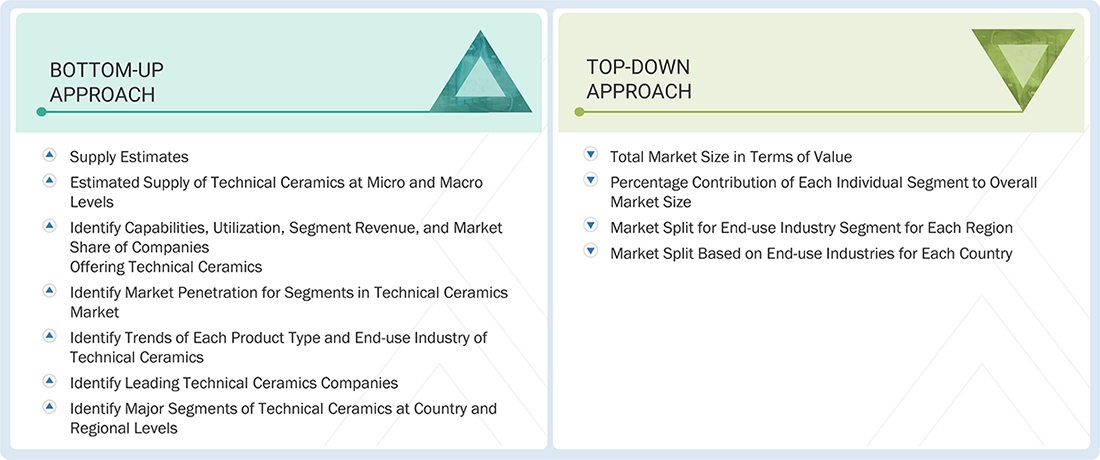
The study involved four major activities to estimate the current size of the global technical ceramics market. Exhaustive secondary research was carried out to collect information on the market, the peer product market, and the parent product group market. The next step was to validate these findings, assumptions, and sizes with the industry experts across the value chain of technical ceramics through primary research. The top-down and bottom-up approaches were employed to estimate the overall size of the technical ceramics market. After that, market breakdown and data triangulation procedures were used to determine the size of different segments and sub-segments of the market.
Secondary Research
The market for companies offering technical ceramics is arrived at by secondary data available through paid and unpaid sources, analyzing the product portfolios of major companies in the ecosystem, and rating the companies by their performance and quality. Various secondary sources, such as Business Standard, Bloomberg, the World Bank, and Factiva, were referred to identify and collect information for this study on the technical ceramics market.
In the secondary research process, various secondary sources were referred to identify and collect information related to the study. Secondary sources included annual reports, press releases, and investor presentations of door vendors, forums, certified publications, and whitepapers. The secondary research was used to obtain critical information on the industry’s value chain, the total pool of key players, market classification, and segmentation from the market and technology-oriented perspectives.
Primary Research
In the primary research process, various primary sources from the supply and demand sides were interviewed to obtain qualitative and quantitative information for this report. The primary sources from the supply side included industry experts, such as Chief Executive Officers (CEOs), Vice Presidents (VPs), marketing directors, technology and innovation directors, and related key executives from several key companies and organizations operating in the technical ceramics market.
After the complete market engineering (calculations for market statistics, market breakdown, market size estimations, market forecasting, and data triangulation), extensive primary research was conducted to gather information and verify and validate the critical numbers arrived at. Primary research was also conducted to identify the segmentation types, industry trends, competitive landscape of technical ceramics offered by various market players, and key market dynamics, such as drivers, restraints, opportunities, challenges, industry trends, and key player strategies.
In the complete market engineering process, the top-down and bottom-up approaches and several data triangulation methods were extensively used to perform the market estimation and market forecasting for the overall market segments and subsegments listed in this report. Extensive qualitative and quantitative analysis was performed on the complete market engineering process to list the key information/insights throughout the report.
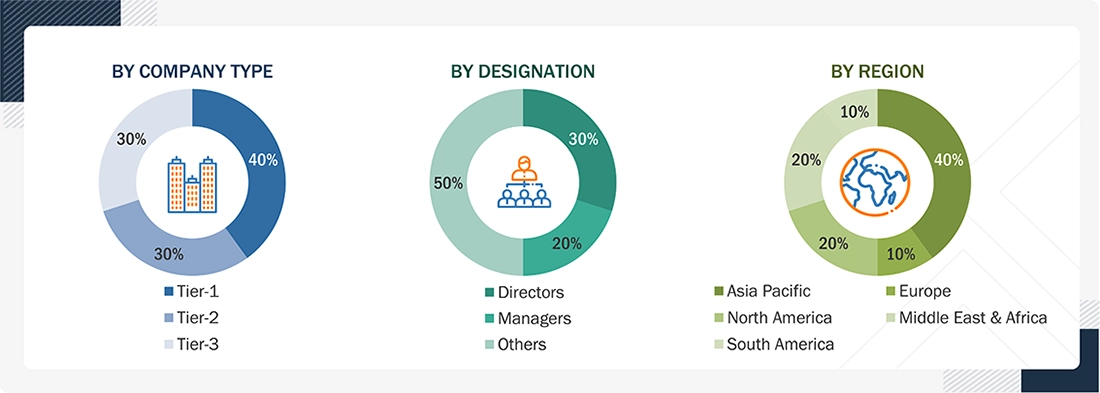
Notes: Other designations include sales, marketing, and product managers.
Tier 1: >USD 1 Billion; Tier 2: USD 500 million–1 Billion; and Tier 3: <USD 500 million.
To know about the assumptions considered for the study, download the pdf brochure
Market Size Estimation
The top-down and bottom-up approaches were used to estimate and validate the size of the global technical ceramics market. These approaches were also used extensively to estimate the size of various dependent market segments. The research methodology used to estimate the market size included the following:
Data Triangulation
After arriving at the overall market size using the market size estimation processes, the market was split into several segments and subsegments. The data triangulation and market breakup procedures were employed, wherever applicable, to complete the overall market engineering process and arrive at the exact statistics of each market segment and subsegment. The data was triangulated by studying various factors and trends from both the demand and supply sides.
Market Definition
Technical ceramics are based on the manufacture of technically sophisticated ceramic materials that have improved mechanical, thermal, electrical, chemical, and wear-resistant properties compared with other materials. Technical ceramics are produced using purified inorganic and non-metallic substances with extreme attention paid to the precision of the manufacturing process. This degree of control enables manufacturers to achieve consistent results in the manufacturing process and the resulting product. Oxides and non-oxides (e.g., alumina, zirconia, silicon carbide, silicon nitride, aluminum nitride, boron carbide, and titanates) comprise the two categories used as technical ceramic materials. Technical ceramics are useful in a combination of applications, from harsh environments to extremely high-performance applications to those requiring high strength. The technical ceramics market caters to different end-use industries, such as electronics/semi-conductors, automotive, aerospace/defense, medical devices, industrial equipment, energy, chemical processing, and telecommunications. In these industries, technical ceramics are used in components such as substrates, insulators, seals, bearings, cutting tools, wear parts, implant components, and thermal management systems.
Key Stakeholders
- Technical ceramics manufacturers
- Raw material suppliers
- Converters & processors
- Distributors and traders
- Industry associations and regulatory bodies
- End users
Report Objectives
- To define, describe, and predict the Big Data market by offering (by type, by deployment, and services), business function, data type, vertical, and region.
- To provide detailed information related to major factors (drivers, restraints, opportunities, and industry-specific challenges) influencing market growth
- To analyze opportunities in the market and provide details of the competitive landscape for stakeholders and market leaders
- To forecast the market size of segments with respect to five main regions: North America, Europe, Asia Pacific, the Middle East & Africa, and Latin America
- To analyze each submarket with respect to individual growth trends, prospects, and contributions to the overall Big Data market
- To analyze competitive developments, such as partnerships, new product launches, mergers & acquisitions, in the Big Data market
- To analyze the competitive developments, such as partnerships, product launches, mergers, and acquisitions, in the Big Data market
- To analyze the impact of macroeconomic factors on the Big Data market across all regions.
Available customizations:
With the given market data, MarketsandMarkets offers customizations according to client-specific needs.
The following customization options are available for the technical ceramics market report:
Product Analysis
- A product matrix that gives a detailed comparison of the product portfolio of each company
Regional Analysis
- A further breakdown of the technical ceramics market for additional countries
Company Information
- Detailed analysis and profiling of additional market players (up to five)
Get the Full Technical Ceramics Market Report
Full forecast, segment splits, and company analysis for all Technical Ceramics Market.
- US Technical Ceramics Market
- MEXICO Technical Ceramics Market
- GERMANY Technical Ceramics Market
- FRANCE Technical Ceramics Market
- SPAIN Technical Ceramics Market
- UK Technical Ceramics Market
- ITALY Technical Ceramics Market
- CHINA Technical Ceramics Market
- JAPAN Technical Ceramics Market
- INDIA Technical Ceramics Market
- SOUTH KOREA Technical Ceramics Market
- SOUTH AFRICA Technical Ceramics Market
- BRAZIL Technical Ceramics Market
- ARGENTINA Technical Ceramics Market
Need a Tailored Report?
Customize this report to your needs
Get 10% FREE Customization
Customize This Report
