
Germany Telecom Cloud Market (2025-2030)

The Germany Telecom Cloud Market was valued at $1463.5 Million in 2025 and projected to reach to $3332.6 Million by 2030, representing a compound annual growth rate of CAGR 17.9%. Germany's telecom cloud market is poised for sustained expansion through 2030, driven by digital transformation initiatives and the modernization of legacy telecom infrastructure.


| Market Size in | USD 26.32 MN |
| Market Forecast in | |
| CAGR | |
| Forecast Period | |
| Units Considered | Value (USD MN) |
Germany Telecom Cloud Market Trends and Insights
- This growth trajectory reflects Germany's strategic position as Europe's leading digital economy and the increasing adoption of cloud infrastructure among German telecommunications providers.
- Germany's market expansion is driven by heightened demand for scalable, cost-efficient cloud solutions and the country's commitment to digital transformation across the telecom sector. The 17.9% compound annual growth rate (CAGR) underscores Germany's accelerating shift toward cloud-native architectures and virtualized network services.
- Germany's telecom operators are investing heavily in cloud platforms to enhance service delivery, reduce operational costs, and support emerging technologies such as 5G and edge computing.
- By 2030, Germany is expected to solidify its position as a key hub for telecom cloud innovation in Europe, with enterprises and service providers leveraging advanced cloud capabilities to remain competitive in an increasingly digital marketplace..
Key Market Statistics
- CAGR (2025-2030) CAGR 17.9%
- Market Size, 2025 ~USD 1463.5 Million
- Forecast, 2030 ~USD 3332.6 Million
- Country Germany
Germany Telecom Cloud Market Overview
Market Valuation Growth :
Germany's telecom cloud market is valued at $1,463.5 million in 2025, with projections reaching $3,332.6 million by 2030, representing a robust 17.9% CAGR over the forecast period.
Digital Economy Leadership :
As Europe's leading digital economy, Germany demonstrates strong cloud infrastructure adoption among telecommunications providers, positioning the country as a key growth driver in the European telecom cloud sector.
Infrastructure Investment Momentum :
German telecom operators are accelerating cloud migration initiatives to enhance service delivery, reduce operational costs, and support 5G and edge computing deployments across the nation.
Regulatory & Compliance Focus :
Germany's stringent data protection regulations and GDPR compliance requirements drive demand for secure, locally-hosted cloud solutions among telecommunications service providers.
Germany Telecom Cloud Market Dynamics
- Major German carriers are investing heavily in cloud-native architectures to support emerging technologies including 5G, IoT, and network slicing capabilities.
- The market benefits from strong government support for digital infrastructure and increasing enterprise demand for reliable, compliant cloud services. The competitive landscape in Germany is characterized by both established global cloud providers and regional specialists offering tailored solutions for telecom operators.
- Investment in data center capacity, particularly in compliance with German data residency requirements, will remain critical.
- The convergence of telecom and cloud services is expected to create new revenue streams and service offerings, further accelerating market growth through the forecast period..
Market Ecosystem
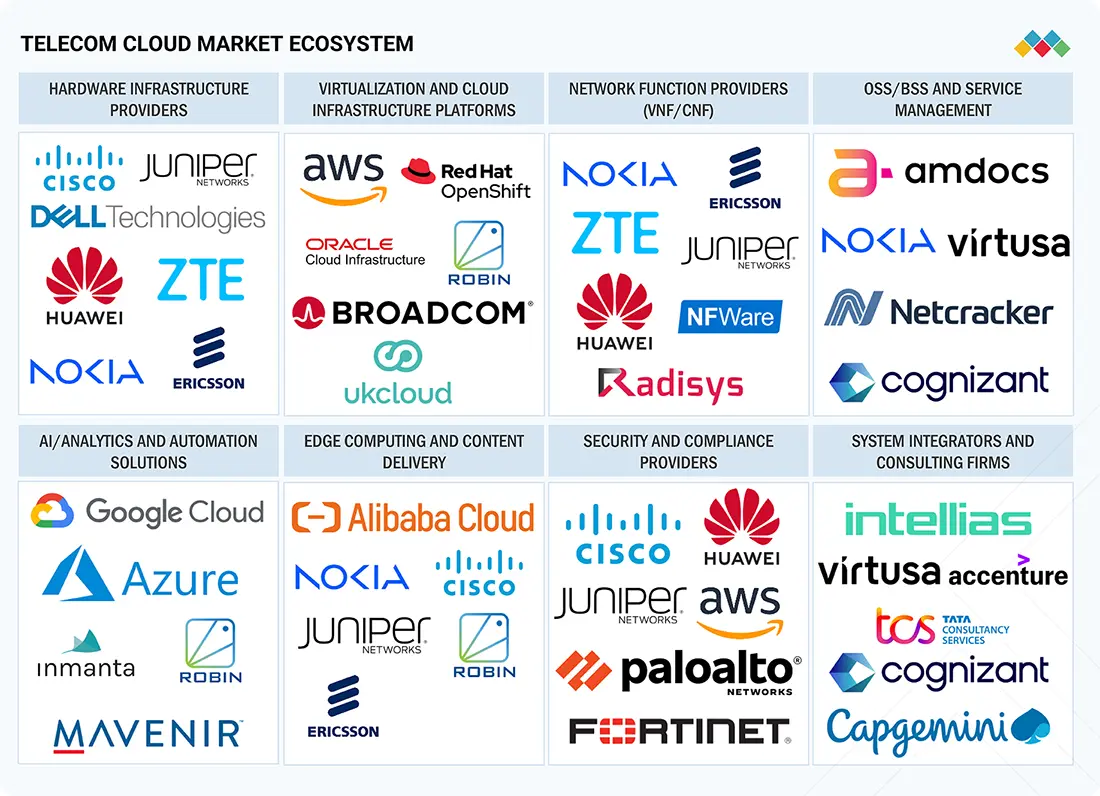
Telecom Cloud Market: COMMERCIAL USE CASES ACROSS INDUSTRIES
| COMPANY | USE CASE DESCRIPTION | BENEFITS |
|---|---|---|
 |
TELUS collaborated with Google Cloud and Onix to transform how it captures and manages data, significantly improving data-driven decisions toward its generative AI and analytics capabilities. | The transformation empowered TELUS's data scientists with tools to enhance customer journeys, leading to improved customer experiences and operational efficiency. |
 |
O2 Telefónica migrated its 5G core network to the cloud using AWS and Nokia technologies, enabling a resilient and scalable architecture for its 5G services. | The cloud-native approach allowed for faster updates, improved performance, and enhanced data security, resulting in a better customer experience and operational agility. |
 |
TPG Telecom partnered with Ericsson to launch Australia's first cloud-native 5G standalone network, simplifying and streamlining its network operations. | The transformation led to faster time-to-market for new offerings, improved network efficiency, and enhanced service delivery to customers. |
 |
stc group co-created a dynamic hybrid cloud foundation with IBM, automating operations and cloudifying applications to accelerate digital transformation across the enterprise. | The initiative resulted in a 30% reduction in capital expenditures, a 30–35% decrease in container costs, and improved disaster recovery capabilities, enhancing overall operational efficiency. |
Logos and trademarks shown above are the property of their respective owners. Their use here is for informational and illustrative purposes only.
Related Ecosystem
Cloud Computing
- Software as A Service (SaaS)
- Natural Language Processing (NLP)
- Platform as A Service (PaaS)
- Machine Learning
- Supply Chain Management
- International Business Machines Corporation
- MICROSOFT CORPORATION
- Oracle Corporation
- Amazon.com, Inc.
Mobility And Telecom
- Smart Utilities
- Smart Healthcare
- Sensors
- Parking Management System
- Passenger Information System (PIS)
- AT&T Inc.
- Cisco Systems, Inc.
- HUAWEI TECHNOLOGIES CO LTD
- Telefonaktiebolaget LM Ericsson (publ)
- International Business Machines Corporation
Key Takeaways
- Germany's telecom cloud market will more than double from $1,463.5M (2025) to $3,332.6M (2030), representing a 17.9% CAGR.
- Germany's strong digital infrastructure and regulatory framework position the country as a leading telecom cloud adopter in Europe.
- German telecom operators are prioritizing cloud migration to support 5G deployment, network virtualization, and operational efficiency.
- Germany's market growth is underpinned by enterprise demand for hybrid and multi-cloud solutions tailored to telecom-specific workloads.
Telecom Cloud Market Report Scope
| Report Metric | Details |
|---|---|
| Base Year | 2025 |
| Fastest Growing Segment | NFVI (Nfv Software) |
| Forecast Period | 2025-2030 |
| Growth Rate | CAGR of 20.3% from 2025 to 2030 |
| Largest Segment | VNFS/CNFS (Nfv Software) |
| Market Size Base Year (Billions) | ~USD 22.23 (2025) |
| Revenue Forecast (Billions) | ~USD 56.01 (2030) |
| Segments Covered | Component, Deployment Model, Cloud Service Model, Nfv Software, Service, Service Model, Infrastructure-As-A-Service |
Germany Telecom Cloud Market Report Segmentation
7 segment dimensions are covered across the global market.
By Component
- Platform
- Services
- Solutions
By Deployment Model
- Hybrid
- Private
- Public
By Cloud Service Model
- IaaS
- PaaS
- SaaS
By Nfv Software
- Nfvi
- Vnfs/Cnfs
By Service
- Managed Services
- Professional Services
By Service Model
- IaaS
- PaaS
- SaaS
By Infrastructure-As-A-Service
- Archiving
- Compute
- Disaster Recovery & Backup
- Primary Storage
Target Audience
- Telecom Operators & Service Providers : German carriers need detailed market intelligence to guide cloud infrastructure investments, competitive benchmarking, and service innovation strategies in an increasingly digital telecom landscape.
- Cloud Solution Providers : Technology vendors targeting German telecom customers require market sizing, growth forecasts, and competitive insights to develop localized offerings and establish market presence in this high-value segment.
- Investment & Private Equity Firms : Financial investors evaluating telecom cloud opportunities in Germany need validated market data, growth trajectories, and risk assessments to inform investment decisions and portfolio strategy.
- Government & Policy Makers : German regulatory bodies and government agencies benefit from comprehensive market analysis to inform digital infrastructure policies, funding initiatives, and competitive framework development.
- Enterprise IT & Digital Leaders : Corporate decision-makers in Germany seeking cloud-based telecom solutions require market insights to evaluate vendor options, assess service quality, and optimize telecommunications infrastructure investments.
Reasons to Buy this Report
- Market Size & Growth Validation : Obtain precise valuation data for Germany's telecom cloud market with verified CAGR of 17.9%, enabling accurate financial forecasting and investment decision-making for the 2025-2030 period.
- Competitive Positioning Intelligence : Understand Germany's unique market dynamics, regulatory environment, and competitive landscape to identify opportunities for market entry, partnerships, or expansion among German telecom operators.
- Strategic Investment Planning : Leverage detailed market segmentation and growth drivers specific to Germany to allocate resources effectively and prioritize cloud infrastructure investments in Europe's largest digital economy.
- Regulatory & Compliance Insights : Access critical information on Germany's data protection requirements, GDPR compliance mandates, and local hosting preferences that shape telecom cloud service offerings and market opportunities.
- Revenue Forecasting Accuracy : Utilize country-specific projections and market trends to develop accurate revenue models, pricing strategies, and go-to-market plans tailored to German telecom cloud market conditions.
Frequently asked questions
What is the current size of Germany's telecom cloud market?
Germany's telecom cloud market is valued at $1,463.5 million in 2025 and is projected to grow to $3,332.6 million by 2030.
What is the expected growth rate for Germany's telecom cloud market?
Germany's telecom cloud market is expected to grow at a compound annual growth rate (CAGR) of 17.9% between 2025 and 2030.
What factors are driving growth in Germany's telecom cloud market?
Key drivers include 5G infrastructure expansion, network virtualization initiatives, cost optimization pressures, and enterprise demand for scalable cloud solutions among German telecom providers.
How does Germany's telecom cloud market compare to other European markets?
Germany represents one of Europe's largest and most mature telecom cloud markets, driven by its advanced digital economy, strong regulatory environment, and leading telecom operators investing in cloud transformation.
What cloud deployment models are most prevalent in Germany's telecom sector?
Germany's telecom operators increasingly adopt hybrid and multi-cloud models to balance performance, compliance, and cost efficiency while supporting diverse workloads and regulatory requirements.
RESEARCH METHODOLOGY
This research study involved extensive secondary sources, directories, and databases, such as Dun & Bradstreet (D&B) Hoovers and Bloomberg BusinessWeek, to identify and collect valuable information for a technical, market-oriented, and commercial study of the telecom cloud market. The primary sources have been mainly industry experts from the core and related industries, and preferred suppliers, manufacturers, distributors, service providers, technology developers, alliances, and organizations related to all segments of the value chain of this market. In-depth interviews were conducted with primary respondents, including key industry participants, subject matter experts, C-level executives of key market players, and industry consultants, to obtain and verify critical qualitative and quantitative information.
Secondary Research
In the secondary research process, various secondary sources were referred to identify and collect information for the study. The secondary sources included annual reports, press releases, investor presentations of companies, white papers, certified publications, and articles from recognized associations and government publishing sources. Several journals and associations were also referenced, including the Journal of Telecommunications and Information Technology, the Journal of Telecommunications and the Digital Economy, and the Journal of Cloud Computing: Advances, Systems, and Applications. Secondary research was used to obtain key information about industry insights, the market’s monetary chain, the overall pool of key players, market classification and segmentation according to industry trends to the bottom-most level, regional markets, and key developments from the market and technology-oriented perspectives.
Primary Research
In the primary research process, various primary sources from the supply and demand sides were interviewed to obtain qualitative and quantitative information for the report. The primary sources from the supply side included industry experts, such as Chief Executive Officers (CEOs), Chief Technology Officers (CTOs), Chief Operating Officers (COOs), Vice Presidents (VPs), marketing directors, technology and innovation directors, and related key executives from various key companies and organizations operating in the telecom cloud market. The primary sources from the demand side included telecom cloud end users, consultants/specialists, Chief Information Officers (CIOs), and subject-matter experts from enterprises and government associations.
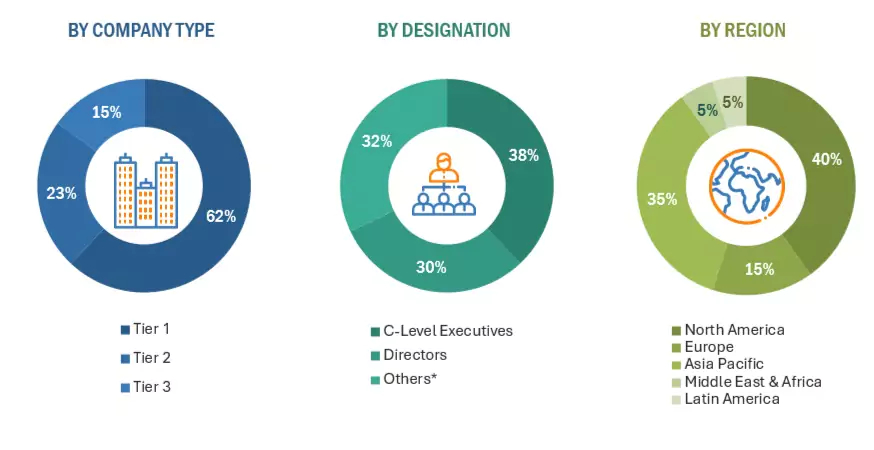
Note: *Others include sales managers, marketing managers, and product managers.
Tier 1 companies’ revenue is more than USD 1 billion; Tier 2 companies’ revenue ranges between USD 500
million to 1 billion; and Tier 3 companies’ revenue ranges between USD 100 million and USD 500 million.
To know about the assumptions considered for the study, download the pdf brochure
Market Size Estimation
Multiple approaches were adopted to estimate and forecast the size of the telecom cloud market. The first approach involves estimating market size by summing up the revenue generated by companies through the sale of telecom cloud solutions.
The top-down and bottom-up approaches were used to estimate and validate the total size of the telecom cloud market. These methods were extensively used to estimate the size of various segments in the market. The research methodology used to estimate the market size includes the following:
- Key players in the market have been identified through extensive secondary research.
- In terms of value, the industry’s supply chain and market size have been determined through primary and secondary research processes.
- All percentage shares, splits, and breakups have been determined using secondary sources and verified through primary sources.
Telecom Cloud Market : Top-Down and Bottom-Up Approach

Data Triangulation
After determining the overall market size, the telecom cloud market was divided into several segments and subsegments. A data triangulation procedure was used to complete the overall market engineering process and determine the exact statistics for all segments and subsegments, wherever applicable. The data was triangulated by studying various factors and trends from the demand and supply sides. Along with data triangulation and market breakdown, the market size was validated by the top-down and bottom-up approaches.
Market Definition
Telecom cloud is a next-generation network architecture that combines software-defined networking, network functions virtualization, and cloud-native technology into a distributed computing network. Since the network and the computing resources are distributed across sites and clouds, automation and orchestration are required. It refers to the transformation of communications service providers (CSPs) using traditional infrastructure networks of vertically integrated proprietary hardware to digital service providers (DSPs) using cloud-based technologies.
A telecom cloud focuses on creating a common virtualized infrastructure to manage various network functions required to deliver communications services. It is a software-defined infrastructure that enables telcos to rapidly extend services, respond to a surge of innovations, and process and store data remotely in data centers. It is a keystone of the telecom industry's shift to digital service providers from CSPs.
Stakeholders
- Cloud Service Providers (CSPs)
- Networking Companies
- Third-party Providers
- Consultants/Consultancies/Advisory Firms
- Support and Maintenance Service Providers
- Telecom Service Providers
- Information Technology (IT) Infrastructure Providers
- System Integrators (SIs)
- Support Service Providers
- Governments And Standardization Bodies
- Data Center Providers
- Regional Associations
- Independent Software Vendors
- Value-added Resellers and Distributors
Report Objectives
- To determine and forecast the global telecom cloud market based on component (platform, solutions, services), deployment model (public cloud, private cloud, hybrid cloud), cloud service model (infrastructure as a service, platform as a service, software as a service), and NFV Software (VNFs/CNFs, NFVI) from 2025 to 2030, and analyze the various macroeconomic and microeconomic factors that affect the market growth
- To forecast the size of the market segments concerning five central regions: North America, Europe, Asia Pacific (APAC), Latin America, and the Middle East & Africa (MEA)
- To provide detailed information about the major factors (drivers, restraints, opportunities, and challenges) influencing the growth of the telecom cloud market
- Analyze each submarket concerning individual growth trends, prospects, and contributions to the overall telecom cloud market
- To analyze the opportunities in the market for stakeholders by identifying the high-growth segments of the telecom cloud market
- To profile the key market players, provide a comparative analysis based on business overviews, regional presence, product offerings, business strategies, and key financials, and illustrate the market’s competitive landscape.
- Track and analyze competitive developments in the market, such as mergers and acquisitions, product developments, partnerships and collaborations, and research and development (R&D) activities
Available Customizations
With the given market data, MarketsandMarkets offers customizations based on the company’s specific needs. The following customization options are available for the report:
Geographic Analysis as per Feasibility
- Analysis for additional countries (up to five)
Company Information
- Detailed analysis and profiling of additional market players (up to 5)
Get the Full Telecom Cloud Market Report
Full forecast, segment splits, and company analysis for all Telecom Cloud Market.
- Canada Telecom Cloud Market
- US Telecom Cloud Market
- UK Telecom Cloud Market
- India Telecom Cloud Market
- UAE Telecom Cloud Market
- Brazil Telecom Cloud Market
- France Telecom Cloud Market
- Nordic Countries Telecom Cloud Market
- Rest Of Europe Telecom Cloud Market
- Australia Telecom Cloud Market
- China Telecom Cloud Market
- Japan Telecom Cloud Market
- Rest Of Asia Pacific Telecom Cloud Market
- Argentina Telecom Cloud Market
- Mexico Telecom Cloud Market
- Rest Of Latin America Telecom Cloud Market
- Israel Telecom Cloud Market
- Saudi Arabia Telecom Cloud Market
- South Africa Telecom Cloud Market
Need a Tailored Report?
Customize this report to your needs
Get 10% FREE Customization
Customize This Report
