
Canada Temperature Sensor Market (2025-2030)

The Canada Temperature Sensor Market was valued at $367 Million in 2025 and projected to reach to $414.4 Million by 2030, representing a compound annual growth rate of 2.5%. Canada's temperature sensor market is positioned for moderate but consistent growth through 2030, supported by the country's mature automotive and industrial sectors.


| Market Size in | USD 26.32 MN |
| Market Forecast in | |
| CAGR | |
| Forecast Period | |
| Units Considered | Value (USD MN) |
Canada Temperature Sensor Market Trends and Insights
- This moderate growth trajectory reflects Canada's mature industrial base and steady demand across automotive, HVAC, and consumer electronics sectors.
- Canada's position within North America positions it as a secondary but strategically important market for temperature sensing technologies. The Canadian temperature sensor market is driven by increasing adoption in industrial automation, smart building systems, and automotive applications.
- Canada's regulatory environment and emphasis on energy efficiency standards support gradual market expansion through 2030.
- Investment in IoT infrastructure and connected devices across Canada continues to create incremental demand for precision temperature measurement solutions. Canada's temperature sensor market benefits from proximity to North American supply chains and integration with U.S.
- manufacturing ecosystems.
- The country's focus on sustainability and climate control in commercial and residential sectors underpins steady growth, though Canada's market growth rate remains below the global average of 3.8% CAGR..
Key Market Statistics
- CAGR (2025-2030) 2.5% CAGR
- Market Size, 2025 ~USD 367 Million
- Forecast, 2030 ~USD 414.4 Million
- Country Canada
Canada Temperature Sensor Market Overview
Market Valuation :
Canada's temperature sensor market is valued at $367.0 million in 2025, with projected growth to $414.4 million by 2030, representing a steady 2.5% CAGR driven by industrial modernization and automotive electrification.
Key Growth Drivers :
Demand is fueled by Canada's robust automotive sector, expanding HVAC applications in commercial buildings, and increasing adoption of IoT-enabled temperature monitoring in manufacturing and consumer electronics.
Regional Position :
As a secondary but strategically important North American market, Canada benefits from proximity to U.S. supply chains and serves as a hub for semiconductor distribution across North America.
Mature Market Dynamics :
Canada's mature industrial base and established manufacturing infrastructure support steady, predictable growth rather than explosive expansion, making it attractive for stable, long-term investments.
Canada Temperature Sensor Market Dynamics
- The 2.5% CAGR reflects stable demand from established applications in HVAC systems, automotive thermal management, and consumer electronics, with particular strength in electric vehicle production and smart building technologies.
- Canadian manufacturers and distributors benefit from integrated North American supply chains and regulatory alignment with U.S.
- standards.
- Growth will be tempered by market maturity but supported by ongoing industrial digitalization and the transition to electric vehicles, which require advanced thermal sensing solutions for battery management and performance optimization..
Market Ecosystem
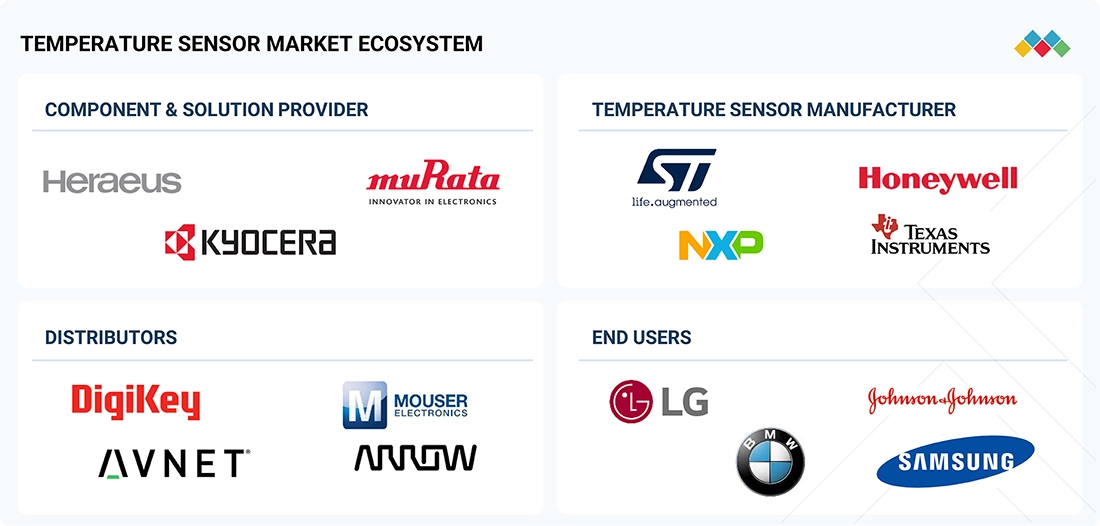
TEMPERATURE SENSOR MARKET SIZE, SHARE & GROWTH, 2030: COMMERCIAL USE CASES ACROSS INDUSTRIES
| COMPANY | USE CASE DESCRIPTION | BENEFITS |
|---|---|---|
 |
Honeywell’s temperature sensors are deployed across aerospace, automotive, and industrial automation sectors for precise thermal monitoring, HVAC control, and energy management. | Enhances operational reliability, reduces maintenance downtime, and optimizes energy efficiency through advanced thermal control and diagnostics. |
 |
Texas Instruments Incorporated analog and digital temperature sensing ICs are used in data centers, EV battery management, and consumer electronics for compact, energy-efficient thermal monitoring. | Enables high-accuracy thermal control, improved device safety, and faster product design cycles through scalable sensor integration.. |
 |
TE Connectivity Ltd. temperature sensors support automotive, industrial, and medical applications, including EV charging systems, HVAC, and patient monitoring devices. | Improves system performance and product safety, ensuring temperature stability and compliance with automotive and medical-grade standards. |
 |
Endress+Hauser’s industrial-grade temperature sensors and transmitters are used in process automation for oil & gas, chemical, and food & beverage sectors. | Enhances process efficiency, ensures product quality, and minimizes operational risks through precise and real-time temperature monitoring. |
 |
Siemens integrates temperature sensors into its automation and building management systems for predictive maintenance and energy optimization. | Enables smart infrastructure and efficient energy utilization through IoT-enabled monitoring and predictive analytics. |
Logos and trademarks shown above are the property of their respective owners. Their use here is for informational and illustrative purposes only.
Related Ecosystem
Automotive Electronics And Electrical Equipment
- Battery Electric Vehicle (BEV)
- Light Commercial Vehicles (LCVs)
- Fuel Cell Electric Vehicle (FCEV)
- Sensors
- Hybrid Electric Vehicle (HEV)
- BOSCH LIMITED
- Continental ag
- DENSO Corporation
- Texas Instruments Incorporated
- Panasonic Holdings Corporation
Aviation
- Narrow Body Aircraft
- Wide Body Aircraft
- Military Helicopters
- Special Mission Aircraft
- Fighter Aircraft
- HONEYWELL INTERNATIONAL INC.
- COLLINS AEROSPACE
- Thales group
- Safran group
- HEICO Corporation
Industrial Equipment
- HVAC System
- Fiberglass
- Actuators
- Cartridge Filters
- Electrostatic Precipitators
- Siemens ag
- GRUNDFOS GROUP
- ABB India Limited
- SCHNEIDER ELECTRIC SE
- Emerson Electric Co.
Key Takeaways
- Canada's temperature sensor market reaches $367.0 million in 2025 with projected growth to $414.4 million by 2030.
- Canada's 2.5% CAGR is below the global average, reflecting a mature and stable market environment.
- Canada's automotive, HVAC, and industrial automation sectors are primary drivers of temperature sensor demand.
- Canada's integration with North American supply chains and energy efficiency regulations support consistent market expansion.
Temperature Sensor Market Report Scope
| Report Metric | Details |
|---|---|
| Base Year | 2025 |
| Fastest Growing Segment | CONSUMER ELECTRONICS (End-User Industry) |
| Forecast Period | 2025–2030 |
| Growth Rate | CAGR of 3.8% from 2025 to 2030 |
| Largest Segment | CONSUMER ELECTRONICS (End-User Industry) |
| Market Size Base Year (Billions) | ~USD 7.42 (2025) |
| Revenue Forecast (Billions) | ~USD 8.94 (2030) |
| Segments Covered | Product Type, End-User Industry, Output |
Canada Temperature Sensor Market Report Segmentation
3 segment dimensions are covered across the global market.
By Product Type
- Bimetallic Temperature Sensors
- Contact
- Fiber-Optic Temperature Sensors
- Infrared Temperature Sensors
- Non-Contact
- Resistive Temperature Detectors
- Temperature Sensor Ics
- Thermistors
- Thermocouples
By End-User Industry
- Aerospace & Defense
- Automotive
- Chemicals
- Consumer Electronics
- Energy & Power
- Food & Beverages
- Glass
- Healthcare
- Metals & Mining
- Oil & Gas
- Other End-User Industries
- Pulp & Paper
By Output
- Analog
- Digital
Target Audience
- Automotive OEMs & Suppliers : Canadian and North American automotive manufacturers need detailed thermal sensor market data to plan EV battery management systems, engine thermal control, and supply chain sourcing strategies.
- HVAC & Building Systems Manufacturers : Commercial and residential HVAC companies require market insights to forecast demand for temperature sensors in smart building applications and optimize product development for the Canadian market.
- Semiconductor & Sensor Manufacturers : Global and regional sensor producers need Canada-specific market data to evaluate market entry opportunities, competitive positioning, and revenue forecasting for North American operations.
- Electronics & IoT Companies : Consumer electronics and IoT solution providers require insights into Canadian demand for temperature monitoring in smart devices, industrial IoT, and connected appliances.
- Investment & Strategy Consultants : Private equity firms, management consultants, and corporate strategists need validated Canadian market data to support due diligence, market entry strategies, and investment thesis development.
Key Companies in the Canada Temperature Sensor Market
| Company | HQ | Ownership | Strongest segments |
|---|---|---|---|
| X-FAB | Germany | Public Company | Analog/Mixed-Signal IC Foundry,MEMS and Sensors (incl. inertial, pressure, image, gas/flow, temperature),Wide Bandgap (SiC and GaN), |
| LG CHEM LTD. | South Korea | Public Company | Ethylene-based synthetic resins (EVA, HDPE, LDPE, LLDPE, metallocene PE, UNIQABLE),Styrene-based resins (ABS, ASA, EPS, PS, SAN),Polycarbonate and engineering/high-performance plastics (KEYFLEX, LUCEL, LUPOY family, etc.), |
| UNITED MICROELECTRONICS CORP | Taiwan | Public Company | Communications & Connectivity ICs,Consumer Electronics ICs,Computing & Peripheral ICs, |
| LENOVO | China | Public Company | Small form factor PCs and commercial desktops as signage controllers,Dedicated media players and embedded systems,Thin clients and edge compute for signage networks, |
| FIRST SENSOR AG | Germany | Public Company | Sensor chips, components, and systems,Connectors, cable assemblies, and interconnect,EMI/EMC, power, and passive components, |
| SOMFY GROUP | France | Private Company | Tubular motors for roller shutters and blinds,Sensors and control systems,Motors for blinds, curtains, and interior shading, |
| HONEYWELL INTERNATIONAL INC. | United States | Public Company | Industrial Automation,Building Automation,Energy and Sustainability Solutions (UOP and related), |
| TE CONNECTIVITY | Ireland | Public Company | Transportation Solutions (auto, e-mobility, commercial vehicles, autosport, rail),Industrial Solutions (automation, aerospace/defense, energy, intelligent buildings, medical, oil and gas/marine),Data and Devices (5G, data centers, personal electronics, IoT connectivity and sensors), |
| TEXAS INSTRUMENTS INCORPORATED | United States | Public Company | Analog – Power Management,Analog – Signal Chain,Embedded Processing (MCUs, processors, connectivity, radar), |
| SIEMENS | Germany | Public Company | Digital Industries (automation and industrial software),Smart Infrastructure (electrification and building technologies),Mobility (rail systems and services), |
| EMERSON ELECTRIC CO. | United States | Public Company | Final Control (valves, actuators, regulators),Measurement & Analytical (instrumentation),Control Systems & Software, |
| ANALOG DEVICES, INC. | United States | Public Company | Data converters (ADC/DAC),Power management and reference ICs,Amplifiers and linear ICs, |
| AMPHENOL CORPORATION | United States | Public Company | High-speed, RF, and fiber optic connectors,Power interconnects, busbars, and power distribution systems,Value-add cable assemblies, harnesses, and cable management, |
| MICROCHIP TECHNOLOGY INC. | United States | Public Company | Microcontrollers and Microprocessors,Analog, Interface, and Power,Memory Products, |
| STMICROELECTRONICS | Netherlands | Public Company | Power and Discrete products (P&D),Embedded Processing (EMP),Analog products, MEMS and Sensors Group (AM&S), |
| NXP SEMICONDUCTORS | Netherlands | Public Company | Microcontrollers (MCUs),Application & Communication Processors,Wireless Connectivity (NFC, UWB, BLE, Zigbee, Thread, Wi-Fi/Bluetooth SoCs), |
| YOKOGAWA ELECTRIC CORPORATION | Japan | Public Company | Control Business (DCS, PLC, field instruments, software, services),Measuring Instruments (waveform, optical communications, power and physical measurement),New Businesses and Other (industrial IoT, cloud, life science, emerging solutions), |
| MURATA MANUFACTURING CO., LTD. | Japan | Public Company | Capacitors,Inductors and Noise Suppression Products,High Frequency Devices & Communication Modules, |
X-FAB
X-FAB is a German public semiconductor company founded in 1992 with 4,300 employees.
LG CHEM LTD.
LG Chem Ltd. is a South Korean public company founded in 1947 with 14,019 employees.
UNITED MICROELECTRONICS CORP
United Microelectronics Corp is a Taiwanese public company founded in 1980 with 20,000 employees.
LENOVO
Lenovo is a Chinese public company founded in 1984.
FIRST SENSOR AG
First Sensor AG is a German public company founded in 1991 with 538 employees.
SOMFY GROUP
Somfy Group is a French private company founded in 1969 with 6,433 employees.
HONEYWELL INTERNATIONAL INC.
Honeywell International Inc. is a United States-based public company founded in 1885 with 101,000 employees.
TE CONNECTIVITY
TE Connectivity is an Ireland-based public company founded in 1941 with 80,000 employees.
TEXAS INSTRUMENTS INCORPORATED
Texas Instruments Incorporated is a United States-based public company founded in 1930 with 33,000 employees.
SIEMENS
Siemens is a German public company founded in 1847 with 310,312 employees.
EMERSON ELECTRIC CO.
Emerson Electric Co. is a United States-based public company founded in 1890 with 71,000 employees.
ANALOG DEVICES, INC.
Analog Devices, Inc. is a United States-based public company founded in 1965 with 24,500 employees.
AMPHENOL CORPORATION
Amphenol Corporation is a United States-based public company founded in 1932 with 170,000 employees.
MICROCHIP TECHNOLOGY INC.
Microchip Technology Inc. is a United States-based public company founded in 1989 with 17,900 employees.
STMICROELECTRONICS
STMicroelectronics is a Netherlands-based public company founded in 1987 with 48,000 employees.
NXP SEMICONDUCTORS
NXP Semiconductors is a Netherlands-based public company founded in 2006 with 32,169 employees.
YOKOGAWA ELECTRIC CORPORATION
Yokogawa Electric Corporation is a Japanese public company founded in 1915 with 18,313 employees.
MURATA MANUFACTURING CO., LTD.
Murata Manufacturing Co., Ltd. is a Japanese public company founded in 1944 with 74,302 employees.
Reasons to Buy this Report
- Precise Market Sizing : Access validated market valuations specific to Canada ($367.0M in 2025) with accurate 5-year forecasts, enabling precise budget allocation and revenue projections for Canadian operations.
- Sector-Specific Insights : Understand demand patterns across Canada's key verticals—automotive, HVAC, and consumer electronics—with actionable intelligence on which segments offer the highest growth potential.
- Competitive Positioning : Benchmark your Canadian market share against regional competitors and identify white-space opportunities in this mature but stable market with predictable 2.5% annual growth.
- Supply Chain Strategy : Leverage insights into Canada's role within North American supply chains to optimize distribution networks, manufacturing footprint, and cross-border logistics planning.
- Investment Decision Support : Make informed decisions on market entry, expansion, or M&A activities in Canada with comprehensive data on market maturity, growth trajectory, and sector dynamics through 2030.
Frequently asked questions
What is the current size of Canada's temperature sensor market?
Canada's temperature sensor market is valued at $367.0 million in 2025 and is expected to reach $414.4 million by 2030.
What is the growth rate of Canada's temperature sensor market?
Canada's temperature sensor market is growing at a CAGR of 2.5% from 2025 to 2030, which is below the global average of 3.8%.
Which industries drive Canada's temperature sensor demand?
Canada's primary demand drivers include automotive manufacturing, HVAC systems, industrial automation, smart buildings, and consumer electronics applications.
How does Canada's market growth compare to global trends?
Canada's 2.5% CAGR reflects a mature market with steady but slower growth compared to the global temperature sensor market's 3.8% CAGR.
What factors support Canada's temperature sensor market expansion?
Canada's market is supported by energy efficiency regulations, IoT infrastructure investment, North American supply chain integration, and sustainability initiatives in commercial and residential sectors.
RESEARCH METHODOLOGY
The study involved major activities in estimating the current size of the temperature sensor market. Exhaustive secondary research was done to collect information on temperature sensors. The next step was to validate these findings, assumptions, and sizing with industry experts across the value chain using primary research. Different approaches, such as top-down and bottom-up, were employed to estimate the total market size. After that, the market breakup and data triangulation procedures were used to estimate the market size of the segments and subsegments of the temperature sensor.
Secondary Research
In the secondary research process, various secondary sources were referred to identify and collect information relevant to this study. Secondary sources included annual reports, press releases, and investor presentations of companies; white papers, certified publications, and articles from recognized authors; directories; and databases. Secondary research was mainly carried out to obtain critical information about the industry’s supply chain, value chain, the total pool of key players, and market classification and segmentation according to industry trends, geographic markets, and key developments from both market- and technology-oriented perspectives. Secondary sources included corporate filings (such as annual reports, investor presentations, and financial statements); trade, business, and professional associations; white papers; IoT technologies journals and certified publications; articles by recognized authors; gold- and silver-standard websites; directories; and databases. Data was also collected from secondary sources, such as the Semiconductor Industry Association, Global Semiconductor Alliance, and Taiwan Semiconductor Industry Association.
Secondary research was mainly used to obtain critical information about the industry's supply chain and value chain, the total pool of key players, market classification and segmentation according to industry trends to the bottom-most level, geographic markets, and key developments from both the market and technology-oriented perspectives. Secondary data has been gathered and analyzed to determine the overall market size, which has also been validated by primary research.
Primary Research
Extensive primary research was conducted after understanding and analyzing the current scenario of the temperature sensor market through secondary research. A number of primary interviews were held with demand and supply side key opinion leaders in four key regions: North America, Europe, Asia Pacific, and Rest of the World. Nearly 25% of the primary interviews were held with the demand side and 75% with the supply side. The primary data was gathered primarily through telephonic interviews, which were 80% of the total primary interviews. Surveys and e-mails were also utilized to gather data.
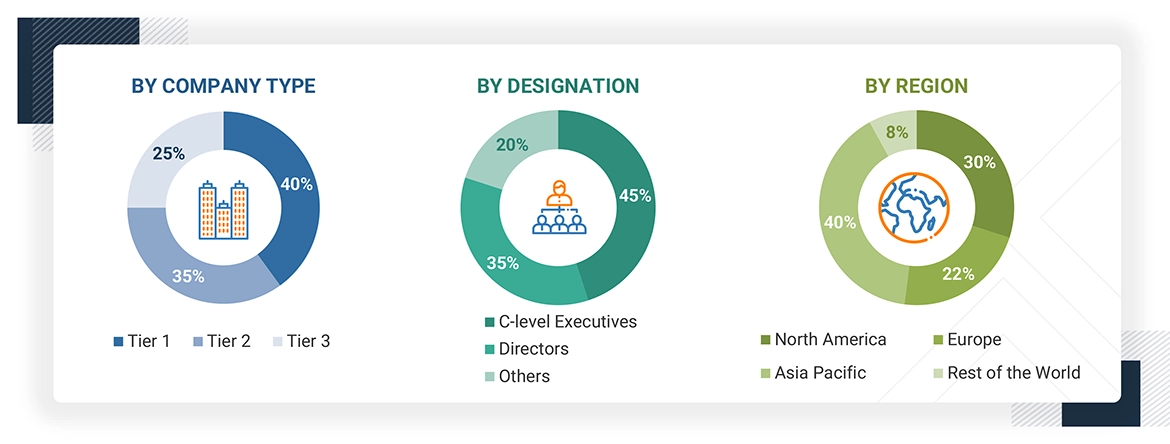
Note: Three tiers of companies are defined based on their total revenue as of 2024; tier 1: revenue more than or equal to USD 500 million, tier 2: revenue between USD 100 million and USD 500 million, and tier 3: revenue less than or equal to USD 100 million. Other designations include sales and marketing executives and researchers, as well as members of various temperature sensor organizations.
To know about the assumptions considered for the study, download the pdf brochure
Market Size Estimation
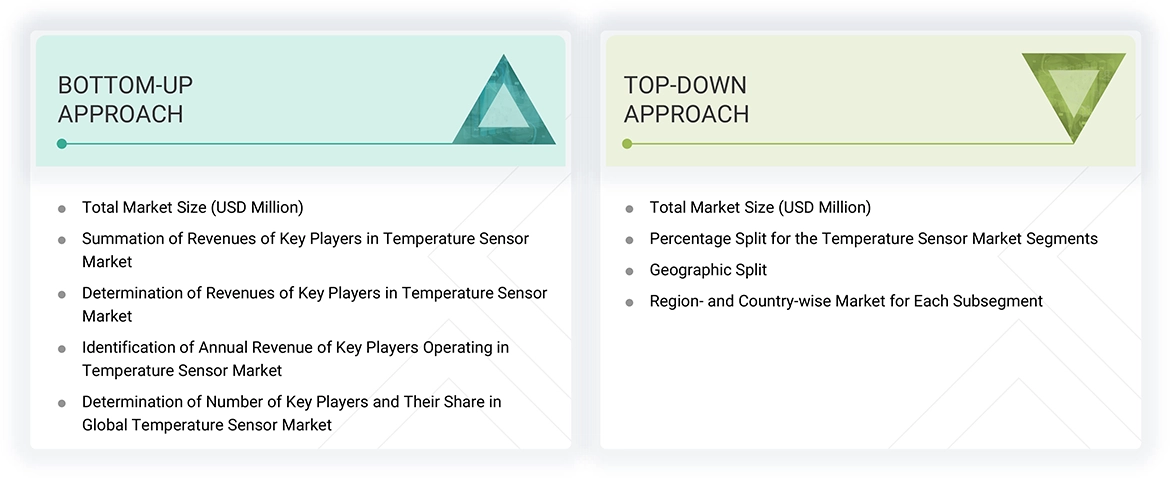
This report implements both the top-down and bottom-up approaches to estimate and validate the size of the temperature sensor market and various other dependent submarkets. Key players in this market are identified through secondary research, and their market shares in the respective regions are determined through primary and secondary research.
This entire research methodology included the study of annual and financial reports of top companies, as well as interviews with experts (such as CEOs, VPs, directors, and marketing executives) for key insights (both quantitative and qualitative). All percentage shares, splits, and breakdowns were determined using secondary sources and verified through primary sources. All the possible parameters that affect the market covered in this research study were accounted for, viewed in detail, verified through primary research, and analyzed to obtain the final quantitative and qualitative data. This data was consolidated and supplemented with detailed inputs and analysis from MarketsandMarkets and presented in this report. The figures given below show the overall market size estimation process employed for this study.
Bottom-Up Approach
- Key players in the temperature sensor market were identified through secondary research, and their global market share was determined through primary and secondary research.
- The research methodology included a study of annual and quarterly financial reports, regulatory filings of major market players (public), and interviews with industry experts for detailed market insights.
- All temperature penetration rates, percentage shares, splits, and breakdowns for the temperature sensor market were determined using secondary sources and verified through primary sources.
- All key macro indicators affecting the revenue growth of the market segments and subsegments were accounted for, viewed in extensive detail, verified through primary research, and analyzed to obtain validated and verified quantitative and qualitative data.
- The gathered market data was consolidated, enhanced with detailed inputs, analyzed, and presented in this report.
Top-Down Approach
- Focusing initially on the top-line investments and expenditures made in the temperature sensor ecosystem, splitting the key market areas into product type, output, connectivity, end-user industry, and region, and listing key developments
- Identifying all leading players and end users in the temperature sensor market based on product type, output, and connectivity through secondary research and fully verifying them through a brief discussion with industry experts
- Analyzing revenues, product mix, geographic presence, and key applications served by all identified players to estimate and arrive at percentage splits for all key segments
- Discussing splits with the industry experts to validate the information and identify key growth pockets across all key segments
- Breaking down the total market based on verified splits and key growth pockets across all segments
Temperature Sensor Market : Top-Down and Bottom-Up Approach
Data Triangulation
After arriving at the overall size of the temperature sensor market from the estimation process explained above, the market was split into several segments and subsegments. The data triangulation and market breakdown procedures were employed (wherever applicable) to complete the overall market engineering process and arrive at the exact statistics for all segments and subsegments. The data was triangulated by studying various factors and trends from both the demand and supply sides. The size of the temperature sensor market was validated using both top-down and bottom-up approaches.
Market Definition
A temperature sensor is a device that is used to measure the degree or level of heat in a substance or its surroundings. Temperature sensors can typically be classified into two types: contact and non-contact sensors.
Contact sensors: These temperature sensors need to make physical contact with the object being sensed. In contact sensors, temperature sensing occurs through conduction. Contact sensors are capable of measuring the temperature of solids, liquids, or gases over a wide range. A few examples of common contact sensors include thermocouples, temperature sensor ICs, thermistors, and RTDs. Non-contact sensors operate on the principles of convection and radiation to detect temperature changes. Non-contact sensors detect the thermal radiation that is emitted from an object and are equipped with infrared radiation sensors. The major types of non-contact sensors are optical and infrared sensors.
Key Stakeholders
- Semiconductor Industry Association
- Global Semiconductor Alliance
- European Semiconductor Industry Association
- Taiwan Semiconductor Industry Association
- SemiconPortal
- AMA Association for Sensor Technology
- OMICS International
- IEEE
- MEMS & Sensors Industry Group
- Educational Institutions Research/White Papers (Published by Communication Organizations)
- Investor Presentations and Annual Reports of Key Market Players
Report Objectives
- To define, describe, and forecast the temperature sensor market, by product type, output, connectivity, end-user industry, and region, in terms of value
- To define, describe, and forecast the global temperature sensor market, in terms of volume
-
To forecast the sizes of various segments with respect to the four major regions—
North America, Europe, Asia Pacific, and Rest of the World (RoW) - To provide a detailed analysis of the temperature sensors supply chain
- To analyze the impact of the recession on the temperature sensor market
- To strategically analyze the micromarkets with respect to individual growth trends and prospects, and their contributions to the total market
- To analyze competitive developments, such as expansions, agreements, partnerships, acquisitions, product developments, and research & development (R&D), in the temperature sensor market
- To analyze the opportunities for market players and provide details of the competitive landscape of the market.
- To benchmark the market players using the proprietary company evaluation matrix framework, which analyzes the market players on various parameters within the broad categories of business strategy excellence and strength of product portfolios
- To strategically profile the key players and comprehensively analyze their market positions in terms of ranking and core competencies, along with a detailed competitive landscape of the market
- To analyze the supply chain, market/ecosystem map, trend/disruptions impacting customer business, technology analysis, Porter’s five force analysis, trade analysis, patent analysis, key conferences & events, and regulations related to the temperature sensor market
Available customizations:
With the market data given, MarketsandMarkets offers customizations according to the company’s specific needs. The following customization options are available for the report:
Company Information
- Detailed analysis and profiling of additional market players (up to 7)
Get the Full Temperature Sensor Market Report
Full forecast, segment splits, and company analysis for all Temperature Sensor Market.
- US Temperature Sensor Market
- Mexico Temperature Sensor Market
- UK Temperature Sensor Market
- Germany Temperature Sensor Market
- France Temperature Sensor Market
- Italy Temperature Sensor Market
- China Temperature Sensor Market
- Japan Temperature Sensor Market
- South Korea Temperature Sensor Market
- India Temperature Sensor Market
- Rest Of Europe Temperature Sensor Market
- Rest Of Asia Pacific Temperature Sensor Market
- Africa Temperature Sensor Market
- Middle East Temperature Sensor Market
- South America Temperature Sensor Market
- GCC Temperature Sensor Market
- Rest Of Middle East Temperature Sensor Market
- Rest Of GCC Temperature Sensor Market
- Saudi Arabia Temperature Sensor Market
- UAE Temperature Sensor Market
Need a Tailored Report?
Customize this report to your needs
Get 10% FREE Customization
Customize This Report
