
South Africa Thermoplastic Elastomers Market (2025-2030)

The South Africa Thermoplastic Elastomers Market was valued at $134.3 Million in 2025 and projected to reach to $168.1 Million by 2030, representing a compound annual growth rate of 4.6%. South Africa's thermoplastic elastomers market is positioned for steady expansion through 2030, supported by continued automotive production and diversification into consumer and industrial sectors.


| Market Size in | USD 26.32 MN |
| Market Forecast in | |
| CAGR | |
| Forecast Period | |
| Units Considered | Value (USD MN) |
South Africa Thermoplastic Elastomers Market Trends and Insights
- South Africa's market is driven by rising demand from automotive, consumer goods, and industrial applications, where thermoplastic elastomers offer superior flexibility, durability, and cost-effectiveness compared to traditional rubber compounds.
- The growth trajectory reflects South Africa's increasing manufacturing capacity and integration into regional supply chains across the Middle East Africa region. South Africa's thermoplastic elastomers sector benefits from steady industrialization and infrastructure development initiatives.
- South Africa's automotive sector, in particular, continues to leverage thermoplastic elastomers for seals, gaskets, and vibration-damping components, supporting market expansion through 2030.
- South Africa's competitive positioning within Africa and emerging applications in medical devices and consumer electronics are expected to sustain moderate but consistent market growth over the forecast period..
Key Market Statistics
- CAGR (2025-2030) 4.6% CAGR
- Market Size, 2025 ~USD 134.3 Million
- Forecast, 2030 ~USD 168.1 Million
- Country South Africa
South Africa Thermoplastic Elastomers Market Overview
Market Size & Growth :
South Africa's thermoplastic elastomers market is valued at USD 134.3 million in 2025, with projected growth to USD 168.1 million by 2030, representing a steady CAGR of 4.6%.
Automotive Sector Dominance :
The automotive industry is a primary driver of TPE demand in South Africa, utilizing elastomers for seals, gaskets, weatherstripping, and interior components that require flexibility and durability.
Industrial & Consumer Applications :
Beyond automotive, South Africa's TPE market benefits from growing adoption in consumer goods manufacturing, industrial equipment, and appliances where cost-effective elastomeric solutions are essential.
Regional Competitiveness :
South Africa's 4.6% CAGR slightly trails the global 5% growth rate, reflecting moderate market maturity but sustained demand from established manufacturing sectors and emerging applications.
South Africa Thermoplastic Elastomers Market Dynamics
- The country's manufacturing base, coupled with increasing demand for lightweight, flexible materials, creates sustained growth opportunities.
- Local manufacturers and importers are capitalizing on TPE's superior performance characteristics and cost advantages over traditional elastomers. Key growth drivers include rising vehicle production, expansion of consumer goods manufacturing, and industrial modernization initiatives.
- However, market growth remains moderate compared to global rates, reflecting South Africa's established market maturity and competitive landscape.
- Strategic investments in local production capacity and supply chain optimization will be critical for capturing emerging opportunities in the forecast period..
Market Ecosystem
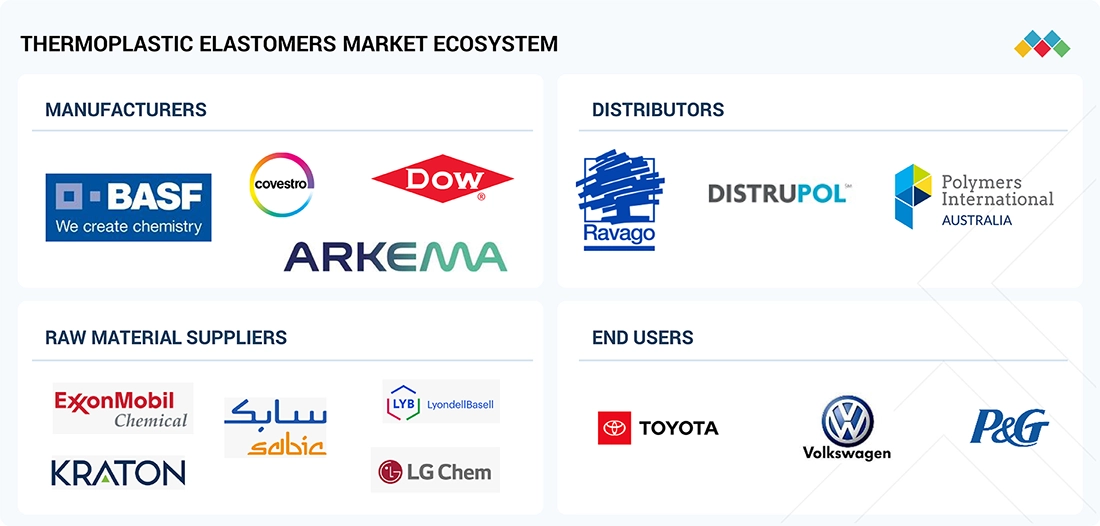
Thermoplastic Elastomers Market: COMMERCIAL USE CASES ACROSS INDUSTRIES
| COMPANY | USE CASE DESCRIPTION | BENEFITS |
|---|---|---|
 |
Liberty used ESTANE® VSN TPU in its eyewear frames to enable novel shapes, color-change effects, and scratch-healing capabilities for premium optical applications. | Delivers lightweight, durable, self-healing frames with stable dimensions and excellent aesthetic flexibility. |
 |
FRESH 32, a producer of oral care products, collaborated with Covestro to develop replaceable toothbrush heads using Desmopan® TPU grades 9385A and 9392A GMP, combined with a reusable metal handle for a more circular design. | Enables 100% recyclable, long-lasting toothbrush heads with high abrasion resistance, microbial protection, and excellent durability for sustainable oral care solutions. |
 |
Hamee Corp, a leading smartphone accessories manufacturer, partnered with BASF to produce its HIGHER series of MagSafe-compatible phone covers using Elastollan N, a bio-based TPU containing about 53% renewable content. | Provides durable, transparent, and UV-resistant covers with reduced yellowing while lowering fossil resource dependence for more sustainable smartphone accessories. |
Logos and trademarks shown above are the property of their respective owners. Their use here is for informational and illustrative purposes only.
Related Ecosystem
Automotive Systems
- Light Commercial Vehicles (LCVs)
- Battery Electric Vehicle (BEV)
- Hybrid Electric Vehicle (HEV)
- Agricultural Tractors
- Fuel Cell Electric Vehicle (FCEV)
- BOSCH LIMITED
- DENSO Corporation
- ZF FRIEDRICHSHAFEN AG
- Continental ag
- GORKOVSKY AVTOMOBILNY ZAVOD
Adhesives And Sealants
- Alkyd Resins
- Polyurethane Resin
- Epoxy Resin
- Polyester Resin
- Polyolefin
- 3M COMPANY
- Henkel ag and co. kgaa
- H.B. Fuller Company
- Sika ag
- DOW CHEMICAL COMPANY
Paints And Coatings
- Polyurethane Resin
- Alkyd Resins
- Epoxy Resin
- Polyester Resin
- Acrylics
- Basf se
- JOTUN
- PPG Industries, Inc.
- DOW CHEMICAL COMPANY
- Akzonobel n.v.
Key Takeaways
- South Africa's thermoplastic elastomers market is valued at USD 134.3 million in 2025 and will reach USD 168.1 million by 2030.
- South Africa's market is growing at a 4.6% CAGR, driven by automotive, industrial, and consumer goods applications.
- South Africa's automotive sector is a primary growth engine, utilizing thermoplastic elastomers for critical sealing and damping components.
- South Africa's regional integration and emerging applications in medical devices position the market for sustained expansion through 2030.
Thermoplastic Elastomers Market Report Scope
| Report Metric | Details |
|---|---|
| Base Year | 2025 |
| Fastest Growing Segment | MEDICAL (Application) |
| Forecast Period | 2025–2030 |
| Growth Rate | CAGR of 5% from 2025 to 2030 |
| Largest Segment | AUTOMOTIVE (End-Use Industry) |
| Market Size Base Year (Billions) | ~USD 30.79 (2025) |
| Revenue Forecast (Billions) | ~USD 39.3 (2030) |
| Segments Covered | Type, End-Use Industry, Application |
South Africa Thermoplastic Elastomers Market Report Segmentation
3 segment dimensions are covered across the global market.
By Type
- Compounded Thermoplastic Polyolefin
- Copolyester Ether Elastomers
- In-Situ Thermoplastic Polyolefin
- Poes
- Polyether Block Amide Elastomers
- Styrenic Block Copolymers
- Thermoplastic Polyolefins
- Thermoplastic Polyurethanes
- Thermoplastic Vulcanizates
By End-Use Industry
- Automotive
- Building & Construction
- Engineering
- Footwear
- Medical
- Other End-Use Industries
- Wire & Cable
By Application
- Automotive
- Building & Construction
- Medical
- Wire & Cable
Target Audience
- Automotive Manufacturers & Suppliers : South African automotive OEMs and Tier-1/Tier-2 suppliers need market data to source TPE materials, optimize component design, and maintain competitiveness in vehicle production.
- Chemical & Material Producers : TPE manufacturers and distributors require South Africa-specific demand forecasts, application trends, and competitive insights to guide production planning and market expansion strategies.
- Industrial Equipment Manufacturers : Companies producing machinery, appliances, and industrial equipment in South Africa need TPE market intelligence to identify material sourcing opportunities and cost optimization strategies.
- Investment & Private Equity Firms : Investors evaluating opportunities in South Africa's chemicals and materials sector require accurate market sizing, growth projections, and sector dynamics to assess investment viability.
- Business Development & Strategy Teams : Corporate strategists in South Africa's manufacturing sector need localized market data to identify partnership opportunities, assess market entry feasibility, and develop growth initiatives.
Key Companies in the South Africa Thermoplastic Elastomers Market
| Company | HQ | Ownership | Strongest segments |
|---|---|---|---|
| TRINSEO | United States | Public Company | SBC and styrenic-based TPEs,TPU and TPU-like engineered elastomers,TPO/TPV compounds, |
| VERSALIS S.P.A | Italy | Private Company | SBC,TPO,TPV, |
| SAUDI ARAMCO | Saudi Arabia | Public Company | TPO,TPV,SBC, |
| LG CHEM LTD. | South Korea | Public Company | TPO,TPV,SBC (incl. SBS-based KEYFLEX BT), |
| ARKEMA SA | France | Public Company | SBC,TPU,TPO, |
| ASAHI KASEI CORPORATION | Japan | Public Company | SBC,TPU,TPO, |
| BASF SE | Germany | Public Company | TPU,TPO,TPV, |
| DOW | United States | Public Company | SBC and polyolefin elastomer alternatives,TPU and polyurethane-linked TPEs,TPO (thermoplastic polyolefins), |
| COVESTRO AG | Germany | Public Company | TPU,Elastomers (non-TPU, including specialty polyurethanes),SBC-based TPEs, |
| HUNTSMAN CORPORATION | United States | Public Company | TPU,TPO & TPV,SBC, |
| EXXON MOBIL CORPORATION | United States | Public Company | TPO,TPV,SBC, |
| MITSUBISHI CHEMICAL GROUP CORPORATION | Japan | Public Company | TPO,TPV,TPU, |
| LUBRIZOL CORPORATION | United States | Private Company | TPU,TPV,TPO, |
| DUPONT DE NEMOURS, INC. | United States | Public Company | TPU,TPO,TPV, |
| SIBUR HOLDING | Russia | Private Company | SBC,TPO,TPV, |
| CELANESE CORPORATION | United States | Public Company | SBC,TPU,TPO, |
| ZEON CORPORATION | Japan | Public Company | SBC and related styrenic TPEs,TPU,TPO and TPV, |
TRINSEO
Trinseo is a United States-based public company founded in 2015 with 2,758 employees. The company operates in the chemical and materials sector.
VERSALIS S.P.A
Versalis S.P.A is an Italian private company established in 1995 with 7,389 employees. The company operates in the chemical industry.
SAUDI ARAMCO
Saudi Aramco is a Saudi Arabian public company founded in 1933 with 79,000 employees. The company is a major global energy and petrochemical corporation.
LG CHEM LTD.
LG Chem Ltd. is a South Korean public company founded in 1947 with 14,019 employees. The company operates in the chemical and advanced materials industry.
ARKEMA SA
Arkema SA is a French public company founded in 2003 with 20,700 employees. The company is a global specialty chemicals and advanced materials manufacturer.
ASAHI KASEI CORPORATION
Asahi Kasei Corporation is a Japanese public company founded in 1922 with 47,895 employees. The company operates across chemicals, materials, and healthcare sectors.
BASF SE
BASF SE is a German public company founded in 1865 with 94,910 employees. The company is one of the world's largest chemical manufacturers.
DOW
Dow is a United States-based public company founded in 1897 with 34,600 employees. The company is a leading global chemical and materials producer.
COVESTRO AG
Covestro AG is a German public company founded in 1863 with 17,806 employees. The company specializes in high-performance polymer materials.
HUNTSMAN CORPORATION
Huntsman Corporation is a United States-based public company founded in 1970 with 6,000 employees. The company manufactures specialty chemicals and materials.
EXXON MOBIL CORPORATION
Exxon Mobil Corporation is a United States-based public company founded in 1870 with 57,900 employees. The company is a major global energy and petrochemical corporation.
MITSUBISHI CHEMICAL GROUP CORPORATION
Mitsubishi Chemical Group Corporation is a Japanese public company founded in 1933 with 56,678 employees. The company operates across chemicals, materials, and specialty products.
LUBRIZOL CORPORATION
Lubrizol Corporation is a United States-based private company founded in 1928 with 7,000 employees. The company specializes in specialty chemicals and additives.
DUPONT DE NEMOURS, INC.
DuPont de Nemours, Inc. is a United States-based public company founded in 2015 with 15,000 employees. The company operates in specialty chemicals and advanced materials.
SIBUR HOLDING
Sibur Holding is a Russian private company founded in 1995 with 18,000 employees. The company operates in the petrochemical and chemical industry.
CELANESE CORPORATION
Celanese Corporation is a United States-based public company founded in 1912 with 11,434 employees. The company manufactures specialty chemicals and advanced materials.
ZEON CORPORATION
Zeon Corporation is a Japanese public company founded in 1950 with 4,425 employees. The company specializes in specialty chemicals and synthetic rubber.
Reasons to Buy this Report
- Localized Market Intelligence : Gain country-specific insights into South Africa's TPE market dynamics, including regional demand patterns, competitive landscape, and growth drivers unique to the South African manufacturing ecosystem.
- Accurate Forecasting Data : Access precise market sizing (USD 134.3M in 2025) and reliable 5-year projections (USD 168.1M by 2030) to inform strategic planning, investment decisions, and resource allocation in South Africa.
- Sector-Specific Opportunity Analysis : Identify high-growth applications across South Africa's automotive, consumer goods, and industrial sectors to prioritize market entry strategies and product development initiatives.
- Competitive Positioning Strategy : Benchmark your business against South Africa's market growth rate (4.6% CAGR) and understand regional competitive dynamics to optimize pricing, distribution, and market penetration strategies.
- Investment & Expansion Planning : Make informed decisions on manufacturing facility location, supply chain development, and partnership opportunities in South Africa's growing TPE market with comprehensive regional data.
Frequently asked questions
What is the current market size of thermoplastic elastomers in South Africa?
South Africa's thermoplastic elastomers market is estimated at USD 134.3 million in 2025.
What is the projected market size for South Africa by 2030?
South Africa's thermoplastic elastomers market is forecast to reach USD 168.1 million by 2030.
What is the growth rate of South Africa's thermoplastic elastomers market?
South Africa's thermoplastic elastomers market is expanding at a compound annual growth rate of 4.6% from 2025 to 2030.
Which industries drive demand for thermoplastic elastomers in South Africa?
South Africa's primary demand drivers include automotive, consumer goods, industrial applications, medical devices, and electronics sectors.
Why is South Africa's thermoplastic elastomers market growing?
South Africa's market growth is supported by industrialization, automotive sector expansion, regional supply chain integration, and emerging applications in high-value industries.
RESEARCH METHODOLOGY
The study involved four major activities to estimate the current size of the global thermoplastic elastomers market. Exhaustive secondary research was carried out to collect information on the market, the peer product market, and the parent product group market. The next step was to validate these findings, assumptions, and sizes with the industry experts across the value chain of thermoplastic elastomers through primary research. The top-down and bottom-up approaches were employed to estimate the overall size of the thermoplastic elastomers market. After that, market breakdown and data triangulation procedures were used to determine the size of different segments and sub-segments of the market.
Secondary Research
The market for the companies offering thermoplastic elastomers is arrived at by secondary data available through paid and unpaid sources, analyzing the product portfolios of the major companies in the ecosystem, and rating the companies by their performance and quality. Various secondary sources, such as Business Standard, Bloomberg, World Bank, and Factiva, were referred to identify and collect information for this study on the thermoplastic elastomers market. In the secondary research process, various secondary sources were referred to identify and collect information related to the study. Secondary sources included annual reports, press releases, and investor presentations of thermoplastic elastomer vendors, forums, certified publications, and whitepapers. The secondary research was used to obtain critical information on the industry’s value chain, the total pool of key players, market classification, and segmentation from the market and technology-oriented perspectives.
Primary Research
In the primary research process, various primary sources from both the supply and demand sides were interviewed to obtain qualitative and quantitative information for this report. The primary sources from the supply side included industry experts, such as Chief Executive Officers (CEOs), Vice Presidents (VPs), marketing directors, technology and innovation directors, and related key executives from several key companies and organizations operating in the thermoplastic elastomers market. After the complete market engineering (calculations for market statistics, market breakdown, market size estimations, market forecasting, and data triangulation), extensive primary research was conducted to gather information and verify and validate the critical numbers arrived at. Primary research was also conducted to identify the segmentation types, industry trends, competitive landscape of thermoplastic elastomers offered by various market players, and key market dynamics, such as drivers, restraints, opportunities, challenges, industry trends, and key player strategies. In the complete market engineering process, the top-down and bottom-up approaches and several data triangulation methods were extensively used to perform the market estimation and market forecasting for the overall market segments and subsegments listed in this report. Extensive qualitative and quantitative analysis was performed on the complete market engineering process to list the key information/insights throughout the report.
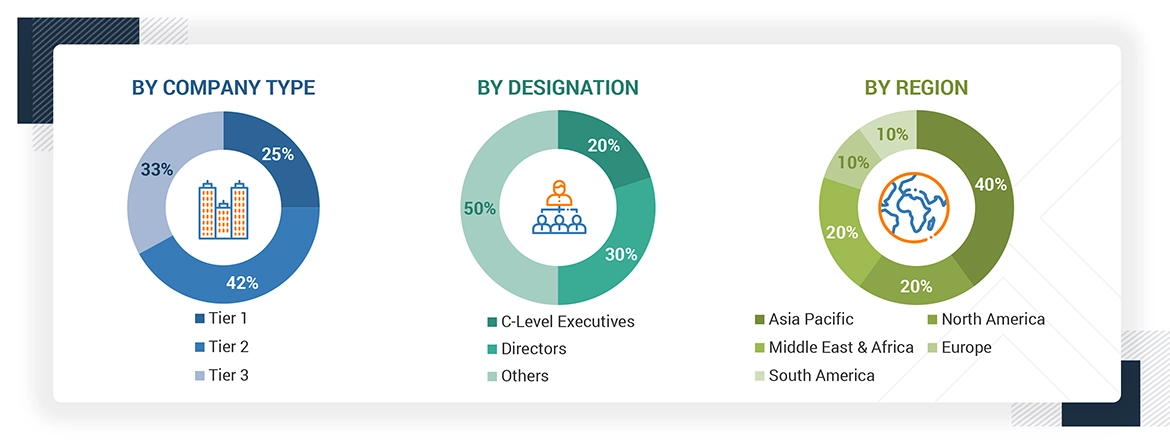
Notes: Others include sales, marketing, and product managers.
Tier 1: >USD 1 Billion; Tier 2: USD 500 million–1 Billion; and Tier 3: < USD 500 million
To know about the assumptions considered for the study, download the pdf brochure
Market Size Estimation
The top-down and bottom-up approaches were used to estimate and validate the size of the global thermoplastic elastomers market. These approaches were also used extensively to estimate the size of various dependent market segments. The research methodology used to estimate the market size included the following:
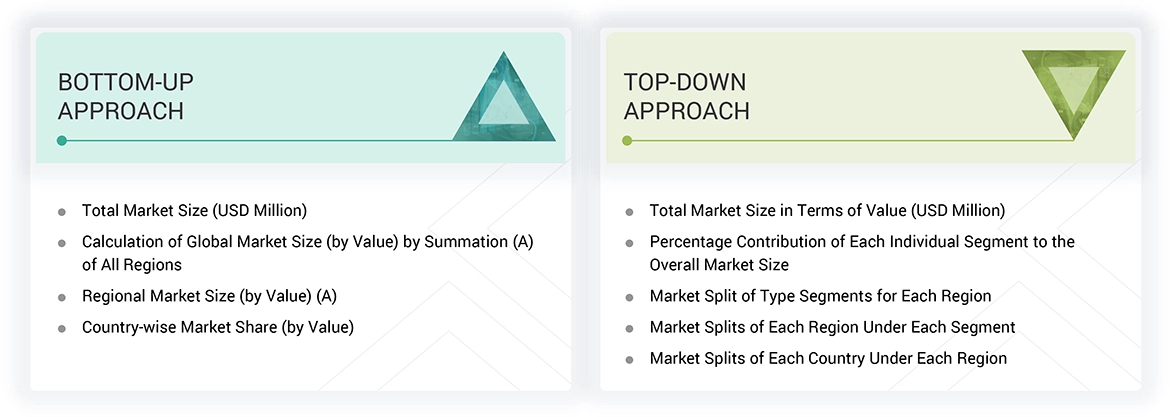
Data Triangulation
After arriving at the overall market size using the market size estimation processes, the market was split into several segments and subsegments. The data triangulation and market breakup procedures were employed, wherever applicable, to complete the overall market engineering process and arrive at the exact statistics of each market segment and subsegment. The data was triangulated by studying various factors and trends from both the demand and supply sides.
Market Definition
Thermoplastic elastomers (TPEs) are a diverse class of polymers that incorporate the elasticity of rubber with the thermoplastic character of ease of processing. In contrast to conventional rubber, which is subjected to vulcanization, thermoplastic elastomers may be melted and remolded repeatedly without causing much degradation, making them suitable for effective manufacturing and recycling. Thermoplastic elastomers offer the elasticity of rubber with the ease of processing of thermoplastics. Thermoplastic elastomers are flexible, resilient, and durable, which makes them suitable for applications that need soft touch, impact survival, and chemical resistance. Thermoplastic elastomers are used in many applications in many different industries, including automotive, medical, consumer products, electronics, and construction. Their moldability to intricate shapes and suitability for different additives make it possible to tailor properties such as hardness, color, and resistance. Increasing environmental consciousness and the need for eco-friendly materials also contribute to increasing the demand for thermoplastic elastomers worldwide.
Stakeholders
- Thermoplastic elastomers manufacturers
- Raw material suppliers
- Converters & processors
- Distributors and traders
- Industry associations and regulatory bodies
- End users
Report Objectives
- To define, describe, and forecast the size of the global thermoplastic elastomers market based on type, end-use industry, and region in terms of value and volume
- To provide detailed information on the significant drivers, restraints, opportunities, and challenges influencing the market
- To strategically analyze micromarkets concerning individual growth trends, prospects, and their contribution to the market
- To assess the growth opportunities in the market for stakeholders and provide details on the competitive landscape for market leaders
- To forecast the market size of segments and subsegments for North America, Europe, Asia Pacific, South America, and the Middle East & Africa
- To strategically profile key players and comprehensively analyze their market shares and core competencies
- To analyze competitive developments such as product launches, acquisitions, expansions, partnerships, and agreements in the thermoplastic elastomers market
- To provide the impact of AI/Gen AI on the market.
Get the Full Thermoplastic Elastomers Market Report
Full forecast, segment splits, and company analysis for all Thermoplastic Elastomers Market.
- US Thermoplastic Elastomers Market
- Canada Thermoplastic Elastomers Market
- Mexico Thermoplastic Elastomers Market
- Germany Thermoplastic Elastomers Market
- UK Thermoplastic Elastomers Market
- France Thermoplastic Elastomers Market
- Russia Thermoplastic Elastomers Market
- Italy Thermoplastic Elastomers Market
- Turkey Thermoplastic Elastomers Market
- China Thermoplastic Elastomers Market
- Japan Thermoplastic Elastomers Market
- South Korea Thermoplastic Elastomers Market
- India Thermoplastic Elastomers Market
- Indonesia Thermoplastic Elastomers Market
- Taiwan Thermoplastic Elastomers Market
- Brazil Thermoplastic Elastomers Market
- Argentina Thermoplastic Elastomers Market
- Rest Of Europe Thermoplastic Elastomers Market
- Rest Of Asia Pacific Thermoplastic Elastomers Market
- GCC Countries Thermoplastic Elastomers Market
- –Rest Of GCC Thermoplastic Elastomers Market
- Rest Of South America Thermoplastic Elastomers Market
Need a Tailored Report?
Customize this report to your needs
Get 10% FREE Customization
Customize This Report
