
Germany Trainer Aircraft Market (2026-2031)

The Germany Trainer Aircraft Market was valued at $266 Million in 2026 and projected to reach to $422.6 Million by 2031, representing a compound annual growth rate of 8.0%. Germany's trainer aircraft market is positioned for sustained growth through 2031, driven by the Luftwaffe's modernization agenda and increased pilot training requirements across NATO operations.


| Market Size in | USD 26.32 MN |
| Market Forecast in | |
| CAGR | |
| Forecast Period | |
| Units Considered | Value (USD MN) |
Germany Trainer Aircraft Market Trends and Insights
- Valued at $266.0 million in 2026, Germany's market is projected to expand to $422.6 million by 2031, representing an 8.0% compound annual growth rate.
- This growth trajectory reflects Germany's strategic investments in pilot training infrastructure and modernization of military aviation capabilities. The German trainer aircraft sector benefits from robust defence spending and the country's established aerospace manufacturing base.
- Germany's commitment to NATO readiness and European defence initiatives drives demand for advanced training platforms.
- Between 2026 and 2031, Germany is expected to see increased procurement of next-generation trainer aircraft to support pilot development programs and fleet renewal initiatives. Germany's market expansion is underpinned by technological advancement and regional collaboration within Europe's defence ecosystem.
- The country's focus on maintaining pilot proficiency standards and transitioning to modern training systems positions Germany as a significant market for trainer aircraft manufacturers throughout the forecast period..
Key Market Statistics
- CAGR (2026-2031) 8.0% CAGR
- Market Size, 2026 ~USD 266 Million
- Forecast, 2031 ~USD 422.6 Million
- Country Germany
Germany Trainer Aircraft Market Overview
Market Valuation Growth :
Germany's trainer aircraft market is valued at $266.0 million in 2026 and is projected to reach $422.6 million by 2031, demonstrating robust expansion driven by modernization initiatives within the Luftwaffe and allied training programs.
Strong CAGR Performance :
The German market exhibits an 8.0% compound annual growth rate from 2026 to 2031, outpacing the global average of 7.4%, reflecting Germany's elevated commitment to aviation training infrastructure and defense capabilities.
Strategic Military Investments :
Germany's investments in pilot training modernization and military aviation capacity expansion are key drivers, supported by NATO commitments and European defense cooperation initiatives that prioritize advanced training platforms.
European Aerospace Hub :
As a leading aerospace and defense nation in Europe, Germany's trainer aircraft market benefits from established manufacturing expertise, supply chain integration, and partnerships with major European defense contractors.
Germany Trainer Aircraft Market Dynamics
- Strategic defense spending and European security initiatives are catalyzing demand for advanced training platforms and simulation technologies.
- The market benefits from Germany's strong aerospace industrial base and collaborative defense partnerships within the EU and NATO framework. Future expansion will be supported by technological advancements in aircraft design, digital training systems, and pilot competency development.
- Germany's focus on maintaining operational readiness and training excellence ensures continued investment in trainer aircraft procurement and fleet upgrades, positioning the country as a significant growth market within the European aerospace and defense sector..
Market Ecosystem
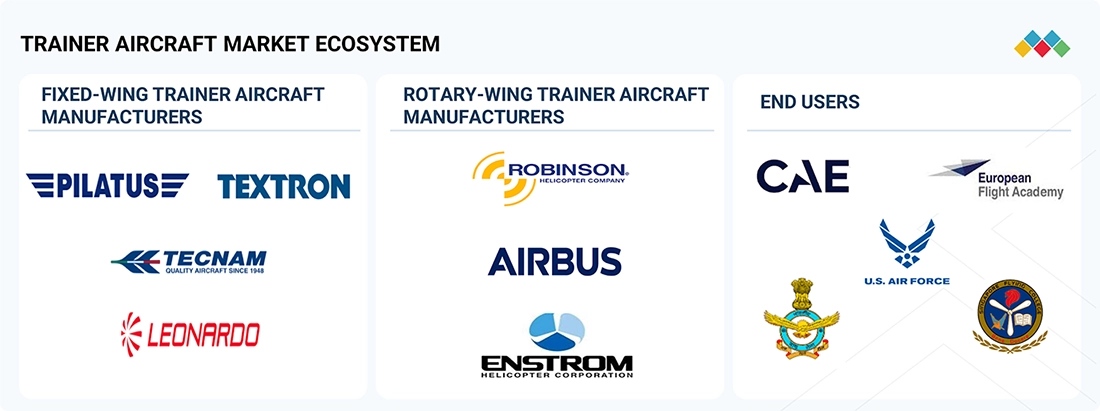
TRAINER AIRCRAFT MARKET: COMMERCIAL USE CASES ACROSS INDUSTRIES
| COMPANY | USE CASE DESCRIPTION | BENEFITS |
|---|---|---|
 |
HAL enhances training of military pilots with domestically manufactured HTT-40 and HJT-36 Yashas trainers. The aircraft are configured to provide basic training and enhance pilot capabilities. | Boosts native pilot training program | Encourages self-sustainability in military flight training | Allows streamlined approach for developing from basic to intermediate flight training |
 |
The company develops advanced military trainer aircraft, including the L-39 Skyfox, to support various training levels for defense. Its aircraft helps in smoother transition of rookies to advanced modern aircraft through necessary training impartation. | Aids in the training of military pilots at various levels| Converts military pilots for first line fighter aircraft, | Enhances the skills in tactical flying, formation flying and weapons training | Reduces expenses by employing dedicated trainer aircraft instead of front-line combat aircraft |
 |
Pilot training for military environment is facilitated by trainer helicopters, namely, H125. H135 and H145. These helicopters are used by armed forces for basic training and advanced pilot instructions. Such platforms helps cadets to develop required flying skills. | Provides required rotary-wing training for pilots | Facilitates smooth transition to operational military helicopters | Standardizes training across defense organizations | Improves availability of fleet through full lifecycle support |
Logos and trademarks shown above are the property of their respective owners. Their use here is for informational and illustrative purposes only.
Related Ecosystem
Key Takeaways
- Germany's trainer aircraft market will grow from $266.0M (2026) to $422.6M (2031) at 8.0% CAGR.
- Germany's defence modernization and NATO commitments are primary drivers of trainer aircraft demand.
- Germany's established aerospace sector and manufacturing capabilities support market expansion.
- Germany's focus on pilot training infrastructure modernization creates sustained procurement opportunities through 2031.
Trainer Aircraft Market Report Scope
| Report Metric | Details |
|---|---|
| Base Year | 2026 |
| Fastest Growing Segment | ADVANCED HELICOPTER TRAINERS (Rotary-Wing Trainer Aircraft) |
| Forecast Period | 2026-2031 |
| Growth Rate | CAGR of 7.4% from 2026 to 2031 |
| Largest Segment | FIXED-WING TRAINER AIRCRAFT (Aircraft Type) |
| Market Size Base Year (Billions) | ~USD 13.83 (2026) |
| Revenue Forecast (Billions) | ~USD 19.76 (2031) |
| Segments Covered | Aircraft Type, Fixed-Wing Trainer Aircraft, Rotary-Wing Trainer Aircraft, Propulsion Type, Seat Configuration, End User |
Germany Trainer Aircraft Market Report Segmentation
6 segment dimensions are covered across the global market.
By Aircraft Type
- Fixed-Wing Simulator
- Fixed-Wing Trainer Aircraft
- Rotary-Wing Simulator
- Rotary-Wing Trainer Aircraft
By Fixed-Wing Trainer Aircraft
- Advanced Trainer Aircraft
- Basic Trainer Aircraft
- Jet Trainer Aircraft
By Rotary-Wing Trainer Aircraft
- Advanced Helicopter Trainers
- Light Helicopter Trainers
By Propulsion Type
- Conventional Fuel-Powered Trainers
- Electrified Trainers
By Seat Configuration
- Others (Five And Six Seats)
- Single Seat
- Three Or Four Seats
- Three To Four Seats
- Two Seats
By End User
- Airline Academies
- Civil Flight Schools
- Government Organizations
- Military Forces
- Private Flying Clubs
- Vcivil Flight Schools
Target Audience
- Defense Procurement Officials : German military and defense ministry decision-makers require detailed market analysis to justify trainer aircraft investments, evaluate supplier capabilities, and align procurement with modernization timelines and NATO commitments.
- Aerospace Manufacturers : Aircraft manufacturers and defense contractors need Germany-specific market data to assess demand potential, identify partnership opportunities with local suppliers, and develop targeted sales strategies for the Luftwaffe and allied training programs.
- Investment & Private Equity Firms : Investors evaluating opportunities in German aerospace and defense require market-specific insights on growth potential, competitive positioning, and risk factors to make informed capital allocation decisions in this high-growth segment.
- Aviation Training Institutions : German pilot training academies and flight schools need market intelligence on aircraft availability, technological advancements, and training platform trends to optimize curriculum development and procurement planning.
- Strategic Consultants & Analysts : Business consultants and market analysts supporting clients in the aerospace and defense sectors require Germany-focused data to develop competitive strategies, market entry plans, and long-term business forecasts.
Reasons to Buy this Report
- Market-Specific Sizing & Forecasts : Access precise valuation data for Germany's trainer aircraft market with detailed 2026-2031 projections, enabling accurate budget allocation and investment planning specific to the German aerospace and defense sector.
- Competitive Landscape Intelligence : Understand Germany's unique competitive dynamics, local manufacturer capabilities, and partnerships with European defense contractors to identify market entry strategies and competitive positioning opportunities.
- Strategic Investment Insights : Gain clarity on Germany's military modernization priorities, Luftwaffe procurement plans, and NATO-aligned training requirements that directly influence trainer aircraft demand and market growth trajectories.
- Regional Growth Drivers : Identify Germany-specific growth catalysts including defense budget trends, pilot training infrastructure investments, and European security initiatives that differentiate this market from broader global trends.
- Stakeholder Decision Support : Equip executives, procurement officers, and strategic planners with Germany-focused market intelligence to support contract negotiations, partnership development, and long-term business strategy in the region.
Frequently asked questions
What is the current size of Germany's trainer aircraft market?
Germany's trainer aircraft market is valued at $266.0 million in 2026 and is projected to reach $422.6 million by 2031.
What is the growth rate for Germany's trainer aircraft market?
Germany's trainer aircraft market is expected to grow at a compound annual growth rate (CAGR) of 8.0% from 2026 to 2031.
What factors are driving growth in Germany's trainer aircraft market?
Germany's trainer aircraft market growth is driven by defence modernization initiatives, NATO commitments, pilot training infrastructure investments, and fleet renewal programs.
How much will Germany's trainer aircraft market grow by 2031?
Germany's trainer aircraft market is forecast to grow by $156.6 million, from $266.0 million in 2026 to $422.6 million in 2031.
Why is Germany an important market for trainer aircraft?
Germany is important due to its strong aerospace manufacturing base, significant defence spending, NATO leadership role, and commitment to maintaining advanced pilot training capabilities.
RESEARCH METHODOLOGY
The study involved four key activities to estimate the current size of the trainer aircraft market. Extensive secondary research was undertaken to collect information on the trainer aircraft market, related markets, and the broader parent market. The findings, assumptions, and preliminary market estimates were then validated through primary interviews with industry experts across the value chain. A demand-side analysis was conducted to determine the overall market size. Finally, data triangulation was used to estimate the size of individual segments and subsegments within the trainer aircraft market.
Secondary Research
During the secondary research phase, a wide range of sources was reviewed to identify and gather relevant information for the study. These sources included government databases such as SIPRI; corporate publications, including annual reports; industry trade associations such as the General Aviation Manufacturers Association (GAMA); press releases and investor presentations; white papers, journals, and certified publications; as well as articles from recognized authors and industry experts, and databases.
Primary Research
Extensive primary research was carried out after collecting initial market information through secondary sources. Several interviews were conducted with market experts representing both the demand and supply sides across key countries in North America, Europe, Asia Pacific, the Middle East, Latin America, and Africa. Primary information was gathered through questionnaires, email interactions, and telephonic interviews.
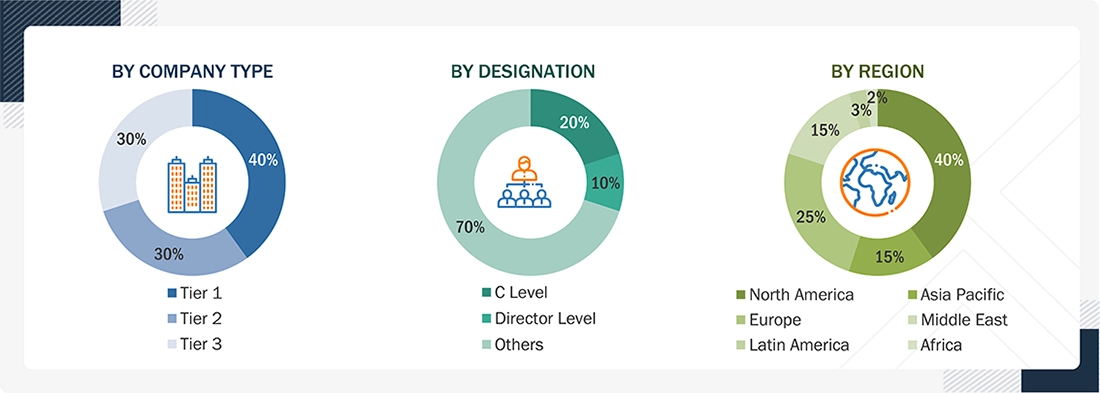
To know about the assumptions considered for the study, download the pdf brochure
Market Size Estimation
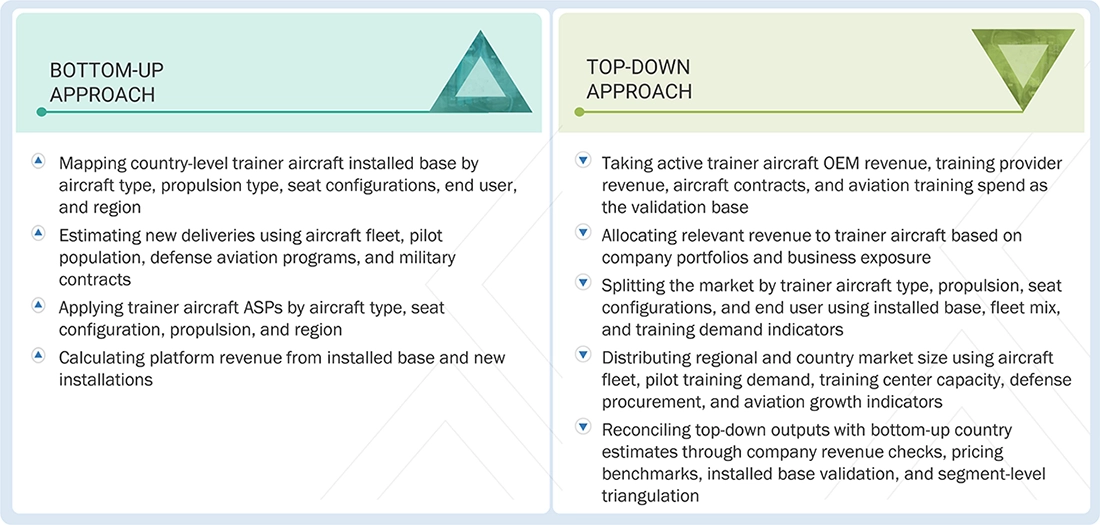
Top-down and bottom-up approaches were used to estimate and validate the size of the Trainer Aircraft market. The research methodology used to estimate the size of the market included the following details:
- Key players in the trainer aircraft market were identified through secondary research, and their market shares were determined through a combination of primary and secondary research. This included a study of the annual and financial reports of the top market players, as well as extensive interviews with leaders, including directors, engineers, marketing executives, and other key stakeholders of leading companies operating in the market.
- All percentage shares, splits, and breakdowns were determined using secondary sources and verified through primary sources.
- All possible parameters that affect the markets covered in this research study were accounted for, viewed in extensive detail, verified through primary research, and analyzed to obtain the final quantitative and qualitative data on the trainer aircraft market. This data was consolidated, enhanced with detailed input, analyzed by MarketsandMarkets, and presented in this report.
Trainer Aircraft Market : Top-Down and Bottom-Up Approach
Data Triangulation
After estimating the overall market size, the market was categorized into multiple segments and subsegments. The data triangulation and market breakdown methods described below were applied, wherever relevant, to complete the market engineering process and derive estimated values for each market segment and subsegment. The data was triangulated by assessing key factors and trends across both demand- and supply-side perspectives. In addition, the market estimates were cross-validated using top-down and bottom-up approaches.
Market Definition
The TRAINER AIRCRAFT MARKET includes the sale of newly manufactured fixed-wing and rotary-wing aircraft designed or configured for civil, military, government, and law-enforcement pilot training. It covers piston, turboprop, jet engine, and turbine-powered platforms used across primary, basic, advanced, and lead-in fighter training stages.
Key Stakeholders
- Trainer Aircraft OEMs
- Helicopter OEMs
- Aircraft Engine, Avionics, and Component Suppliers
- Flight Training Schools and Aviation Academies
- Military Training Commands and Air Forces
- Civil Aviation, Government, and Law Enforcement Agencies
- Defense Procurement and Aircraft Acquisition Agencies
- Aircraft Dealers and Distributors
- Simulator and Integrated Training Solution Providers
- Regulatory and Certification Bodies
Report Objectives
- To define, describe, and forecast the trainer aircraft market based on aircraft type, propulsion type, seat configuration, end user, and region in terms of value and volume
- To forecast the size of various segments of the market across North America, Europe, Asia Pacific, Latin America, the Middle East, and Africa in terms of value and volume
- To identify and analyze the drivers, restraints, opportunities, and challenges influencing the growth of the market
- To identify industry trends, market trends, and technology trends currently prevailing in the market
- To provide an overview of the regulatory landscape with respect to trainer aircraft across regions
- To analyze micro markets with respect to individual growth trends, prospects, and their contribution to the overall market
- To analyze opportunities in the market for stakeholders by identifying key market trends
- To profile key market players and comprehensively analyze their market share and core competencies
- To evaluate the degree of competition in the market by analyzing recent developments, such as contracts, agreements, and acquisitions adopted by leading market players
- To identify detailed financial positions, key products, and unique selling points of leading companies in the market
- To provide a detailed competitive landscape of the market, along with market share analysis and revenue analysis of key players
Available customizations:
MarketsandMarkets offers the following customizations for this market report:
- Additional country-level analysis of the trainer aircraft market
- Profiling of other market players (up to 5)
Product Analysis
- Product matrix, which provides a detailed comparison of the product portfolios of each company in the trainer aircraft market
Get the Full Trainer Aircraft Market Report
Full forecast, segment splits, and company analysis for all Trainer Aircraft Market.
- Canada Trainer Aircraft Market
- US Trainer Aircraft Market
- Czech Republic Trainer Aircraft Market
- France Trainer Aircraft Market
- Italy Trainer Aircraft Market
- Switzerland Trainer Aircraft Market
- UK Trainer Aircraft Market
- Australia Trainer Aircraft Market
- India Trainer Aircraft Market
- Indonesia Trainer Aircraft Market
- Japan Trainer Aircraft Market
- South Korea Trainer Aircraft Market
- Thailand Trainer Aircraft Market
- Argentina Trainer Aircraft Market
- Brazil Trainer Aircraft Market
- Mexico Trainer Aircraft Market
- Israel Trainer Aircraft Market
- Nigeria Trainer Aircraft Market
- Saudi Arabia Trainer Aircraft Market
- South Africa Trainer Aircraft Market
- Turkey Trainer Aircraft Market
- UAE Trainer Aircraft Market
- Rest Of Europe Trainer Aircraft Market
- Rest Of Asia Pacific Trainer Aircraft Market
- Rest Of Latam Trainer Aircraft Market
- Rest Of Africa Trainer Aircraft Market
- Rest Of Middle East Trainer Aircraft Market
Need a Tailored Report?
Customize this report to your needs
Get 10% FREE Customization
Customize This Report
