
US Truck Refrigeration Unit Market (2024-2029)

The US Truck Refrigeration Unit Market was valued at $722.3 Million in 2024 and projected to reach to $866.2 Million by 2029, representing a compound annual growth rate of 3.1%. The US truck refrigeration unit market is poised for steady growth through 2029, driven by accelerating e-commerce food delivery adoption and pharmaceutical cold chain expansion.


| Market Size in | USD 26.32 MN |
| Market Forecast in | |
| CAGR | |
| Forecast Period | |
| Units Considered | Value (USD MN) |
US Truck Refrigeration Unit Market Trends and Insights
- The US market benefits from robust cold chain logistics demand driven by e-commerce food delivery, pharmaceutical distribution, and perishable goods transportation.
- Growth in the US is supported by regulatory compliance requirements for temperature-controlled transport and increasing adoption of advanced refrigeration technologies in the US fleet. The US truck refrigeration unit market reflects steady expansion as US-based logistics providers and fleet operators invest in modernizing their refrigerated transport capabilities.
- Between 2024 and 2029, the US market will experience incremental growth fueled by replacement cycles, fleet expansion, and the integration of IoT and telematics in US refrigeration systems.
- The US remains a critical hub for cold chain infrastructure, with demand concentrated in food distribution, pharmaceutical logistics, and specialty cargo sectors..
Key Market Statistics
- CAGR (2024-2029) 3.1% CAGR
- Market Size, 2024 ~USD 722.3 Million
- Forecast, 2029 ~USD 866.2 Million
- Country US
US Truck Refrigeration Unit Market Overview
Market Size & Growth :
The US truck refrigeration unit market is valued at $722.3 million in 2024 and is projected to reach $866.2 million by 2029, representing a steady CAGR of 3.1% over the forecast period.
E-Commerce & Cold Chain Expansion :
Rapid growth in US e-commerce food delivery and last-mile logistics is driving demand for advanced refrigeration units, with major retailers and third-party logistics providers investing heavily in temperature-controlled fleet expansion.
Regulatory Compliance Drivers :
Stringent FDA and USDA regulations for pharmaceutical and perishable goods transportation across US states are compelling fleet operators to upgrade to compliant, efficient refrigeration systems.
Regional Market Dynamics :
The US market benefits from established cold chain infrastructure, high consumer demand for fresh food delivery, and significant pharmaceutical distribution networks spanning urban and rural regions.
US Truck Refrigeration Unit Market Dynamics
- Fleet operators are increasingly prioritizing energy-efficient and IoT-enabled refrigeration units to reduce operational costs and ensure regulatory compliance.
- The market will benefit from rising consumer expectations for fresh product delivery and stricter temperature-control mandates across healthcare and food sectors.
- Investment in sustainable refrigeration technologies and telematics integration will shape competitive dynamics, with established OEMs and aftermarket suppliers competing for market share among regional and national logistics providers..
Market Ecosystem
Related Ecosystem
Automotive Systems
- Light Commercial Vehicles (LCVs)
- Battery Electric Vehicle (BEV)
- Hybrid Electric Vehicle (HEV)
- Agricultural Tractors
- Fuel Cell Electric Vehicle (FCEV)
- BOSCH LIMITED
- DENSO Corporation
- Continental ag
- ZF FRIEDRICHSHAFEN AG
- TENNECO
Logistics And Transportation
- Internal Combustion Engine (ICE)
- Crawler Excavator
- Fuel Cell
- Light Commercial Vehicles (LCVs)
- Sensors
- Siemens ag
- Alstom s.a.
- Hitachi, Ltd.
- Godrej Industries Limited
- Toshiba Corporation
Key Takeaways
- The US truck refrigeration unit market is valued at $722.3 million in 2024 and will reach $866.2 million by 2029 at a 3.1% CAGR.
- US cold chain logistics demand is driven by e-commerce food delivery, pharmaceutical distribution, and perishable goods transportation expansion.
- Regulatory compliance and temperature-control standards are key growth drivers for refrigeration unit adoption across the US fleet.
- Integration of IoT and telematics technologies is accelerating modernization of US truck refrigeration systems through 2029.
Truck Refrigeration Unit Market Report Scope
| Report Metric | Details |
|---|---|
| Base Year | 2024 |
| Fastest Growing Segment | ELECTRIC/HYBRID (Propulsion) |
| Forecast Period | 2024-2029 |
| Growth Rate | CAGR of 4.4% from 2024 to 2029 |
| Largest Segment | NOSE-MOUNTED (Type) |
| Market Size Base Year (Billions) | ~USD 6.82 (2024) |
| Revenue Forecast (Billions) | ~USD 8.46 (2029) |
| Segments Covered | Application, Type, Vehicle Type, Size, Mode Of Operation, Power Source, Propulsion, End-Use Industry |
US Truck Refrigeration Unit Market Report Segmentation
8 segment dimensions are covered across the global market.
By Application
- Chilled
- Frozen
By Type
- Nose-Mounted
- Roof-Mounted
By Vehicle Type
- Light Commercial Vehicle
- Medium & Heavy Commercial Vehicle
- Trailer
By Size
- Above 40 Feet
- Below 40 Feet
By Mode Of Operation
- Multi Temperature
- Single Temperature
By Power Source
- Engine-Powered
- Independent
By Propulsion
- Diesel
- Electric/Hybrid
By End-Use Industry
- Food & Beverage
- Pharmaceutical & Drugs
Target Audience
- Fleet Operators & Logistics Companies : Need detailed US market data to make informed decisions on refrigeration unit procurement, fleet modernization, and technology investments aligned with regional cold chain demands.
- Refrigeration Equipment Manufacturers : Require comprehensive US market analysis to identify growth opportunities, competitive positioning, and customer segments for product development and go-to-market strategies.
- Automotive & Transportation OEMs : Seek US-specific market intelligence to understand refrigeration unit integration opportunities, aftermarket demand, and regulatory compliance requirements for vehicle platforms.
- Investment & Private Equity Firms : Need accurate US market forecasts and growth drivers to evaluate investment opportunities in cold chain logistics, refrigeration technology, and transportation infrastructure companies.
- Regulatory & Policy Advisors : Require market data on US compliance trends, regulatory impacts on refrigeration standards, and industry responses to inform policy recommendations and compliance strategies.
Reasons to Buy this Report
- Accurate US Market Sizing : Obtain precise valuation data specific to the US market ($722.3M in 2024) with detailed forecasts through 2029, enabling accurate budget allocation and investment planning for regional operations.
- Competitive Landscape Intelligence : Understand key US market players, their market positioning, and competitive strategies tailored to American regulatory requirements and logistics infrastructure.
- Growth Driver Analysis : Identify and quantify specific US growth catalysts including e-commerce expansion, pharmaceutical distribution growth, and regulatory compliance requirements driving refrigeration unit demand.
- Regional Opportunity Assessment : Evaluate state-level variations in cold chain demand, logistics hubs, and regulatory environments to identify high-potential markets for expansion and partnership development.
- Technology & Innovation Trends : Access insights on emerging refrigeration technologies, IoT integration, and sustainability initiatives gaining traction in the US market to inform product development strategies.
Frequently asked questions
What is the current size of the US truck refrigeration unit market?
The US truck refrigeration unit market is valued at $722.3 million in 2024 and is expected to grow to $866.2 million by 2029.
What is the growth rate of the US truck refrigeration unit market?
The US truck refrigeration unit market is growing at a compound annual growth rate of 3.1% from 2024 to 2029.
What are the primary drivers of growth in the US truck refrigeration unit market?
Key drivers include increased e-commerce food delivery demand, pharmaceutical logistics expansion, regulatory compliance requirements, and adoption of advanced refrigeration technologies in the US.
Which sectors are the largest consumers of truck refrigeration units in the US?
The US food distribution, pharmaceutical logistics, and specialty cargo sectors are the largest consumers of truck refrigeration units.
How is technology impacting the US truck refrigeration unit market?
IoT and telematics integration is modernizing US refrigeration systems, enabling real-time temperature monitoring and fleet optimization through 2029.
RESEARCH METHODOLOGY
The study encompassed four primary tasks to determine the present and future scope of the truck refrigeration unit market. Initially, extensive secondary research was conducted to gather data on the market, its related sectors, and overarching industries. Subsequently, these findings, along with assumptions, were corroborated and validated through primary research involving industry experts across the value chain. Employing bottom-up methodology, the complete market size was estimated. Following this, a market breakdown and data triangulation approach were utilized to determine the size of specific segments and subsegments within the market.
Secondary Research
The secondary sources referred to for the truck refrigeration unit market study are directly dependent on end-use industry growth. Truck refrigeration unit market sales and end-use industry demand are derived through secondary sources such as the Japan Automobile Manufacturing Association Inc. (JAMA), Society of Indian Automobile Manufacturers (SIAM), China Association of Automobile Manufacturers (CAAM), Canada Statistics, Korea Automobile Manufacturers Association (KAMA), International Energy Agency (IEA), International Organization of Motor Vehicle Manufacturers (OICA), European Automobile Manufacturers Association (ACEA), and Department of Transportation (US - DOT), corporate filings such as annual reports, investor presentations, and financial statements, and paid repository. Historical production data has been collected and analysed, and the industry trend is considered to arrive at the forecast, further validated by primary research.
Primary Research
In the primary research process, various primary sources from both the supply and demand sides were interviewed to obtain qualitative and quantitative information on the market. The primary sources from the supply side included various industry experts, such as CXOs, vice presidents, directors from business development, marketing, product development/innovation teams, and related key executives from various key companies. Various system integrators, industry associations, independent consultants/industry veterans, and key opinion leaders were also interviewed.
Primary interviews have been conducted to gather insights such as truck refrigeration unit market sizing estimation and forecast, future technology trends, and upcoming technologies in the truck refrigeration unit market. Data triangulation of all these points was done using the information gathered from secondary research and model mapping. Stakeholders from the demand and supply sides have been interviewed to understand their views on the aforementioned points.
Primary interviews have been conducted with market experts from the demand-side (end-use industries) and supply-side (Truck Refrigeration Unit providers) across three regions: Americas, Europe, and Asia Pacific. Approximately 70% and 30% of the primary interviews were conducted on the refrigeration unit manufacturers and dealer/distributors sides, respectively. Primary data has been collected through questionnaires, emails, and telephonic interviews. After communicating with primaries, we have strived to cover various departments within organizations, such as sales and operations, to provide a holistic viewpoint in our report. After interacting with industry experts, we have also conducted brief sessions with highly experienced independent consultants to reinforce the findings from our primaries. This and the in-house subject matter experts’ opinions have led us to the conclusions described in the remainder of this report.
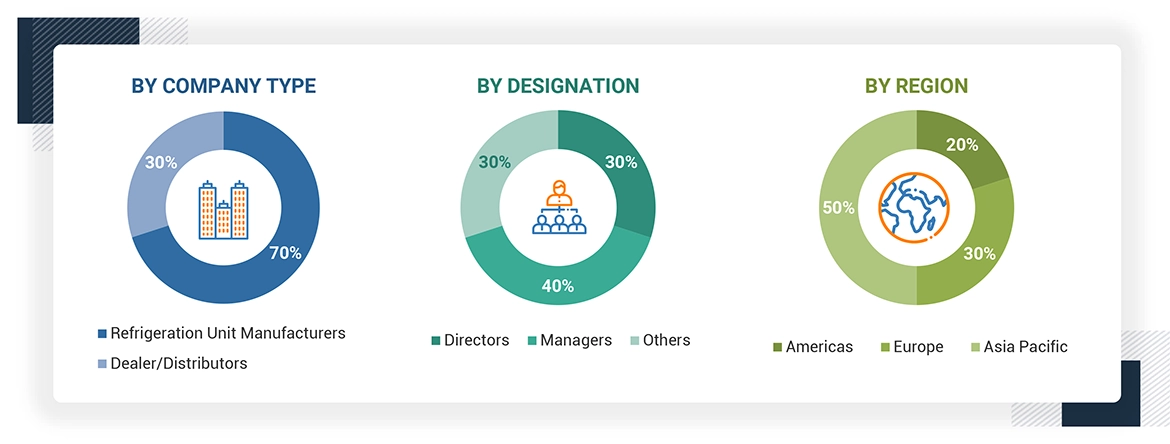
Note: Others in designation include sales, marketing, and product managers, Others in company tiers include end-use organizations
Company tiers are based on the supply chain; the company's revenue is not considered.
To know about the assumptions considered for the study, download the pdf brochure
Market Size Estimation
As mentioned below, a detailed market estimation approach was followed to estimate and validate the value and volume of the truck refrigeration unit market and other dependent submarkets:
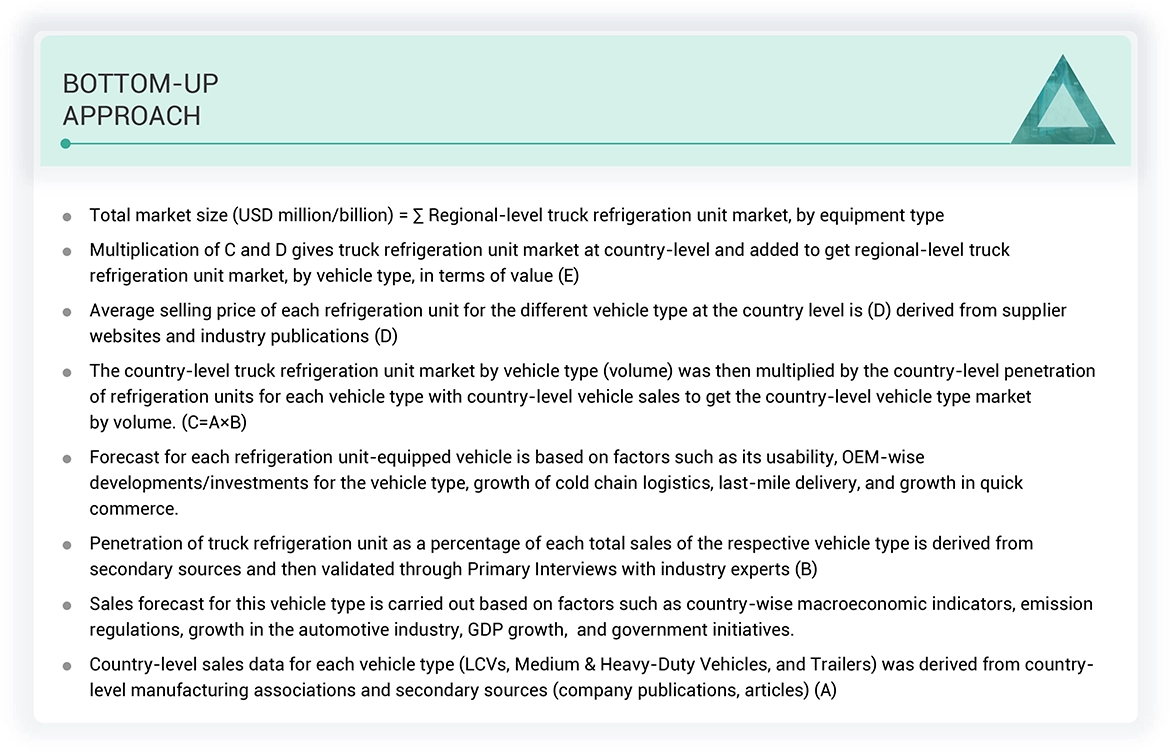
- The bottom-up approach was used to estimate and validate the truck refrigeration unit market size by vehicle type. The country-level sales of each vehicle type (LCVs, MHCVs, and Trailer) were referred from country-level manufacturing associations and secondary sources (company publications, articles, etc.).
- The sales forecast for this vehicle type is based on factors such as country-wise macroeconomic indicators, emission regulations, growth in the automotive industry, GDP growth, and government spending.
- The penetration of refrigeration units in each vehicle type as a percentage of each total sale of the respective vehicles is referred to from secondary sources and then validated through primary interviews with industry experts (B).
- The forecast of each refrigeration unit-equipped vehicle type is based on factors such as its usability, OEM-wise developments/investments for the vehicle type, growth of cold chain logistics, last-mile delivery, and growth in quick commerce, among others.
- The country-level truck refrigeration unit market by vehicle type (volume) was then multiplied by the country-level average selling price (ASP) of each vehicle type equipped with a refrigeration unit to get the country-level vehicle type market by value.
- The summation of the country-level market would give the regional level. Then, further additions provide the global truck refrigeration unit market by vehicle type in terms of volume and value.
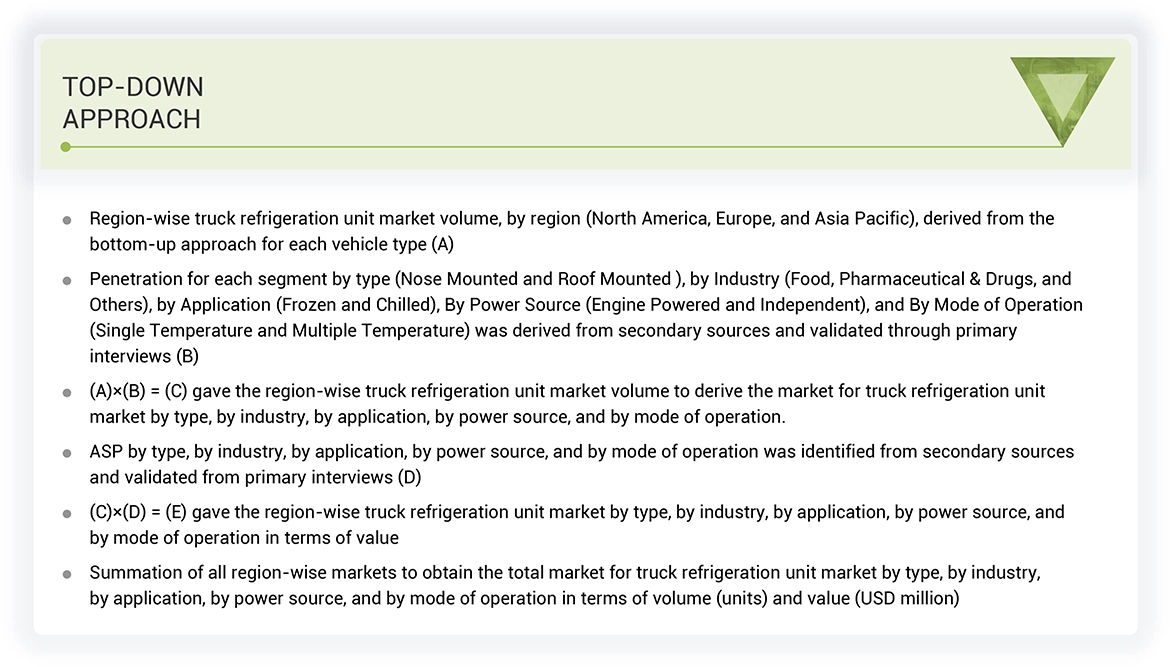
- The top-down approach is used to estimate the type by industry, application, power source, and mode of operation at the regional level.
- All key macro indicators affecting the revenue growth of the market segments and subsegments were accounted for, viewed in extensive detail, verified through primary research, and analyzed to get the validated and verified quantitative and qualitative data.
- The gathered market data was consolidated and added with detailed inputs, analyzed, and presented in this report.
Truck Refrigeration Unit Market : Bottom-Up Approach
Truck Refrigeration Unit Market : Top-Down Approach
Data Triangulation
All percentage shares, splits, and breakdowns have been determined using secondary sources and verified by primary sources. All parameters that affect the markets covered in this research study have been accounted for, viewed in extensive detail, and analyzed to obtain the final quantitative and qualitative data. This data has been consolidated and enhanced with detailed inputs and analysis from MarketsandMarkets and presented in the report.
Market Definition
Truck Refrigeration Unit: Truck Refrigeration Units are climate control systems that maintain temperature in trucks and trailers by cooling or freezing, even when the engine is off. While driving, they draw power from the truck's engine or an auxiliary engine/battery. The units can continue operating using the main engine or a separate standby engine when stationary. Truck Refrigeration Units include monitoring systems like temperature sensors and alarms to ensure proper temperature control, making them essential for transporting goods such as fresh food, frozen food, pharmaceuticals, and chemicals.
Stakeholders
- Truck Refrigeration Unit Manufacturers
- Truck Refrigeration Unit Component providers
- Service Providers for Truck Refrigeration Units
- Dealers and Distributors of Truck Refrigeration Units
- Industrial and End Use Organizations/Associations
- Regulatory Authorities
Report Objectives
-
To define, describe, and forecast the size of the Truck Refrigeration Unit market in terms of volume (Thousand units) and Value (USD Million) between 2024 and 2030 based on the following segments:
- By Application (Frozen and Chilled)
- By Vehicle Type (Light Commercial Vehicles, Medium and Heavy Commercial Vehicles, and Trailers)
- By Type (Split System and Roof Mounted System)
- By Industry Vertical (Frozen Food, Pharma and Drugs, Others)
- By Trailer/Truck Size (Below 40 feet, above 40 feet)
- By Power Source (Engine Powered and Independent)
- By Mode of Operation (Single temperature and Multi temperature)
- By Independent Refrigeration Unit by propulsion (Diesel and Electric/Hybrid)
- By Region (Asia Pacific, Europe, Americas)
- To identify and analyze key drivers, restraints, opportunities, and challenges influencing the market
- To analyze the market share of leading players in the Truck Refrigeration Unit market and evaluate competitive leadership mapping.
- To strategically analyze key player strategies and company revenue analysis
-
To study the following with respect to the market
- Trends and Disruptions Impacting Customers’ Businesses
- Market Ecosystem
- Supply Chain Analysis
- Patent Analysis
- Regulatory Landscape
- Case Study Analysis
- Key Conferences and Events
- Investment and Funding Scenario
- Pricing Analysis
- To analyze recent developments, including product launches, partnerships, acquisitions, expansions, and other developments undertaken by key industry participants in the market
- To give a brief understanding of the Truck Refrigeration Unit market in the recommendations chapter
Available Customizations
MarketsandMarkets offers the following customizations for this market report:
TRUCK REFRIGERATION UNIT MARKET BY APPLICATION, BY COUNTRY
- Frozen
- Chilled
TRUCK REFRIGERATION UNIT MARKET BY MODE OF OPERATION, BY COUNTRY
- Single Temperature
- Multi-Temperature
INDEPENDENT REFRIGERATION UNIT MARKET BY VEHICLE TYPE, BY REGION
- MHCV
- Trailer
Get the Full Truck Refrigeration Unit Market Report
Full forecast, segment splits, and company analysis for all Truck Refrigeration Unit Market.
- China Truck Refrigeration Unit Market
- India Truck Refrigeration Unit Market
- Japan Truck Refrigeration Unit Market
- South Korea Truck Refrigeration Unit Market
- Thailand Truck Refrigeration Unit Market
- Germany Truck Refrigeration Unit Market
- France Truck Refrigeration Unit Market
- UK Truck Refrigeration Unit Market
- Spain Truck Refrigeration Unit Market
- Italy Truck Refrigeration Unit Market
- Mexico Truck Refrigeration Unit Market
- Canada Truck Refrigeration Unit Market
- Brazil Truck Refrigeration Unit Market
- Rest Of Europe Truck Refrigeration Unit Market
Need a Tailored Report?
Customize this report to your needs
Get 10% FREE Customization
Customize This Report
