
Middle East Ultralight & Light Aircraft Market (2024-2029)

The Middle East Ultralight & Light Aircraft Market was valued at $469.2 Million in 2024 and projected to reach to $798.2 Million by 2029, representing a compound annual growth rate of 11.2%. The Middle East ultralight and light aircraft market is poised for substantial growth through 2029, supported by regional economic diversification, increased tourism, and rising private aviation adoption.


| Market Size in | USD 26.32 MN |
| Market Forecast in | |
| CAGR | |
| Forecast Period | |
| Units Considered | Value (USD MN) |
Middle East Ultralight & Light Aircraft Market Trends and Insights
- This growth trajectory reflects increasing demand across the Middle East for cost-effective aviation solutions, driven by rising tourism, private aviation adoption, and regional infrastructure development.
- The Middle East's strategic geographic position and expanding wealth in key markets are catalyzing investment in general aviation capabilities. During the 2024-2029 forecast period, the Middle East market will benefit from enhanced regulatory frameworks, growing pilot training initiatives, and rising interest in recreational and commercial ultralight operations.
- The Middle East is witnessing accelerated adoption of modern aircraft technologies and increased participation from both established and emerging operators.
- Market expansion in the Middle East is supported by favorable demographics, improving airport infrastructure, and growing cross-border connectivity demands that favor lightweight, efficient aircraft platforms..
Key Market Statistics
- CAGR (2024-2029) 11.2% CAGR
- Market Size, 2024 ~USD 469.2 Million
- Forecast, 2029 ~USD 798.2 Million
- Geography Middle East
Middle East Ultralight & Light Aircraft Market Overview
Rapid Market Expansion :
The Middle East ultralight and light aircraft market is growing at 11.2% CAGR, expanding from USD 469.2 million in 2024 to USD 798.2 million by 2029, driven by increasing regional aviation demand and infrastructure investments.
Tourism & Private Aviation Boom :
Rising tourism across Middle Eastern destinations and growing adoption of private aviation among high-net-worth individuals are key growth catalysts, particularly in UAE and Saudi Arabia's diversification initiatives.
Strategic Regional Hub Development :
Major Middle Eastern countries are positioning themselves as aviation hubs, with enhanced airport infrastructure and regulatory frameworks supporting the adoption of cost-effective ultralight and light aircraft solutions.
Cost-Effective Aviation Solutions :
Ultralight and light aircraft offer economical alternatives for regional connectivity, training, and recreational flying, aligning with the Middle East's growing interest in accessible aviation technologies and services.
Middle East Ultralight & Light Aircraft Market Dynamics
- Key markets including UAE and Saudi Arabia are investing heavily in aviation infrastructure and regulatory frameworks that facilitate market expansion.
- The region's strategic geographic position and growing wealth among private aviation enthusiasts create favorable conditions for ultralight and light aircraft manufacturers and service providers. Government initiatives promoting non-oil economic sectors and tourism development are expected to further accelerate market penetration.
- The demand for cost-effective, efficient aircraft solutions for regional connectivity, flight training, and recreational purposes will continue to drive market growth.
- Additionally, partnerships between international manufacturers and regional distributors are likely to enhance market accessibility and support the projected USD 798.2 million market valuation by 2029..
Market Ecosystem

ULTRALIGHT & LIGHT AIRCRAFT MARKET SIZE, SHARE & GROWTH: COMMERCIAL USE CASES ACROSS INDUSTRIES
| COMPANY | USE CASE DESCRIPTION | BENEFITS |
|---|---|---|
 |
Used for personal flying, pilot training, and premium recreational aviation. | Offers advanced safety features and modern avionics that enhance pilot confidence and training efficiency. |
 |
Serves general aviation, training academies, and small business travel segments. | Provides reliable, easy to maintain aircraft with wide service support globally. |
 |
Used for utility missions, regional operations, and private transport. | Delivers strong performance and versatility across varied mission profiles. |
 |
Frequently deployed in flight schools and personal ownership for short haul flying. | Ensures affordable operation with proven airframe designs suitable for new pilots. |
 |
Used for training fleets, leisure flying, and eco efficient light aircraft operations. | Offers low fuel burn and cost effective ownership supported by lightweight materials and modern engineering. |
Logos and trademarks shown above are the property of their respective owners. Their use here is for informational and illustrative purposes only.
Related Ecosystem
Aviation
- Narrow Body Aircraft
- Wide Body Aircraft
- Military Helicopters
- Special Mission Aircraft
- Fighter Aircraft
- HONEYWELL INTERNATIONAL INC.
- COLLINS AEROSPACE
- Thales group
- Safran group
- HEICO Corporation
Key Takeaways
- The Middle East ultralight and light aircraft market is valued at USD 469.2 million in 2024, with a compound annual growth rate of 11.2% through 2029.
- The Middle East market is projected to reach USD 798.2 million by 2029, driven by rising private aviation demand and tourism expansion.
- The Middle East benefits from strategic geographic positioning and improving regulatory environments that support general aviation growth.
- The Middle East's expanding wealth and infrastructure investments are accelerating adoption of cost-effective ultralight and light aircraft solutions.
Ultralight & Light Aircraft Market Report Scope
| Report Metric | Details |
|---|---|
| Base Year | 2024 |
| Fastest Growing Segment | SOLAR (Electric-Hybrid Propulsion) |
| Forecast Period | 2024-2029 |
| Growth Rate | CAGR of 11.2% from 2024 to 2029 |
| Largest Segment | CONVENTIONAL FUEL (Propulsion) |
| Market Size Base Year (Billions) | ~USD 10.17 (2024) |
| Revenue Forecast (Billions) | ~USD 17.29 (2029) |
| Segments Covered | Oem, Mtow, Aftermarket, System, Flight Operation, Technology, Propulsion, Electric-Hybrid Propulsion, Conventional Fuel, End Use, Civil & Commercial End Use, Military End Use, Material |
Middle East Ultralight & Light Aircraft Market Report Segmentation
13 segment dimensions are covered across the global market.
By Oem
- Light Aircraft
- Ultralight Aircraft
By Mtow
- 2500 - 5,700 Mtow
- 600 - 2,500 Mtow
By Aftermarket
- Mro
- Parts Replacement
By System
- Aerostructures
- Aircraft Systems
- Avionics
- Cabin Interiors
By Flight Operation
- Ctol
- Vtol
By Technology
- Manned
- Unmanned
By Propulsion
- Conventional Fuel
- Electric-Hybrid
By Electric-Hybrid Propulsion
- Fuel Cell
- Fully Electric
- Hybrid
- Solar
By Conventional Fuel
- Piston
- Turboprop
By End Use
- Civil & Commercial
- Military
By Civil & Commercial End Use
- Agriculture
- Commercial Cargo
- Medical
- Passenger
- Personal
- Survey & Research
- Training
By Military End Use
- Isr
- Military Cargo
- Search & Rescue
- Training
By Material
- Aluminum
- Composite
- Composites
Target Audience
- Aircraft Manufacturers : Ultralight and light aircraft manufacturers need Middle East market data to identify growth opportunities, establish regional partnerships, and develop localized product strategies for this high-growth market.
- Aviation Service Providers : Flight training schools, maintenance providers, and charter operators require market insights to expand operations across UAE, Saudi Arabia, and other Middle Eastern countries experiencing aviation sector growth.
- Investment & Private Equity Firms : Investors seeking exposure to Middle Eastern aviation growth need detailed market forecasts and country-level data to evaluate investment opportunities in aircraft distribution, leasing, and related services.
- Government & Regulatory Bodies : Regional aviation authorities and government agencies use market data to inform policy decisions, infrastructure investments, and regulatory frameworks supporting ultralight and light aircraft operations.
- Distributors & Resellers : Aircraft distributors and regional resellers require market segmentation and growth projections to optimize inventory, negotiate supplier agreements, and plan expansion across Middle Eastern territories.
Countries within Middle East - compare and drill down
| Country | 2025 size (native) |
|---|---|
| UAE | USD 174.4 Million |
| Saudi Arabia | USD 207 Million |
| Rest Of Middle East | USD 416.8 Million |
Country market size visualization
Reasons to Buy this Report
- Market Size & Growth Data : Access precise market valuation (USD 469.2M in 2024) and 5-year forecast (USD 798.2M by 2029) specific to Middle East, enabling accurate business planning and investment decisions.
- Country-Level Insights : Detailed breakdown of UAE (USD 174.4M) and Saudi Arabia (USD 207M) markets, plus Rest of Middle East (USD 416.8M), allowing targeted market entry and expansion strategies.
- Growth Driver Analysis : Comprehensive understanding of tourism expansion, private aviation adoption, and infrastructure development trends unique to the Middle East region driving the 11.2% CAGR.
- Competitive Positioning : Identify market opportunities and competitive landscape specific to Middle Eastern buyers, distributors, and manufacturers in the ultralight and light aircraft segment.
- Strategic Investment Guidance : Data-driven insights for manufacturers, investors, and service providers to capitalize on the region's rapid market expansion and emerging aviation sector opportunities.
Frequently asked questions
What is the current market size of ultralight and light aircraft in the Middle East?
The Middle East ultralight and light aircraft market was valued at USD 469.2 million in 2024.
What is the projected market size for the Middle East by 2029?
The Middle East market is forecast to reach USD 798.2 million by 2029, representing significant growth over the five-year period.
What is the CAGR for the Middle East ultralight and light aircraft market?
The Middle East market is expected to grow at a compound annual growth rate of 11.2% from 2024 to 2029.
What factors are driving growth in the Middle East ultralight and light aircraft market?
Growth in the Middle East is driven by rising private aviation demand, tourism expansion, improved regulatory frameworks, and increasing infrastructure investments in general aviation.
Why is the Middle East an attractive market for ultralight and light aircraft?
The Middle East offers strategic geographic positioning, expanding wealth, improving airport infrastructure, and growing demand for cost-effective aviation solutions that support regional connectivity.
RESEARCH METHODOLOGY
The study involved four major activities in estimating the current market size for the Ultralight and Light Aircraft market. Exhaustive secondary research was conducted to collect information on the market, the peer markets, and the parent market. The next step was to validate these findings, assumptions, and sizing with industry experts across the value chain through primary research. Both top-down and bottom-up approaches were employed to estimate the complete market size. Thereafter, market breakdown and data triangulation procedures were used to estimate the market size of segments and subsegments.
Secondary Research
In the secondary research process, various secondary sources, such as D&B Hoovers, Bloomberg, BusinessWeek, Dow Jones Factiva and different magazines, were referred to identify and collect information for this study. Secondary sources also included annual reports, press releases & investor presentations of companies, certified publications, articles by recognized authors, and simulator databases. Secondary sources referred for this research study included General Aviation Manufacturers Association (GAMA); International Air Transport Association (IATA) publications, corporate filings (such as annual reports, investor presentations, and financial statements); Federal Aviation Administration (FAA) and trade, business, and professional associations. Secondary data was collected and analyzed to arrive at the overall market size, which was further validated by primary respondents.
Primary Research
The Ultralight and Light Aircraft Market comprises several stakeholders, such as raw material providers, Ultralight and Light Aircraft manufacturers and suppliers, and regulatory organizations in the supply chain. While the demand side of this market is characterized by various end users, the supply side is characterized by technological advancements in sensors and wireless connected systems. Various primary sources from both the supply and demand sides of the market were interviewed to obtain qualitative and quantitative information. Following is the breakdown of primary respondents:
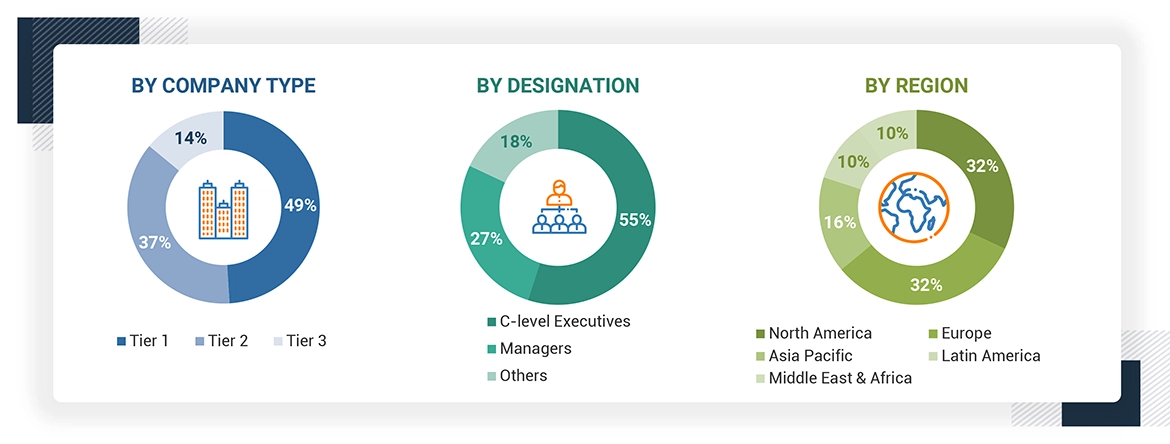
Notes: C-Level includes CEO, COO, and CTO, among others.
Others include sales managers, marketing managers, and product managers.
The tier of the companies has been defined based on their total revenue as of 2019: Tier 1 = > USD 1 billion,
Tier 2 = From USD 100 million to USD 1 billion, and Tier 3 = < USD 100 million.
To know about the assumptions considered for the study, download the pdf brochure
Market Size Estimation
Both top-down and bottom-up approaches were used to estimate and validate the total size of the Ultralight and Light Aircraft market. These methods were also used extensively to estimate the size of various subsegments of the market. The research methodology used to estimate the market size includes the following:
- Key players in the industry and markets were identified through extensive secondary research.
- The industry’s supply chain and market size, in terms of value, were determined through primary and secondary research processes.
- All percentage shares, splits, and breakdowns were determined using secondary sources and verified through primary sources.
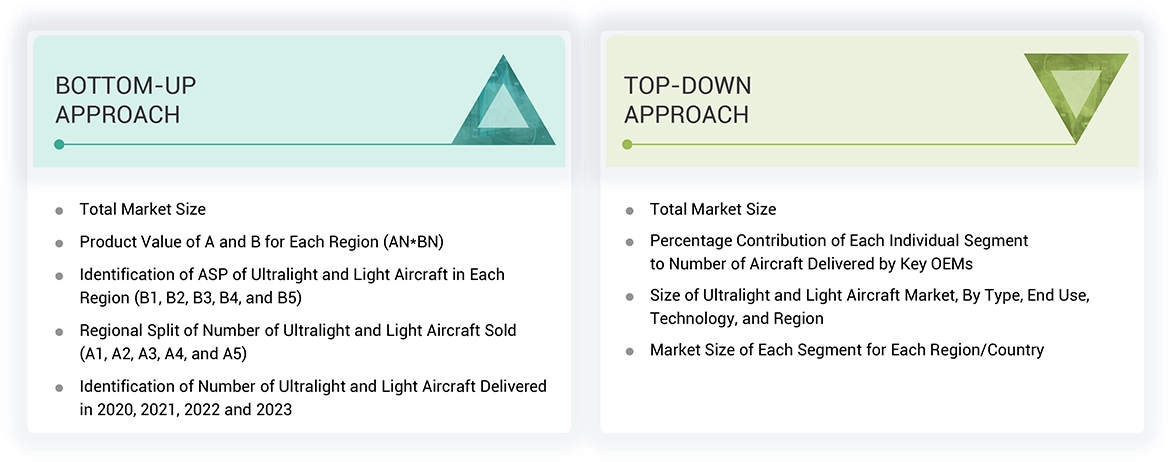
Market size estimation methodology: Bottom-up approach
The bottom-up approach was employed to arrive at the overall size of the ultralight and light aircraft market. All types of new aircraft delivered were considered to calculate the size of the ultralight and light aircraft market. This data was segmented based on aircraft type, propulsion, technology, and flight operation. The number of each type of aircraft delivered was then multiplied by its respective Average Selling Price (ASP). ASPs of aircraft were identified based on the model and type of aircraft.
Market size estimation methodology: Top-down approach
In the top-down approach, the size of the ultralight and light aircraft market was used to estimate the sizes of individual segments through percentage splits obtained from primary and secondary research. For the calculation of the size of specific market segments, the size of the immediate parent market was used to implement the top-down approach. The bottom-up approach was also implemented to validate the revenues obtained for various other segments.
The ultralight and light aircraft market was considered a part of the global aviation market due to its significant share in the market. The market size of each segment was cross-checked and validated to arrive at a common value. Similar methodologies were adopted to determine the sizes of different subsegments of the ultralight and light aircraft market. For instance, in the aircraft type, parameters such as aircraft cost, MTOW, seating capacity, and aircraft range were considered to arrive at the market split for various aircraft models and aircraft types.
Market shares were estimated for each company to verify revenue shares used in the bottom-up approach. With the data triangulation procedure and validation of data through primaries, the size of the parent market and each individual segment was determined and confirmed. Moreover, the total volumes of the Exports and Imports (EXIM) were also considered for the validation ofto validate the total size of the ultralight and light aircraft market.
Ultralight & Light Aircraft Market : Top-Down and Bottom-Up Approach
Data Triangulation
After arriving at the overall size of the ultralight and light aircraft market from the market size estimation process explained above, the total market size was split into several segments and subsegments. Market breakdown and data triangulation procedures were implemented, wherever applicable, to complete the overall market engineering process and arrive at the exact statistics for different market segments and subsegments. The data was triangulated by studying various factors from both the demand and supply sides. In addition, the market size was validated using both top-down and bottom-up approaches.
In the top-down approach, the size of the ultralight and light aircraft market was derived by calculating the country-level data. Moreover, in the bottom-up approach, the market size was derived by estimating the revenues of key companies operating in the market and validating the data acquired through primary research.
The following figure indicates the market breakdown and data triangulation procedures implemented in the market engineering process used to develop this report on the ultralight and light aircraft market.
Market Definition
Ultralight Ultralight and light aircraft are twoentirely different categories of small aviation vehicles that mainly differ in weight and intent. Ultralight aircraft typically weigh less than 600 kg, and these are small, light planes that are mostly utilized for recreational flying, training, and sport aviation. They usually are often designed for single or dual occupancy with the purpose of developing a relatively easy hands-on flying experience. Ultralights are generally restricted as far as speed, altitude, and operational range and, in some countries, have fewer regulatory restrictions, making more room for enthusiasts to fly much more easily.
Light aircraft weigh between 600 to 5700 Kg Light and are used for a variety of jobs such as personal transportation, training, aerial photography, agriculture, and small business operations. Light aircraft generally can carry more passengers, such as up to 10 or more, with advanced avionics more features for safety, and longer ranges. They are generally required to have a private pilot's license to fly in most countries because they adhere to stricter aviation standards. Each of them has positive features with ultralights being very accessible for recreational users and light aircraft for practical and commercial purposes.
Stakeholders
- Ultralight and Light Aircraft Manufacturers
- Ultralight and Light Aircraft Material Providers
- Ultralight and Light Aircraft Propulsion Manufacturers
- Regulatory Bodies for Light and Ultralight Aircraft
- Research Institutes and Consultancy Companies
- Distribution Channels for Ultralight and Light Aircraft Services
Report Objectives
- To define, describe, and forecast the ultralight and light aircraft market based on point of sale, flight operation, system, technology, propulsion, end use, material, and region.
- To forecast sizes of various segments of the market with respect to major regions, namely, North America, Europe, Asia Pacific, Middle East, Latin America, and Africa along with key countries in each of these regions.
- To identify and analyze the drivers, restraints, opportunities, and challenges influencing the growth of the ultralight and light aircraft market.
- To identify industry trends, market trends, and technology trends currently prevailing in the ultralight and light aircraft market
- To provide an overview of the regulatory landscape with respect to ultralight and light aircraft regulations across regions.
- To analyze micromarkets1 with respect to individual growth trends, prospects, and their contribution to the overall market
- To analyze opportunities in the market for stakeholders by identifying key market trends
- To profile key market players and comprehensively analyze their market shares and core competencies
- To analyze the degree of competition in the ultralight and light aircraft market by analyzing recent developments such as contracts, agreements, expansions, and new product launches adopted by leading market players
- To identify detailed financial positions, key products, and unique selling points of leading companies in the market
- To provide a detailed competitive landscape of the market, along with market ranking analysis, market share analysis, and revenue analysis of key players
1. Micromarkets are defined as further segments and subsegments of the ultralight and light aircraft market included in the report.
2. Core competencies of the companies have been captured in terms of their key developments and strategies adopted by them to sustain their position in the market.
Available Customizations
Along with the market data, MarketsandMarkets offers customizations as per the specific needs of companies. The following customization options are available for the report:
Product Analysis
- Product matrix, which gives a detailed comparison of the product portfolio of each company
Geographic Analysis as per Feasibility
- Further breakdown of the market segments at country level
Company Information
- Detailed analysis and profiling of additional market players (up to 6)
Get the Full Ultralight & Light Aircraft Market Report
Full forecast, segment splits, and company analysis for all Ultralight & Light Aircraft Market.
- Canada Ultralight & Light Aircraft Market
- US Ultralight & Light Aircraft Market
- UK Ultralight & Light Aircraft Market
- France Ultralight & Light Aircraft Market
- Germany Ultralight & Light Aircraft Market
- Russia Ultralight & Light Aircraft Market
- Italy Ultralight & Light Aircraft Market
- Spain Ultralight & Light Aircraft Market
- China Ultralight & Light Aircraft Market
- India Ultralight & Light Aircraft Market
- Japan Ultralight & Light Aircraft Market
- Australia Ultralight & Light Aircraft Market
- South Korea Ultralight & Light Aircraft Market
- UAE Ultralight & Light Aircraft Market
- Saudi Arabia Ultralight & Light Aircraft Market
- South Africa Ultralight & Light Aircraft Market
- Brazil Ultralight & Light Aircraft Market
- Mexico Ultralight & Light Aircraft Market
- Rest Of Europe Ultralight & Light Aircraft Market
- Rest Of Asia Pacific Ultralight & Light Aircraft Market
- Rest Of Latin America Ultralight & Light Aircraft Market
- Rest Of Middle East Ultralight & Light Aircraft Market
- Rest Of Africa Ultralight & Light Aircraft Market
Need a Tailored Report?
Customize this report to your needs
Get 10% FREE Customization
Customize This Report
