
South Korea Underfloor Heating Market (2024-2029)

The South Korea Underfloor Heating Market was valued at $164 Million in 2024 and projected to reach to $213 Million by 2029, representing a compound annual growth rate of 5.4%. South Korea's underfloor heating market is positioned for sustained growth through 2029, driven by the nation's commitment to energy efficiency and green building standards.


| Market Size in | USD 26.32 MN |
| Market Forecast in | |
| CAGR | |
| Forecast Period | |
| Units Considered | Value (USD MN) |
South Korea Underfloor Heating Market Trends and Insights
- This growth trajectory reflects South Korea's increasing adoption of energy-efficient heating solutions in residential and commercial properties, driven by rising consumer awareness of climate control technologies and government incentives for sustainable building practices.
- South Korea's advanced manufacturing capabilities and strong electronics sector position the country as a key player in the development and deployment of smart underfloor heating systems. The South Korea underfloor heating market benefits from the nation's high urbanization rate and preference for modern home automation solutions.
- Between 2024 and 2029, South Korea is expected to see accelerated market penetration as builders and renovators integrate underfloor heating into new construction projects and retrofit applications.
- South Korea's emphasis on energy efficiency standards and building codes continues to support market expansion, with both residential and commercial segments contributing to the overall growth trajectory..
Key Market Statistics
- CAGR (2024-2029) 5.4% CAGR
- Market Size, 2024 ~USD 164 Million
- Forecast, 2029 ~USD 213 Million
- Country South Korea
South Korea Underfloor Heating Market Overview
Market Valuation :
South Korea's underfloor heating market is valued at USD 164.0 million in 2024, with strong growth momentum driven by residential and commercial sector adoption.
Growth Trajectory :
The market is projected to reach USD 213.0 million by 2029, representing a steady 5.4% CAGR, outpacing many regional markets in Asia-Pacific.
Energy Efficiency Focus :
South Korean consumers increasingly prioritize energy-efficient heating solutions, supported by government sustainability initiatives and rising utility costs.
Residential & Commercial Expansion :
Both residential apartments and commercial buildings are adopting underfloor heating systems, reflecting South Korea's modernization of building infrastructure.
South Korea Underfloor Heating Market Dynamics
- The residential sector remains the primary growth engine, with increasing consumer preference for comfort and cost-effective heating solutions in apartments and single-family homes.
- Government incentives for energy-efficient retrofits and new construction standards are accelerating market penetration. The commercial segment is also expanding as office buildings and retail spaces adopt underfloor heating for improved climate control and operational efficiency.
- Technological advancements in smart heating systems and integration with IoT platforms are creating new opportunities.
- South Korea's strong manufacturing base and technological expertise position local companies to innovate and capture growing market share in this segment..
Market Ecosystem
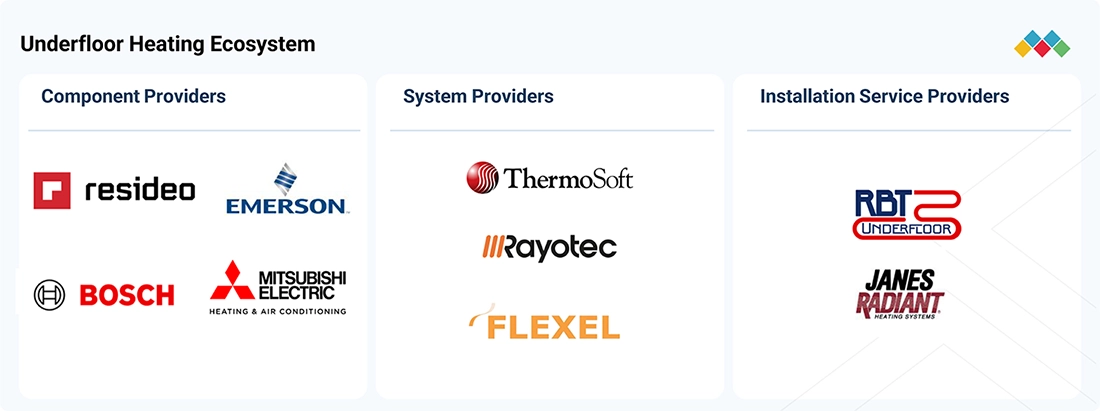
UNDERFLOOR HEATING MARKET SIZE, SHARE AND GROWTH: COMMERCIAL USE CASES ACROSS INDUSTRIES
| COMPANY | USE CASE DESCRIPTION | BENEFITS |
|---|---|---|
 |
Uponor supplies hydronic underfloor heating solutions integrated with Smatrix intelligent room controls and auto-balancing technology. The systems operate across residential homes, multi-family apartment buildings, and commercial facilities to provide automated low-temperature water distribution through cross-linked polyethylene (PEX) pipe networks. | Eliminates manual circuit balancing through automated algorithmic flow control | Lowers annual heating energy costs compared with traditional high-temperature radiator systems | Accelerates commissioning and installation speed for field contractors | Enables multi-zone individual room temperature management via cloud connectivity |
 |
Danfoss delivers digital underfloor heating platforms using the Icon2 main controller and smart room thermostats. The platform connects hydronic floor heating and cooling circuits across residential developments and light commercial properties, linking dynamic floor actuators directly with smart home systems. | Delivers automatic hydronic balancing across variable-length pipe loops without manual presetting | Lowers supply temperature requirements to optimize heat pump system performance | Simplifies installer setup via mobile app guided commissioning | Integrates seamlessly with third-party home automation protocols |
 |
REHAU provides radiant floor heating systems using RAUPEX PEXa cross-linked pipes and low-profile RAUPANEL dry-installation modules. The infrastructure supports new concrete slab construction, residential renovations, light commercial spaces, and outdoor snow melting applications. | Provides high resistance to pipe degradation and stress cracking using cross-linked polyethylene | Enables dry retrofit installations without requiring heavy concrete overpours | Delivers silent, uniform bottom-up heat distribution without circulating airborne dust or allergens | Secures reliable mechanical joints with long-term leak-free connection fittings |
 |
Resideo Technologies provides hydronic zoning platforms such as the Honeywell Home HCC100 multi-zone controller and connected thermostats. The system manages multi-room radiant underfloor circuits integrated with central heating systems, heat pumps, and motorized zone valves in modern dwellings. | Supports independent temperature scheduling for multiple distinct living zones | Coordinates heat demand directly with heat pumps and central boilers to reduce cycle losses | Provides flexible hybrid configurations supporting wired and wireless sensor endpoints | Optimizes indoor comfort through continuous two-way communication protocols |
 |
Watts manufactures stainless-steel radiant heating manifolds, mixing stations, and hydronic circulation modules for radiant floor projects. The equipment operates in custom residential homes, commercial office buildings, and institutional facilities to manage hot water distribution through sub-floor pipe circuits. | Delivers balanced hydraulic flow rates across all connected underfloor loops | Provides high corrosion resistance and mechanical strength with stainless-steel manifolds | Facilitates precise flow measurement and circuit monitoring through integrated flow meters | Integrates directly with secondary mixing shunts to maintain safe sub-floor fluid temperatures |
Logos and trademarks shown above are the property of their respective owners. Their use here is for informational and illustrative purposes only.
Related Ecosystem
Electronics System And Components
- Sensors
- Temperature Sensors
- Pressure Sensors
- Actuators
- Image Sensors
- Lenovo
- Samsung
- Texas Instruments Incorporated
- HONEYWELL INTERNATIONAL INC.
- Teledyne Technologies Incorporated
Smart Home
- Sensors
- Pressure Sensors
- Temperature Sensors
- Actuators
- Face Recognition
- HONEYWELL INTERNATIONAL INC.
- SCHNEIDER ELECTRIC SE
- Siemens ag
- Samsung
- Godrej Industries Limited
Key Takeaways
- South Korea's underfloor heating market is valued at USD 164.0 million in 2024 and is forecast to reach USD 213.0 million by 2029.
- South Korea is experiencing a 5.4% CAGR, reflecting steady demand for energy-efficient heating solutions in the region.
- South Korea's advanced electronics manufacturing and smart home integration capabilities drive innovation in underfloor heating technology.
- South Korea's stringent building energy codes and sustainability initiatives are key growth catalysts for the underfloor heating market through 2029.
Underfloor Heating Market Report Scope
| Report Metric | Details |
|---|---|
| Base Year | 2024 |
| Fastest Growing Segment | SERVICES (Offering) |
| Forecast Period | 2024-2029 |
| Growth Rate | CAGR of 7.3% from 2024 to 2029 |
| Largest Segment | HARDWARE (Offering) |
| Market Size Base Year (Billions) | ~USD 5.34 (2024) |
| Revenue Forecast (Billions) | ~USD 7.6 (2029) |
| Segments Covered | Installation Type, Application, Offering, Product Type, Component Type |
South Korea Underfloor Heating Market Report Segmentation
5 segment dimensions are covered across the global market.
By Installation Type
- New Installations
- Retrofit Installations
By Application
- Commercial
- Healthcare
- Industrial
- Residential
- Sports & Entertainment
By Offering
- Hardware
- Services
By Product Type
- Electric Underfloor Heating
- Hydronic Underfloor Heating
By Component Type
- Heating Cables
- Heating Mats
- Heating Pipes
- Manifolds And Valves
- Thermal Actuators
- Thermostats And Sensors
- Wiring Centers
- Zone Valves
Target Audience
- HVAC Manufacturers & Suppliers : Evaluate South Korea's underfloor heating market opportunity to develop localized products, establish distribution networks, and capture growing demand in residential and commercial sectors.
- Real Estate Developers : Understand market trends and consumer preferences for underfloor heating in South Korea to incorporate these systems in new residential and commercial projects for competitive advantage.
- Energy Efficiency Consultants : Access South Korea-specific market data to advise clients on underfloor heating adoption, cost-benefit analysis, and alignment with government energy efficiency programs.
- Investment & Private Equity Firms : Identify investment opportunities in South Korea's growing underfloor heating sector, including market sizing, growth potential, and strategic acquisition targets.
- Building Automation & Smart Home Companies : Leverage South Korea market insights to develop integrated smart heating solutions and IoT-enabled underfloor systems for the tech-savvy Korean consumer base.
Reasons to Buy this Report
- Market Size & Growth Data : Access precise valuation of South Korea's underfloor heating market (USD 164M in 2024) with detailed 5-year forecasts to 2029, enabling accurate business planning and investment decisions.
- Competitive Landscape Analysis : Understand South Korea-specific market dynamics, local player strategies, and competitive positioning to identify opportunities for market entry or expansion.
- Sector-Specific Insights : Gain detailed analysis of residential and commercial segments within South Korea, including adoption rates, customer preferences, and growth drivers unique to the Korean market.
- Regulatory & Policy Context : Understand South Korean government initiatives, building codes, and sustainability policies driving underfloor heating adoption and market growth.
- Strategic Investment Guidance : Make informed decisions on market entry, product development, and partnership strategies tailored to South Korea's specific market conditions and consumer behavior.
Frequently asked questions
What is the current market size of underfloor heating in South Korea?
South Korea's underfloor heating market was valued at USD 164.0 million in 2024 and is expected to grow to USD 213.0 million by 2029.
What is the projected growth rate for South Korea's underfloor heating market?
South Korea's underfloor heating market is projected to grow at a compound annual growth rate (CAGR) of 5.4% from 2024 to 2029.
What factors are driving growth in South Korea's underfloor heating market?
South Korea's market growth is driven by increasing energy efficiency awareness, government sustainability incentives, high urbanization rates, and the integration of smart home technologies in residential and commercial properties.
Which segments contribute most to South Korea's underfloor heating market?
Both residential and commercial segments contribute significantly to South Korea's underfloor heating market, with residential applications leading due to high adoption in new apartment complexes and renovation projects.
How does South Korea's underfloor heating market compare to global trends?
South Korea's 5.4% CAGR is slightly lower than the global average of 7.3%, reflecting a more mature market with steady, sustainable growth rather than rapid expansion.
RESEARCH METHODOLOGY
The research process for this study involved the systematic gathering, recording, and analysis of data on customers and companies operating in the underfloor heating market. This process involved the extensive use of secondary sources, directories, and databases (Factiva and OANDA) to identify and collect valuable information for a comprehensive, technical, market-oriented, and commercial study of the market. In-depth interviews were conducted with primary respondents, including experts from core and related industries, as well as preferred manufacturers, to obtain and verify critical qualitative and quantitative information and assess growth prospects. Key players were identified through secondary research, and their market rankings were determined through a combination of primary and secondary research. This research involved studying the annual reports of top players and conducting interviews with key industry experts, including CEOs, directors, and marketing executives.
Secondary Research
Various sources were utilized in the secondary research process to identify and collect information relevant to this study. These include company annual reports, press releases, investor presentations, white papers, technology journals, certified publications, articles by recognized authors, directories, and databases. Secondary research was primarily used to gather key information on the industry’s value chain, the total pool of market players, market classification by industry trends at the most detailed level, regional markets, and key developments from market- and technology-oriented perspectives.
Primary Research
Primary research was conducted to identify the segmentation types, key players, competitive landscape, and key market dynamics, including drivers, restraints, opportunities, challenges, and industry trends, as well as the key strategies adopted by players operating in the underfloor heating market. Extensive qualitative and quantitative analyses were conducted across the complete market engineering process to present key information and insights throughout the report.
Extensive primary research has been conducted following the acquisition of knowledge about the underfloor heating market scenarios through secondary research. Several primary interviews were conducted with experts from the demand side (application and region) and the supply side (product type, offering, and installation type) across four major geographic regions: North America, Europe, Asia Pacific, and RoW. Approximately 60% and 40% of the primary interviews were conducted from the supply and demand sides, respectively. These primary data have been collected through questionnaires, emails, and telephonic interviews.
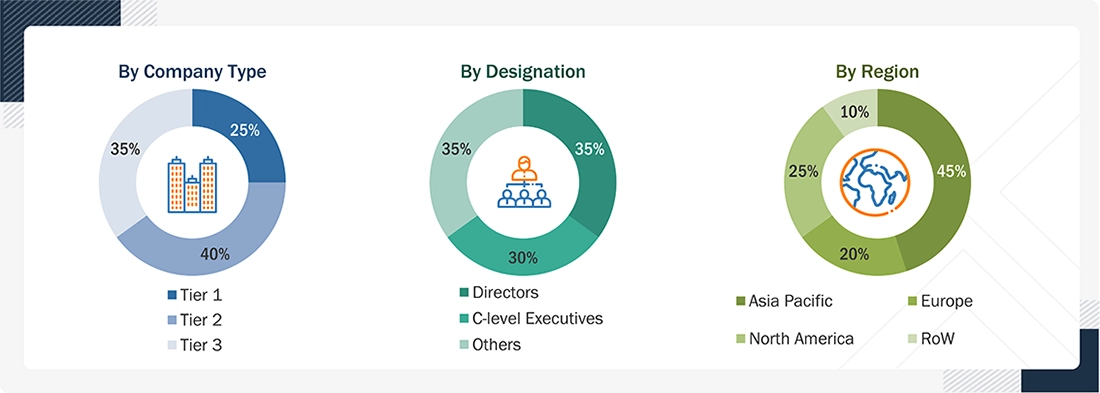
Notes: The three tiers of companies have been defined based on their total/segmental revenue as of 2025: Tier 1 = > USD 1 billion, Tier 2 = USD 1 billion–USD 500 million, and Tier 3 = < USD 500 million.
Other designations include sales, marketing, and product managers.
To know about the assumptions considered for the study, download the pdf brochure
Market Size Estimation
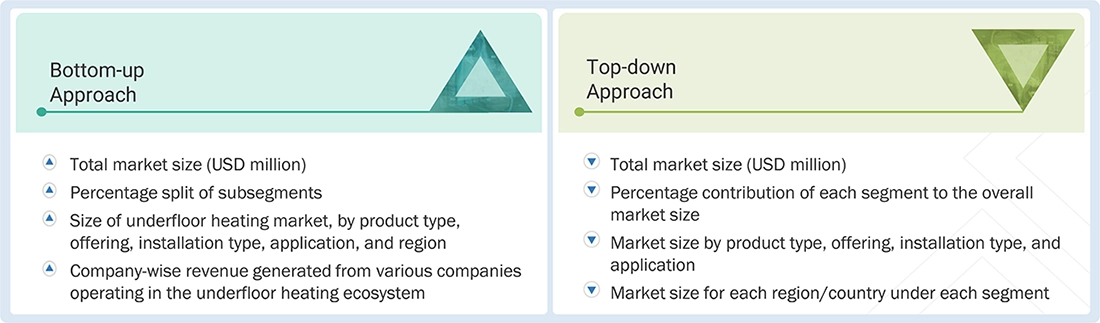
In the complete market engineering process, top-down and bottom-up approaches, along with several data triangulation methods, were used to estimate and validate the size of the underfloor heating market and various other dependent submarkets. Key players in the market were identified through secondary research, and their market share in each region was determined through a combination of primary and secondary research. This research methodology involved analyzing the annual and financial reports of the top players and conducting interviews with experts (CEOs, VPs, directors, and marketing executives) to gather key insights (quantitative and qualitative).
All percentage shares, splits, and breakdowns were determined using secondary sources and verified through primary sources. All possible parameters affecting the markets covered in this study were accounted for, examined in detail, verified through primary research, and analyzed to obtain final quantitative and qualitative data. This data was consolidated and supplemented with detailed inputs and analysis from MarketsandMarkets and presented in this report.
Underfloor Heating Market : Top-Down and Bottom-Up Approach
Data Triangulation
After determining the overall market size through the estimation process, as explained above, the total market was divided into several segments and subsegments. To complete the overall market engineering process and obtain precise statistics for all segments and subsegments, the data triangulation procedure was employed, as applicable. The data were triangulated by studying various factors and trends from the demand and supply sides. Additionally, the market has been validated using both top-down and bottom-up approaches.
Market Definition
The underfloor heating (UFH) system is a type of central heating system that regulates indoor temperature for thermal comfort using conduction, radiation, and convection methods. The underfloor heating market includes hydronic and electric underfloor heating systems. Hydronic UFH systems rely on hot water for in-floor heating, whereas electric UFH systems operate on electricity. Underfloor heating systems have many advantages over radiator heating systems and have become a viable method of space heating. The major players in the underfloor heating market include Uponor Corporation (Finland), Resideo Technologies Inc. (US), nVent (UK), Warmup Plc (UK), Rehau Ltd (Switzerland), Emerson Electric Co. (US), Robert Bosch GmbH (Germany), Danfoss (Denmark), Mitsubishi Electric Corporation (Japan), Siemens AG (Germany), Schneider Electric (France), and Incognito Heat Co. (UK).
Key Stakeholders
- End users
- Government bodies, venture capitalists, and private equity firms
- Underfloor heating manufacturers
- Underfloor heating distributors
- Underfloor heating industry associations
- Professional service/solution providers
- Research institutions and organizations
- Standards organizations and regulatory authorities
- System integrators
- Technology consultants
Report Objectives
- To describe and forecast the underfloor heating market, by offering, product type, installation type, application, and region, in terms of value
- To describe and forecast the underfloor heating market, by component type, in terms of volume
- To forecast the size of the market segments for four major regions, namely North America, Europe, Asia Pacific, and the Rest of the World (RoW), in terms of value
- To provide detailed information regarding the major factors influencing the growth of the market, such as drivers, restraints, opportunities, and challenges
- To offer an ecosystem analysis, case study analysis, patent analysis, technology analysis, pricing analysis, Porter’s Five Forces analysis, and regulations pertaining to the market
- To give a detailed overview of the value chain of the underfloor heating ecosystem
- To strategically analyze micromarkets with respect to individual growth trends, prospects, and contributions to the total market
- To strategically profile the key players and comprehensively analyze their market shares and core competencies
- To analyze the opportunities in the market for stakeholders and describe the competitive landscape of the market
- To study competitive developments, such as collaborations, partnerships, and product developments, in the market
- To provide the macroeconomic outlook for each region that has been covered in the report
Available customizations:
With the given market data, MarketsandMarkets offers customizations according to the company’s specific needs. The following customization options are available for the report:
Get the Full Underfloor Heating Market Report
Full forecast, segment splits, and company analysis for all Underfloor Heating Market.
- Canada Underfloor Heating Market
- Mexico Underfloor Heating Market
- US Underfloor Heating Market
- Belgium Underfloor Heating Market
- France Underfloor Heating Market
- Germany Underfloor Heating Market
- Netherlands Underfloor Heating Market
- Poland Underfloor Heating Market
- Rest Of Europe Underfloor Heating Market
- UK Underfloor Heating Market
- China Underfloor Heating Market
- Japan Underfloor Heating Market
- Rest Of Asia Pacific Underfloor Heating Market
Need a Tailored Report?
Customize this report to your needs
Get 10% FREE Customization
Customize This Report
