
South Korea Unmanned Surface Vehicles Market (2025-2030)

The South Korea Unmanned Surface Vehicles Market was valued at $15 Million in 2025 and projected to reach to $28.5 Million by 2030, representing a compound annual growth rate of 13.8%. South Korea's Unmanned Surface Vehicles market is poised for significant expansion, driven by strategic defense investments and the nation's technological prowess in maritime automation.


| Market Size in | USD 26.32 MN |
| Market Forecast in | |
| CAGR | |
| Forecast Period | |
| Units Considered | Value (USD MN) |
South Korea Unmanned Surface Vehicles Market Trends and Insights
- This 13.8% compound annual growth rate reflects South Korea's strategic investments in autonomous maritime technologies and defense modernization.
- South Korea's advanced shipbuilding and electronics sectors position the nation as a key player in USV development, driven by increasing demand for coastal surveillance, naval operations, and maritime security applications. The South Korea USV market benefits from government support for next-generation defense capabilities and the country's technological expertise in robotics and AI integration.
- South Korea's focus on autonomous systems for both military and commercial maritime operations is accelerating market adoption.
- Between 2025 and 2030, South Korea is expected to see heightened competition among domestic manufacturers and increased collaboration with international defense contractors, solidifying its role in the Asia Pacific USV ecosystem..
Key Market Statistics
- CAGR (2025-2030) 13.8% CAGR
- Market Size, 2025 ~USD 15 Million
- Forecast, 2030 ~USD 28.5 Million
- Country South Korea
South Korea Unmanned Surface Vehicles Market Overview
Defense Modernization Drive :
South Korea's commitment to autonomous maritime defense systems is accelerating USV adoption, with government investments in next-generation naval capabilities driving market expansion at 13.8% CAGR through 2030.
Advanced Shipbuilding Ecosystem :
South Korea's world-leading shipbuilding industry provides a competitive advantage in USV manufacturing, leveraging existing expertise in marine electronics, hull design, and autonomous systems integration.
Strategic Market Valuation :
The South Korean USV market is valued at $15.0 million in 2025, with projections reaching $28.5 million by 2030, representing a 90% growth opportunity over the five-year forecast period.
Electronics & AI Integration :
South Korea's robust electronics and artificial intelligence sectors enable sophisticated USV development, positioning local manufacturers to compete in autonomous navigation, sensor fusion, and real-time data processing capabilities.
South Korea Unmanned Surface Vehicles Market Dynamics
- The 13.8% CAGR reflects growing demand for autonomous patrol vessels, mine countermeasure platforms, and surveillance systems aligned with regional security priorities.
- South Korea's advanced shipbuilding infrastructure and electronics manufacturing capabilities create a competitive ecosystem for USV development and commercialization. Looking ahead to 2030, the market will benefit from increased R&D funding, integration of AI and machine learning technologies, and potential export opportunities to allied nations.
- Domestic demand from the Korean Navy and coast guard modernization programs will sustain growth, while private sector participation in commercial maritime applications expands the addressable market beyond defense applications..
Market Ecosystem
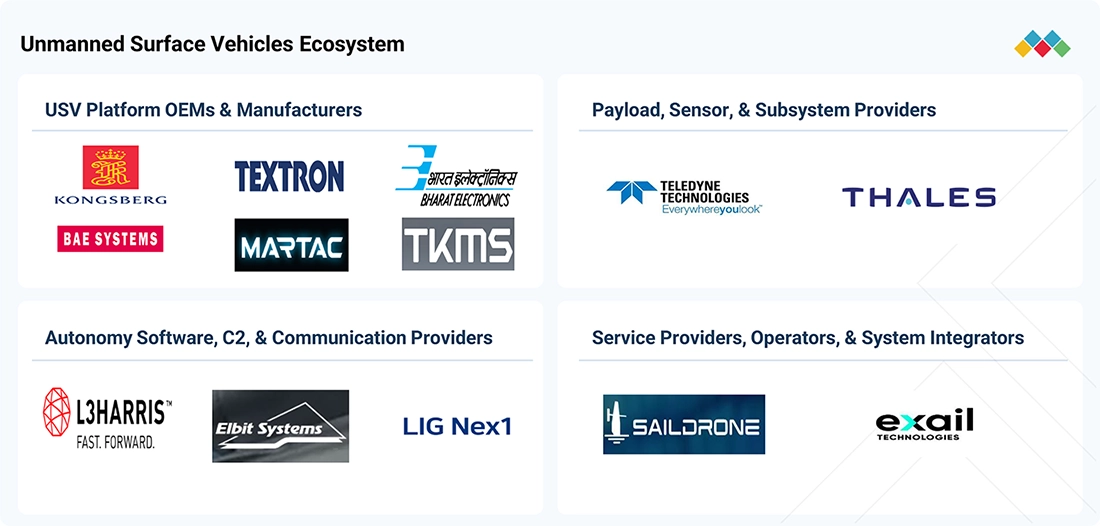
UNMANNED SURFACE VEHICLES (USV) MARKET SIZE, SHARE, GROWTH & TRENDS: COMMERCIAL USE CASES ACROSS INDUSTRIES
| COMPANY | USE CASE DESCRIPTION | BENEFITS |
|---|---|---|
 |
Saildrone develops and operates USVs for maritime surveillance, ocean mapping, undersea detection, and environmental data collection. Its platforms are used by defense and scientific organizations for long-duration missions, including hurricane observations, ocean monitoring, and maritime data collection. | Supports persistent maritime surveillance | Enables long-duration ocean monitoring | Provides real-time environmental and maritime data | Supports integration of mission-specific payloads |
 |
Exail provides DriX USVs for hydrographic surveying, oceanographic monitoring, maritime domain awareness, and defense missions. The DriX H-9 is designed for extended autonomous operations and can support hydrographic and oceanographic missions using integrated navigation, communication, and survey payloads. | Supports long-duration survey operations | Enables high-resolution hydrographic data collection | Supports maritime domain awareness | Reduces dependence on continuous crewed survey operations |
 |
Kongsberg provides Sounder USVs for hydrographic and oceanographic applications, with integrated autonomous navigation, communication, situational-awareness, and hydroacoustic capabilities. The platforms are designed to collect seabed and water-column data while operating remotely or autonomously. | Supports hydrographic and seabed surveys | Enables integration of acoustic payloads | Supports autonomous data collection | Provides remote mission-control capabilities |
Logos and trademarks shown above are the property of their respective owners. Their use here is for informational and illustrative purposes only.
Related Ecosystem
Unmanned Systems
- Rotary Wing Aircraft
- Fixed-Wing Drones
- Sensors
- Fuel Cell
- Fixed Wing Aircraft
- LOCKHEED MARTIN CORPORATION
- Northrop Grumman Corporation
- ISRAEL AEROSPACE INDUSTRIES LTD
- Elbit Systems Ltd.
- Thales group
Drones And Robotics
- Sensors
- Articulated Robots
- Cartesian Robots
- Scara Robots
- Actuators
- ABB India Limited
- KUKA AG
- MOMENTIVE PERFORMANCE MATERIALS INC.
- Fanuc Corporation
- STAUBLI INTERNATIONAL AG
Key Takeaways
- South Korea's USV market is valued at $15.0 million in 2025, growing at a 13.8% CAGR through 2030.
- South Korea's advanced shipbuilding and electronics sectors provide competitive advantages in USV manufacturing and innovation.
- Government defense modernization initiatives in South Korea are driving demand for autonomous maritime surveillance and naval operations.
- South Korea is positioned as a regional leader in USV technology, with increasing domestic competition and international partnerships expected by 2030.
Unmanned Surface Vehicles Market Report Scope
| Report Metric | Details |
|---|---|
| Base Year | 2025 |
| Fastest Growing Segment | 10–30 KNOTS (Cruising Speed) |
| Forecast Period | 2025–2030 |
| Growth Rate | CAGR of 14.1% from 2025 to 2030 |
| Largest Segment | SINGLE (Hull Type) |
| Market Size Base Year (Billions) | ~USD 0.82 (2025) |
| Revenue Forecast (Billions) | ~USD 1.59 (2030) |
| Segments Covered | Application, Subapplication, Type, Cruising Speed, Endurance, Hull Type, Size, System |
South Korea Unmanned Surface Vehicles Market Report Segmentation
8 segment dimensions are covered across the global market.
By Application
- Commercial
- Defense
By Subapplication
- Anti-Submarine Warfare
- Communication Gateway
- Electronic Warfare
- Environment Monitoring
- Firefighting
- Hydrographic Survey
- Infrastructure Inspection
- Isr
- Logistic Support
- Marine Aquaculture
- Mine Countermeasure
- Mine Countermeasures
- Naval Warfare
- Search And Rescue
- Security
- Weather Monitoring
By Type
- Aluminium
- Autonomous Surface Vehicle
- Carbon Fiber
- Diesel/Gasoline
- Electric
- Fiberglass
- Hybrid
- Lidar
- Optical System
- Other Communication Systems
- Other Payload Systems
- Radar
- Radio
- Radio Frequency
- Remotely Operated Surface Vehicle
- Renewable
- Satellite Communication
- Sonar
- Thermoplastic
- Uhf/Vhf
- Wi-Fi
By Cruising Speed
- 10–30 Knots
- <10 Knots
- > 30 Knots
- >30 Knots
By Endurance
- 100–500 Hours
- 500–1,000 Hours
- < 100 Hours
- > 1,000 Hours
By Hull Type
- Rigid Inflatable
- Single
- Triple
- Twin
By Size
- Extra Large
- Large
- Medium
- Small
By System
- Chassis
- Communication
- Electronic Component
- Electronics Component
- Navigation, Guidance, & Control Systems
- Navigation, Guidance, And Control Systems
- Payload
- Propulsion
Target Audience
- Defense Contractors & OEMs : South Korean and international defense manufacturers need market-specific data to develop USV solutions aligned with Korean Navy requirements, procurement timelines, and technology standards for competitive bidding.
- Government & Military Agencies : South Korean defense ministry, Navy, and coast guard officials require market intelligence to inform capability development, budget planning, and technology roadmap decisions for autonomous maritime systems.
- Investment & Private Equity Firms : Investors evaluating opportunities in South Korea's aerospace & defense sector need validated market data, growth forecasts, and competitive dynamics to assess portfolio companies and identify acquisition targets.
- Technology & Electronics Companies : South Korean electronics, AI, and sensor manufacturers need market insights to identify USV integration opportunities, develop specialized components, and expand into autonomous maritime applications.
- Maritime & Shipping Operators : Commercial shipping companies and port operators in South Korea require market analysis to evaluate USV adoption for surveillance, inspection, and autonomous operations to enhance operational efficiency.
Key Companies in the South Korea Unmanned Surface Vehicles Market
| Company | HQ | Ownership | Strongest segments |
|---|---|---|---|
| ADLINK TECHNOLOGY INC. | United States | ||
| ENERSYS | United States | ||
| HANWHA CORPORATION | South Korea | Public Company | Mine Countermeasure USVs,Anti-Submarine Warfare USVs,Security and Force Protection USVs, |
| JABIL | United States | Public Company | Mine Countermeasure USV electronics and systems,Anti-Submarine Warfare USV payloads and control systems,Hydrographic Survey and oceanographic USV systems, |
| LEIDOS | United States | Public Company | Autonomous USVs and mission systems,Remotely operated USVs and control systems,Mine countermeasure application packages, |
| ALTRAN | France | Private Company | Autonomous USV systems engineering and software,Remotely operated USV command-and-control integration,Mine countermeasure and anti-submarine warfare applications, |
| L3HARRIS TECHNOLOGIES, INC. | United States | Public Company | Mine Countermeasure USVs and mission systems,Anti-Submarine Warfare USVs and payloads,Hydrographic Survey and ocean data USVs, |
| THALES | France | Public Company | Mine Countermeasure USVs and systems,Anti-Submarine Warfare USVs and systems,Hydrographic Survey USVs, |
| EXAIL TECHNOLOGIES | France | Public Company | Mine Countermeasure USV systems,Hydrographic Survey USV systems,Security and port protection USV systems, |
| TEXTRON INC. | United States | Public Company | Mine Countermeasure,Anti-Submarine Warfare,Hydrographic Survey, |
| TELEDYNE TECHNOLOGIES INCORPORATED | United States | Public Company | Mine Countermeasure Payloads and Systems,Anti-Submarine Warfare and Maritime ISR Payloads,Hydrographic Survey and Oceanographic Instrumentation, |
| ELBIT SYSTEMS LTD. | Israel | Public Company | Mine Countermeasure USVs,Security & Coastal Protection USVs,Anti-Submarine Warfare USVs, |
| KONGSBERG | Norway | Public Company | Mine Countermeasure USVs and systems,Anti-Submarine Warfare USVs and systems,Hydrographic Survey and research USVs, |
| ISRAEL AEROSPACE INDUSTRIES LTD. | Israel | Private Company | Security (port, coastal, and critical infrastructure USVs),Mine Countermeasure USVs,Anti-Submarine Warfare USVs, |
| QINETIQ | United Kingdom | Public Company | Mine Countermeasure USV Systems,Anti-Submarine Warfare USV Systems,Hydrographic Survey & Research USVs, |
| LIG NEX1 | South Korea | Public Company | Security USVs (force protection, patrol, armed Sea Sword variants),Anti-Submarine Warfare USVs,Mine Countermeasure USVs, |
| BAE SYSTEMS | United Kingdom | Public Company | Mine Countermeasure USVs,Anti-Submarine Warfare USVs,Hydrographic Survey USVs, |
| SEAROBOTICS CORP. | United States | Private Company | Autonomous USVs for Hydrographic Survey,Autonomous USVs for Security and Surveillance,Remotely Operated USVs and Workboats, |
ADLINK TECHNOLOGY INC.
ADLINK Technology Inc. is a United States-based company operating in the technology sector.
ENERSYS
EnerSys is a United States-based company specializing in energy storage and power solutions.
HANWHA CORPORATION
Hanwha Corporation is a South Korean public company founded in 1952 with 3,493 employees, operating across multiple industrial sectors.
JABIL
Jabil is a United States public company founded in 1966 with 135,000 employees, providing manufacturing and supply chain solutions.
LEIDOS
Leidos is a United States public company founded in 1969 with 50,000 employees, offering engineering and technology services.
ALTRAN
Altran is a French private company founded in 1970 with 50,124 employees, providing engineering and consulting services.
L3HARRIS TECHNOLOGIES, INC.
L3Harris Technologies, Inc. is a United States public company founded in 1895 with 45,000 employees, providing aerospace and defense solutions.
THALES
Thales is a French public company founded in 1893 with 82,111 employees, operating in aerospace, defense, and security sectors.
EXAIL TECHNOLOGIES
Exail Technologies is a French public company founded in 1988 with 2,259 employees, specializing in robotics and autonomous systems.
TEXTRON INC.
Textron Inc. is a United States public company founded in 1923 with 34,000 employees, manufacturing aerospace and defense products.
TELEDYNE TECHNOLOGIES INCORPORATED
Teledyne Technologies Incorporated is a United States public company founded in 1960 with 15,800 employees, providing instrumentation and digital imaging solutions.
ELBIT SYSTEMS LTD.
Elbit Systems Ltd. is an Israeli public company founded in 1966 with 20,000 employees, specializing in defense electronics and systems.
KONGSBERG
Kongsberg is a Norwegian public company founded in 1814 with 7,586 employees, operating in maritime, aerospace, and defense sectors.
ISRAEL AEROSPACE INDUSTRIES LTD.
Israel Aerospace Industries Ltd. is an Israeli private company founded in 1953 with 15,151 employees, manufacturing aircraft and aerospace systems.
QINETIQ
QinetiQ is a United Kingdom public company founded in 2001 with 7,378 employees, providing defense and security technology services.
LIG NEX1
LIG Nex1 is a South Korean public company founded in 1976 with 5,766 employees, specializing in defense systems and weapons.
BAE SYSTEMS
BAE Systems is a United Kingdom public company founded in 1979 with 111,400 employees, providing aerospace, defense, and security solutions.
SEAROBOTICS CORP.
SeaRobotics Corp. is a United States private company founded in 1999, developing autonomous marine robotics and systems.
Reasons to Buy this Report
- Localized Market Intelligence : Gain deep insights into South Korea's specific USV market dynamics, including government procurement patterns, defense budgets, and domestic manufacturer capabilities essential for market entry or expansion strategies.
- Competitive Landscape Analysis : Understand South Korean competitors, their technological capabilities, manufacturing strengths, and market positioning within the region's defense and maritime sectors to identify partnership or acquisition opportunities.
- Investment Decision Support : Access validated market sizing ($15.0M in 2025, $28.5M in 2030) and growth projections to support investment decisions, business case development, and resource allocation for South Korea operations.
- Technology & Supply Chain Insights : Leverage detailed analysis of South Korea's advanced shipbuilding ecosystem, electronics manufacturing base, and AI capabilities to optimize sourcing, manufacturing partnerships, and technology integration strategies.
- Strategic Growth Opportunities : Identify high-potential segments within South Korea's market including defense modernization programs, coast guard applications, and emerging commercial maritime automation opportunities aligned with regional demand.
Frequently asked questions
What is the current market size of Unmanned Surface Vehicles in South Korea?
South Korea's USV market was valued at $15.0 million in 2025 and is projected to reach $28.5 million by 2030.
What is the growth rate of South Korea's USV market?
South Korea's USV market is expected to grow at a compound annual growth rate (CAGR) of 13.8% from 2025 to 2030.
What factors are driving growth in South Korea's USV market?
South Korea's USV market growth is driven by government defense modernization, advanced shipbuilding capabilities, increasing demand for maritime security, and investments in autonomous systems and AI integration.
Which sectors in South Korea are leading USV development?
South Korea's shipbuilding, electronics, robotics, and defense industries are leading USV development, leveraging the country's technological expertise and manufacturing capabilities.
What applications are driving USV demand in South Korea?
South Korea's USV demand is driven by coastal surveillance, naval operations, maritime security, autonomous patrol missions, and commercial maritime applications.
RESEARCH METHODOLOGY
The study involved four major activities to estimate the current size of the unmanned surface vehicles market. Exhaustive secondary research was conducted to gather information on the unmanned surface vehicles market, its adjacent markets, and its parent market. The next step was to validate these findings, assumptions, and sizing with industry experts across the value chain through primary research. Demand-side analysis was conducted to estimate the overall market size. Thereafter, data triangulation procedures were employed to estimate the sizes of various segments and subsegments within the unmanned surface vehicles market.
Secondary Research
During the secondary research process, various sources were consulted to identify and collect information for this study. Secondary sources included government sources such as SIPRI; corporate filings, including annual reports, press releases, and investor presentations; white papers, journals, and certified publications; and articles from recognized authors, directories, and databases.
Primary Research
Extensive primary research was conducted after acquiring information on the unmanned surface vehicles market through secondary research. Several primary interviews were conducted with market experts from the demand and supply sides across major countries of North America, Europe, Asia Pacific, the Middle East and Africa, and Latin America. Primary data was collected through questionnaires, emails, and telephonic interviews.
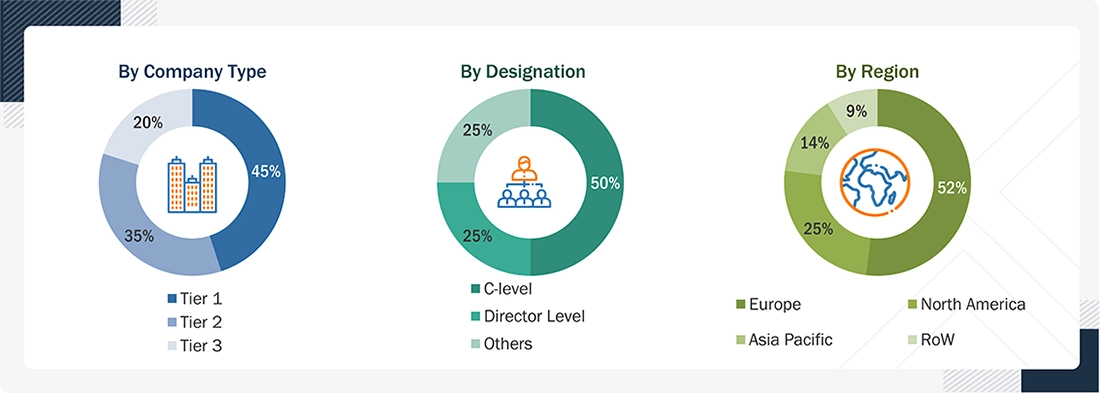
To know about the assumptions considered for the study, download the pdf brochure
Market Size Estimation
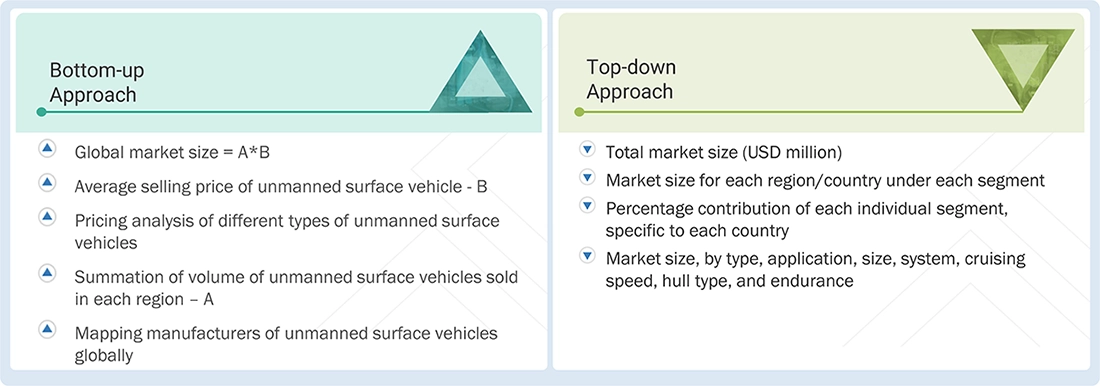
Top-down and bottom-up approaches were used to estimate and validate the size of the unmanned surface vehicles market. The research methodology used to estimate the size of the market included the following details:
- Key players in the unmanned surface vehicles market were identified through secondary research, and their market shares were determined through a combination of primary and secondary research. This included a study of the annual and financial reports of the top market players, as well as extensive interviews with leaders, including directors, engineers, marketing executives, and other key stakeholders of leading companies operating in the market.
- All percentage shares, splits, and breakdowns were determined using secondary sources and verified through primary sources.
- All possible parameters that affect the markets covered in this research study were accounted for, viewed in extensive detail, verified through primary research, and analyzed to obtain the final quantitative and qualitative data on the unmanned surface vehicles market. This data was consolidated, enhanced with detailed input, analyzed by MarketsandMarkets, and presented in this report.
Unmanned Surface Vehicles Market Size: Bottom-up and Top-down Approaches
Data Triangulation
After determining the overall market size, the total market was classified into several segments and subsegments. The data triangulation and market breakdown procedures explained below were implemented, wherever applicable, to complete the overall market engineering process and arrive at the estimated market numbers for the market segments and subsegments. The data was triangulated by examining various factors and trends on both the demand and supply sides. Additionally, the market size was validated using top-down and bottom-up approaches.
Market Definition
An unmanned surface vehicle (USV) is a marine vessel that operates on the water surface without human intervention. It has a complex system that includes system integration, environmental perception, and autonomous decision-making and control. USVs are powered by diesel/gasoline engines, rechargeable lithium-ion batteries, or solar energy. These vehicles are also equipped with various sensors, cameras, communication systems, and other payloads to collect data, perform tasks, and communicate information back to a control station or operator. They are primarily utilized for ocean exploration and various maritime applications.
Key Stakeholders
- USV Manufacturers
- Parts & Sub-component Manufacturers
- Maintenance, Repair, and Overhaul (MRO) Companies
- Research Organizations, Forums, Alliances, and Associations
- Ministries of Defense
- Original Equipment Manufacturers (OEMs)
- Regulatory Bodies
- R&D Companies
Report Objectives
- To define, describe, and forecast the unmanned surface vehicles market based on type, length overall, application, system, power source, hull configuration, cruising speed, endurance, launch mode, and region in terms of value
- To forecast the size of various segments of the market across North America, Europe, the Asia Pacific, the Middle East & Africa, and Latin America in terms of value
- To identify and analyze the drivers, restraints, opportunities, and challenges influencing the growth of the market
- To identify industry trends, market trends, and technology trends currently prevailing in the market
- To analyze micromarkets with respect to growth trends, prospects, and their contribution to the overall market
- To analyze opportunities in the market for stakeholders by identifying key market trends
- To profile key market players and comprehensively analyze their market share and core competencies
- To evaluate the degree of competition in the market by analyzing recent developments, such as contracts, agreements, and acquisitions adopted by leading market players
- To identify detailed financial positions, key products, and unique selling points of leading companies in the market
- To provide a detailed competitive landscape of the market, along with market share analysis and revenue analysis of key players
Available customizations:
MarketsandMarkets offers the following customizations for this market report:
- Additional country-level analysis of the unmanned surface vehicles market
- Profiling of other market players (up to five)
Product Analysis
- Product matrix, which provides a detailed comparison of the product portfolios of each company in the unmanned surface vehicles market
Get the Full Unmanned Surface Vehicles Market Report
Full forecast, segment splits, and company analysis for all Unmanned Surface Vehicles Market.
- US Unmanned Surface Vehicles Market
- Canada Unmanned Surface Vehicles Market
- UK Unmanned Surface Vehicles Market
- Germany Unmanned Surface Vehicles Market
- France Unmanned Surface Vehicles Market
- Italy Unmanned Surface Vehicles Market
- Norway Unmanned Surface Vehicles Market
- China Unmanned Surface Vehicles Market
- India Unmanned Surface Vehicles Market
- Japan Unmanned Surface Vehicles Market
- Australia Unmanned Surface Vehicles Market
- UAE Unmanned Surface Vehicles Market
- Saudi Arabia Unmanned Surface Vehicles Market
- Israel Unmanned Surface Vehicles Market
- Rest Of Europe Unmanned Surface Vehicles Market
- Rest Of Asia Pacific Unmanned Surface Vehicles Market
- Rest Of Middle East Unmanned Surface Vehicles Market
Need a Tailored Report?
Customize this report to your needs
Get 10% FREE Customization
Customize This Report
